Waves of Memories

247517_10150256442837848_538727847_8828545_8012558_n

Somewhere around Bentota, you start to notice the graveyards. Small clusters of tombstones emerge here and there along the coastal road, grown over with tropical shrubbery and mold. Some of the graves fall back into the hills, where fishermen’s wives hang laundry, and some are right along the beach, not far from the little wooden shacks where locals mingle around tables of freshly caught fish. The graves look old. But they aren’t old — it just doesn’t take long for anything left alone in Sri Lanka to be invaded by the erosion of damp clingy natural stuff. When the bus slows down to avoid a stray dog or road bump, you see the date repeated: 26-12-2004, 26-12-2004. Everything here is so close to the shoreline: the road, the graves, the people, the small abandoned houses that are also covered with mold, plus shrubs and laundry and the morning’s fish haul. On one hand, the scene from the bus window is just daily life. Conversation, homemaking, the marketplace. The activities are innocuous. At the same time, civilization here is at its most vulnerable, because behind the road is the pounding, pulsing, thirsty Indian Ocean. You can imagine how, with one good push of the sea, life could easily come tumbling apart. Being an island, Sri Lanka is never far from the ocean in any direction. The water is always there and everybody knows it.

more from Stefany Anne Golberg at The Smart Set here.

the beast 666

Baker_221531h

When he found himself notorious after the publication of Naked Lunch in 1959, William Burroughs wrote to calm his mother and say “I hope I am not ludicrously miscast as the wickedest man alive, a title vacated by the late Aleister Crowley”. Crowley, who liked to be known as The Beast 666 after the monster in the Book of Revelation, seems fated to be a touchstone of wickedness – particularly after his vilification by the Beaverbrook press in the 1920s, under headlines such as “King of Depravity” and “A Man We’d Like to Hang” – but inevitably this has been part of his popular appeal. The main focus of Crowley’s immense energy was magick (as he liked to spell it, distinguishing it from conjuring) and it is also the central focus of these two biographies. Magick was a synthesis and reinvention of the occult tradition, making a sacramental use of sex, and taking as its springboard the nineteenth-century occult revival in general and the Order of the Golden Dawn, in particular. W. B. Yeats was another prominent member of the Golden Dawn, and his disagreements with Crowley led to its break-up, but Crowley went beyond the Golden Dawn.

more from Phil Baker at the TLS here.

a sort of solar socialism

Image

Unable to imagine the past except in the form of costume dramas or to think of the future except in terms of far-off collapse, our era has suffered from a blocked political imagination. For twenty years we flattered or rued our condition as the end of history. But present-day civilization reflects arrangements exceptional in human history—and perhaps equally fragile. It is characterized in particular by an unprecedented dominance of fossilized labor (or capital) over living labor, and of fossil energy—oil, coal, and natural gas—over living energy. This reign of the fossils must and will end. Two special conditions that we’ve taken for granted are not long for this world: an ever-growing supply of fossil fuel and other non-renewable resources, and endless economic growth. The words ecology and economy share a root in oikos, Greek for household. This suggests the concerns they name must ultimately coincide: the establishment and maintenance of the human residence on earth. Yet economics and ecology are rarely taken seriously at the same time, and official opinion usually denies that a crisis exists in either sphere. Few professional economists and no prominent politicians will concede what was obvious to the classical economists: namely, that economic growth would eventually terminate in what John Stuart Mill called a “stationary state.”

more from Benjamin Kunkel at n+1 here.

River of Smoke by Amitav Ghosh

Reviewed by Chandrahas Choudhury in the New York Times:

09CHOUDRY-popupNo writer in modern India has held a novelistic lamp to the subcontinent’s densely thicketed past as vividly and acutely as Amitav Ghosh. Since the publication of “The Circle of Reason,” in the mid-1980s, Ghosh’s work has been animated by its inventive collages and connections. “River of Smoke,” the second volume of his ambitious Ibis trilogy, is the work of a writer with a historical awareness and an appetite for polyphony that are equal to the immense demands of the material he seeks to illuminate.

Like its predecessor, “Sea of Poppies,” this new novel fashions narrative pleasures from narcotic ones, exploring the fizzing currents of language, politics, trade and culture that swept through the vast opium network operated by the British East India Company in the 19th century. “Sea of Poppies” was set almost entirely in the cities, harbors and plains of India, the source of the poppies from which the opium was made. “River of Smoke” takes the action forward to the same opium’s destination, the Chinese trading outpost of Canton.

Although convincing in its reconstruction of early-19th-­century India and revelatory in its linguistic ventriloquism, “Sea of Poppies” often labored under its own weight. Improbable plot turns too often tied its narrative threads together; its pastiches too frequently lapsed into stretches of creaking comedy. Superficially less dramatic, “River of Smoke” is much more evenly written and engaging.

More here.

Thursday Poem

Becoming Human

Once a man came to me and spoke for hours about
“His great visions of God” he felt he was having.

He asked me for confirmation, saying,
“Are these wondrous dreams true?”
I replied, “How many goats do you have?”
He looked surprised and said,
“I am speaking of sublime visions
And you ask
About goats!”
And I spoke again saying,
“Yes, brother – how many do you have?”
“Well, Hafiz, I have sixty-two.”
“And how many wives?”
Again he looked surprised, then said,
“Four.”
“How many rose bushes in your garden,
How many children,
Are your parents still alive,
Do you feed the birds in winter?”
And to all he answered.
Then I said,
“You asked me if I thought your visions were true,
I would say that they were if they make you become
More human,
More kind to every creature and plant
That you know.”

by Hafiz
from The Gift -Versions of Hafiz
by Daniel Ladinsky

Wednesday, November 9, 2011

The Truth about Violence: Three Principles of Self-defense

Sam Harris in his blog:

Principle #1: Avoid dangerous people and dangerous places.

ScreenHunter_06 Nov. 09 17.14The primary goal of self-defense is to avoid becoming the victim of violence. The best way to do this is to not be where violence is likely to occur. Of course, that’s not always possible—but without question, it is your first and best line of defense. If you visit dangerous neighborhoods at night, or hike alone and unarmed on trails near a big city, or frequent places where drunken young men gather, you are running some obvious risks.

I once knew an experienced martial artist who decided to walk across Central Park late at night. He was aware of the danger, but he thought “I have a black belt in karate. Why shouldn’t I be able to walk wherever I want?” As it happened, this rhetorical question was answered almost immediately: My friend hadn’t ventured more than a hundred yards into the darkness of the park before he was confronted by three men, one of whom plunged a hypodermic needle into his thigh without a word. Our hero bolted and escaped, otherwise unharmed, but he spent the next three months wondering whether he had been infected with HIV, hepatitis, or some other blood-borne disease. (He was fine.) The lesson: Whatever your training, you needn’t be foolish.

Similarly, all men should learn to recognize and shun status-seeking displays of aggression. This is one problem that women generally don’t have to worry about. It is, for instance, very rare for a woman to find herself party to an exchange like this:

“What are you looking at, asshole?”

“Who are you calling an asshole?”

“You, bitch. What are you going to do about it?”

Nevertheless, young men are easily lured into social dominance games from which neither party can find a face-saving exit. The violence that erupts at such moments is as unnecessary as it is predictable. If you want to preserve your health and stay out of prison, you must learn to avoid or defuse conflict of this kind.

More here.

Welcome to the Multiverse

Sean Carroll in his inaugural column at Discover:

ScreenHunter_05 Nov. 09 17.04Theoretical cosmologist isn’t one of the more hazardous occupations of the modern world. The big risks include jet lag, caffeine overdose, and possibly carpal tunnel syndrome. It wasn’t always so. On February 17, 1600, Giordano Bruno, a mathematician and Dominican friar, was stripped naked and driven through the streets of Rome. Then he was tied to a stake in the Campo de’ Fiori and burned to death. The records of Bruno’s long prosecution by the Inquisition have been lost, but one of his major heresies was cosmological. He advocated that other stars were like our sun, and that they could each support planets teeming with life. Orthodox thought of the time preferred to think that Earth and humanity were unique.

These days, cosmologists like me may be safer, but our ideas have grown only more radical. One of the most controversial but widely discussed concepts in the field resembles a hugely amplified version of Bruno’s cosmology: the idea that the thing we call “the universe” is just one of an infinite number of regions in a much larger universe of universes, or multiverse. A big focus of my own research asks whether a multiverse can help explain the arrow of time.

Also like Bruno, cosmologists are reaching far beyond what observational evidence can tell them. At the time of Bruno’s death, Galileo had not yet turned the very first telescope upward to the stars. Today, nobody has looked beyond the boundaries of the known universe. In fact, such a far-reaching vision seems impossible by definition.

More here.

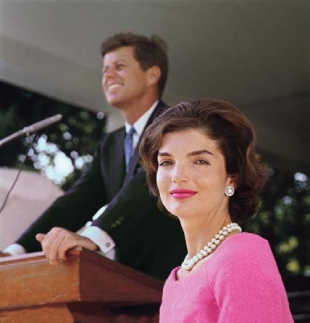
Jackie: savvy, manipulative, disingenuous—and lacking the class for which she was so admired

Christopher Hitchens in Vanity Fair:

Cn_image_size_hitchensMuch of the commentary on Jacqueline Kennedy: Historic Conversations on Life with John F. Kennedy has focused on the self-subordinating, near-doormat opinion that Jackie voiced of her own status as a wife. Enhanced by the unexpected breathiness of her voice (almost Marilyn-like on some portions of the tape), the avowal of being confined to an awful Victorian or “Asiatic” kind of marriage, or a “Japanese” one, as Schlesinger prompts her to say, has upset her granddaughters and those ladies on The View, who believe in the tradition of strong womanhood. But when examined carefully and in context, the pouting refusal to have any ideas except those supplied by her lord and master turns out not to be evidence of winsome innocence but a soft cover for a specific sort of knowingness and calculation.

Left out of the boys’ conversation and kept in the dark, eh? She tells Schlesinger, when the subject of Dr. Martin Luther King Jr. and civil rights is raised, that she regards Dr. King as a moral monster who goes as far as to arrange orgies in Washington hotels. She can have been in a position to say this only if, as a special treat, she had been cut in on the salacious surveillance tapes by which J. Edgar Hoover kept the enemies of the Kennedy clan (and Kennedy himself) under his thumb. This was the rawest and raunchiest underside of access to crude power. It has to make one ask how much else she knew, about the president’s stupefying consumption of uppers and downers, for example—rather difficult to conceal from a wife—let alone how often she had to close her eyes or her ears as the door practically banged on the heels of a departing mistress or hooker (or Sam Giancana’s moll Judith Exner).

More here.

Wednesday Poem

Sublime Generosity

I was dead, then alive.
Weeping, then laughing.

The power of love came into me,
and I became fierce like a lion,
then tender like the evening star.

He said, ‘You’re not mad enough.
You don’t belong in this house.’

I went wild and had to be tied up.
He said, ‘Still not wild enough
to stay with us!’

I broke through another layer
into joyfulness.

He said, ‘Its not enough.’
I died.

He said, ‘You are a clever little man,
full of fantasy and doubting.’

I plucked out my feathers and became a fool.
He said, ‘Now you are the candle
for this assembly.’

But I’m no candle. Look!
I’m scattered smoke

He said, ‘You are the Sheikh, the guide.’
But I’m not a teacher. I have no power.

He said, ‘You already have wings.
I cannot give you wings.’

But I wanted his wings.
I felt like some flightless chicken.

Then new events said to me,
‘Don’t move. A sublime generosity is
coming towards you.’

And old love said, ‘Stay with me.’

I said, ‘I will.’

You are the fountain of the sun’s light.
I am a willow shadow on the ground.
You make my raggedness silky.

The soul at dawn is like darkened water
that slowly begins to say Thank you, thank you.

Then at sunset, again, Venus gradually
Changes into the moon and then the whole nightsky.

This comes of smiling back
at your smile.

The chess master says nothing,
other than moving the silent chess piece.

That I am part of the ploys
of this game makes me
amazingly happy.
.
by Rumi

Camus the Jew

From Tablet:

Albert_camus620The question of whether Albert Camus was Jewish is, of course, absurd. Born in French Algeria 98 years ago today, he was the second child of Lucien Camus, a farm worker raised in a Protestant orphanage, and Catherine Sintes, the illiterate child of Catholic peasants from Minorca, Spain. He was given communion at the age of 11 and died an atheist at the age of 43. Camus understood, however, that the absurd reveals deep truths about the world and our own selves. Cradled between the semi-centenary of his death in 1960 and the centenary of his birth in 1913, we might take a moment to consider the question of Camus’ ties to Judaism. They are surprisingly deep and broad, encompassing not just his own life but his political and philosophical thought as well. Though a number of his childhood friends were Jewish, Camus was as indifferent to their particular faith as they themselves were. In republican France, Jewishness was largely a private matter; it was only when Nazi Germany buried the Republic in 1940 that Jewishness became a public matter and indifference to the fate of Jews was no longer possible—or should not have been possible.

Yet when the authoritarian regime of Vichy passed a salvo of anti-Semitic laws in 1940, most Frenchmen and -women did not blink. One of the few who did blink—in fact, doubled over in shock and revulsion—was Camus. Working for the newspaper Paris-Soir, Camus was stunned when his Jewish colleagues were fired. In a letter to his wife Francine Faure—a native of the city of Oran, Algeria, who was very close to the local Jewish community—Camus said that he could not continue to work at the paper; any job at all in Algeria, even one on a farm, would be preferable. As for the new regime, he was merciless: “Cowardice and senility is all they have to offer. Pro-German policies, a constitution in the style of totalitarian regimes, great fear of a revolution that will not come: all of this to truckle up to an enemy who has already pulverized us and to salvage privileges which are not threatened.”

More here.

Why some birds of prey become transvestites

From MSNBC:

BirdBirds of prey may be thought of as fierce foes, but scientists find that some males disguise themselves as peaceful females. These males belong to a species of raptor known as the marsh harrier. Using plastic decoys, French researchers learned that the transvestites among these predators are less aggressive than other males. Some animals will use the tactic known as sexual mimicry in the cutthroat battle to survive. For instance, young male birds often have female plumage that helps camouflage them; they will acquire more striking plumage only after reaching sexual maturity, to help them attract mates. However, permanent lifelong female mimicry, in which males look like females throughout life, is extraordinarily rare in birds. Until now, it had been studied in only one species, the ruff (Philomachus pugnax), a shorebird in which some males engage in female behavior to sneakily get sex.

Why dudes dress like ladies
The only other bird in which this practice has been found is the marsh harrier (Circus aeruginosus). In one exceptional population in midwestern France, 40 percent of the males of this bird of prey disguise themselves in female plumage. To study the marsh harriers there, ornithologists including Vincent Bretagnolle, directorof the Center for Biological Studies of Chizé, France, created decoys painted to closely resemble the females, typical males, and female-like males. Females are mostly brown with ocher-brown eyes, while typical males are mostly gray with yellow-white eyes, and female-like males are mostly brown with yellow-white eyes. Males are also approximately 30 percent smaller and lighter than females. The researchers then spent three months watching how both kinds of males responded to decoys placed in the wild near the nests of 36 breeding pairs of marsh harriers. Some funny situations arose during this field work.

More here.

the antwerp project

Jorge_carrera_andrade Forgive me for linking to something of my own, here. But our friend J. M. Tyree has just put together a number of fragments I wrote last year for his lovely literary site The Owls. It started with Bad Translations and ended with murder…. Also, thanks to everyone for supporting 3QD in our just completed fund raiser. It feels very nice to know that our work here is valued. So thanks.

The idea for Bad Translations came to me a number of years ago in Ecuador. My wife and I, the mysterious Shuffy©, were staying in a little pension outside of the old town in Quito and there was a ramshackle bookstore nearby we would duck into during violent confrontations between groups of young protesters and the police. People were pissed off about the dollarization of the currency. Gustavo Noboa had recently been elected president. But this is ancient history. I found an old volume of poetry by Jorge Carrera Andrade. The pages hadn’t even been split and it smelled of dirt. Andrade is more or less a big deal in Latin American literature though you don’t hear his name very often up north. Such is the way of things. The poems were in Spanish, since Andrade wrote them that way. My Spanish is terrible. But I decided to start translating them anyway. Some years ago, before even the trip to Ecuador, the man who taught me to read Golden Age Latin, the hairy and intense Alan Fishbone, made a comment to me over a game of pool. “You know,” he said (I’m paraphrasing here), “It’s all syntax, …. And syntax is magic.”

more from me at The Owls here.

How Julius Fromm’s Condom Empire Fell to the Nazis

ArthurKorn_FrommGummifabrikBerlinKoepenick

JULIUS FROMM WAS BORN Israel Fromm on 4 March 1883 in Konin, what was then a small town in the Russian Empire and now part of Poland. Like many Jewish families in the region, the Fromms moved in 1893 to a rapidly expanding Berlin in search of a safer life and better opportunities for the children. They were culturally assimilated, and Israel Fromm adopted the name Julius. The Fromms made a living rolling cigarettes during the day, and selling them one by one in cafés at night. This was a line of work which lent itself to impoverished immigrants in Germany who often had little more than manual dexterity. The patriarch Bernhard Fromm died in 1898 at the age of forty-two and Regina died in 1911, leaving Julius and his elder brother Salomon the responsibility of raising the entire family. Julius Fromm, a “quintessential ‘entrepreneurial proletariat’”, and a modest man with minimal education, sought a career alternative to making cigarettes and began taking evening classes in rubber chemistry around 1912. Julius Fromm then hit upon the idea of making condoms. The early condoms from the eighteenth century were generally made of animal intestines, and were used primarily by wealthy men – like Giacomo Casanova, who referred to them as “English riding coats” – to protect against the incurable syphilis. These condoms were difficult to use, diminished pleasure, frequently broke, and offered only limited protection against venereal diseases.

more from Leon Rocha at the Berlin Review of Books here.

the reckoning

1320685835377.gif.CROP.article568-large

America’s insularity knows no bounds. This is a paradoxical statement, of course, but it’s an apt way to describe America’s current debate about “our future,” and not a bad way to view Washington’s strained efforts to grapple with an economy wounded by two decades of economic Puritanism. As grand as the rhetoric may be, politicians in the United States remain incapable of looking beyond the next election—this goes for the haughty Democrat in the White House and goes double for the Republican opposition. The fact is, airy-fairy optimism still sells on the campaign trail, particularly when the day-to-day reality of the average American is so difficult. Christian, agnostic, Jew, Muslim, or otherwise, we’re a country of people constantly seeking redemption, and we’re suckers for a smooth-talking messiah. Not this time. At the risk of breaking the hearts that throb for Rick Perry, Mitt Romney or Barack Obama, they cannot deliver us from the future. Thanks to a catastrophic series of decisions by presidents of both parties that radically deregulated our financial system and arrogantly dismissed the “lessons of Vietnam” as dusty, irrelevant history, the United States has shortened the period during which it will remain the dominant power in the 21st century. I know, I know, all the presidential candidates say we’re still the best! And so we are, in almost every economic and military measure. But measurements of power are like the altimeter of an aircraft: It’s not the altitude that matters, it’s the trajectory, and by now most Americans finally understand that Captain America is trending downward.

more from Michael Moran at Slate here.

Thank You

Dear Supporters and Loyal Readers,

AbbasAndRobinWhen I went to sleep last night, we were $1,235.04 away from our goal of raising $25,000. I awakened this morning to find that a single donor had sent in that exact amount! So, we are done. And we finished with a bang!

On behalf of everyone at 3QD, I would like to convey our deepest gratitude to all of you who have supported us over the years, and of course, especially to those who gave money during this fundraising drive! Due to the overwhelming desire of the donors to remain anonymous, I will not be thanking you by name here, but you know who you are. It is extremely gratifying and moving to us that the first time we asked our readers for help, they came through beautifully. There were a total of 490 donors and the individual amounts you sent us ranged from $1 to $3,000. The average donation was thus $51.10! This speaks very highly of the generosity of our audience, though by no means do I wish to suggest that we are not appreciative of the many smaller donations we received. We have been very touched by each of your gifts.

The Pakistani novelist Mohsin Hamid (an old supporter of our site) just wrote to me excitedly and among other things this is what he suggested as a self-effacing new tag line: “3QD: funded by contributions from the fucking smartest, most interesting people on the planet!” Indeed. I couldn't have put it better. 🙂

I will get the plans for improvements to the site rolling now, and I will report progress as it happens. Meanwhile, we will continue to do what we do: spend our time finding the best stuff on the web so you don't have to! Once again, thank you.

Yours,

Abbas

P.S. Not to toot our own horn too much, but here are some of the appreciative comments I received along with the donations:

Read more »

Tuesday, November 8, 2011

The drumbeat for war with Iran

Tony Karon in Time:

Aircraftcarrier-500x357If the proverbial “drumbeat” for war with Iran has grown more insistent in recent weeks, it's about to turn into something akin to the opening bars of Black Sabbath's “Iron Man”. That's because the International Atomic Energy Agency is expected, in a report on Iran's nuclear program due for release early this week, to suggest that the Islamic Republic's nuclear program may include a “possible military dimension”, giving Tehran the means — possibly with the help of foreign scientists — to relatively quickly build nuclear weapons should it choose to do so.

The U.N. nuclear watchdog is expected to publish some evidence — long ago shared among key international players — suggesting that Iran may have in recent years conducted theoretical work on warhead design, and experiments on high-explosive triggering systems that don't appear to have any purpose outside of nuclear weapons development.

The buildup to the IAEA report has seen a dramatic uptick in media chatter, and spectacles staged for the media, suggesting that an Israeli attack on Iran is imminent. Over the weekend, Defense Minister Ehud Barak refused to rule out a military strike on Iran, while President Shimon Peres warned that “the possibility of a military attack against Iran is now closer to being applied than the application of a diplomatic option.”

More here.

Porochista Khakpour explores the protean category of “Iranian-American”

Porochista Khakpour in Guernica:

Porochista_intro-575There was a time, not long ago, when I was downright allergic to journal issues devoted to ethnic and/or racial grouping—about as aesthetically relevant as clusterings based on eye color or mole placement, I insisted. To be put in a box based on something you did not choose seemed uninspired, reductive, and even dangerous. Plus, I had personal reasons: categorization and its many cons had haunted me since I came to this country as a wee preschooler. With looks described as exotic at best and a hyperethnic multisyllabic name regarded as unattemptable at worst, I was coronated an ambassador of my particular brand of other just by virtue of being someone else’s first. When I was four, I decided to be a writer precisely because the realm of the imagination freed me from confinement regarding how and to whom I was born. But by the time the writing touched any remote professionalization (college workshops, for instance) I was again asked to “write what I know” by wide-eyed, smiling professors—whose “knowing better” was nestled somewhere between an oily did and flaky didn’t—and sheltered students who seemed torn between “coo” and “ew” when it came to me. By a combination of dead-end fatalism and pure accident, I went there (or at least I attempted to), merging the writing of the many whats that I knew with my interests in art, language, and slightly experimental forms (outcome: my first novel). It was only through doing it that I found I actually did have some genuine interest in who and what I was (outcome: years of personal-essay writing on Iranian-American issues).

The seesaw between Iranian and American appeared to have arrived at a miraculous balance. “Iranian-American” was not a label I could necessarily nest in, but at least one I could take a breath at. Even with its pigeonholes and pitfalls, traps and hurdles, stereotypes and caricatures and clichés, it was something I could live with, and this was more than I had ever had. So my disregard for ethnicity-focused anything was ultimately tempered by some authentic self-discovery, some admitted abnegation, and a consequential phobia of hypocrisy—and only really intensely inflamed by those starless lows of overwhelming suspicion and cynicism at everything and everyone American.

More here.

The Neuroscience of Barbie

Travis Riddle in Scientific American:

ScreenHunter_04 Nov. 08 22.37In science fiction and fantasy tales, there is a long running fascination with the idea of dramatically diminishing or growing in stature. In the 1989 classic, Honey, I Shrunk the Kids, Rick Moranis invents a device which accidentally shrinks both his own and the neighbor’s children down to a quarter-of-an-inch tall. Preceding this by more than 100 years, Lewis Carroll wrote about a little girl who, after tumbling down a rabbit hole, nibbles on some cake and then grows to massive proportions. Nearly 300 years ago, Jonathan Swift described the adventures of Gulliver while on the island of Lilliputan, on which he is a giant, and then on the island of Brobdingnag, where everyone else is a giant.

These kinds of experiences, however, have been limited to the world of fictional stories. The world around us does not actually change in size. Nor, with the exception of too many late-night Chinese deliveries, do our bodies become appreciably larger or smaller.

Or at least, they were mythical until recently. A research group at the Karolinska Institute in Sweden has managed to make people feel as though they actually inhabited bodies of vastly different size – either that of dolls or of giants.

More here.