Aging Brains Match Youth in Some Mental Tasks

From Scientific American:

Aging-brains-match-youth_1The researchers studied how people of different ages performed when put through a battery of cognitive tests, which included guessing the number of asterisks on a screen (fewer or more than 50) and identifying strings of letters as either words or non-words. The new research added young kids into the mix, from elementary-school age through college age. They found the very young kids slower at decision-making tasks, with performance improving with older groups. “Younger children are not able to make as good of use of the information they are presented, so they are less accurate,” Ratcliff said. “That improves as they mature.”

Individuals aged 60 and older also had a slower response time for these tasks, but the researchers found that instead of just taking longer to follow the same thought process as young people, the older people took longer to make sure they responded accurately. These older people even could be trained to respond quicker in some decision-making tasks without hurting their accuracy, similarly to younger adults. “Older people don't want to make any errors at all, and that causes them to slow down. We found that it is difficult to get them out of the habit, but they can with practice,” study researcher Gail McKoon, also from Ohio State, said in a statement. “For these simple tasks, decision-making speed and accuracy is intact even up to 85 and 90 years old.”

More here.

Wednesday, December 28, 2011

Michael Dummett, 1925-2011

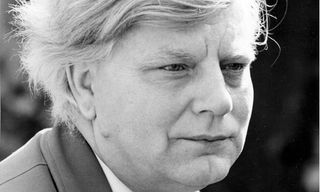
Michael-Dummett-007A.W. Moore in The Guardian [h/t: Justin Smith]:

Sir Michael Dummett, who has died aged 86, was one of the greatest British philosophers of the 20th century. He was also an international authority on tarot cards, a campaigner for racial justice and a devoted family man. His wife, Ann, was a co-worker in his fight against racism and collaborated with him on a number of publications on the subject.

Dummett was a staunch advocate of “analytic” philosophy, the fundamental tenet of which he took to be that “the philosophy of language is the foundation of all other philosophy”. He also once characterised it as “post-Fregean philosophy”, the 19th-century German philosopher Gottlob Frege having done as much as anyone to treat the philosophy of language in this way. Much of Dummett's own work was accordingly devoted to the interpretation and exposition of Frege's ideas, and he will be as well remembered for his exegesis of Frege as he will for his own seminal contributions to analytic philosophy.

Frege held that the way in which the words in a sentence combine reflects the structure of the thought that the sentence expresses. In the sentence “Michael smokes,” a proper name combines with a verb so as to express the thought that a particular person, Michael, indulges in a particular activity, smoking. This thought is true if Michael does in fact smoke, and false otherwise.

On this apparently innocuous and simple basis, Frege erected an elaborate set of ideas that have had an immense influence. Nevertheless, Dummett believed that Frege made certain assumptions concerning truth and falsehood that could be called into question. Frege allowed for the possibility of a thought that was neither true nor false. An example would be the thought that Father Christmas smokes. Given that there is no such person as Father Christmas, then neither is there anything to make this thought true or false. But Frege was not in the least reluctant to admit that a thought could be true or false without our having any way of telling which. An example might be the thought that Plato would have enjoyed smoking. This is what caused Dummett to pause.

Hitchens, Athens, 1984

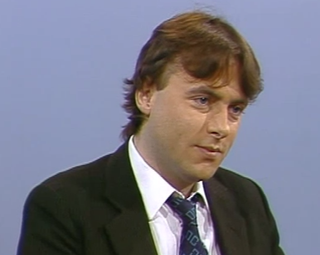
Hitchens-firing-lineHendrik Hertzberg in The New Yorker:

In Athens, we stole time from the conference to eat, and drink, and explore. We climbed the Parthenon, and, needless to say, Christopher was as erudite and entertaining a guide as one could imagine. But there was a touch of melancholy, a hint of preoccupation, about his mood.

That road trip never took place. On our third day in Athens I got an urgent call from home. My father, who was in treatment for lung cancer, had been rushed to the hospital and was in the intensive-care unit. A ventilator was keeping him alive, but he might die at any moment.

Christopher instantly took over, booking my flight to New York for me the following afternoon and turning his full attention to me. That evening we talked far into the night, mostly about our parents. He stunned me with a long, wrenching, and extraordinarily moving story—the story of his father, the silent former naval officer Eric, and his mother, the dreamy, self-sacrificing, faintly exotic (and secretly part Jewish) Yvonne, and their unhappy marriage.

The climax of the story was a shocker. Until that week, Christopher told me, he had not been to Athens for eleven years—not since 1973, when he was twenty-four. Greece then was still governed by a quasi-fascist military junta, against which he had written and spoken. The junta’s indifferent authorities had custody of the body of his mother, which he had come, alone, to recover: in an Athens hotel, with her lover, Yvonne Hitchens had committed suicide.

A Symposium on American Grace: How Religion Divides and Unites Us

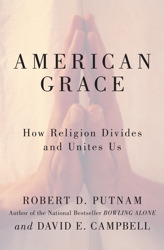
American-Grace2Over at The Immanent Frame, there is an interesting discussion on David Campbell and Robert Putnam's American Grace: How Religion Divides and Unites Us with a series of responses to the book by John Torpey, Molly Worthen, Jon Butler and David Hollinger. Hollinger:

Is bland beautiful? Almost never, most of us would say. But when it comes to religion in a diverse society, the answer may be yes.

This is the chief, if probably unintended implication of American Grace, which I take to be the most successfully argued, comprehensive sociological study of American religion in more than half a century. Robert Putnam and David Campbell harvest a generation of research and mature reflection about how religious affiliations of all kinds divide and unite Americans of different generations, regions, sexes, educational levels, and ethno-racial groups. Will Herberg’s endlessly discussed Protestant-Catholic-Jew, a book of 1955, was not remotely as methodologically self-conscious and as empirically grounded as is American Grace, but one must go back to Herberg to find so striking a single volume purporting to explain the religion of an author’s contemporary Americans. If this coming generation of scholars and journalists allow Putnam and Campbell to define the terms of conversation to the extent that our predecessors allowed Herberg to perform this role, we will be in fine shape.

Why does this book prompt the suspicion that bland may be beautiful? Because Putnam and Campbell argue that the decline of intense, sectarian devotion to any particular faith enables religious believers to be more tolerant and appreciative of ideas and practices different from their own. Putnam and Campbell’s central, data-driven theme is the fluidity of American religion. Americans move in and out of religious affiliations with dizzying frequency. While in other societies religious identity is more often perceived “as a fixed characteristic,” they explain, in the United States “it seems perfectly natural” to refer to one’s religion as a mere “preference.”

Story Theory: Confessions of a Literary Darwinist

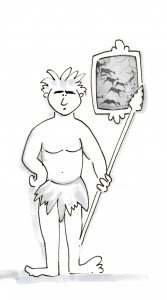
Primitive-dude-1-167x300R. Salvador Reyes over at the Tottenville Review:

First confession. I didn’t start out this way: believing that art is a Godless domain, a tactically-consumed, evolutionarily-wrought siren to the mind—just another victim hunted by our massive, pulverizing desire to devour and catalog every pattern in the universe that presents itself to our perpetually-ravished brains. I didn’t believe any of those things. Not in the beginning.

In the beginning, I just wanted to write. Why should I care how humans had come to love literature and art? I didn’t care. Until I asked the question. How had humans come to love literature and art? People have been asking this for centuries, and they’ve put forth a plethora of fascinating answers. But during the last couple of decades, theorists have started examining the question through the lens of evolution—and it’s beginning to look like a new future for literary studies is taking shape. Two of the most eloquent and compelling arguments for art’s evolutionary roots are the recently published On the Origin of Stories (Harvard University Press), by Brian Boyd and The Art Instinct (Bloomsbury Press), by Denis Dutton. Both seem destined to become part of the foundation of the emerging field of Literary Darwinism—where literature is being examined from new viewpoints, like neuroscience and evolutionary psychology. It’s a field that’s beginning to gain a following in the halls of academia, but my own journey to Literary Darwinism was trod outside those halls. I was simply a writer who wondered why readers sought out and consumed the literary objects I was trying to create. And while Boyd’s and Dutton’s books focus on the evolutionary answers to why humans began and continue to create art, as an artist I was more interested in how evolution has shaped audiences’ responses to art.

Because Literary Darwinism’s territory is still raw and untamed, taking the journey without a tour guide has given me the chance to carve my own path into its wilderness. Think of this as my travelogue—something to provide a view of this freshly-discovered fauna and flora from a writer’s perspective.

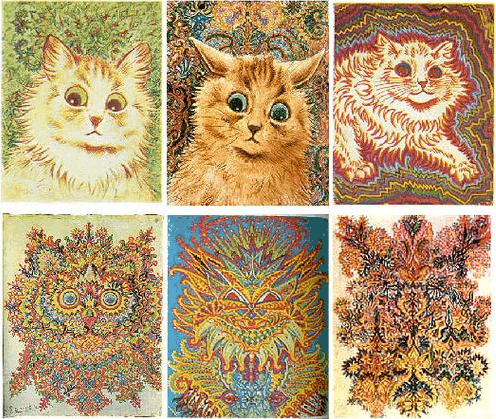
How a mental disorder opened up an invisible world of colour and pattern

ScreenHunter_03 Dec. 28 17.51
Joseph Milton in Scientific American:

As Wain’s condition worsened, so his pictures of cats became more abstract until, towards the end of his life, they were barely recognisable as cats at all, instead becoming intricately detailed, fractal shapes full of unnaturally (at least for a cat) bright colours. The foreknowledge that they are images of felines allows the viewer to pick up on certain shapes – the pointy triangular ears and some features of the face – but without it, you would be hard-pressed to realise these are cats.

The tale of Wain’s life is a sad one. For a time he was a successful artist, but a series of poor investment decisions left him penniless and he began to develop mental health problems in the early 20th century. He deteriorated quickly, becoming a suspicious and sometimes violent man, prone to incoherent, rambling speech. In 1924 he was incarcerated in the pauper ward at Springfield Mental Hospital in Tooting, south London, not far from where I live. After intervention by some famous and influential figures, including Stanley Baldwin, the Prime Minister of the day, and H.G. Wells, Wain was transferred to more pleasant surroundings. He ended his days in Napsbury Hospital, north of London, which had a garden and, happily for Wain, a colony of cats. In this environment he was able to resume drawing, and it was here he produced some of his most spectacular work.

More here.

Tintin est Mort!

Tumblr_lwu89xOUOy1qhwx0o

On March 3rd, 1983, the French daily Libération ran under an unusual cover: Against a black background, as though seen through a telescope, a circular drawing portrayed a cowlicked boy lying face down in the snow while a white fox terrier keened brokenly beside him. Tintin est Mort! tolled the headline. It was in fact Hergé, the Belgian-born creator of the tufty-haired hero, who had departed the day prior, but the headline of that issue — in which Libération replaced every illustration, including those for political news, TV listings, weather reports, and even ads, with drawings from Hergé’s canon — indicated the extent to which the man had become enmeshed with his famous creation. For the French-speaking world, it may as well have been Tintin who’d died, rather than the man who, despite valuing lightness, clarity, and humor above all, was never nearly so clear and precise in his politics as he was in his art. Hergé’s style, to bowdlerize Roland Barthes, might be called biographical: He and Tintin are linked by this very tension between truth and simplicity. The Tintin stories — published in 1929 in the right-leaning Catholic newspaper Le Petit Vingtieme, then later in Hergé’s own Journal Tintin and the series of Casterman albums through which we know them now — are celebrated for what the Dutch artist Joost Swarte, writing in 1977, dubbed Hergé’s ligne claire, or “clear line,” style. In his use of uniform, strong lines, flat, saturated color, and clearly delineated shapes and volumes, Hergé negotiates between the techniques of his era’s naturalistic adult adventure comics like Chester Gould’s Dick Tracy and those of gag-based newspaper strips like Bud Fisher’s Mutt and Jeff.

more from Jenny Hendrix at the LA Review of Books here.

the bridge

Barghouti-575-4

Once again we start the journey from Cairo to Amman and from there to the bridge. Since my first crossing in 1996, after thirty years of exile, I have crossed many times, sometimes with ease and sometimes with difficulty. I’ve seen Israeli soldiers whose seriousness, which can rise to the level of scowls of superiority, never leaves them and others who practice their job with professionalism, as though they were customs inspectors and nothing more. In the eyes of some, I’ve seen a certain confusion and, very occasionally, I’ve seen one who smiles or shows some desire to be of help. There is no homogeneity to their features—Ethiopian, Brooklynite, Slavic, Yemeni. The common factor is that they’re all armed. Some are newly conscripted adolescents, male and female, and some of these seem bewildered by their daily contact with hundreds of the Arab ‘enemy.’ In all cases, though, the rifles are ready for use at any moment. Taken together, they constitute a nightmare for every Palestinian who crosses the bridge. It’s difficult to trust the smile of a person carrying weapons here. Our problem with the Jew, here in this ‘Jewish state’ as they insist on calling it, is that all three or four generations of Palestinians have seen of him is his helmet. They’ve seen the Jew only in khaki, with his finger on the rifle’s trigger. They’ve seen him only as a sniper at a window, an officer in a tank, a conscript at a checkpoint, a guard clacking his metal heels past the doors to prison cells or along the long corridors that separate them, or a heavy hand in the interrogation rooms, where Israeli law allows the use of what they call ‘moderate physical force’(!) to extract confessions. Many western journalists who maintain a studied and malign blindness to the Occupation have asked me whether the Palestinian people are really ready to coexist with the Jews and I reply that we coexisted with them for hundreds of years in Palestine, the Arab countries, and Andalusia, and that it is Europe, which reproves us and holds us to account, that couldn’t coexist with them and sent millions of them mercilessly to the Holocaust. What is asked of us today, however, and has been ever since their military occupation of our land, is to coexist with their tanks in our bedrooms! Show me one person in this world, I say to them, who can live with a tank in his bedroom.

more from Mourid Barghouti at Guernica here.

christmas in india

India

I always say that I fell in love with my husband at Kinko’s. Charged with printing blown up photographs for the annual fundraiser for the afterschool program where we both worked, I arrived to pick them up only to find the pictures grainy and only half of the job completed. While I panicked that I’d be fired and was ready to scream at the woman at the counter, Terence calmly, but firmly explained what needed to be done and the urgency with which it had to be completed. We’d been dating for less than two months, but in that moment I thought, this is the person I need by my side. Three years later, we were engaged. For our Christmas affianced, we booked a trip overseas, eager to show our independence, and maybe even create a new tradition apart from our families. On December 22, 2009, we arrived to New Delhi, India. Our plan was to spend a few days there, and then on Christmas Eve we would take a train to Agra so that we could see the Taj Mahal on Christmas Day. From there, we’d travel through Rajasthan and eventually fly to Mumbai. We had tickets for an early morning train out of Delhi, and when we arrived at the station it was still dark. I knew immediately that I didn’t want to be there. People huddled around fires that were lit on the sidewalks and beggars swarmed. I told myself that when the sun came up, everything would feel less scary, but in my rush to get downstairs to the train track, I missed a step. My legs folded forward in a way that only a camel’s should.

more from Courtney Knowlton at The Common here.

Photographs of the year 2011

From The Guardian:

Spider-trees-in-pakistan--006I was in Pakistan a year ago for DFID, looking at the impact of British aid in helping people affected by the floods. In northern Sindh a vast area had been flooded, but the waters had finally receded enough for local communities to start to return. While we were there the local NGOs told us about this odd phenomenon: miles and miles of flooded land, where every piece of vegetation was shrouded in these spider webs, like candy floss. It was stunning – a surreal sight. The trees were the only things above the water, so it was a very strange landscape, definitely ghostly.

More here.

A Hipster’s Guide to Hinduism

From Smithsonian:

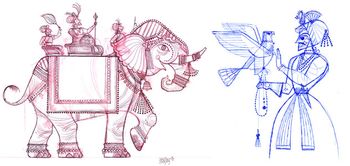
Sanjay-Patel-drawings-631Sanjay Patel arrives at the entrance of San Francisco’s Asian Art Museum, breathless. His vahana, or vehicle, is a silver mountain bike; his white helmet is festooned with multicolored stickers of bugs and goddesses. Though we’ve barely met, Patel takes my arm. He propels me through dimly lit halls, past austere displays of Korean vases and Japanese armor, until we arrive at a brightly lit gallery. This room is as colorful as a candy store, its walls plastered with vivid, playful graphics of Hindu gods, demons and fantastic beasts. “This is awesome.” Patel spins through the gallery, as giddy as a first-time tourist in Times Square. “It’s a dream come true. I mean, who gets the opportunity to be in a freakin’ major museum while they still have like all their hair? Let alone their hair still being black? To have created this pop-culture interpretation of South Asian mythology—and to have it championed by a major museum—is insane.”

The name of the show—Deities, Demons and Dudes with ‘Staches—is as quirky and upbeat as the 36-year-old artist himself. It’s a lighthearted foil to the museum’s current exhibition, Maharaja: The Splendor of India’s Royal Courts. Patel, who created the bold banners and graphics for Maharaja, was given this one-room fiefdom to showcase his own career: a varied thali (plate) of the animated arts. “I’ve known of Sanjay’s work for a while,” says Qamar Adamjee, the museum’s associate curator of South Asian Art, ducking briefly into the gallery. At first, she wanted to scatter examples of Patel’s work throughout the museum; the notion of giving him a solo show evolved later. “[Hindu] stories are parts of a living tradition, and change with each retelling,” Adamjee observes. “Sanjay tells these stories with a vibrant visual style—it’s so sweet and so charming, yet very respectful. He’s inspired by the past, but has reformulated it in the visual language of the present.”

More here.

Wednesday Poem

Blues

Love won't behave. I've tried

all my life to keep it chained up.

Especially after I gave up pleading.

I don't mean the woman,

but the love itself. Truth is,

I don't know where it comes from,

why it comes, or where it goes.

It either leaves me feeling the knife

of my first breath

or hang-dog and sick

at someone else's unstoppable

and as the blues song says,

can't sit down, stand up, lay down pain.

Right now I want it.

Read more »

Tuesday, December 27, 2011

Final Proof that Faster-Than-Light Neutrinos are Impossible?

920909f9645f4b0193c5748d23599a22Even though it seemed exceedingly unlikely, I wanted to see what a world in which the future could shape the past looked like. Alasdair Wilkins in io9:

Washington University St. Louis physicist Ramanath Cowsik and his team have come up with what is quite possibly an impossible problem for these faster-than-light neutrinos to overcome. Instead of focusing on the neutrinos themselves, Cowsik looked at the other subatomic particles in the experiment that were smashed together to create the neutrinos.

Here's how the OPERA experiment worked: Protons were shot towards a stationary object, which produced a pulse of particles known as pions. These are low-mass subatomic particles that are composed of a pair of quarks. (For more on pions, check out our particle physics field guide.) These pions were magnetically forced through a long tunnel, and there they decayed into neutrinos and muons, which are like a more massive cousin of electrons.

When the particles reached the end of the tunnel, the muons smashed into the wall and came to a stop, but the extremely light neutrinos slipped right through and made their way to Gran Sasso, a journey they seemingly completed 60 nanoseconds too quickly.

The problem, from a theoretical perspective, is how to fit the pions into this story. To reach superluminal speeds, the neutrinos must have possessed extreme amounts of energy. The law of conservation of energy and momentum demands that that energy came from somewhere — specifically, the pions. But Cowsik calculated that if pions were to have enough energy to create faster-than-light neutrinos, then their lifetimes would also increase.

Physics on the Fringe

Michael D. Gordin in American Scientist:

ScreenHunter_02 Dec. 27 17.29Many people enjoy doing physics, and the vast majority of them work as professional scientists. Margaret Wertheim’s Physics on the Fringe, however, is about the minority, those who devote a significant portion of their lives to investigating the structure of the universe at their kitchen tables while their families sleep. These individuals (those she discusses are, with one exception, all men) did not train as scientists and then fail to find employment in their chosen field. And they are not amateurs who study physics textbooks and read scholarly journals. They are at the fringe, a place most of us ignore completely.

That is because the fringe is, well, fringy. Among Wertheim’s protagonists are those who deny quantum mechanics, postulate new structures for atoms, revive the ether or reject special relativity, and just about all of them despise general relativity. They self-publish their theories—sometimes they just photocopy handwritten manuscripts—and circulate them among scientists worldwide, who usually end up tossing them in the wastebasket. Wertheim, an accomplished science writer, has collected such texts for years now and sympathetically narrates many of them for us. Such ephemera are very hard to come by, given their frequent encounters with the trash heap, and her archival efforts are to be lauded (as is the renewed attention she brings to mathematician Augustus De Morgan’s delightful 1872 book, A Budget of Paradoxes, which catalogs the rejectamenta of the science of his day). She wants us to take these “outsider physicists” seriously, not as a kooky cultural phenomenon, but as people actually doing science in a way that demands as much attention from mainstream science as folk art now claims from the elite art community.

More here.

A Shared Fate: The Political Implications of the Eurozone Crisis

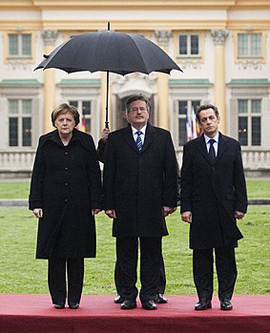
Mueller_36.6_leadersJan-Werner Müller in The Boston Review:

Paul Krugman recently wondered whether it was possible to be “both terrified and bored” by the Eurozone crisis. It is indeed terrifying: the EU—the most important political innovation since the invention of the democratic welfare state—might break apart, or worse. Some are predicting the return of large-scale political violence; protesters on the streets of Athens are already comparing Greece, 2011 to Dachau, 1933. But the crisis is also boring, in that a sad pattern has predictably been repeating itself: markets jitter; politicians declare a make-or-break moment; national leaders host an all-night summit; bleary-eyed, they declare the crisis’s final resolution; the market-confidence fairy makes a brief appearance; and then the cycle starts all over again.

By now most people have settled on one of two economic solutions: either let the European Central Bank act as lender of last resort and issue Eurobonds (everyone’s view, it seems, except the German government’s) or impose discipline so as to avoid inflation and a permanent Southern European Mezzogiorno (the official German view).

In the economic debate, however, it is easy to lose sight of the political and, ultimately, moral stakes. While it’s true that much of the business of the EU is business—running a common market—European integration was always first and foremost a political project: its goals included enduring peace, the entrenchment of democracy in member states, and, most recently, moving toward “ever closer union.” The crisis may indeed require Europeans to get serious about political union, at least among the Eurozone countries. But political union will not work without some sense of democratic legitimacy, which the current proposal for tighter cooperation among national executives is unlikely to generate.

Brian Leiter on the Analytic/Continental Distinction

Over at Philosophy Bites:

Many philosophers self-identify as 'analytic' or 'continental' philosophers. But does this sort of label make sense? Brian Leiter, who, amongst other things, is an expert on Nietzsche, is sceptical of the value of the terms as typically used. In this episode of the Philosophy Bites podcast he explains why.

Listen to Brian Leiter on the Analytic/Contintental Distinction

Rejoice for Utopia is Nigh!

GernsbackProspero in The Economist:

ONE hundred years ago an American immigrant invented science fiction.

Okay, that’s not true. Not even close. People have been building fantastic narratives out of scientific gobbledygook since the days of the Greeks. Lucian of Samosata imagined a trip to the moon over 17 centuries before Jules Verne took a whack at it. And decades before 1911 Verne and H.G. Wells wrote the stories that established the contours of the genre: fantastic voyages in space and time, alien encounters, technology run amok, and so forth. The term “science fiction” wouldn’t even be invented until 1929.

But the genre as a coherent field of literary endeavour—as the thing that takes up a whole wall at your local Barnes & Noble or Waterstone’s—might not have come to be if it weren’t for a failed inventor-turned-publisher with aesthetic ambitions. Naive, utopian and romantic, a man named Hugo Gernsback ended up establishing a new strand of science fiction, one that helped shape (and was shaped by) the American century.

Gernsback had come to America in 1904 with the common immigrant dream of striking it rich. He planned to revolutionise battery technology, but when that didn’t pan out he turned to scientific-magazine publishing. He started out with mail-order catalogues for his imported radio-equipment business, but, as the years went on, his efforts took a more explicitly literary turn. Amazing Stories, which he founded in 1926, has a fair claim to being the first magazine dedicated solely to what he called “scientifiction”. It would go on to help define the genre, publishing the debuts of some of its greatest authors.

Imran Khan: My time has come

From The Telegraph:

RallyImran Khan has been written off before. As a cricketer, he was initially dismissed as having average ability before captaining his team to World Cup glory. For the past 15 years his political party has stumbled from one election humiliation to the next. Now though, he is convinced his time has come. Riding a tsunami of popular support ahead of elections widely expected next year, he is bracing himself for a campaign of dirty tricks. “During a match there comes a time when you know you have the opposition on the mat. It is exactly the feeling now, that I have all the opposition by their balls,” he said, in an interview last month with The Daily Telegraph as he travelled to the north-western city of Peshawar for yet another rally on his 59th birthday. “Whatever they do now will backfire.”

Further evidence of Mr Khan’s steepling ascent was on display in Karachi, Pakistan’s biggest city, today on Christmas Day, when at least 100,000 people turned out to hear his message that change was sweeping the country. The figure is all the more remarkable as the city is far from Mr Khan’s stronghold of Lahore. “I’ve never seen a gathering like this in Karachi in two decades,” said a local journalist covering the rally. Everything changed in October, when he attracted more than 100,000 supporters to a parade ground in Lahore. The world took notice of a new star in Pakistan's political firmament, dominated for decades by a handful of the richest families. A YouGov-Cambridge poll released on Fri Dec 23 found that Khan is the most popular political figure in Pakistan by far, with some 81 per cent of respondents choosing him as the person they think best suited to lead the country. Two thirds meanwhile said they would vote for his PTI party.

More here.