
Jia Tolentino at The New Yorker:
 In 2013, a mysterious producer named Sophie released “Bipp,” a minimalist club track that sounded like it had been formed on another planet and squeezed through hyperdrive before arriving on ours. “Bipp” was black space latticed with radically strange objects: a rubbery squelch of a bass beat, a melodic line like a laser coated in latex, percussive punctuation marks that seemed to morph from plasma into steel. Sophie continued releasing singles, each one accompanied by a 3-D rendering of a ladderless slide. The objects looked the way the songs sounded, like uncanny candy—slick, chemical, jaw-breakingly hard.
At the time, not much was known about Sophie. She was associated with the collective PC Music, which specialized in the aggressively, gleefully synthetic. With the producer A. G. Cook, Sophie put out a catchy PC Music single called “Hey QT,” a promotional jingle for a fake energy drink, QT, which, in 2015, was distributed to concert attendees in a stunt at SXSW. This micro-era was a peak of absurd corporate branding in music—for the past few years, SXSW artists had performed inside a giant vending machine sponsored by Doritos.
more here.
Enjoying the content on 3QD? Help keep us going by donating now.
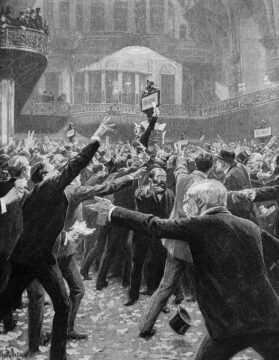 In the chilling speech he gives at the end of the film Margin Call, Jeremy Irons says that no one should say they believe in equality, because no one really thinks it exists: The very idea camouflages the endurance of hierarchy in an essentially unchanging form. “It’s certainly no different today than it’s ever been,” he explains to an underling. “There have always been and there always will be the same percentage of winners and losers….Yeah, there may be more of us than there’s ever been, but the percentages? They stay exactly the same.”
 Both of us understand the powerful effects that food has on your health and longevity. A poor diet may lead to
  People volunteer at organizations that fail to advance the causes to which they are supposedly devoted. They donate to their local cat shelter even though there are already enough organizations caring for stray pets in their affluent neighborhood. They buy their alma mater a fancy new gym even though the campus already has state-of-the-art facilities.
 J.D. Vance looks annoyed. It’s a Tuesday afternoon in August, and we’re sitting near the front of his campaign plane, flying from a rally in Michigan to a fundraiser in Tennessee. Across the aisle is his mother Bev, whose role in Vance’s traumatic and disruptive childhood he chronicled in his best-selling memoir, Hillbilly Elegy. As flight attendants serve Chick-fil-A, Vance gripes about the ongoing controversy over his three-year-old comments complaining that the U.S. is being run by Democrats, corporate oligarchs, and “childless cat ladies” who “don’t really have a direct stake” in the country’s future. As with his boss, Vance’s instincts are to punch back. “I think it’s a ridiculous thing to focus on,” he says, “instead of the underlying argument I was trying to make.”
 There’s a bar in Baltimore, Maryland, that very few people get to enter. It has a cocktail station, beer taps and shelves stacked with spirits. But only scientists or drug-trial volunteers ever visit, because this bar is actually a research laboratory. Here, in a small room at the US National Institutes of Health (NIH), scientists are harnessing the taproom ambience to study whether blockbuster anti-obesity drugs might also curb alcohol cravings.
 F
F The monomyth, otherwise known as the “hero’s journey,” attempts to set structure to story. First developed by folklorist Joseph Campbell, the monomyth is the type of concept you are quizzed on in a college literature survey course—a multi-stage narrative journey that includes an archetypal hero, a departure from a homeland, a period of trial often necessitating a descent into an underworld, and a triumphant return with newfound power and experience. It is an attractive formula, in part because it monumentalizes many well-loved works of literature—turning anything from the Odyssey to Star Wars to The Lord of the Rings into a simple series of steps. The monomyth is helpful insofar as it illuminates patterns, but, like all theoretical frameworks, it is capable of obscuring distinctive aspects of any given work.
 Entomologist Erica McAlister, the Curator of Diptera at the Natural History Museum, London (NHM), has previously written two popular science books on flies,
 I am an
 Here are two abortion stories. Both are mine. Both came with heartache and upheaval — and both prevented heartache and upheaval. One was an experience common to