From Scientific American:
More here.

From Scientific American:
More here.
From MSNBC:

More here.
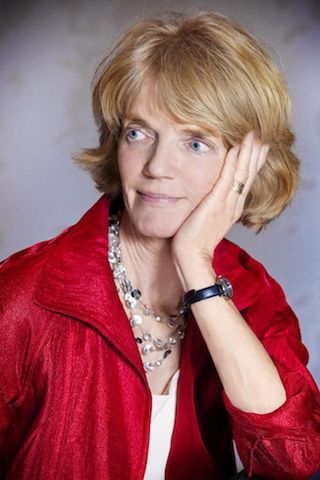
3:AM: Your approach to philosophy may strike some as being not really philosophical. This is because you place neuroscience at the heart of your approach. Can you say something about why you think this approach has caused some people to worry that it undermines the claims of philosophical enquiry proper and how you respond?
PC: Philosophical enquiry proper – mmmmmm is that the sort of thing Aristotle and Hume were doing, or the sort of thing that Kripke and Gettier were doing? Let me sound curmudgeonly for a moment: if I want to know how people use words, I will go to sociolinguists, who actually do science to try to find those things out. If I want to know how we learn and remember and represent the world, I will go to psychology and neuroscience. If I want to know where values come from, I will go to evolutionary biology and neuroscience and psychology, just as Aristotle and Hume would have, were they alive.
Theorizing is of course essential to make progress in understanding, but theorizing in the absence of knowing available relevant facts is not very productive. Given how long philosophers have been at conceptual analysis (I mean the 20th century stuff), and how many have been doing it, what can we say are the two most important concept results of all that effort? By ‘important’ here, let’s mean ‘has a significant impact outside philosophy on how people understand something’. Otherwise, as Feyerabend said, we are just talking to ourselves; taking in each other’s laundry. Incidentally, the analytic claim that knowledge is “true justified belief” does not accord with how ordinary people in fact use the word “know”. So whose concept is being analyzed? When philosophers try to understand consciousness, much of what they claim is not conceptual analysis at all, though it may be shopped under that description. Actually, they are really offering a theory about the nature of consciousness. When that theory is isolated from known facts, it is likely not to be productive.
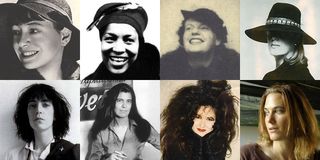
In 1967, Patti Smith wrote in Just Kids, she was considering a move to New York City. “I had enough money for a one-way ticket. I planned to hit all the bookstores in the city. This seemed ideal work to me.” Twenty-seven years before her, in 1940, Shirley Jackson and her soon-to-be husband Stanley Hyman graduated from Syracuse and moved to New York. According to this biography, “For quite some time they had known exactly what they were going to do: move to New York City, live as cheaply as possible, take menial jobs if necessary and wait for the Big Break. Not just wait—push for it.”
And fifteen years before that: “The first week of January 1925, Zora Neale Hurston moved to New York City, as she recalled, with a dollar and fifty cents in her purse, 'no job, no friends, and a lot of hope,'” as one of her biographers put it.
The equivalent young female writer arriving in New York in search of literary success in 2012 (as calculated by the CPI Inflation Calculator) would have $19.51 in her purse, which could buy breakfast at Balthazar, or a pack of smokes and one Happy Hour cocktail, or about ten hours' rent.
We've looked at how much the costs of things like Reeses peanut butter cups and TV sets have changed over time—very specific items. Let's cast a wider net. For more than a century, the young flock to New York as the place to launch a career in the arts. Is it as expensive a proposition now as it always has been? Has the size of the potential rewards increased or decreased? And more importantly, just what was it like? In what ways was hanging at the Algonquin Roundtable just like (and not like) bumming around the lobby of the Chelsea Hotel? Let's look at the Bohemian set over time, as seen through the eyes (and pocketbooks) of some of the women writers we've been reading for decades, from Dorothy Parker and Hurston onward to today.
The man most physicists refer to as the “Einstein of our day” or the “most intelligent human alive” talks about his life's work here.
From The New York Times:

Mr. Kadri’s background gives him a grounded and many-angled perspective on Islamic law. He finds a great deal to admire in it, and he is deft at dispelling myths. Stoning, for example, is not mentioned in the Koran as a punishment for adultery. In his reading of the Shariah, he finds rationality and flexibility. His argument is with recent hard-liners who, he writes, “have turned Islamic penal history on its head.” He is furious that fundamentalists “have associated the Shariah in many people’s minds with some of the deadliest legal systems on the planet.” He calls them traditionalists who ignore tradition. He is disgusted that warped opinions “are mouthed today to validate murder after murder in Islam’s name.”
More here.
From Scientific American:
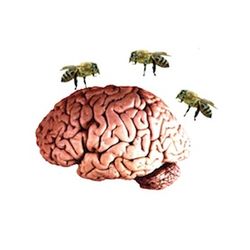
Hills and his colleagues asked 141 Indiana University Bloomington students to type the names of as many animals as they could think of in three minutes. For decades, psychologists have used such “verbal fluency tasks” to study memory and diseases in which memory breaks down, such as Alzheimer's and dementia. Again and again, researchers have found that people name animals—or vegetables or movies—in clusters of related items. They might start out saying “cat, dog, goldfish, hamster”—animals kept as pets—and then, having exhausted that subcategory, move onto ocean animals: “dolphin, whale, shark, octopus.” On average, the students in Hills's experiment named 37 animals in three minutes and, like so many of their predecessors, the lists they typed were organized into groups of animals unified by a single theme—pets, the savanna, etcetera. What Hills and his colleagues really wanted to know was whether the students shifted from one themed cluster to another the same way some animals hop from patch to patch of food. To make the most of its time and get the most food possible, a bird feeding on berries, for example, should only stay on any one particular bush if the plant will yield more berries than nearby bushes. At some point, the bird has eaten so many berries on the first bush that it makes more sense to switch to one with more to offer.
More here.
A Poem I Wrote Standing Up- Indictment
We are proud to be Africans on distant shores,
learning ancient tongues, fighting for their survival,
while forgetting our own.
We adopt new inflections
and sing-song ways of speaking
to camouflage our origins,
hiding from the tainted brush.
We are the new Celts – darker, more robust.
We sanction our memories of sun and hunger
and hopeful hopelessness.
We unlearn our songs and disappear through our children –
the pristine generation, unmarked by unpopular citizenry.
We are not proud. We are not Africans.
by Blessing Musariri
publisher: PIW, 2011
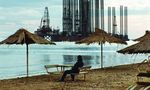
A man with a briefcase arrives in a place called City-A looking like a double agent from 1973: mustachioed and trenchcoated, forever ducking into phone booths for cryptic conversations. The man, Mr. Holz, is a geophysicist of unknown origin. He has come here to work for the New Method Oil Well Cementing Company. City-A is mesmerizingly bleak, a grid of concrete high-rises set between a brackish sea and a wintry industrial wasteland, all of it reeking of environmental contamination and failed utopia. Many things, Holz notices, are amiss here. Clocks don’t run sixty seconds to the minute in City-A. The drinking water is spiked with lithium, a shadowy entity has confiscated his passport, language is rationed, and what exactly is this New Method Oil Well Cementing Company, anyway? As the bewildered-looking Holz moves through the city, is he piecing together clues to solve these mysteries or just being shuttled around by a powerful unseen force?
more from Jane Yager at the Paris Review here.
Vladislavić is one of the great writers of the fragment. The two works preceding Double Negative, The Exploded View (2004) and Portrait with Keys (2006), both attest to this. The Exploded View is a novel in four parts, one for each of four protagonists—a statistician gathering census data, a civil engineer working on post-apartheid housing developments, a market-savvy artist (who makes a delightful return in Double Negative), and an erector of billboards. All of them have a privileged perspective on life and society in Vladislavić’s home city, Johannesburg. Vladislavić calls the The Exploded View a novel, and though the juries of literary prizes disagree with him, I think this is a claim to be taken seriously. A case could be made that the novel’s divided form is justified by its object: Johannesburg, which is, as cliché would have it, the “divided” city. But Vladislavić’s tightly knit prose belies this diagnosis. Sensitive readers are struck by the uncanny repetitions, haunting resonances, and resounding echoes across the novel’s parts: by the work’s and the city’s unity, not their partition. Portrait with Keys is a collection of 138 short pieces about the city, which can be read in order, at random, or according to one of the suggested “itineraries” included with a map at the back of the book. This book is classified as “non-fiction,” and this time the juries of literary prizes do agree. The “portrait” in 138 brush-strokes has two subjects: the city and the artist himself. Both are rendered in imbricated, mutually enriching fragments, forming a nuanced whole. Neither rendering would be out of place in the very best fiction.
more from Jan Steyn at The Quarterly Conversation here.
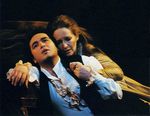
The Sufferings of Young Werther (otherwise known as The Sorrows of Young Werther) appeared in 1774. Goethe sent a synopsis to a friend: I present a young person gifted with deep, pure feeling and true penetration, who loses himself in rapturous dreams, buries himself in speculation, until at last, ruined by unhappy passions that supervene, in particular an unfulfilled love, puts a bullet in his head. This synopsis is notable for the distance Goethe seems to be putting between himself and a hero whose story was in important respects his own. He too had gloomily asked himself whether a self-defeating compulsion did not underlie his practice of falling in love with unattainable women; he too had contemplated suicide, though he had lacked the courage to do the deed. The crucial difference between himself and Werther was that he could call on his art to diagnose and expel the malaise that afflicted him, whereas Werther could only suffer it. As Thomas Mann put it, Werther is “the young Goethe himself, minus the creative gift.” Two energies go into the making of Werther: the confessional, which gives the book its tragic emotional force, and the political. Passionate and idealistic, Werther is representative of the best of a new generation of Germans sensitive to the stirrings of history, impatient to see the renewal of a torpid social order.
more from J.M. Coetzee at the NYRB here.
Peter Reuell in the Harvard Gazette:
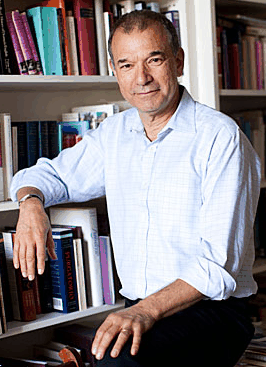
Greenblatt’s book, which describes how an ancient Roman philosophical epic helped pave the way for modern thought, was awarded the 2012 Pulitzer Prize for general nonfiction.
In its citation, the Pulitzer board described “The Swerve” as “a provocative book arguing that an obscure work of philosophy, discovered nearly 600 years ago, changed the course of history by anticipating the science and sensibilities of today.”
The book tells the story of Lucretius’ “On the Nature of Things,” which 2,000 years ago posited a number of revolutionary ideas — that the universe functioned without the aid of gods, that religious fear was damaging to human life, and that matter was made up of very small particles in eternal motion, colliding and swerving in new directions.
Once thought lost, the poem was rediscovered on a library shelf in the winter of 1417 by a Poggio Bracciolini. The copying and translation of the book fueled the Renaissance, inspiring artists such as Botticelli and thinkers such as Giordano Bruno; shaped the thought of Galileo and Freud, Darwin and Einstein; and had a revolutionary influence on writers such as Montaigne and Shakespeare and even Thomas Jefferson.
More here.
William G. Eberhard and William T. Wcislo in American Scientist:
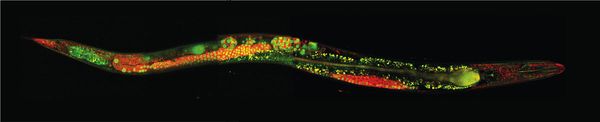
By focusing on evolutionary increases in brain size, biologists generally have overlooked nervous system organization in the smallest of animals. But when one looks closely at very small animals, an important question emerges: Where can a relatively large brain fit in a small body? The answers displayed by one animal after another deliver a new perspective on variation in nervous system design among animals. And this variation calls into question some basic assumptions regarding the uniformity of how central nervous systems function overall. In other words, much remains to be learned from the smallest of the small.
More here.
Vali Nasr at Bloomberg:
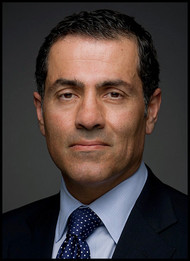
If that weren’t enough, three weeks later, extremists attacked the naval base in Karachi, which houses nuclear warheads. They destroyed a helicopter and two advanced P-3C Orion patrol aircraft. Pakistani special forces lost 10 men and had to fight for 16 hours to end the siege.
More embarrassments followed. Impassioned appeals to the Supreme Court to find President Asif Ali Zardari a traitor backfired on the army and intelligence chiefs when the credibility of their witness, who had claimed that Zardari was colluding with the U.S. against the military, dissolved amid the man’s ever-changing story and his cameo in a mud-wrestling video. Next, the Supreme Court opened hearings in a case alleging that the military bought votes in the 1990 election. The televised spectacle of generals hauled to court to answer judges has mesmerized Pakistanis.
The humbling of the military is good news for democracy in Pakistan. National elections may take place as early as October and must occur by February. With the military restrained, there is hope that voting will be free and fair, and that the outcome may further strengthen civilian rule.
More here.
From the Top of the Stairs
Of course
those who are standing at the top of the stairs
know
they know everything
with us it's different
sweepers of squares
hostages of a better future
those at the top of the stairs
appear to us rarely
with a hushing finger always at the mouth
we are patient
our wives darn the sunday shirts
we talk of food rations
soccer prices of shoes
while on saturday we tilt the head backward
and drink
we aren't those
who clench their fists
brandish chains
talk and ask questions
in a fever of excitement
urging to rebel
incessantly talking and asking questions
here is their fairy tale –
we will dash at the stairs
and capture them by storm
the heads of those who were standing at the top
will roll down the stairs
and at last we will gaze
at what can be seen from those heights
what future
what emptiness
we don't desire the view
of rolling heads
we know how easily heads grow back
and at the top there will always remain
one or three
while at the bottom it is black from brooms and shovels
sometimes we dream
those at the top of the stairs
come down
that is to us
and as we are chewing bread over the newspaper
they say
– now let's talk
man to man
what the posters shout out isn't true
we carry the truth in tightly locked lips
it is cruel and much too heavy
so we bear the burden by ourselves
we aren't happy
we would gladly stay
here
these are dreams of course
they can come true
or not come true
so we will
continue to cultivate
our square of dirt
square of stone
with a light head
a cigarette behind the ear
and not a drop of hope in the heart
From Himal Southasian:
Tara Parker-Pope in The New York Times:

“The dominant social-cultural norm in the West is meat consumption,” said Hanna Schösler, a researcher in the Institute for Environmental Studies at Vrije University in Amsterdam, who has studied consumer acceptance of meat substitutes. “The people who want to shift to a more vegetarian diet find they face physical constraints and mental constraints. It’s not very accepted in our society not to eat meat.” Still, the numbers are substantial, according to according to a 2008 report in Vegetarian Times. Three percent of American adults, 7.3 million people, follow a vegetarian diet, and one million of them are vegans, who eat no animal products at all — no meat, fish, eggs, milk, cheese, even honey. (And 23 million say they rarely eat meat.)
More here.
As Kinkade himself said, light is optimism — and optimism is always a mix of hope and fantasy, of the natural and supernatural. A thatched-roof house in a grove that recalls a memory of a perfectly nameless country town is also reminiscent of a hobbit house from The Lord of the Rings. A young deer standing in a flowerbed by a stream looks to an impossible rainbow that juts from a cliff and the deer also happens to be Bambi. This kind of unapologetically sincere optimism is an easy target. There is something undeniably childish — even ludicrous — about hope. For this reason, just as the light in Kinkade’s paintings is a light of hope and joy, his paintings are melancholy, too. At the Fashion Show Mall last year, I was reminded of something Robert Walser once wrote about the easy delights of Berlin’s Tiergarten. It was like a painted picture, he wrote, “then like a dream, then like a circuitous, agreeable kiss. …[O]ne is lightly, comprehensibly enticed to gaze and linger.” “A Circuitous, Agreeable Kiss” might be the name for any one of Thomas Kinkade’s paintings, for this title conveys well the sense of longing and melancholy that stimulates both Kinkade’s fans and critics. Thomas Kinkade has often been likened to Norman Rockwell — that other American populist who painted scenes of a happier America that existed in a bygone age. Like Rockwell, some have said, Kinkade attracted Americans not so much with hope but rather with nostalgia, the sweet sorrow of loss. Yet Kinkade’s paintings are not nostalgic; they are simply unreal. If anything, they depict an America that has never existed, and will never exist. It is the fantasy that makes them so attractive.
more from Stefany Anne Golberg at The Smart Set here.
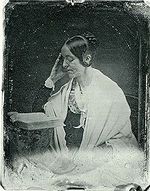
In America, celebrated public intellectuals who are women have, most often, been admitted to the ranks of high cultural regard only one at a time, and never without qualification. In the last century, for instance, the spotlight fell on Mary McCarthy in the 1940s and Susan Sontag in the 1960s, each of whom was smilingly referred to by the public intellectuals of their times as the “Dark Lady of American Letters.” In the first half of the nineteenth century, although a fair number of her sex among abolitionists and suffragists were brilliant, it was Margaret Fuller, world-class talker and author of the influential treatise Woman in the Nineteenth Century (1845), who stood in the allotted space, alone in a sea of gifted men, most of whom chose to denature her—she thinks like a man—as they could not believe they had to take seriously a thinking woman. This was a great mistake, thought a former student of Fuller’s. “With all the force of her intellect,” said Ednah Dow Cheney in 1902, “all the strength of her will, all her self-denial and power of thought she was essentially and thoroughly a woman, and she won her victories not by borrowing the peculiar weapons of man, but by using her own with courage and skill.” Some 160 years after her death, Fuller remains a haunting figure not so much for the one important book she committed to paper as for the exceptional life she lived, the significance it had in its own moment as well as the one it might have had, if it had not been cut severely short in 1850 when she was 40.
more from Vivian Gornick at The Nation here.