The Importance of Being Orwell

From Vanity Fair, an adapted introduction by the late Christopher Hitchens to forthcoming Diaries by George Orwell:

OrwellAs someone who had been brought up in a fairly rarefied and distinctly reactionary English milieu, in which the underclass of his own society and the millions of inhabitants of its colonial empire were regarded with a mixture of fear and loathing, Orwell also made an early decision to find out for himself what the living conditions of these remote latitudes were really “like.” This second commitment, to acquaint himself with the brute facts as they actually were, was to prove a powerful reinforcement of his latent convictions.

Read with care, George Orwell’s diaries, from the years 1931 to 1949, can greatly enrich our understanding of how Orwell transmuted the raw material of everyday experience into some of his best-known novels and polemics. They furnish us with a more intimate picture of a man who, committed to the struggles of the mechanized and “modern” world, was also drawn by the rhythms of the wild, the rural, and the remote.

Read the rest here.

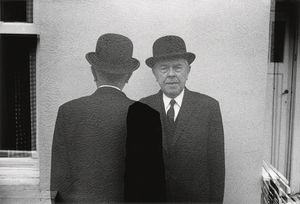
A Visit with Magritte

From lensculture:

Michals_1“If I indulge myself and surrender to memory, I can still feel the knot of excitement that gripped me as I turned the corner into Rue Mimosas, looking for the house of Rene Magritte. It was August, 1965. I was thirty three years old and about to meet the man whose profound and witty surrealist paintings had contradicted my assumptions about photography.”
—Duane Michals

This slender book is really a joy to behold, and one can sense the photographer's excitement at meeting and collaborating with one of the most influential masters of surrealism.

More here.

Mind bending: Why our memories are not always our own

From The Independent:

BabeWhen brothers and sisters are young, observed the psychologist Dorothy Rowe, they fight with each other for their parents' attention. When they are older, “siblings battle over who has the most truthful, accurate memory of their shared past”. Adult siblings generally do not face the same pressures as, say, married couples to agree on a story about their pasts. Individuals who have spent a lifetime trying to define themselves in opposition to each other are unlikely to be quite as motivated to settle their memory differences. And the fact is that adult siblings usually do not get as many opportunities as couples do to negotiate their memory disputes.

Why are some memories easier to negotiate than others? An obvious answer is that the people concerned are more committed to some of their memories than to others, and so are less willing to let go. But the study of sibling memories also convincingly demonstrates how two forces go head to head in memory. There is the drive to represent events accurately, which means being true to the often vivid impressions we have about what actually happened. And there is the drive for coherence, the need to produce a narrative whose elements fit together. In this case, coherence is a matter of agreement between people. Our stories need to make sense to us individually, but they also need to make sense to those who matter to us.

More here.

Sunday Poem

Third Person

a haze a heron in a tide-pool
and for a long time out of
time
two children push a giant yellow globe

coyotes come and every June the same
the unrequited
loneliness the same
out-of-tune expressions herons dance
the same blue
wings
it all made sense
the way he asked me for
the Book of Job
to make some pattern make some rhyme
out of his life
before he died
the way he scrutinized his patterned robe

when he did die it's simply that he sensed
there was no
more to do no other dance
to be composed no present tense

by Maria Gapotchenko
from Clarion 15, Boston University

Saturday, July 14, 2012

How to have a conversation

From FT Magazine:

Perhaps it was the opium talking, but Thomas de Quincey once wrote that an evening in the company of Samuel Coleridge was “like some great river”. The poet “swept at once into a continuous strain of dissertation, certainly the most novel, the most finely illustrated, and traversing the most spacious fields of thought, by transitions the most just and logical, that it was possible to conceive”. Most of us have hopefully felt the unmoored elation of staying up all night talking with a friend or a lover. But Coleridge was that rare thing, a conversationalist: eloquent, witty, with a seemingly bottomless reservoir of cultural knowledge. Nor was he the only one back then who could claim his company was a performance art. David Hume once engaged in so much raillery at a dinner party he left Jean-Jacques Rousseau clinging to a table leg.

What makes a good conversationalist has changed little over the years. The basics remain the same as when Cicero became the first scholar to write down some rules, which were summarised in 2006 by The Economist: “Speak clearly; speak easily but not too much, especially when others want their turn; do not interrupt; be courteous; deal seriously with serious matters and gracefully with lighter ones; never criticise people behind their backs; stick to subjects of general interest; do not talk about yourself; and, above all, never lose your temper.” But Cicero was lucky: he never went on a first date with someone more interested in their iPhone than his company.

More here.

The Vice Presidents That History Forgot

From Smithsonian:

History-Veeps-Dan-Quayle-631In 1966, I stood outside my elementary school in Maryland, waving a sign for Spiro Agnew. He was running for governor against a segregationist who campaigned on the slogan, “Your Home Is Your Castle—Protect It.” My parents, like many Democrats, crossed party lines that year to help elect Agnew. Two years later, he became Richard Nixon’s surprise choice as running mate, prompting pundits to wonder, “Spiro who?” At 10, I was proud to know the answer. Agnew isn’t otherwise a source of much pride. He became “Nixon’s Nixon,” an acid-tongued hatchet man who resigned a year before his boss, for taking bribes. But “Spiro who?” turned me into an early and enduring student of vice-presidential trivia. Which led me, a few months ago, to Huntington, Indiana, an industrial town that was never much and is even less today. It’s also the boyhood home of our 44th vice president.

His elementary school is unmarked, a plain brick building that’s now a senior citizens center. But across the street stands an imposing church that has been rechristened the “Quayle Vice Presidential Learning Center.” Inside the former chapel, you can see “Danny” Quayle’s report card (A’s and B’s), his toy truck and exhibits on his checkered tenure as vice president. He “accomplished more than most realize,” a caption states, noting Quayle’s visits to 47 countries and his chairmanship of the Council on Competitiveness. But the learning center isn’t a shrine to Quayle—or a joke on its namesake, who famously misspelled “potato.” It is, instead, a nonpartisan collection of stories and artifacts relating to all 47 vice presidents: the only museum in the land devoted to the nation’s second-highest office. This neglect might seem surprising, until you tour the museum and learn just how ignored and reviled the vice presidency has been for most of its history. John Nance Garner, for one, said the job wasn’t worth a bucket of warm spit.

More here.

Saturday Poem

Siren Song

This
is the one song everyone
would like to learn: the song
that is
irresistible:

the song that forces men
to leap overboard in
squadrons
even though they see the beached skulls

the song nobody
knows
because anyone who has heard it
is dead, and the others can't remember.

Shall I tell you the secret
and if I do, will you get me

out of this bird suit?

I don'y enjoy it here
squatting on this
island
looking picturesque and mythical

with these two feathery
maniacs,
I don't enjoy singing
this trio, fatal and valuable.

I
will tell the secret to you,
to you, only to you.
Come closer. This
song

is a cry for help: Help me!
Only you, only you can,
you are
unique

at last. Alas
it is a boring song
but it works every time.

by Margaret Atwood

A Small World After All?

Over at The Wilson Quarterly, Ethan Zuckerman examines the paradox of our increasing insularity in the era of globalization:

InternetAs we start to understand how people actually use the Internet, the cyberutopian hopes of a borderless, postnational planet can look as naive as most past predictions that new technologies would transform societies. In 1912, radio pioneer Guglielmo Marconi declared, “The coming of the wireless era will make war impossible, because it will make war ridiculous.” Two years later a ridiculous war began, ultimately killing nine million Europeans.

While it’s easy to be dismissive of today’s Marconis—the pundits, experts, and enthusiasts who saw a rise in Internet connection leading to a rise in international understanding—that’s too simple and too cynical a response. Increased digital connection does not automatically lead to increased understanding. At the same time, there’s never been a tool as powerful as the Internet for building new ties (and maintaining existing ones) across distant borders.

The challenge for anyone who wants to decipher the mysteries of a connected age is to understand how the Internet does, and does not, connect us. Only then can we find ways to make online connection more common and more powerful.

Read the rest at here.

Nicholas Ostler on the History and Diversity of Language

From The Browser:

It’s widely presumed that the English language will become entrenched as the world’s lingua franca and that minority languages will continue to die out. But you don’t really buy into this theory and have argued that new technology might allow minority languages to thrive. I wonder if you could expand on this?

LanguageI try to look at things from a historical perspective rather than just what’s happening in this decade or century. I look at the progress of languages over centuries and millennia – my book Empires of the Word starts in 3000 BC and ends in modern times. Each of us only lives two or three generations, so it’s quite difficult for us to get that perspective without really striving for it. When it comes to languages, we tend to be familiar only with the one that we use on a daily basis. When we are also conscious that in the last century or two that language has spread out all over the world, it gives us a very foreshortened perspective. What I’m trying to do is to correct that.

There have been many lingua francas and English, although it is the most widespread that we know of, is a relative latecomer. We still can’t tell the full form of its life history yet because if you look at a really established lingua franca like Latin it lasted for one and a half millennia. Just when it was thought that it was on its way out with the collapse of the Western Roman Empire, it got a new lease of life through its association with the Catholic church. So these things are difficult to predict.

More here.

Geneticists evolve fruit flies with the ability to count

Liat Clark in Wired:

Shutterstock_21494596After repeatedly subjecting fruit flies to a stimulus designed to teach numerical skills, the evolutionary geneticists finally hit on a generation of flies that could count — it took 40 tries before the species' evolution occurred. The findings, announced at the First Joint Congress on Evolutionary Biology in Canada, could lead to a better understanding of how we process numbers and the genetics behind dyscalculia — a learning disability that affects a person's ability to count and do basic arithmetic.

“The obvious next step is to see how [the flies'] neuro-architecture has changed,” said geneticist Tristan Long, of Canada's Wilfrid Laurier University, who admits far more research is needed to delve into what the results actually mean. Primarily, this will involve comparing the genetic make-up of an evolved fruit fly with that of a standard test fly to pinpoint the mutation.

The research team, made up of geneticists from Wilfrid Laurier University in Canada and the University of California, repeatedly subjected test flies to a 20-minute mathematics training session. The flies were exposed to two, three or four flashes of light, with two or four flashes coinciding with a shake of the container the flies were kept in. Following a pause, the flies were again subjected to the flashing light, however none prepared themselves for a repeat of the shake since they could not discern a difference between two, three or four flashes. That is, until the key 40th generation of descendants were put to the test.

More here.

Spies Like Us

From the Moscow Times:

BondI never thought I'd write a column about the word агент (agent). What's there to write?

Both агент and agent come originally from the Latin, although агент probably entered Russian later than it entered English. Both агент and agent share pretty much the same range of meanings. Агент might be a representative of an organization or person who is empowered to act for them, like страховой агент (insurance agent) or литературный агент (literary agent). Or агент might be a substance that causes some kind of change, like активный агент (active agent) in a chemical process. And then агент might be a spy, like двойной агент (double agent). Interestingly, a dictionary from the 1930s lists the last meaning as разговорное, устаревшее (colloquial, archaic). My, how things change.

But still — so far, so good. For once, the two languages are in perfect harmony.

And then in its recent legislative bacchanalia, the Russian parliament proposed that the term иностранный агент (foreign agent) be used to identify any nongovernmental organization in Russia that receives foreign funding, insisting that this is a direct translation of the U.S. designation “foreign agent.”

And with that, harmony went out the window.

More here.

hope I get old before i die

5e6868a1-283c-46b9-87bd-38ac617fd262

The Rolling Stones, it might be argued, were not even as radical as the Beatles. But their music was defiantly dirty, and it got better and better. The syncopated chops that kicked “Jumpin’ Jack Flash” into being were the prelude to a domination of the rock scene that perfectly mirrored the febrile times. The band members themselves still flirted with the accoutrements of gracious living, twisting its elegant ways to suit their own purposes. In 1969, guitarist Keith Richards and his then partner, the actress Anita Pallenberg, moved into a Queen Anne mansion in Chelsea bought from a Conservative undersecretary of state. “The study where government officials had debated the Suez crisis in 1956 was now occupied by a large hookah,” writes Sandford with no little relish. It wasn’t the Stones selling out to the establishment, so much as vice versa.

more from Peter Aspden at the FT here.

darwin’s ghosts

15RAFFLES-articleInline

Darwin had anticipated the charge of plagiarism. Buried somewhere in his notes was a list of predecessors he had planned to acknowledge. With so many enemies lining up against him — venting the expected “disgust and outrage” at his theory of natural selection — he could ill afford to offend his allies. So in the first American edition of “Origin,” he appended a “Historical Sketch” crediting 18 others, including Powell. In subsequent editions, the roll expanded. Stott usefully includes as an appendix the version Darwin added to the fourth British edition, in 1866. It cites over 30 names, many now obscure. Stott, in her absorbing account, shows that Darwin, who had sat on his discoveries for 20 years, had good reason to worry about his book’s reception. Among many other cautionary tales, there was one very close to home: that of the doctor and poet Erasmus Darwin, his talented and outspoken grandfather.

more from Hugh Raffles at the NY Times here.

Trieste and Joyce

600

The year 1909 would be an important and traumatic one for Joyce, challenging him once again as a writer, and enticing him back to the novel over which he had laboured so long and which he had come to neglect. But it took a moment of mutual discovery to galvanize him. In February, Ettore Schmitz, his student, mentioned to him shyly that he too was a writer and had published two novels under the pseudonym “Italo Svevo.” These were “Una Vita” and “Senilità,” published ten years earlier. Joyce took them to read and was deeply impressed, telling him, “Do you know that you are a neglected writer? There are passages in ‘Senilità’ that even Anatole France could not have improved.” His words moved Schmitz almost to tears. From then on he talked to Joyce openly about his frustrated ambitions. Joyce’s enthusiasm had reignited his will to write, and he would soon embark on the novel that would bring him literary recognition. His brother, said Stanislaus, was more than a teacher to Schmitz, he was “an influence.”

more of the excerpt from Gordon Bowker’s new biography on Joyce at the LA Times here.

Friday, July 13, 2012

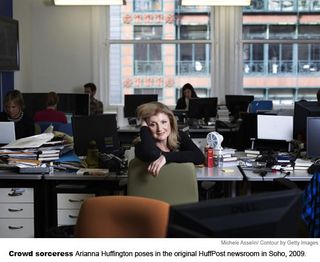
How The Huffington Post Ate the Internet

Shapiro_interiorMichael Shapiro in Columbia Journalism Review:

Of the many and conflicting stories about how The Huffington Post came to be—how it boasts 68 sections, three international editions (with more to come), 1.2 billion monthly page views and 54 million comments in the past year alone, how it came to surpass the traffic of virtually all the nation’s established news organizations and amass content so voluminous that a visit to the website feels like a trip to a mall where the exits are impossible to locate—the earliest and arguably most telling begins with a lunch in March 2003 at which the idea of an online newspaper filled with celebrity bloggers and virally disseminated aggregated content did not come up.

The invitation for the lunch came from Kenneth Lerer. He was 51 and casting about for something new, having recently left his position as executive vice president for communications at AOL. Lerer was a private man who was nonetheless comfortable in the presence of powerful people with whom he had earned a reputation for honing images in disrepair, most famously for the disgraced and subsequently rehabilitated junk bond trader Michael Milken. Lerer had made a good deal of money and a good many friends after having first made a name for himself in the quixotic 1974 New York senate campaign of Ramsey Clark (for which he was hired by the chairman of this magazine, Victor Navasky, who later recruited him for CJR’s Board of Overseers, which has no say in content). Lerer was splitting his time between New York and skiing at his vacation home in Utah when he came across a new book by a young sociologist, Duncan Watts. The book was called Six Degrees. Lerer was so taken by it that he took Watts to lunch.

He brought the book with him and Watts would recall that the copy was dog-eared, the flatteringly telltale sign of a purposeful read. Lerer had a plan and he wanted Watts to help him. He had set himself an ambitious target. He wanted to take on the National Rifle Association.

He told Watts: “I know the answer to this is somewhere in these pages.”

No-Arms

PlatonovA short story by Andrey Platonov, in Caravan:

THERE WAS ONCE AN OLD PEASANT who lived in a village with his wife and their two children. He came to the end of his life and he died. Then it was his old woman’s turn to get ready to die—her time had come too. She called the children to her, her son and her daughter. The daughter was the elder, the son the younger.

She said to her son, “Obey your sister in everything, as you have obeyed me. Now she will be a mother to you.”

The mother gave a last sigh—she was sorry to be parting from her children forever—and then died.

After the death of their parents, the children lived as their mother had told them to live. The brother obeyed his sister, and the sister took care of her brother and loved him.

And so they lived on without their parents, perhaps many years, perhaps few. One day the sister said to her brother, “It’s hard for me to keep house on my own, and it’s time you were married. Marry—then there’ll be a mistress to look after the home.”

But the brother did not want to marry. “The home has a mistress already,” he said. “Why do we need a second mistress?”

“I’ll help her,” said his sister. “With two of us the work will be easier.”

The brother didn’t want to marry, but he didn’t dare disobey his elder sister. He respected her as if she were his mother.

The brother married and began to live happily with his wife. As for his sister, he loved and respected her just as before, obeying her in everything.

At first his wife seemed not to mind her sister-in-law. And the sister-in-law, for her part, did all she could to be obliging.

But soon the wife began to feel upset.