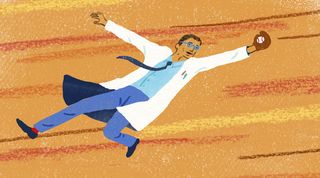
The Rose in Neruda
I have
but one dress
like the rose
in Neruda does
my flesh too
dips toward love
.
by Tina Crane
from Barrow Street,
Fall 2001

The Rose in Neruda
I have
but one dress
like the rose
in Neruda does
my flesh too
dips toward love
.
by Tina Crane
from Barrow Street,
Fall 2001
John Noble Wilford in The New York Times:
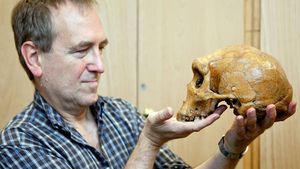
To help make sense of this cascade of new information, a leading authority on modern human evolution — the British paleoanthropologist Chris Stringer — recently sat for an interview in New York that ranged across many recent developments: the evidence of interbreeding between Neanderthals and Homo sapiens; the puzzling extinct species of little people nicknamed the hobbits; and the implications of a girl’s 40,000-year-old pinkie finger found in a Siberian cave.
More here.
Matt Taibbi in Rolling Stone:

Romney really showed us something in his luridly self-congratulating N.A.A.C.P. gambit, followed by the awesomely disgusting “free stuff” post-mortem speech he delivered the next night in front of friendlier audiences. The twin appearances revealed the candidate to be not merely unlikable, and not merely a fatuous, unoriginal hack of a politician, but also a genuinely repugnant human being, a grasping corporate hypocrite with so little feel for how to get along with people that he has to dream up elaborate schemes just to try to pander to the mob.
At first, it was hard to say what exactly Romney was thinking when he decided to address the N.A.A.C.P. He plunged into the speech with a creepy kamikaze smile and a rushed, weird (even for him) delivery, acting like someone proud of what a ballsily moronic dare he was attempting – like a high school kid mooning a squad car from the back of a school bus, or Peter McNeeley rushing face-first into the ring with Mike Tyson.
More here.
Linda Holmes on psychologist Robin Rosenberg's new book, from NPR's Weekend Edition:

She argues that our confusion at why Bruce Wayne would throw himself in the path of all manner of catastrophes misses the point that there's something in it for him, too. “I think it misses that it's about getting a whole life,” she says. “He experienced something that is terrifying as a kid, but his decision to become Batman gave his life meaning and purpose. It found a silver lining in tragedy.” And perhaps there's something in it for the rest of us: “The idea of superheroes that we carry around in our heads may help us to actually do good in our own lives.”
More here.
Oliver Burkeman at The Guardian talks to Paul Zak, an expert on oxytocin, aka 'the moral molecule':

…What drives Zak's hunger for human blood is his interest in the hormone oxytocin, about which he has become one of the world's most prominent experts. Long known as a female reproductive hormone – it plays a central role in childbirth and breastfeeding – oxytocin emerges from Zak's research as something much more all-embracing: the “moral molecule” behind all human virtue, trust, affection and love, “a social glue”, as he puts it, “that keeps society together”. The subtitle of his book, “the new science of what makes us good or evil”, gives a sense of the scale of his ambition, which involves nothing less than explaining whole swaths of philosophical and religious questions by reference to a single chemical in the bloodstream. Being treated decently, it turns out, causes people's oxytocin levels to go up, which in turn prompts them to behave more decently, while experimental subjects given an artificial oxytocin boost – by means of an inhaler – behave more generously and trustingly. And it's not solely because of its effects on humans that oxytocin is known as “the cuddle hormone”: for example, male meadow voles, normally roguishly promiscuous in their interactions with female meadow voles, become passionately monogamous when their oxytocin levels are raised in the lab.
Read more here.
Sonali K in Open:

Being a sex columnist means…
» Getting used to mild cardiac arrests on a daily basis. Like when my little brother grabs my laptop before I’ve cleared my browser history. It also means sackfuls of emails from lecherous men each time a new issue hits the stands. “No, I’m not available for sex at 2300 hours next Saturday, Sir. That’s right, not even if you pay me by the minute.”
» Directing porn films starring friends. How do you stop a hysterical friend from describing her lover’s erectile problem in graphic detail? And how do you look at said paramour in the eye when you meet him at a party two days later?
More here.
The battle between Delhiites and their monkeys has been going on for some time now. As frustrated Delhiites look for solutions, others are trying to understand the reasons behind the increase in monkeys and monkey chutzpah. Loss of habitat due to the vast expansion of the city is one. What now belongs to the streets once belonged to the monkeys. Others point out that the Hindu citizens of New Delhi have been feeding the monkeys on Tuesdays and Saturdays even as they complain about them on other days of the week. They do this to honor Hanuman, the monkey god and a symbol of strength and devotion. (Ironically, the langurs that have been employed to intimidate Delhi’s monkeys are called “Hanuman langurs.”) Authorities plead with Delhiites and threaten them with fines in the hope that this will curb the wanton public feeding of the monkeys. But it is to no avail. A few years back, food collection centers to regulate monkey feeding were set up near Hanuman temples. The collection boxes remained empty. It was not enough for Hanuman worshipers to know the monkeys would be fed in their honor. For it is the direct relationship between human and monkey that makes the act of worship meaningful. A spokesperson for the Municipal Corporation of Delhi told the Indo-Asian News Service that “religious sentiment” was the campaign’s biggest challenge.
more from Stefany Anne Golberg at The Smart Set here.
When we think of modern architecture, two modes come to mind. The first is the sleek, planar, glass-and-steel style established by Mies Van Der Rohe and his interpreters at Skidmore, Owings & Merrill and elsewhere, epitomized by Mies’s Seagram Building (1958). The second is heavy, sculptural steel-reinforced concrete, with much of its artistry in the treatment of the cast concrete surface, most closely associated with the late work of Le Corbusier. The architectural term brutalism is said to have its origins in Corbusier’s use of the phrase béton brut, or “raw concrete,” the brut connoting not brutality or brutishness (although critics would play up that association) but the decision to leave the concrete’s surface rough and unfinished, and often impressed with the wood grain, joints, and other irregularities of the boards with which it was cast. The concept of “the New Brutalism” was brought into being by the critic Reyner Banham’s 1966 book of that name, which highlighted the work of postwar British architects Alison and Peter Smithson.
more from Thomas de Monchaux at n+1 here.
THEY ARE, in their very different ways, monuments of American civilization. The first is a building: a grand, beautiful Beaux-Arts structure of marble and stone occupying two blocks’ worth of Fifth Avenue in midtown Manhattan. The second is a delicate concoction of metal, plastic, and glass, just four and a half inches long, barely a third of an inch thick, and weighing five ounces. The first is the Stephen A. Schwarzman Building, the main branch of the New York Public Library (NYPL). The second is an iPhone. Yet despite their obvious differences, for many people today they serve the same purpose: to read books. And in a development that even just thirty years ago would have seemed like the most absurd science fiction, there are now far more books available, far more quickly, on the iPhone than in the New York Public Library. It has been clear for some time now that this development would pose one of the greatest challenges that modern libraries—from institutions like the NYPL on down—have ever encountered. Put bluntly, one of their core functions now faces the prospect of obsolescence.
more from David A. Bell a TNR here.
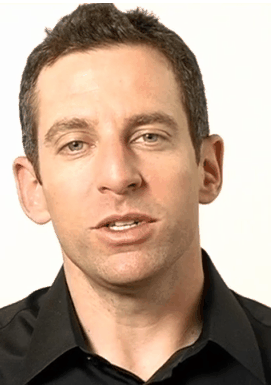
Sam Harris at Big Think:
Question: What is religion?
More here.
Jessica Valenti in The Nation:
Believe it or not, jokes about rape can be funny. (Yes, even feminists think so.) But Daniel Tosh’s hotly debated “joke” aimed at a female heckler was far from humorous—in fact, it was a perfect example of hownot to joke about rape.
Tosh has come under fire this week after a woman blogged about her experience seeing Tosh at a comedy club. According to her, Tosh was talking about how rape jokes were always “hilarious.” She called out, “Actually, rape jokes are never funny!”
After I called out to him, Tosh paused for a moment. Then, he says, “Wouldn’t it be funny if that girl got raped by like, 5 guys right now? Like right now? What if a bunch of guys just raped her…”
Her post has since gone viral, prompting Tosh to write a tepid apology on his Twitter account:
all the out of context misquotes aside, i’d like to sincerely apologize j.mp/PJ8bNs
— daniel tosh (@danieltosh) July 10, 2012
In the meantime, hordes of fans and other comedians have come to his defense, some in the most violently misogynist way possible.
Elissa Bassist at The Daily Beast gets to the heart of why what Tosh said wasn’t funny—in fact, why it wasn’t a joke at all.
Tosh says he was joking. Comedians make rape jokes every day, so why is this one getting so much attention? Because Tosh was more than “just kidding.” He was angry. His “joke” was reactive to the so-called heckler who called him out in front of an audience. He used humor to cut her down, to remind her of own vulnerability, to emphasize who was in control. The “joke” ignited a backlash because it was not a joke; it was vastly different from other jokes about rape.
Jokes about rape that work—those that subvert rather than terrify—do exist. Sarah Silverman has one about being raped by a doctor: “…so bittersweet for a Jewish girl,” she says.
Terrance Tomkow in his own excellent blog:
You are travelling to a lawless 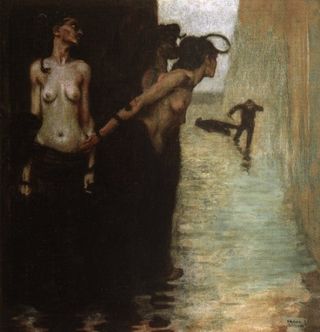
Friends advise you to arm yourself, but you are not comfortable with guns. Instead, you visit the office of a private security agency (“The Agency”) to investigate the possibility of hiring bodyguards. The Agency's sales rep explains to you that because of the prevalence of violence and the total absence of law in this country the demand for private security there is high and so the service is very expensive. Looking at their rate sheet you realize it is far more costly than you can afford. As you rise to leave, the sympathetic rep offers you a brochure for one of The Agency's other services. They call it “Revenge Insurance”.
The brochure explains that Revenge Insurance does not provide any protection to its policy holders. However, in the event that a subscriber is the victim of wrongful injury while in-country, the agency will undertake to use its considerable resources to track down the wrongdoer. When they find him, The Agency's operatives will not try to have the wrongdoer pay the policy holder compensation or recover stolen goods. That is a separate service and, given the general poverty in the country, rarely worth the cost. But, if you have Revenge Insurance, what the agency will do to the bad guy who injured you is hurt him.
Question: Is it morally permissible for you to buy Revenge Insurance?
More here.
From The Economist:

Mr Federer’s corresponding advantage is his versatility. Whereas Mr Nadal often tries to wear down his rivals with his punishing strength and stamina, Mr Federer aims to disrupt the rhythm of fitter opponents by mixing up his shots. He has become better than ever at keeping his adversary guessing, even though he is much more likely to lose energy and focus over the course of a long match than he once was.
Yet it was no coincidence that Ms Williams and Mr Federer both ended their title droughts at the same tournament. Wimbledon is the only Grand Slam that is played on grass, where tennis balls bounce lower and retain more of their speed than they do on other surfaces. That leads to shorter rallies, reducing the physical demands on players, and favours the aggressive, risk-taking style of tennis that both Ms Williams and Mr Federer play.
More here.
In case you haven't read enough yet, more from Steven Weinberg in the NYTimes:
A case can be made for this sort of spending, even to those who don’t care about learning the laws of nature. Exploring the outer frontier of our knowledge of nature is in one respect like war: It pushes modern technology to its limits, often yielding new technology of great practical importance.
For instance, the new particle was produced at CERN in collisions of protons that occur at a rate of over a hundred million collisions per second. To analyze the flood of data produced by all these collisions requires real time computing of unmatched power. Also, before the protons collide, they are accelerated to an energy over 3,000 times larger than the energy contained in their own masses while they go many times around a 27-kilometer circular tunnel. To keep them in their tracks requires enormously strong superconducting magnets, cooled by the world’s largest source of liquid helium. In previous work at CERN, elementary particle physicists developed a method of sharing data that has become the World Wide Web.
On a longer time scale, the advance of technology will reflect the coherent picture of nature we are now assembling. At the end of the 19th century physicists in England were exploring the properties of electric currents passing through a near vacuum. Although this was pure science, it led to our knowledge of the electron, without which a large part of today’s technology would be impossible. If these physicists had limited themselves to work of obvious practical importance, they would have been studying the behavior of steam boilers.
More here.
From Vanity Fair, an adapted introduction by the late Christopher Hitchens to forthcoming Diaries by George Orwell:

Read with care, George Orwell’s diaries, from the years 1931 to 1949, can greatly enrich our understanding of how Orwell transmuted the raw material of everyday experience into some of his best-known novels and polemics. They furnish us with a more intimate picture of a man who, committed to the struggles of the mechanized and “modern” world, was also drawn by the rhythms of the wild, the rural, and the remote.
Read the rest here.
From lensculture:
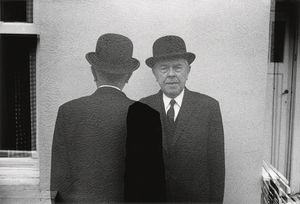
—Duane Michals
This slender book is really a joy to behold, and one can sense the photographer's excitement at meeting and collaborating with one of the most influential masters of surrealism.
More here.