disciplined down to his mismatched socks

19HOCKNEY-articleInline

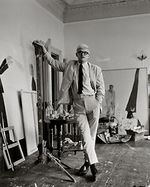
Unlike Warhol, whom he befriended early on, Hockney openly explored the nature of gay love in his work and declined to hide behind a stockade of soup cans. Yet his assaults on convention always seemed free of provocation or menace. With his mop of bleached hair and large, goggle-like glasses, he has cultivated a personal style that might suit the host of a children’s television show. Now 75 and residing in his native Yorkshire, Hockney is still inclined to appear in public in mismatched socks, bright red ties and stripes that go in every direction. Well read, gregarious and intensely inquisitive, he has the sort of innate cheerfulness that is widely regarded as a professional liability if not a disqualification for a major career in art. His childhood, as portrayed by Sykes, was a spartan working-class affair overshadowed by war and shortages and his family’s eccentric politics. Sykes opens his book in August 1940, when 3-year-old David huddles with his parents beneath a staircase in their home as sirens blare and German bombs whistle through the night.

more from Deborah Solomon at the NY Times here.

A new form of encryption allows you to compute with data you cannot read

Brian Hayes in American Scientist:

Alice hands bob a locked suitcase and asks him to count the money inside. “Sure,” Bob
says. “Give me the key.” Alice shakes her head; she has known Bob for many years, but she’s just not a trusting person. Bob lifts the suitcase to judge its weight, rocks it ScreenHunter_34 Aug. 18 15.05back and forth and listens as the contents shift inside; but all this reveals very little. “It can’t be done,” he says. “I can’t count what I can’t see.”

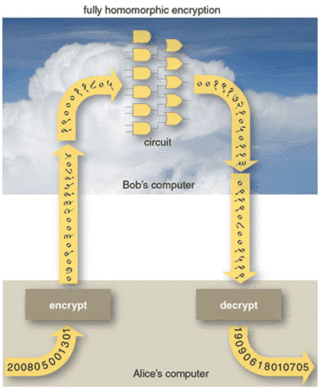
Alice and Bob, fondly known as the first couple of cryptography, are really more interested in computational suitcases than physical ones. Suppose Alice gives Bob a securely encrypted computer file and asks him to sum a list of numbers she has put inside. Without the decryption key, this task also seems impossible. The encrypted file is just as opaque and impenetrable as the locked suitcase. “Can’t be done,” Bob concludes again.

But Bob is wrong. Because Alice has chosen a very special encryption scheme, Bob can carry out her request. He can compute with data he can’t inspect. The numbers in the file remain encrypted at all times, so Bob cannot learn anything about them. Nevertheless, he can run computer programs on the encrypted data, performing operations such as summation. The output of the programs is also encrypted; Bob can’t read it. But when he gives the results back to Alice, she can extract the answer with her decryption key.

The technique that makes this magic trick possible is called fully homomorphic encryption, or FHE. It’s not exactly a new idea, but for many years it was viewed as a fantasy that would never come true. That changed in 2009, with a breakthrough discovery by Craig Gentry, who was then a graduate student at Stanford University.

More here.

Confessions of a Ramadan Rookie

Rollo Romig in The New Yorker:

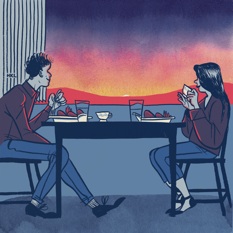
RamadanThe reason I haven’t been eating lunch is that I’m fasting for Ramadan, which is what you’re supposed to do when you’re a Muslim, which I became nearly four years ago, not long before I was married. It’s true that I likely never would have converted if my wife wasn’t Muslim, but that doesn’t mean that my conversion was merely symbolic. I wanted to join her life and her family, and since being Muslim is so central to who they are, that meant joining Islam. Over the previous decade, my own, vaguely Irish-American family had gradually drifted from being very Catholic to not being Catholic at all, so I had nothing to turn away from. I was open to wherever love took me.

Technically, becoming a Muslim takes about as long as ordering a Swiss-cheese sandwich. All that’s required is to recite the brief Islamic creed—there is no god but God, and Muhammad is His prophet—with genuine intention. But adopting a new religion doesn’t happen in a moment. I figured I’d start by focussing on practice. You’ve heard people describe themselves as spiritual but not religious. For me, it’s the opposite: I’ve never felt even a twinge of the supernatural, but I like many of the rituals and traditions of religions. In Islam, there’s lots to do—scripture to memorize, prayers to perform, charity to disburse, a pilgrimage to take—and, during Ramadan especially, lots not to do. I would begin by quite literally going through the motions, and in going through them find out what they meant to me.

More here.

First evidence for photosynthesis in insects

Kathryn Lougheed in Nature:

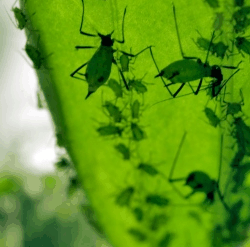
ScreenHunter_33 Aug. 18 14.11The biology of aphids is bizarre: they can be born pregnant and males sometimes lack mouths, causing them to die not long after mating. In an addition to their list of anomalies, work published this week indicates that they may also capture sunlight and use the energy for metabolic purposes.

Aphids are unique among animals in their ability to synthesize pigments called carotenoids. Many creatures rely on these pigments for a variety of functions, such as maintaining a healthy immune system and making certain vitamins, but all other animals must obtain them through their diet. Entomologist Alain Robichon at the SophiaAgrobiotech Institute in Sophia Antipolis, France,and his colleagues suggest that, in aphids, these pigments can absorb energy from the Sun and transfer it to the cellular machinery involved in energy production1.

Although unprecedented in animals, this capability is common in other kingdoms. Plants and algae, as well as certain fungi and bacteria, also synthesize carotenoids, and in all of these organisms the pigments form part of the photosynthetic machinery.

More here.

Hemingway, Urdu, Doughnuts

From The Paris Review:

  • Ernest Hemingway’s World War II spying career was less than illustrious. In fact, when it came to one ill-fated Cuban operation, Papa was downright bumbling.
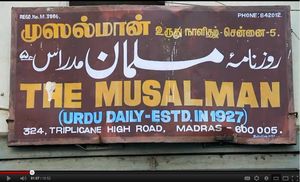
  • The-MusalmanMeet The Musalman, a handwritten Urdu daily that has been published continuously since 1927 in Chennai, India.
  • “It hurts to be rejected, and it hurts even more when you walk into a real bookstore, one with chirpy sales clerks and splashy book covers, and see truly godawful books by authors represented by some of these very same agents.” Michael Borne on how to weather the agent-finding process.
  • Generation Y (those born between 1979 and 1989) outspent Boomers in books for the first time last year.
  • Check out Electric Literature’s Single Sentence Animations—in which an artist animates a favorite sentence from a writer’s story—here.
  • Dough Country for Old Men (subtitle: “As I Lay Frying”) is a blog that juxtaposes literary quotes against images of doughnuts.

More here. (Note: Urdu lovers, take a few minutes to watch the accompanying evocative video about The Musalman)

Imran Khan Must Be Doing Something Right

Pankaj Mishra in The New York Times:
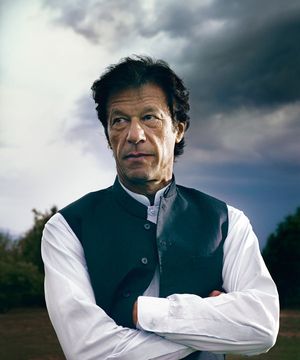
KhanOn a cool evening in March, Imran Khan, followed by his dogs, walked around the extensive lawns of his estate, sniffling with an incipient cold. “My ex-wife, Jemima, designed the house — it is really paradise for me,” Khan said of the villa, which sprawls on a ridge overlooking Himalayan foothills and Pakistan’s capital, Islamabad. “My greatest regret is that she is not here to enjoy it,” he added, unexpectedly poignantly. We walked through the living room and then sat in his dimly lighted bedroom, the voices of servants echoing in the empty house, the mournful azans drifting up from multiple mosques in the city below. Khan, once Pakistan’s greatest sportsman and now its most popular politician since Benazir Bhutto, exuded an Olympian solitude that evening; it had been a long day, he explained, of meetings with his party’s senior leaders. The previous two months, he said, had been the most difficult in his life. His party was expanding amazingly fast and attracting “electables” — experienced men from the governing and main opposition parties. But the young people who constituted his base wanted change; they did not want to see old political faces. “I was being pulled apart in different directions,” Khan said. “I thought I was going mad.” Khan’s granitic handsomeness, which first glamorized international cricket and has sustained the British media’s long fascination with his public and private lives, is now, as he nears 60, a bit craggy. There are lines and dark patches around his eyes. The stylishly barbered hair, thinning at the top, is flecked with gray, and his unmodulated baritone, ubiquitous across Pakistan’s TV channels, can sound irritably didactic. “The public contact is never easy for me,” he said. “I am basically a private person.” The moment of melancholy confession passed. Leaning forward in the dark, his hands chopping the air for emphasis, Khan unleashed a flood of strong, often angrily righteous, opinions about secularism, Islam, women’s rights and Salman Rushdie.

That month he had canceled his participation at a conference in New Delhi where Rushdie was expected, citing the offense caused by “The Satanic Verses” to Muslims worldwide. Rushdie, in turn, suggested Khan was a “dictator in waiting,” comparing his looks with those of Libya’s former dictator, Col. Muammar el-Qaddafi. “What is he talking about? What is he talking about?” Khan started, “I always hated his writing. He always sees the ugly side of things. He is — what is the word Jews use? — a ‘self-hating’ Muslim. “Why can’t the West understand? When I first went to England, I was shocked to see the depiction of Christianity in Monty Python’s ‘Life of Brian.’ This is their way. But for us Muslims, the holy Koran and the prophet, peace be upon him, are sacred. Why can’t the West accept that we have different ways of looking at our religions? “Anyway,” Khan said in a calmer voice, “I am called an Islamic fundamentalist by Rushdie. My critics in Pakistan say I am a Zionist agent. I must be doing something right.”

More here.

Saturday Poem

A Matter of Some Regret

No, I’m not so depressed
As to stay
Under the duvet
All day
That would be an exaggeration

It’s just that
My eye
Gladdened at the sight of you,
Stranger,
Left behind
Last night

And this morning
There’s a taste of stout
And regret
In my mouth.
.

by Ailbhe Ní Ghearbhuigh
from Péacadh
publisher: Coiscéim, Dublin, 2008
translation: 2008, Gabriel Rosenstock

Friday, August 17, 2012

Gaza: Life Under Lockdown

Jamal Mahjoub in Guernica:

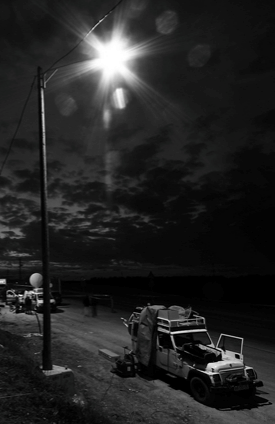
ScreenHunter_31 Aug. 17 17.36On each occasion when I have travelled to Palestine, an element of uncertainty has hung over the whole venture. As we travel on towards Gaza City, night falls over a landscape that appears eerily normal. And why shouldn’t it? We had crossed a line in the sand. The scruffy mix of fields and gray block houses could be located anywhere in Egypt. The occasional row of date palms or narrow grove of olive trees hint at the rural idyll that foundered in the not-too-distant past. The first reminder that we are not in Egypt comes with the gas stations that are flagged early by queues of vehicles tailing back along the road, three cars wide. Since 2008 there has been an almost complete ban on fuel imports. Sporadic and unpredictable supplies explain the queues and the power cuts, some of which last up to twelve hours.

What is striking about the Gaza Strip is the lack of a visible military presence. In the West Bank at checkpoints and crossings, Israeli Defense Force soldiers in green fatigues strut about with their automatic rifles at the ready. They are young, some of them in their teens, and they sling their weapons over their shoulders like guitars as they demand papers and issue orders.

More here.

Salman Rushdie: rereading The Remains of the Day by Kazuo Ishiguro

Salman Rushdie in The Guardian:

ScreenHunter_27 Aug. 17 16.19The surface of The Remains of the Day is almost perfectly still. Stevens, a butler well past his prime, is on a week's motoring holiday in the West Country. He tootles around, taking in the sights and encountering a series of green-and-pleasant country folk who seem to have escaped from one of those English films of the 1950s in which the lower orders doff their caps and behave with respect towards a gent with properly creased trousers and flattened vowels. It is, in fact, July 1956 – the month in which Nasser's nationalisation of the Suez Canal triggered the Suez Crisis – but such contemporaneities barely impinge upon the text. (Ishiguro's first novel, A Pale View of Hills, was set in post-war Nagasaki but never mentioned the bomb. The Remains of the Day ignores Suez, even though that débâcle marked the end of the kind of Britain whose passing is a central subject of the novel.)

Nothing much happens. The high point of Mr Stevens's little outing is his visit to Miss Kenton, the former housekeeper at Darlington Hall, the great house to which Stevens is still attached as “part of the package”, even though ownership has passed from Lord Darlington to a jovial American named Farraday who has a disconcerting tendency to banter. Stevens hopes to persuade Miss Kenton to return to the hall. His hopes come to nothing. He makes his way home. Tiny events; but why, then, is the ageing manservant to be found, near the end of his holiday, weeping before a complete stranger on the pier at Weymouth? Why, when the stranger tells him that he ought to put his feet up and enjoy the evening of his life, is it so hard for Stevens to accept such sensible, if banal, advice? What has blighted the remains of his day?

More here.

The Generation Game

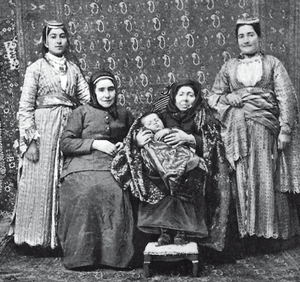
300px-Lynch_Armenia_Five_generationsJohn Quiggin in Crooked Timber (image from Wikimedia Commons):

One of the standard ploys in journalism, marketing and political commentary is the generation game. The basic idea is to label a generation ‘X’ or ‘Y’, then dissect its attitudes, culture, and relationship with other generations. The most famous generation, of course, is that of the Baby Boomers, born between the end of World War II and the early 1960s, and their most enduring contribution to the generation gap is the ‘Generation Gap’ between children and their parents.

The generation game is played with particular vigour in cultural commentary, but its reach seems to be extending all the time. No US Presidential election would now be complete without voluminous commentary on the generational backgrounds of the contenders. There is even a branch of economics called generational accounting, which is supposed to show whether one generation is subsidising another through the tax and welfare system.

At first sight, discussion of this kind can carry with it an air of fresh insight, but most of it stales rapidly. Much of what passes for discussion about the merits or otherwise of particular generations is little more than a repetition of unchanging formulas about different age groups Ð the moral degeneration of the young, the rigidity and hypocrisy of the old, and so on.

Demographers have a word (or rather two words) for this. They distinguish between age effects and cohort effects. The group of people born in a given period, say a year or a decade, is called a cohort. Members of a cohort have things in common because they have shared common experiences through their lives. But, at any given point in time, when members of the cohort are at some particular age, they share things in common with the experience of earlier and later generations when they were at the same age.

Healing Spirits

HealingDaniel Mason in Lapham's Quarterly:

In his 1943 study of the psychology of medicine men, historian Erwin Ackerknecht surveyed a vast anthropological literature and distinguished between two patterns of initiation into the healing arts. For one group, medical knowledge was obtained through carefully practiced ritual, induced by fasting, drugs, or ceremonies invoking spirits who could lead the healer to a cure. For the second, Ackerknecht cited Russian travelers to Siberia, who had reported rituals among the Yakuts that were anything but methodical:

He who is to become a shaman begins to rage like a raving madman. He suddenly utters incoherent words, falls unconscious, runs through the forests, lives on the bark of trees, throws himself into fire and water, lays hold on weapons and wounds himself, in such ways that his family is obliged to keep watch on him.

Despite the ubiquity of the word shaman today, its diffusion is recent. It comes from saman, from the Tungus—known today as the Evenk—people of Siberia, and the first outsiders to take detailed note were exiled Russian intellectuals. After a trickle of reports in the late nineteenth century, shamanism arrived in the West in two principal waves: during the Russo-American cooperation in the 1897-1902 Jesup North Pacific Expedition, and later, in more popular works, describing convulsive “pre-shamanic psychosis” as a disease unique to the North Asian steppes. From then, the word proved infectious, acquiring the hazy meaning of any healer who works by mysterious means. Seeking a definition for his monumental survey, Shamanism, the historian of religion Mircea Eliade worried over these loose boundaries between medicine man, sorcerer, medium, physician. At the same time, he felt there was an essence—an archaic “technique of ecstasy”—that could be found in a spectrum of practices from around the world.

Twenty Minutes with Martin Amis

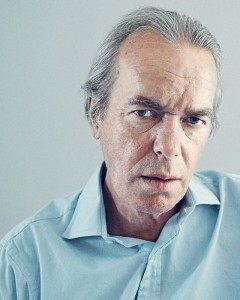
Ronald K. Fried interviews the writer in Tottenville Review:Amis120730_1_560-240x300

INTERVIEWER

Critics have questioned your choice—or your right, really—to write about what used to be called the underclass. But isn’t that what urban novelists have always done—from Balzac through Dickens and Bellow? Is there something censorious about this criticism?

MARTIN AMIS

Not only censorious, I think self-righteous is a better word. I think it’s also primitive and illiterate. Writers have always had this freedom. I’ve been doing that for forty years without being challenged once on it. So I just think it was a new touchiness and also the search for self-righteousness.

INTERVIEWER

Is it a species of political correctness—telling the novelist what he can and cannot write about?

MARTIN AMIS

I don’t know. It’s weird isn’t it? Because you’d think that what we call political correctness had peaked some time ago, and to get this now, it’s very odd. Particularly since I’ve been doing it for so longand during that high noon of PCwithout it coming up. My slogan is writing is freedom and to hell with everything else.

INTERVIEWER

Lionel Asbo follows The Pregnant Widow, which had autobiographical elements, while the new novel describes characters who are more outside your immediate experience. Does this require a different part of your imagination—a different set of muscles?

MARTIN AMIS

Well, The Pregnant Widow started life as an autobiographical novel and I wasted a lot of time trying to do it and it was just completely dead. And it was illuminating in a way. I realized that what gives a novel life is not verisimilitude or truth to life. On the contrary, only very few novelists have been able to write from their own lives, Saul Bellow being the towering example. But most of us can’t do it that way. Bellow found a way of being universal in writing about things quite close to his own life, whereas we have to search for universality by a different route.

Remembering Nusrat 15 Years Later

NFAK3_20120816

Hiromi Lorraine Sakata in Outlook India:

Many of us in the Northwest feel a certain privileged connection with Nusrat Fateh Ali Khan because of his six-month residency at the University of Washington Ethnomusicology Program from September 1992 to March 1993. Students and staff from across campus registered for his classes, and others from off-campus and even out-of-state came to register for his classes through University Extension, just for the chance to sit with him in small groups to learn qawwali.

Those were heady days for many of us in Seattle, when Nusrat could be seen walking around the block in his Adidas athletic clothes, at a public swimming pool with some of his students, riding one of the Washington State ferries, or shopping at a local Pakistani-Indian grocery store where surprised customers recognized him, spoke to him, and sent him gifts of halaal lamb, rice, etc. His 5-bedroom home in Lake City was always full of friends, students, family, musicians, fans and promoters. Nusrat enjoyed his relative anonymity in Seattle which permitted him to do what he could never dream of doing in Pakistan.

Nusrat’s decision to accept his teaching position at the University of Washington was not an easy one to make. On the negative side was the fact that the position was for Nusrat alone, not for his entire qawwali party. The livelihood of approximately 100 people (families of his ensemble) depended on the performances of Nusrat Fateh Ali Khan and his Party. How could he take six months out of his full performance schedule and still help the members of his ensemble maintain their livelihood? On the positive side was the full health care benefits provided to full-time faculty members. Even his ensemble members could see that Nusrat needed the time to seek special medical attention at a top-rated medical facility.

More here. [Thanks to Raghu Desikan.]

These rainbow colored transparent ants are what they eat

From Smithsonian:

Surprising-Science-multicolor-ants-2Not long ago, Dr. Mohamed Babu, of Mysore, South India, noticed something strange about the ants scurrying around on the floor of his kitchen: After drinking some spilled milk, their abdomens turned white. Realizing the insects’ bodies were transparent, he got an idea for a stunning set of photographs, he told the Daily Mail.

Mixing different varieties of food coloring along with sugar, water and a waxy base, he set out small droplets of liquid on a white plastic sheet outside in his garden and let the ants do the rest. “As the ant’s abdomen is semi-transparent, the ants gain the colors as they sip the liquid,” he said.

More here.

A book complete with illustrations has been encoded in DNA

From Nature:

BookA trio of researchers has encoded a draft of a whole book into DNA. The 5.27-megabit tome contains 53,246 words, 11 JPG image files and a JavaScript program, making it the largest piece of non-biological data ever stored in this way. DNA has the potential to store huge amounts of information. In theory, two bits of data can be incorporated per nucleotide — the single base unit of a DNA string — so each gram of the double-stranded molecule could store 455 exabytes of data (1 exabyte is 1018 bytes). Such dense packing outstrips inorganic data-storage devices such as flash memory, hard disks or even storage based on quantum-computing methods. The book, which is fittingly a treatise on synthetic biology, was encoded by geneticists George Church and Sriram Kosuri at the Wyss Institute for Biologically Inspired Engineering in Boston, Massachusetts, and Yuan Gao, a biomedical engineer at Johns Hopkins University in Baltimore, Maryland. They report their work in Science1 this week.

It marks a significant gain on previous projects — the largest of which encoded less than one-six-hundredth of the data — but organic flash drives are still many years away. There are a number of reasons why the method is not practical for everyday use. For example, both storing and retrieving information currently require several days of lab work, spent either synthesizing DNA from scratch or sequencing it to read the data. The work illustrates the potential of nonconventional approaches, says Stuart Parkin, who is developing dense forms of inorganic storage media at the IBM-Stanford Spintronic Science and Applications Center in San Jose, California. “You could say that the physical sciences have exhausted the playground of concepts, and we now need to go beyond that world,” he says. “This coupling of the biological world to the physical world will lead to some very interesting storage devices in the next decade.”

More here.

Friday Poem

What of the animal that kills itself,
How long may it reign?
— Anon

Trouble Spot: General Post Office, 1986

Here, father, is this where it started?
Here we became strangers to each other?
Was it here?

You thought most of what we said was nonsense –
Even when we agreed with you:
Inheritors of the event who never knew the smell
Of gunpowder, or of terror,
Who never fired a shot in anger,
Worse yet,
Never stood up to one . . .

We retreated from you into the Pale of Irish;
That was our familiar terre guerre,
And the Ulsterman
In you
Could not follow our tracks
Or tame our barbarism –
Spenser’s civilitie
Had beguiled you.

We took after our mother’s tribe:
The high-blown ways of Munster;
You were the recalcitrant old badger
Run to ground by howling spaniels.

In later years, we tried again;
You learned to be charitable,
But we still had to tread carefully;
Your intelligence and sense of justice
Never practised deception;
I am the same age as the state
And neither turned out as you wished . . .

In this place, father, you are the unknown
Youth who went missing –
Neglect and awkwardness hide the key from my mind –
But I hear now the Northern accent
Of the elder man I loved with hard devotion:
Do you remember the rebuke you delivered
Before it became fashionable?
You spoke thus:

I see no cause for rejoicing
That Irishmen once again
Are killing other Irishmen
On the streets of Belfast.
.
.
by Máire Mhac an tSaoi
from The Miraculous Parish / An Paróiste Míorúilteach
O'Brien Press / Cló Iar-Chonnacht, Dublin, 2011
© Translation: 2011, Louis de Paor

Thursday, August 16, 2012

walking

Thorpe_287529h

If walks are themselves narratives, then their literature has to beguile the reader with an illusion of grounded actuality, of honest movement through space and time, or it loses us. Pain is part of the story, as it was (and still is) for pilgrims: in the “porcelain snow” of Tibet near the sacred mountain of Minya Konka, an altitude-sick Macfarlane follows routes sacred for thousands of years, where worshippers have performed the kora – body-length prostrations – “for thirty-two miles of tough rocky path, over the 18,000-foot Drolma pass”. Macfarlane’s own account of “pedestrian life at 15,000 feet” – all “ragged breathing” and cold felt in the bone – may not match the rigours of the polar explorer Apsley Cherry-Garrard’s masterpiece The Worst Journey in the World (1922), the most extraordinary and compellingly written slog of them all, but it makes the pilgrims’ efforts seem yet more remarkable.

more from Adam Thorpe at the TLS here.

As beauty seeks for wisdom in retreat

Aoh_x_apol_pirithous-150x150

In sculpture, the inert becomes animate, or if not actually animate, certainly worked through by mind, infused with life, meaning and finality by mind. Although Aristotle’s example is of a sculptor working in bronze, maybe the paradigm sculptural case is the worker in stone. The typical sculptural instruments are chisel, hammer, knife, capable both of strength, necessarily so, but also delicacy. Aristotle would, of course, have known this well enough. Greek temples were virtual repositories of stone sculpture, both inside, with colossal statues of Athene, Zeus and other gods, and outside, as part of the architecture. And there were, of course, the kouroi, those astonishing marble figures, often life-sized, their faces and figures human in a way Egyptian sculpture is not, but without the illusionistic smoothness and softness of Hellenistic sculpture.

more from Anthony O’Hear at the Fortnightly Review here.