Weird Parents, Normal Children

Clancy Martin in Harper:
Parents-Dec1900-400x400In 1994, when my eldest daughter was born, “Ferber-izing” (after Dr. Richard Ferber, a pediatrician who specializes in child sleep disorders) was all the rage. The idea was that very small children, indeed newborn babies, should learn to sleep in their own beds: they’d cry themselves to sleep for a few nights, so the theory went, and then they’d get used to it. I learned from Diamond that this practice was common in Germany for many years:

The magic words for German parents were that children should acquire Selbstständigkeit (meaning, approximately, “self-reliance”) and Ordnungsliebe (literally, “love of order,” including self-control and complying with the wishes of others) as quickly as possible. German parents considered American children spoiled, because American parents attended too quickly to a child’s crying.

My wife and I tried this once. I remember the night. She asked me to leave the house — I couldn’t take the screaming. When I came back, an hour later, our daughter was asleep in bed next to her, her infant mouth still attached to her mother’s breast. She “co-slept” with us — despite the strong moral disapproval of many of our friends, who thought we were coddling her and interfering with her independence — for years afterward.

When my next daughter was born, Ferberizing was still around, and my second wife, too, thought that our new baby would learn independence from crying herself to sleep. Then she changed her mind and decided that both of our daughters (a second quickly followed the first) would be allowed to sleep in bed with us for as long as they liked. All three of my daughters are what Diamond calls WEIRD children: children of a Western, educated, industrial, rich, democratic society. Here, according to Diamond, is how they’re probably being raised:

We follow the rabbit-antelope pattern: the mother or someone else occasionally picks up and holds the infant in order to feed or play with it, but does not carry the infant constantly; the infant spends much or most of the time during the day in a crib or playpen; and at night the infant sleeps by itself, usually in a separate room from the parents.

Ha! I wish. During the first two years of my daughters’ lives, it was an open question whether or not the girls could walk. In fact, my eldest never crawled at all, because she had developed the more efficient practice of sitting and yelling until she was picked up and carried to wherever she wanted to go. Both of my younger daughters, now ages six and eight, still regularly demand to be carried when they are tired of walking. A friend of mine, a tattoo artist, often has his girls with him in his studio all day long, surrounded by the instruments of his craft — precisely the sorts of “dangerous tools” Diamond believes only the children of hunter-gatherer societies are exposed to. The same problem extends to Diamond’s overgeneralizations about how Western parents discipline and educate their children. He has done a fascinating job of studying how hunter-gatherer societies raise their children, but he doesn’t seem to have spent enough time observing how contemporary Westerners actually raise their children. It’s probably true that most of us wish our children would spend hours “playing with their plastic ready-made store-bought toys,” but the fact is that they don’t. They unwrap the damn things at Christmas, and within an hour they’re having more fun jumping on the bubble wrap than flying the $50 remote-control helicopter.

What I’m suggesting is that the difference between “their kids and our kids” is much smaller than Diamond argues, or perhaps that we would like to pretend. Even violent disciplinarians like my stepfather — the exception, not the rule, in our society — are found among hunter-gatherers: Diamond tells the frightening story of a mother who beats her child until, still unsatisfied by her tears, she rubs her face with stinging nettles. I do see one key difference between how we parent in the West and in the societies Diamond describes: We WEIRD parents of WEIRD children worry far more about whether or not we’re parenting properly. We lie about how we parent or don’t parent; we’re hypocrites and judge other parents for not doing what we ourselves don’t do (or for doing what we ourselves also do). We spend millions of dollars on books, toys, manuals, tutors, and videos for our own and our children’s entertainment and education, and still we are freaked out about whether or not we are doing it properly. First “helicoptering” is necessary in the terrifying contemporary world, then it’s morally blameworthy; first laissez-faire parenting is the new way, then it’s for irresponsible slackers. We parent with “love and logic,” or whatever the latest bestseller prescribes. “The lessons from all those experiments in child-rearing that lasted for such a long time,” Diamond writes, “are worth considering seriously.” But we don’t have to consider them; most of us are already practicing them. From the time they’re newborns, your kids are pretty clear about their needs, about what serves their flourishing and what interferes with it — and most of us, whether we admit it or not, get with the program quickly enough, just as I and both my wives did in the face of the popular moral conviction that the Ferber method was how all good parents would teach their newborns to sleep alone.

You new parents: your child-rearing instincts are the product of hundreds of thousands of years of evolutionary programming. The one way you’ll mess it up is by overthinking it.

More here.

Punish trafficker, safeguard prostitute

Ruchira Gupta in The Telegraph:

AshIndia is on the brink of a paradigm shift in its legal framework to deal with human trafficking based on the Justice Verma Committee recommendations set up after the December 16 rape in Delhi. Through the current Criminal Law (Amendment) Ordinance, 2013 and the proposed changes to the Criminal Law (Amendment) Bill and the Immoral Traffic Prevention Act, 1956, India has finally broadened the definition of trafficking to include all forms of enslavement — from servitude to prostitution. These amendments will bring India on a par with the UN Protocol to End Trafficking in Persons, Especially Women and Children. The trafficking definition legally explains exploitation, the exploiter and the exploited for the first time in India’s Independent history. Exploitation is defined as forced labour or services, slavery or practices similar to slavery, servitude, the forced removal of organs and prostitution or other forms of sexual exploitation.

…These recommendations pave the way for our country to create a contemporary, democratic society where women and girls can live lives free of male violence. It addresses both the urgency of the crisis in India, where 17 women are raped “officially” everyday, and hopefully sets the stage for legislation that will recognise that any society that claims to defend principles of legal, political, economic and social equality for women and girls must reject the idea that women and children, mostly girls, are commodities that can be bought, sold and sexually exploited by men. To do otherwise is to allow that a separate class of female human beings, especially women and girls who are economically and caste-wise marginalised, is excluded from measures being set in place for women’s security. As well as from the universal protection of human dignity enshrined in our Constitution and the body of international human rights instruments developed during the past 60 years.

More here. (Note: Dear friend Ruchira Gupta is the founder president of Apne Aap Women Worldwide, a grassroots movement to end sex trafficking.)

Sunday Poem

Shahid Reads His Own Palm
I come from the cracked hands of men who used the smoldering ends of blunts to blow shotguns,  men who arranged their lives around the mystery of the moon breaking a street corner in half.  I come from "Swann Road" written in a child's slanted block letters across a playground fence,  the orange globe with black stripes in Bishop's left hand, untethered and rolling to the sideline,  a crowd openmouthed, waiting to see the end of the sweetest crossover in a Virginia state pen.  I come from Friday night's humid and musty air, Junk Yard Band cranking in a stolen Bonneville,  a tilted bottle of Wild Irish Rose against my lips and King Hedley's secret written in the lines of my palm.  I come from beneath a cloud of white smoke, a lit pipe and the way glass heats rocks into a piece of heaven,  from the weight of nothing in my palm, a bullet in an unfired snub-nosed revolver.  And every day the small muscles in my finger threaten to pull a trigger, slight and curved like my woman's eyelashes.
.

by Reginald Dwayne Betts
from Shahid Reads His Own Palm
Alice James Books, 2010

Saturday, March 9, 2013

Books of Ice: Sculptures by Basia Irland

From Orion Magazine:

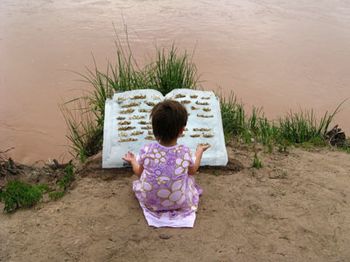
Ice is a seed. Book

Balls of ice sowed seeds of life on Earth. That’s what comets are, just clumps of ice holding interstellar rocks and dust. But in that dust are amino acids and nucleotides that build living things. Many scientists think that this might be one way life began on Earth, 4 billion years ago, when the spinning arms of the galaxy cast comets over the planet, comets and comets and comets, protolife smacking onto the broken lava plains, until basins gathered the meltwater into oceans, and the oceans nurtured onrushing life. Ice sows ice, too. The first grains gleamed in white sunshine, throwing back the sun’s heat and cooling their own small shadows. More ice formed in the cool places, and the shine of it cooled a larger shadow, until the reflectivity of the growing ice sheets cooled the whole planet, finally draped in dazzling layers of ice. Now the glaciers that remain in mountain valleys give life to rivers—the Ganges, the Fraser, the Colorado—as meltwater slides down blue rills and finally cuts a channel through gravel and till.

A seed is a book.

IceIn hot winds at the end of summer, mountain mahogany seeds unfurl. Each pod sprouts a few white feathers, loosely coiled. A feather-seed lofts over the ridge and drifts onto dirt. After a hard rain, the seed swells and uncoils, augering its hard head into the soil. There it plants all the instructions for making a mountain mahogany sapling, laid out in the language of DNA. A seed is a conveyance system for information. It is words taken wing—words written in the language of adenine, cytosine, guanine, thymine, ancient instructions clasped between hard covers, everything needed to carry a story to a new place where it can take root. Long before writers figured it out, seed-bearing plants had found a way to convey to the next generation wisdom accumulated over millions of years. A samara is wisdom with ailerons. A dryas seed is a set of instructions with hair as wild as Einstein’s. A dandelion seed is an epic on a parachute. A sandbur seed is a poem stuck to a sock. An elm seed is a prayer book: This way is life. This way is rootedness.

More here. (Note: Do take a few minutes to watch the stunning video)

Flip of a single molecular switch makes an old brain young

From Yale News:

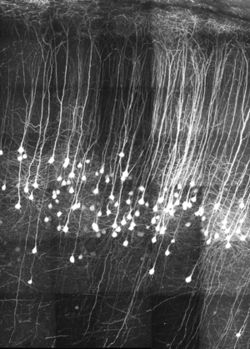
White-imageThe flip of a single molecular switch helps create the mature neuronal connections that allow the brain to bridge the gap between adolescent impressionability and adult stability. Now Yale School of Medicine researchers have reversed the process, recreating a youthful brain that facilitated both learning and healing in the adult mouse.

Scientists have long known that the young and old brains are very different. Adolescent brains are more malleable or plastic, which allows them to learn languages more quickly than adults and speeds recovery from brain injuries. The comparative rigidity of the adult brain results in part from the function of a single gene that slows the rapid change in synaptic connections between neurons. By monitoring the synapses in living mice over weeks and months, Yale researchers have identified the key genetic switch for brain maturation a study released March 6 in the journal Neuron. The Nogo Receptor 1 gene is required to suppress high levels of plasticity in the adolescent brain and create the relatively quiescent levels of plasticity in adulthood. In mice without this gene, juvenile levels of brain plasticity persist throughout adulthood. When researchers blocked the function of this gene in old mice, they reset the old brain to adolescent levels of plasticity. “These are the molecules the brain needs for the transition from adolescence to adulthood,” said Dr. Stephen Strittmatter. Vincent Coates Professor of Neurology, Professor of Neurobiology and senior author of the paper. “It suggests we can turn back the clock in the adult brain and recover from trauma the way kids recover.”

More here.

our common humanity and stuff

228c671c-b7ab-4c98-a633-40a5363aff7b

Now, The Undivided Past suggests, the only solidarity that is acceptable is solidarity with humankind: nothing less will do because anything more partial risks dividing us, and division means fisticuffs or worse. Yet is there not something ultimately quietist about writing off many of the conceptual vehicles that have previously allowed people to mobilise? Not all conflict, after all, is bad and justice sometimes may even require it. Behind Cannadine’s story of identities that need to be shrugged off is the interesting intellectual question of when we all got so hung up on this business of identity and started seeing it as something limiting rather than liberating. Nazism and fascism took the shine off nationalism for many European liberals. “Identity” began to be used in the contemporary sense sometime in the 1950s but it acquired a harder and more negative edge during the culture wars on British and American campuses. In an earlier book, Ornamentalism (2001), Cannadine criticised Edward Saïd’s influential account of Orientalism by claiming that in the British empire divisions of class trumped race. In The Undivided Past he seeks to do away with such categories completely, trumping them by an appeal to our common humanity.

more from Mark Mazower at the FT here.

He wasn’t a gangster anymore

600

When Whitey Bulger was arrested in Santa Monica late on the afternoon of June 22, 2011, it brought to an end one of the longest, and strangest, manhunts in U.S. history. Nearly 82, Bulger had spent 15 years hiding in plain sight in an apartment complex near the Pacific with longtime girlfriend Cathy Greig. In that time, he had literally reinvented himself: from a ruthless murderer and extortionist, who for more than a quarter century ruled South Boston, or Southie, to a grandfatherly figure, white-haired, bearded and nondescript. “We were looking for a gangster, and that was part of the problem,” explains former Boston police detective Charles Fleming in Kevin Cullen and Shelley Murphy’s “Whitey Bulger: America’s Most Wanted Gangster and the Manhunt That Brought Him to Justice,” a definitive account of Bulger’s life and the city that helped create him. “He wasn’t a gangster anymore.”

more from David L. Ulin at the LA Times here.

weird life

0310-Fortey-articleInline

We are used to thinking of life based upon the distinctive properties of carbon and water. It does not have to be like that, according to astrobiologists. Life probably requires solvents, and a way for complex molecules to be built up: a prerequisite for self-replication that is one of life’s essential features. However, out on Titan (a moon of Saturn) there is liquid methane in which life could arise and whole new biochemical pathways could be imagined. A National Research Council report concludes: “If life is an intrinsic property of chemical reactivity, life should exist on Titan.” ut why stop there? On Triton (a moon of Neptune), where temperatures are so low that gases liquefy, a metabolism based on strange silica compounds and liquid nitrogen has been posited. Or again, astrobiologists have proposed life in the clouds surrounding Venus, and based on sulfuric acid. Why not life around red dwarfs if one tweaks the elements in a different fashion?

more from Richard Fortey at the NY Times here.

Saturday Poem

The Next Superpower

On the much-publicised full moon
festive youths and families gorge

on overpriced moon-cakes
to celebrate mid-autumn. How

very poetic. Not all that far away
the plants’ wastes flow

to choke the Yangtze. I can’t
appreciate the taste of the cakes,

their severe sweetness. The Chinese
cherish the stuff. This, they say,

is a beloved tradition. I can’t
remember ever loving anything

resembling one. You can’t finish
yours, and stroll onto the balcony

to view the fireworks. I’m worried
about the colossal dam cracking

and the River devouring this stuffy,
miasmic city. Will nature

ever know what to do with
humans? Will humans surpass words

like “nature”, “river” and “moon”?
The cake, I’ve been told, grows

every year in price. China swells
every year in wealth and power. I’m

frankly terrified of an ecological
armageddon. You seem bored with

the festivities and utterly finished
with the West. We left Australia

for an ancient culture. How
perturbed we are to discern

this country’s gargantuan
industrialisation. I leer at the remnants

of the pungent cake. The West
has traded its soul for a few dollars. Will

China remember the Opium War or
keep eating the impossibly rich

sweets? Am I being simply
disrespectful? What

of it? Glaciers melt and, yes,
this autumn is hotter than summer. So

Capitalism won; the cadres swapped
their gray Mao-esque suits

for the latest Armani. Indeed
your ennui and my disenchantment

match. We’re in love, two ex-pats
struggling to finish our moon-cakes

in the furnace of “the next Shanghai”.
.
.

by Ali Alizadeh
from Eyes in Times of War
Salt Publishing, Cambridge, UK, 2006

Friday, March 8, 2013

Darkness Lit From Within: On A.B. Yehoshua

466px-Abraham_Jehoshua

Vivian Gornick in The Nation (image from Wikimedia Commons):

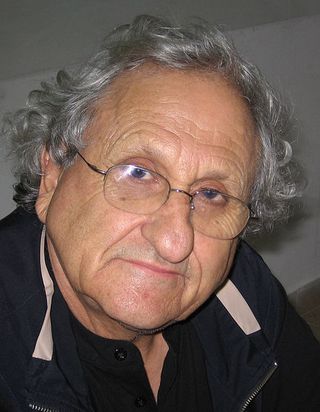
When I stumbled on the writing of A.B. Yehoshua, it was as though a fault line had opened in a hardened surface to expose me to an emotional insight that life on the Israeli street had denied me. Interestingly enough, I met the author before I read the work, and only later realized that it demonstrated beautifully the old chestnut about the best part of a writer residing in the work, not in the person. Yehoshua’s prose penetrated to a level of psychological understanding that moved me deeply, whereas he himself could have doubled for the bullying Israeli with whom I dealt daily.

I met him in Haifa, where he lives and teaches. A friend in New York had sent him a letter of introduction on my behalf, and one day when I was in the city, I called and was invited to come right over. He was sitting at his desk when I arrived: a man in his mid-40s with a bulky body, a powerful face and a mass of curly black hair. He looked up and said in a voice rising on a note of insinuation, “So why are you still living in the Diaspora? Why aren’t you living here where you belong?” I laughed. “You’re kidding,” I said. He told me that he most certainly was not kidding and went on to sketch a picture of my life in the States as one at risk in a Christian nation that, at any time, might turn on me; right now, at this very minute, I was standing on a narrow strip of beach with the sea at my back and the goyim, for all I knew, beginning to advance on me. The visit lasted an hour, during which I said little while Yehoshua harangued me.

When I got back to Tel Aviv, I bought a collection of his early stories and sat down in my rented apartment with its stone floors, shuttered balcony and long door handles to read the writing of this fiercest of old-fashioned Zionists. I began to read in mid-afternoon and continued straight through to the last page of the last story, whereupon I remained sitting with the book in my lap, staring into a room now shrouded in a darkness that, mysteriously, felt lit from within.

While Yehoshua’s conversation mimicked the national idiom, his writing was soaked in existential loneliness. The stories, all of them set in modern Israel, were uniformly tales of disconnect in marriage and friendship. At once timeless but of their Israeli moment, they were the work of a writer who, wanting to dive down into those psychic regions of loss and defeat common to all humanity, knew how to make metaphorical use of a sick, sweating man awakening in an empty flat in Tel Aviv on a hot summer morning sometime in the 1970s.

We’re All Bystanders to the Sandberg-Mayer Mommy Wars

A_3x-horizontal

Ann Friedman in The Cut (via Andrew Sullivan):

Many corporations now strive for a veneer of family friendliness, so it’s not likely a woman will get the stink-eye for leaving early to catch her kid’s soccer game. Which is a feminist victory. But if a childless employee cops to the fact that she’s ducking out for a yoga class? It’s seen as downright indulgent and may even show up on a performance review. In interviews, Mayer has suggested that the professionally ambitious woman pick one thing — one thing! — that helps them unwind, and do it every week. (In other words, it’s okay to go to yoga, but only yoga.) I want all working women to have opportunities — and all working men to have life balance, too — but have caught myself thinking, why is it easier to ask me to work during my three-day weekend than it is to demand my co-worker check e-mail while on vacation with her kids? “Work-life balance” has become synonymous with “upper-class working moms,” and that’s a problem for everyone.

Systemic solutions like more flexible family-leave policies and subsidized childcare would be game-changers for mommy warriors. But, ironically, when such policy solutions are on the table, the people on the front lines agitating for them aren’t professional-track mothers. They’re usually low-wage workers of all genders. Case in point: New York City Council Speaker and mayoral hopeful Christine Quinn is single-handedly blocking a bill that would ensure paid sick days for all workers in the city. This news item, which should be at the heart of the work-life balance conversation, has rarely been noted as we huff and puff about Sandberg’s circles and Mayer’s nursery. “While we all worry about the glass ceiling, there are millions of women standing in the basement,” British feminist Laurie Penny once wrote, “and the basement is flooding.” Have you read much about the domestic workers’ strike in California, much less participated in a Twitter debate about it? Me neither. The “mommy wars” is like a discourse borg that manages to absorb and distort all conversations about women and work.

Giving Women in Academia Genuine Equal Opportunities

386px-Frauentag_1914_Heraus_mit_dem_Frauenwahlrecht

For this International Women's Day, Ingrid Robeyns in Crooked Timber (image from Wikimedia Commons):

I want to use this occasion to share some thoughts about how to given women in academia a fair chance. I’m not talking about affirmative action or quota, but rather making both the environment more welcoming to women, the formal practices fairer to women, and the informal practices such that they are less disadvantageous for women. The reason why these things need to be discussed is that I increasingly encounter academics (mostly men, I fear) who think that there are no further issues with the environment/procedures/practices, and who believe that in reality women now get better chances in academia than men. While there may be isolated cases of such favorable treatment of women, my judgement of the situation is that all things considered many women are still in many (subtle and not-so-subtle) ways disadvantaged, and that unfortunately many academics do not understand how the practices in academia are disadvantaging women. So, let us look at some of these factors, and ask what each of us can do to give women an equal chance in academia.

Implicit bias
In many situations the causes of women’s unequal chances are small and not visible to those not trained to diagnose the situation. One cause is the effects of implicit bias, which implies that if a piece of work is being done by women, it will be judged of lower quality than exactly the same piece of work done by me, due to non-conscious associations we hold. Or, a certain skill, capacity or personality trait will be judged positively if we see it in a man, and less positively or even negatively if it’s a trait of a woman. A typical case is being assertive, which is in men seen as a sign of leadership, but in women quickly interpreted as being aggressive. Implicit bias is often at work in how we judge CV’s and publication list: a woman with a strong publication list will be seen as ‘promising’, a man will be seen as ‘excellent’. These differences in evaluation are documented in studies on implicit bias, but many colleagues (from various universities and fields) who know about implicit bias, have seen it work in evaluative situations (like hiring committees) in which the work and capacities of men and women were evaluated.

a history of debt

Graeber_460w

Historically, as we have seen, ages of virtual, credit money have also involved creating some sort of overarching institutions – Mesopotamian sacred kingship, Mosaic jubilees, Sharia or Canon Law – that place some sort of controls on the potentially catastrophic social consequences of debt. Almost invariably, they involve institutions (usually not strictly coincident to the state, usually larger) to protect debtors. So far the movement this time has been the other way around: starting with the ’80s we have begun to see the creation of the first effective planetary administrative system, operating through the IMF, World Bank, corporations and other financial institutions, largely in order to protect the interests of creditors. However, this apparatus was very quickly thrown into crisis, first by the very rapid development of global social movements (the alter-globalisation movement), which effectively destroyed the moral authority of institutions like the IMF and left many of them very close to bankrupt, and now by the current banking crisis and global economic collapse. While the new age of virtual money has only just begun and the long-term consequences are as yet entirely unclear, we can already say one or two things. The first is that a movement towards virtual money is not in itself, necessarily, an insidious effect of capitalism. In fact, it might well mean exactly the opposite.

more from David Graeber at Eurozine here.

more than clever

123

In the early 20th century, incipient Modernists, most notably T.S. Eliot, found new layers of value in Donne. His perceived cool intellectualism seemed fresh and vigorous to poets grown weary of Romanticism’s emotionalism and emphasis on the self. Donne soon became a favorite of the New Critics as well. That school’s emphasis on reading poems as autonomous systems—discounting extra-textual considerations such as the author’s intentions and historical situation—was well suited to Donne’s poetry; his intentions are difficult or impossible to determine, and each poem he wrote seemed designed to function as, to use a phrase from one of Donne’s Holy Sonnets, “a little world made cunningly.” Donne’s poems in general, and “A Valediction: of Weeping” in particular, are certainly cunning. But it would be a mistake to think of them as nothing more than exercises in cleverness.

more from Joel Brouwer at Poetry here.

Koolhaas in china

1362587153cctvbeijing4

Subtending Koolhaas’s decision to build in Beijing was a feeling of disgust with mass culture and free-market capitalism that came to a head in the early aughts. In 2002, the same year he won the commission for the CCTV complex, he published an essay called “Junkspace.” It takes the form of an obsessive list of definitions, in the vein of Susan Sontag’s “Notes on ‘Camp.’” Junkspace, narrowly defined, is the opposite of what Koolhaas means by architecture. Lacking substance and form, “it is subsystems only, without superstructure, orphaned particles in search of framework or pattern.” But junkspace is not a technical term. It fuses with Koolhaas’s anxieties about suburbanization, Americanization, malls, air conditioning, casual Fridays, and vast cultural leveling to become something more symbolically vivid. Junkspace is “kindergarten grotesque,” “mini-Starbucks on interior plazas”; it “is like being condemned to a perpetual Jacuzzi with millions of your best friends.” What emerges is a conflicted blend of angst, glibness, Western Marxism, and arch patrician contempt.

more from Colin Jones at Dissent here.

Friday Poem

Following Frida

That mono-brow wouldn’t work today.
Girls wax the in-betweens, the ups and
downs, smooth, smooth. Sometimes,
the greenery around the hacienda
itches so much we sneeze and tickle,
create unnecessary frowns, a slippage.
There’s always Dr. Death, of course,
his bright smile, that happy mouth
inviting us to pout and make kiss shapes.
Kiss, kiss! Kiss, kiss! he urges. His short needle
makes cushions of our worries. Little prick here,
another there, there, there,
it’s all right darlings, growing old
needn’t hurt so badly
.
The hairs remind us, marching to link brow
to brow, shadowing our lips.
We want to be Frida, earnest with hair,
mocking Dr. Death's short needle
before it punctures our flesh.
Old, old! we shout the words he hates,
loose and old, not tight and old!
Senses, raging, in need of colour
as we behold ourselves, mirror-wise,
the women we always were,
just older, looser, still there.
.
.

by Mary O'Donnell
from The Ark Builders
Arc Publications, Todmorden, 2009
.
.

Frida Kahlo's Brows