in this moral void

Hedges_37.4_soldier

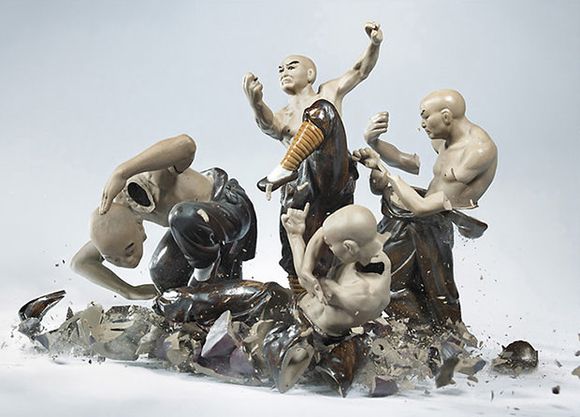
War comes wrapped in patriotic slogans; calls for sacrifice, honor, and heroism; and promises of glory. It comes wrapped in the claims of divine providence. It is what a grateful nation asks of its children. It is what is right and just. It is waged to make the nation and the world a better place, to cleanse evil. War is touted as the ultimate test of manhood, where the young can find out what they are made of. From a distance it seems noble. It gives us comrades and power and a chance to play a bit part in the great drama of history. It promises to give us identities as warriors, patriots, as long as we go along with the myth, the one the war-makers need to wage wars and the defense contractors need to increase their profits. But up close war is a soulless void. War is about barbarity, perversion, and pain.

more from Chris Hedges at Boston Review here.

Thursday, July 19, 2012

Reality Bites: Massachusetts Economy Proves Health Care Reform Didn’t Destroy Businesses

Kelly Bovio at the Huffington Post:

RomneycareSince implementation of the MA health care reform law, signed by then-Governor Mitt Romney, Wolf testified that Cape Air has “added a solid 15 percent more MA-based jobs, with our total revenue growing far faster.” While his business saw a 5 percent increase in health insurance premiums this year, Wolf stated that the cost was, “too much, but far from the 15 to 20 percent increases we saw year after year before reform took effect.”

Not only has health care reform been good for Cape Air, but Wolf argued the law has neither soured the business climate in Massachusetts nor ruined state's economy. “Unemployment in Massachusetts has dropped from 8 percent in 2009 to 5.8 percent in May of this year. This is 2.4 percent below the national average. Massachusetts ranks eighth in the nation in job creation this year, adding 37,800 new jobs through May. And, since January 2007, Massachusetts has ranked third in the nation in economic performance, as defined by gross state product.”

More here.

Military Spends Too Much On Music, Sports Promos

Betty McCollum (D) of Minnesota's Fourth District writes in the Star Tribune:

Earnhardt071812aIn May, USA Today reported that the National Guard's $26.5 million taxpayer-funded contract with Dale Earnhardt Jr.'s No. 88 NASCAR team resulted in the National Guard being “contacted by more than 24,800 individuals expressing interest in joining.” Of these contacts, the National Guard spokesperson said that “20 were qualified candidates and that none joined.” That's right, $26.5 million for zero recruits.

Military music has a long, proud tradition. However, borrowing $4 billion over the next 10 years from China to pay for the Navy Band New Orleans, the Air Force Falconaires jazz ensemble or the Army Medical Command Band does not advance our national security interests. I hope my House colleagues, especially Tea Party Republicans, will support my amendment. Spending $200 million for military ceremonial music, choral performances and country jam sessions needs to be enough.

More here.

Would a message from God pass these Catholic rules on revelation?

Julian Baggini in The Guardian's Comment is free:

RevelationHerein contains what we might call the paradox of revelation, which is confronted by any organised religion that is based on revelation, in whole or part. As its meaning makes clear, you can't have a “revelation” that tells everyone what they already know. The supposed revelations of God to humanity through Christ, or the word of God to Mohammed through the angel Gabriel, had the power they did because they indicated new truths, new directions for followers.

However, having established a religion on those revelations, the teachings revealed through them become non-negotiable, and the ecclesiastical authorities become the arbiters of their interpretation. And so that means no further revelation is admissible if it contradicts what is already believed. Revelation of radical new truths, if accepted as real, thus makes future revelation of radical new truths impossible. To put it another way, what was absolutely valid for the establishing of a religion becomes by necessity invalid once it already exists.

This isn't trivial. Although the Catholic church exists to further God's will on earth, the criteria set out by the Sacred Congregation for the Doctrine of the Faith make it impossible for the church to accept God's will as being anything other than what they already believe. So while in theory entirely subservient to God's will, God's will actually turns out to be subservient to that of the church.

Read the rest here.

When the Army was Democratic

William Pfaff in NYRB:

ArmyUp to Vietnam, the United States Army had been a people’s army. When the country thought it had to fight a war, it raised an army of citizens. The citizens defended the country and its beliefs, often making family and economic sacrifices to support the war effort. They enabled America’s wars. They also prevented them. The army was a democratic army, and the government was compelled to recognize and respect the popular will and the will of the civilian soldiers and ROTC and OCS officers who manned it. What fundamentally was destroyed in Vietnam was the democratic army. The all-volunteer professional army enables undemocratic wars, ideological in nature and inspiration, and, it would seem, without real end.

Read the full article here.

From the Ruins of Empire

From The Guardian:

From-the-Ruins-of-Empire-TheDebates about the rise of the modern west (and corresponding decline of the east) remain a fertile source of historical polemic. Such oppositional historiography – the idea of a head-on clash of civilisations, with a clear winner and loser – seems to hold a perennial appeal in terms of both its simplicity and its drama of antagonism. Last year, Niall Ferguson – in his pugnaciously titled Civilization: The Six Ways the West Beat the Rest – brought the subject back into sharp media focus. “The rise of the west,” he argued, “is the pre-eminent historical phenomenon of the second half of the second millennium after Christ. It is the story at the very heart of modern history. It is perhaps the most challenging riddle historians have to solve.” To condense two extremes of a now venerable argument, the old school contended that somewhere in the early modern period a progressive and free-trading Europe surged ahead through innate superiority of character and government, while ancient superpowers such as China turned complacently in on themselves. A newer, postcolonial school places the “great divergence” rather later, arguing that until 1800, the Chinese empire largely kept up with Britain, the most prosperous and vigorous of the European economies. Early in the 19th century, however, Britain began to nose ahead, through sheer good fortune. Easy access to coal and Caribbean sugar fuelled the steam-power and workforces of the industrial revolution. New World calories, timber and silver (paying for tea, coffee, textiles) in turn liberated millions of European arable acres for other productive purposes, permitting the industrial revolution to generate firepower that, by the 1840s, was trouncing the great non-European conquest empires.

In From the Ruins of Empire, Pankaj Mishra turns his attention to the other side of the story: to attempts by Asian thinkers (in Afghanistan, China, India, Iran, Turkey) to rebuild their cultural and political identities after collisions with the imperialist west. His account begins in the first half of the 19th century with the west already approaching ascendancy in east Asia, India and the Muslim world. It spans Asia's steady disillusionment with western modernity through two world wars, then ends with the rise of China, India and global Islam, and the much-rumoured decline of the west.

More here.

Neanderthals ate their greens

From Nature:

1_11030_C0103517-Neanderthals_cooking_vegetables,_artwork-SPLNeanderthals have long been viewed as meat-eaters. The vision of them as inflexible carnivores has even been used to suggest that they went extinct around 25,000 years ago as a result of food scarcity, whereas omnivorous humans were able to survive. But evidence is mounting that plants were important to Neanderthal diets — and now a study reveals that those plants were roasted, and may have been used medicinally. The finding comes from the El Sidrón Cave in northern Spain, where the roughly 50,000-year-old skeletal remains of at least 13 Neanderthals (Homo neanderthalensis) have been discovered. Many of these individuals had calcified layers of plaque on their teeth. Karen Hardy, an anthropologist at the Autonomous University of Barcelona in Spain, wondered whether it might be possible to use this plaque to take a closer look at the Neanderthal menu.

Using plaque to work out the diets of ancient animals is not entirely new, but Hardy has gone further by looking for organic compounds in the plaque. To do this she and a team including Stephen Buckley, an archaeological chemist at the University of York, UK, used gas chromatography and mass spectrometry to analyse the plaque collected from ten teeth belonging to five Neanderthal individuals from the cave. The plaque contained a range of carbohydrates and starch granules, hinting that the Neanderthals had consumed a variety of plant species. By contrast, there were few lipids or proteins from meat. Hardy and her colleagues also found, lurking in the plaque of a few specimens, a range of alkyl phenols, aromatic hydrocarbons and roasted starch granules that suggested that the Neanderthals had spent time in smoky areas and eaten cooked vegetables. The results are published today in Naturwissenschaften1. “The idea that Neanderthals were largely meat-eaters has been hard for me to accept given their membership in a mainly vegetarian clade. It is exciting to see this new set of techniques applied to understanding their palaeo-diet,” says Richard Wrangham, an anthropologist at Harvard University in Cambridge, Massachusetts

More here.

Fred and Adele

Cohen_281261h

The New York response to the Astaires was enthusiastic, but in London it was ecstatic. British audiences had never seen anything like them. They associated the pair’s seemingly effortless skill and breezy humour with an idea of America at its best. Adele, in particular, had a frothy, satirical charm that threw British audiences and critics into paroxysms of delight. The country’s aristocratic society embraced them. Fred and Adele partied with Lord and Lady Mountbatten, the Duke of York and the Prince of Wales, with Fred picking up sartorial tips from the latter who also, Riley notes, may have picked up some from him. The future Edward VIII was impressed, for example, by the dancer’s extensive collection of colourful braces. Riley also chronicles their friendship with George Gershwin, which began in 1914, when Fred and Adele were not yet on Broadway and Gershwin was working as a song-plugger for $15 a week. Gershwin and Astaire had an immediate affinity.

more from Paula Marantz Cohen at the TLS here.

architecture and war

Atlantik_jpg_230x800_q85

There has long been a tendency to see the most important innovations of Modernism as arising directly from progressive causes. War, in this view, was considered a limiting if not wholly destructive force that stymied civilian architecture in favor of retrogressive military structures. But in his groundbreaking recent book Architecture in Uniform: Designing and Building for the Second World War, the French architectural historian and architect Jean-Louis Cohen establishes one big, awful, inescapable truth: the full potential of twentieth-century architecture, engineering, and design was realized not in the social-welfare and urban-improvement schemes beloved by the early proponents of the Modern Movement, but rather through technologies perfected during the two world wars to slaughter vast armies, destroy entire cities, decimate noncombatant populations, and industrialize genocide. It is hard to come away from Architecture in Uniform without the same feelings of profound horror and lingering dread that overtake readers of recent books on World War II by Max Hastings, Timothy Snyder, and other historians who continue to reveal with terrifying immediacy just how horrific that catastrophe was.

more from Martin Filler at the NYRB here.

Die Verfassung Europas!

JurgenHabermas

Habermas’s most recent book, Die Verfassung Europas, has caused a stir in Germany since its publication by Suhrkamp in November; it has just been published here in an English translation as The Crisis of the European Union. But its appeal in Germany has rested not so much on Habermas’s justified indignation about the EU, but instead on his tempered optimism about the future of democracy in Europe. Die Zeit called Die Verfassung Europas “the book of the hour”; Der Spiegel, “a philosopher’s mission to save the EU”; and the Frankfurter Allgemeine Zeitung, a manifesto for “a second chance for a united Europe.” The near unanimous enthusiasm of reviewers probably reflected less a consensus about the book’s arguments than sheer relief, given the daily bad news from Europe, that Habermas had written a hopeful book. He affirms his longstanding commitment to a cosmopolitan Europe in which the dynamics of global capitalism can be remastered beyond the nation-state, at a supranational and global level, and he sees a radically altered European Union as a model—indeed, as the precursor—for a constitutionally sanctioned cosmopolitan world order based not on utopian illusions but on realistic assessments.

more from Anson Rabinbach at The Nation here.

Wednesday, July 18, 2012

All’s Not Fair in Science and Publishing

From Frederick Southwick in The Scientist:

07_12_CriticSouthwickI had recently taken a position at an Ivy League institution when another junior faculty member showed me a micrograph of a macrophage containing intracellular bacteria. I immediately noticed an electron-dense material near the bacterial cells, which I suspected might be actin filaments of the host cell. I agreed to test this hypothesis, and using a fluorescent actin stain, found that, indeed, many of the bacterial cells had actin filaments on one pole. “Could this bacterium be harnessing the host’s actin to move within cells?” I wondered aloud to my colleague.

A month later I brought additional data confirming my findings to my collaborator’s office, where I noticed a paper on his desk with the bacterium’s name and actin in the title. He and a senior professor were listed as the authors, but I was not. “Where’s my name?” I asked. He noted that he and this senior professor had decided to perform their own electron microscopy studies, and were submitting their findings to a prestigious journal. “You’re welcome to publish your work separately,” he suggested.

More here.

Why Is This Man Wearing A Turban?

Portrait_of_a_Man_by_Jan_van_Eyck-small-383x525Teju Cole in New Inquiry:

He is unknown. No name, no profession, no identifying details, but he looks out with the calm sternness of one who knows his place in the world. And because of this calmness, this sternness—the skeptical gaze and tight lips—we suspect it might be an image of the artist himself. Self-portraits of artists often present them with a certain forthrightness, which is necessary because the status of artists is always uncertain—this was true in the 15th century, and it is true now. And so, in their portraits of themselves, artists show confidence, worldliness, and a measure of pride in being artists.

Worldliness: the artist is Jan van Eyck, the portrait was painted in 1433 in Bruges, and it is as much a portrait of a man as it is a portrait of his enormous red turban. Each wrinkle of the cloth, each fold, each soft glimmer of light across the soft weave, is painted with the holy precision Jan van Eyck helped introduce to art. He had abandoned tempera and begun to dissolve his pigments in linseed oil in the 1420s. With that came control and a perfection in painterly mimesis never since matched. An inscription on the frame reads, in pseudo-Greek letters, ALC.IXH.XAN—“as I can,” or “to the best of my ability.” He must have known that his best was the best. The gray-eyed gaze of the man in the painting is a dare. Show me who’s done it better, he seems to say. Didn’t think so, he adds.

***

I was in Brussels a few weeks ago. At the end of my brief visit, something happened that reminded me, in an oblique way, of the fearlessness of “Man in a Turban.” It was a Thursday, and I had a free evening. My friend F. invited me to join her at the opening of a hip place in a central part of town. Around ten, she sent a text message: “I will be a bit later, feels like a scene from your book; there are riots in Molenbeek, the part of Brussels where I live.”

She eventually arrived, and as we got our beers at the sleek new bar, in which I was the only non-white customer, F. told me about Molenbeek. It is an immigrant neighborhood, mostly Muslim, mostly poor. F., as pale as the women in paintings by Van Eyck and Memling, and her husband, who is also Flemish, chose to raise their family among Moroccan neighbors. There are African blacks in the area too. There are sometimes tensions between the two groups.

Slavoj Žižek Responds to His Critics

Zizeksmall-791x1024Slavoj Žižek in Jacobin:

If I am repelled by John Gray’s review of my two last books (‘The Violent Visions of Slavoj Žižek’, New York Review of Books, July 12 2012), it is not because the review is highly critical of my work, but because its arguments are based on such a crude misreading of my position that, if I were to answer it in detail, I would have to spend way too much time just answering insinuations and setting straight the misunderstandings of my position, not to mention direct false statements – which is, for an author, one of the most boring exercises imaginable. So I will limit myself to one paradigmatic example which mixes theoretical dismissal with moral indignation; it concerns anti-Semitism and is worth quoting in detail:

Žižek says little regarding the nature of the form of life that might have come into being had Germany been governed by a regime less reactive and powerless than he judges Hitler’s to have been. He does make plain that there would be no room in this new life for one particular form of human identity:

“The fantasmatic status of anti-Semitism is clearly revealed by a statement attributed to Hitler: “We have to kill the Jew within us.” … Hitler’s statement says more than it wants to say: against his intentions, it confirms that the Gentiles need the anti-Semitic figure of the “Jew” in order to maintain their identity. It is thus not only that ”the Jew is within us“—what Hitler fatefully forgot to add is that he, the anti-Semite, is also in the Jew. What does this paradoxical entwinement mean for the destiny of anti-Semitism?”

Žižek is explicit in censuring “certain elements of the radical Left” for “their uneasiness when it comes to unambiguously condemning anti-Semitism.” But it is difficult to understand the claim that the identities of anti-Semites and Jewish people are in some way mutually reinforcing—which is repeated, word for word, in Less Than Nothing—except as suggesting that the only world in which anti-Semitism can cease to exist is one in which there are no longer any Jews.

What is going on here? The above-quoted passage from Less Than Nothing immediately continues with:

Here we can again locate the difference between Kantian transcendentalism and Hegel: what they both see is, of course, that the anti-Semitic figure of the Jew is not to be reified (to put it naïvely, it does not fit “‘real Jews”), but is an ideological fantasy (“projection”), it is “in my eye.” What Hegel adds is that the subject who fantasizes the Jew is itself “in the picture,” that its very existence hinges on the fantasy of the Jew as the “little bit of the Real” which sustains the consistency of its identity: take away the anti-Semitic fantasy, and the subject whose fantasy it is itself disintegrates. What matters is not the location of the Self in objective reality, the impossible-real of “what I am objectively,” but how I am located in my own fantasy, how my own fantasy sustains my being as subject.

Are these lines not perfectly clear? The mutual implication is not between the Nazis and the Jews, but between the Nazis and their own anti-Semitic fantasy: “you take away the anti-Semitic fantasy, and the subject whose fantasy it is itself disintegrates.” The point is not that Jews and anti-Semites are somehow co-dependent, so that the only way to get rid of the Nazis is to get rid of the Jews, but that the identity of a Nazi depends on his anti-Semitic fantasy…

Beethoven — For A Buck

From Anastasia Tsioulcas at Deceptive Cadence:

BeethovenI have no idea why Beethoven is the common theme, but it's evidence of a larger story coming into play. Labels are making changes in what they charge for new releases, and it remains to be seen what impact that might have as consumers begin to expect a lower price as a new norm, rather than a special offer.

Long, long ago — say, the late 20th century — labels put releases into three distinct categories. “Front line” releases were new recordings made by current artists, and they fetched the highest price at retail, somewhere around $16 or so for a single CD. “Mid-line” releases were usually reissues, frequently remastered and very lavishly repackaged, whose retail cost was about $10-12 per CD. And “budget” releases were either new recordings made relatively inexpensively by unknown artists (a field the Naxos label dominated), or they were reissues and compilations done on the cheap, often by third-party labels. (These labels were — and often continue — to be based in Europe, where copyright holds for just 50 years, making all sorts of prized treasures among great recordings fair game, even if they weren't technically allowed to be sold in the U.S., where copyright holds longer.) And even as late as last year, new “front-line” digital releases were generally priced at about $10.

More here.

Obama’s Scramble for Africa

Nick Turse in Guernica:

AfricaThey call it the New Spice Route, an homage to the medieval trade network that connected Europe, Africa, and Asia, even if today’s “spice road” has nothing to do with cinnamon, cloves, or silks. Instead, it’s a superpower’s superhighway, on which trucks and ships shuttle fuel, food, and military equipment through a growing maritime and ground transportation infrastructure to a network of supply depots, tiny camps, and airfields meant to service a fast-growing U.S. military presence in Africa.

Few in the U.S. know about this superhighway, or about the dozens of training missions and joint military exercises being carried out in nations that most Americans couldn’t locate on a map. Even fewer have any idea that military officials are invoking the names of Marco Polo and the Queen of Sheba as they build a bigger military footprint in Africa. It’s all happening in the shadows of what in a previous imperial age was known as “the Dark Continent.”

More here.

Dear HBO,

Over at Slate, Tanner Colby writes about a TV show begging to be made:

HBOIt’s been a banner year for lambasting the deplorable state of race and television. Lately it seems you can pick a fight just about anywhere on the dial. Grey’s Anatomy showrunner Shonda Rhimes recently got into a Twitter dust-up by calling out the lily-white casting of ABC’s Bunheads. That was a minor skirmish compared to the scorched-earth campaign of criticism waged over Lena Dunham’s Girls this past spring. Mad Men is too white. Tyler Perry’s Meet the Browns is too black. Then there are your reality-TV disasters: VH1’s Basketball Wives isn’t doing the modern black woman any favors, and we’ve got lawyers suing ABC over The Bachelor because it casts only white contestants, a lawsuit that must represent a new low for civil rights litigation in America.

Friday Night Lights and The Wire both offered intelligent, thoughtful portraits of race. For laughs, we’ve still got the smart and subtle humor of NBC’s Community, FX’s Louie, and Comedy Central’s Key & Peele. But in what is supposedly a new age of groundbreaking, “novelistic” television drama, one of the most dramatic threads of America’s cultural history is strangely absent. We did Mad Men, the well-lit, glossy “before” picture of white America, taken just as the civil rights movement was about to upend Madison Avenue’s cushy status quo. And we’ve done The Wire, the gritty “after” shot of urban America in the wake of white flight and the drug war. But we skipped the middle chapter. We haven’t done the part about how America stopped being Mad Men and turned into The Wire. That would be the story of the failure of racial integration in the 1970s.

Read the rest here.

Wednesday Poem

Enriching the Earth
.
To enrich the earth I have sowed clover and grass
to grow and die. I have plowed in the seeds
of winter grains and various legumes,
their growth to be plowed in to enrich the earth.
I have stirred into the ground the offal
and the decay of the growth of past seasons
and so mended the earth and made its yield increase.
All this serves the dark. Against the shadow
of veiled possibility my workdays stand
in a most asking light. I am slowly falling
into the fund of things. And yet to serve the earth,
not knowing what I serve, gives a wideness
and a delight to the air, and my days
do not wholly pass. It is the mind's service,
for when the will fails so do the hands
and one lives at the expense of life.
After death, willing or not, the body serves,
entering the earth. And so what was heaviest
and most mute is at last raised up into song.
.
byWendell Berry
from Collected Poems 1957-1982

Yasser Arafat and when poison ‘kills the president’

From The Independent:

But if there’s a quintessential death of an individual that created too offensive a smell in the nostrils of his people to be forgotten, it is that of late Palestinian President Yasser Arafat in 2004. And the long-held suspicions surrounding the nature of his death were once again brought into the limelight last week when a radiation physics laboratory in Switzerland, upon request of an investigation being undertaken by Al Jazeera television, found high levels of polonium on samples taken from his hair, toothbrush and underpants which they were able to examine posthumously. The circumstances of his illness were always shrouded in mystery. Despite being flown to a French military hospital suffering from severe complications relating to flu, intestinal infection and a sharp decrease in blood platelets (thrombocytes) it took just three weeks before the 75-year-old leader fatally succumbed to his illness. Yet what was extraordinary about this case, and the reason why so many columns written following his death appeared to be laced with gossipy benzene, was that they failed to determine the exact cause of his death, saying only that he had a “mystery blood disorder”. The failure of Arafat’s family to sanction an autopsy and comments by then Palestinian Foreign Minister Nabil Shaath about the French ruling out the possibility that poisoning may have caused his condition, did nothing to stem the suspicions. Fast forward seven years, and now one of the worlds leading specialist laboratories in radiation have an unequivocally confirmed that high levels of the radioactive toxin Polonium were present in his body at the time of his death.

Why Arafat, Polonium and the possible culprits?

More here.

Punishing Cheaters: Are We the Dark Knight—Or Just Dark?

From Science:

ManIf you could confront the pickpocket who ripped you off in the subway, would you simply demand your wallet back, or would you seek vengeance? Your decision to punish the thief might hinge on whether the thief ended up richer than you, a new study suggests. According to most economic theories, self-interest is the prime motivator in human behavior. However, studies show that people consistently sacrifice their own welfare to punish cheats. For example, in a classic economic experiment called the “ultimatum game,” one person holds a certain number of dollars and can offer as many as she likes to a second player. If the second player rejects the offer, the first player loses everything. Rather than accepting any offer, the second player will consistently reject low offers, preferring to receive nothing than to allow her rival to retain the larger sum. In 1999, Swiss economists Ernst Fehr and Klaus Schmidt defined this spiteful reaction toward cheats and freeloaders as “inequity aversion.” They hypothesized that such behavior is essential for cooperation and bargaining, and that it is separate from the desire for revenge, or “reciprocity,” as social scientists call it. However, says Fehr, it isn't easy to tease apart the two motivations in experiments, much less real life. “This is a long-standing question that has not been answered to our full satisfaction.”

More here.