Michael Chabon on race, sex, Obama

Andrew O'Hehir in Salon:

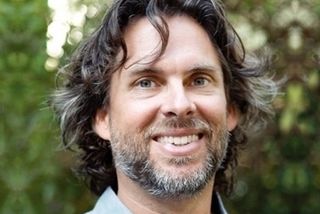
Chabon_rect-460x307If you’ve ever lived in Berkeley, Calif., that much-ridiculed college town on the eastern shores of San Francisco Bay, or even visited the place, you probably have highly specific associations with Telegraph Avenue, a historic street of political protests and retail commerce (legal and otherwise) that dead-ends against the University of California campus at Sather Gate. Michael Chabon’s new novel is pointedly not about that Telegraph Avenue, and its characters have no relationship to the university campus or to the 1960s explosion of left-wing activism that made Berkeley internationally famous – and, briefly, in my childhood, the locus of martial law as ordered by the governor of California, Ronald Reagan.

Chabon’s “Telegraph Avenue” calls our attention, literally and figuratively, to the other end of the street, where Telegraph crosses the city line and becomes the main drag of the Temescal district, a racially and economically mixed neighborhood in northwest Oakland. That’s where Archy Stallings, a 36-year-old African-American Gulf War vet who is the novel’s central character, and his Jewish partner Nat Jaffe (whose background resembles Chabon’s own) are not so slowly running a vintage vinyl emporium called Brokeland Records into the ground. It’s the summer of 2004, and a wealthy former NFL star and Oakland native, Gibson “G-Bad” Goode, is planning to open an immense new retail-entertainment complex – called, wonderfully, the “Dogpile Thang” – four blocks away, applying the coup de grace to Archy and Nat’s failing business.

More here.

Sunday Poem

Break

We put the puzzle together piece
by piece, loving how one curved
notch fits so sweetly with another.
A yellow smudge becomes
the brush of a broom, and two blue arms
fill in the last of the sky.
We patch together porch swings and autumn
trees, matching gold to gold. We hold
the eyes of deer in our palms, a pair
of brown shoes. We do this as the child
circles her room, impatient
with her blossoming, tired
of the neat house, the made bed,
the good food. We let her brood
as we shuffle through the pieces,
setting each one into place with a satisfied
tap, our backs turned for a few hours
to a world that is crumbling, a sky
that is falling, the pieces
we are required to return to.

by Dorianne Laux
from Awake, 2001
University of Arkansas Press

Mouse Mouth Mitt

Eliot Weinberger in London Review of Books:

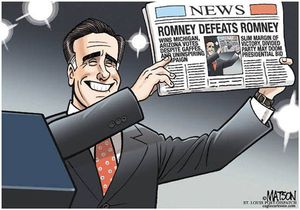
Romney-Defeats-RomneyThe racial message was clear enough to those eating their $50,000 dinners in Boca Raton, but broadcast into the larger and somewhat more reality-based world it took on another meaning. The vast majority of the 47 per cent (actually 46 per cent) are white and nearly all are extremely poor people or the retired elderly who are living off their savings and Social Security or the disabled (including veterans) or students or soldiers serving in combat zones (who don’t pay taxes – no wonder Mitt didn’t mention those spongers at the convention). Among those who pay ‘no income tax’ – meaning federal taxes – almost all pay state and local taxes, and payroll taxes (Social Security and Medicare). Some pay property taxes; everyone pays sales taxes. The states with the highest number of 47-percenters traditionally vote Republican. ‘Those people’, in other words, include quite a few potential Romney voters – many of whom, one imagines, are now former potential Romney voters. Television has gone round-the-clock with tales of honorable people who found themselves in hard times and needed temporary help, including – it is perfect – the young George Romney, Mitt’s sainted Dad, before he made his millions. Trying to follow Republican logic can often induce vertigo. Mitt prides himself on his tax-avoidance skills, and thousands of 1-percenters (including six known multibillionaires) pay no federal taxes at all, thanks to their elaborate systems of loopholes and tax shelters, most of them legislated by Republicans. The Ryan budget proposes to eliminate entirely nearly all the taxes that the mega-rich pay. But, in the Mittopian universe, where the rich shouldn’t have to pay any taxes, the poor who don’t pay taxes are a bunch of moochers.

Romney will never recover from Mouse Mouth, but there is something sinister that will linger on. The primary word that the right is using to characterise the 47 per cent, and the left is using to characterise the characterisation, is ‘parasite’. As Mary Matalin, an omnipresent Republican talking head, put it on CNN: ‘There are makers and takers, there are producers and there are parasites.’ Tens of millions will vote for Romney and many of them will be believers in this myth. Perhaps it’s worth remembering the last time a large segment of a population was vilified as parasites: Der Jude als Weltparasit (‘The Jew as World Parasite’). These things tend to stick.

More here.

How the West created modernity

Pierre Manent in City Journal:

ModernWe have been modern for several centuries now. We are modern, and we want to be modern; it is a desire that guides the entire life of Western societies. That the will to be modern has been in force for centuries, though, suggests that we have not succeeded in being truly modern—that the end of the process that we thought we saw coming at various moments has always proved illusory, and that 1789, 1917, 1968, and 1989 were only disappointing steps along a road leading who knows where. The Israelites were lucky: they wandered for only 40 years in the desert. If the will to be modern has ceaselessly overturned the conditions of our common life and brought one revolution after another—without achieving satisfaction or reaching a point where we might rest and say, “Here at last is the end of our enterprise”—just what does that mean? How have we been able to will something for such a long time and accept being so often disappointed? Could it be that we aren’t sure what we want? Though the various signs of the modern are familiar, whether in architecture, art, science, or political organization, we do not know what these traits have in common and what justifies designating them with the same attribute. We find ourselves under the sway of something that seems evident yet defies explication.

…We congratulate ourselves for the attenuation of party conflict while oddly treating transfers of power as matters of momentous importance. The political landscape has been leveled. The webs of feelings, opinions, and language that once made up political convictions have unraveled. It is no longer possible to gain political ground by taking a position. This is why all political actors tend to use all political languages indiscriminately. Political speech has become increasingly removed from any essential relation to a possible action. The notion of a political program, reduced to that of “promises,” has been discredited. The explicit or implicit conviction that one has no choice has become widespread: what will be done will be determined by circumstances beyond our control. Political speech no longer aims to prepare a possible action but tries simply to cover conscientiously the range of political speech. Everyone, or almost everyone, admits that the final meeting between action and speech will be no more than a meeting of independent causal chains.

More here.

Saturday, September 22, 2012

Prison Rape: Obama’s Program to Stop It

David Kaiser and Lovisa Stannow in the New York Review of Books:

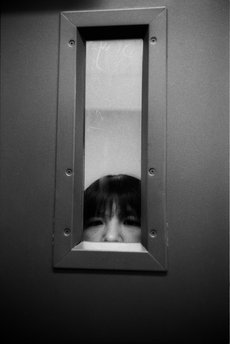
Kaiser_1-101112_jpg_230x1424_q85The United States has by far the largest prison system in the world. It is so large, in fact, so sprawling and dispersed, so administratively complex, that just how many people we keep locked up is uncertain. The most commonly cited statistic is that we have about 2.3 million inmates. This comes from the Bureau of Justice Statistics (BJS), a division of the Justice Department that surveys the national prison system and found that on June 30, 2009, the US had 203,233 federal prisoners, 1,326,547 state prisoners, and 767,620 detainees in local jails.

But then, in addition, more than 80,000 youth are held in juvenile detention facilities on any given day. Before being deported, about 400,000 people a year also pass through our immigration detention system, which is run mostly by the Department of Homeland Security. Hundreds of thousands more are held in halfway houses and police lockups; no one knows the exact number. The Bureau of Indian Affairs oversees jails in Indian Country, and the Department of Defense has its own network of more than sixty detention facilities all over the globe.

The people we imprison are overwhelmingly our most disadvantaged: the poor and the poorly educated, the black and the brown, the mentally ill. Typically, they’re given extraordinarily long sentences compared to prisoners in the European Union, often for infractions that would not warrant incarceration elsewhere. And while they’re imprisoned, appalling numbers of them are subjected to sexual abuse.

More here.

Philosophy v science: Julian Baggini talks to Lawrence Krauss

Julian Baggini and Lawrence Krauss in The Guardian:

Julian Baggini No one who has understood even a fraction of what science has told us about the universe can fail to be in awe of both the cosmos and of science. When physics is compared with the humanities and social sciences, it is easy for the scientists to feel smug and the rest of us to feel somewhat envious. Philosophers in particular can suffer from lab-coat envy. If only our achievements were so clear and indisputable! How wonderful it would be to be free from the duty of constantly justifying the value of your discipline.

Philosophy-science-009However – and I'm sure you could see a “but” coming – I do wonder whether science hasn't suffered from a little mission creep of late. Not content with having achieved so much, some scientists want to take over the domain of other disciplines.

I don't feel proprietorial about the problems of philosophy. History has taught us that many philosophical issues can grow up, leave home and live elsewhere. Science was once natural philosophy and psychology sat alongside metaphysics. But there are some issues of human existence that just aren't scientific. I cannot see how mere facts could ever settle the issue of what is morally right or wrong, for example.

Some of the things you have said and written suggest that you share some of science's imperialist ambitions. So tell me, how far do you think science can and should offer answers to the questions that are still considered the domain of philosophy?

Lawrence Krauss Thanks for the kind words about science and your generous attitude. As for your “but” and your sense of my imperialist ambitions, I don't see it as imperialism at all. It's merely distinguishing between questions that are answerable and those that aren't. To first approximation, all the answerable ones end up moving into the domain of empirical knowledge, aka science.

More here.

The President and the Pakistani, a new play about Barack and the friend he left behind

Rashid Razaq in the London Evening Standard:

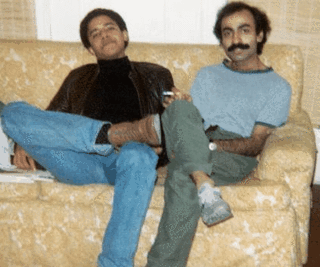
ScreenHunter_10 Sep. 22 17.48In fact, Obama had several close Pakistani friends. There was Imdad Husain, the intellectual British public school-educated room-mate at Occidental College, who spoke with an English accent and was partial to “peacoats and rugby shirts”; And the gregarious and generous Hasan Chandoo, whose family were in the shipping business and became like a “big brother”. The 20-year-old Obama even went to Karachi for his summer holidays in 1981, splitting his time there between the homes of Chandoo and another friend Wahid Hamid.

“These were my closest friends,” said Obama years later. World citizens who spanned cultures and shared his international perspective. It was to Beenu Mahmood that a young Obama revealed the fierce ambition that he kept hidden from almost everybody with the question, “Do you think I will be President of the United States?”

So tight was his clique that Obama’s white Australian girlfriend, Genevieve Cook, grumbled that they only ever seemed to socialise with the “Paki Mob” even after he had graduated and was working as a business researcher in New York.

David Maraniss’ expansive biography, Barack Obama: The Making of The Man, published earlier this year, minutely details how the future President formed life-long friendships with his Pakistani college buddies, sketching in the real people behind his fictional characters and even highlighting inconsistencies in Obama’s own account of his life in Dreams. Chandoo and Hamid, who became high-fliers in the worlds of finance and business, were invited to Obama’s wedding to Michelle in 1992 and even fundraised for his last election campaign. But there was one member of the Paki Mob Obama did not stay in touch with and his story is the most intriguing.

More here.

notes from underground

33b31f80-0379-11e2-a284-00144feabdc0

In his introduction to Naked Lunch, William Burroughs explained the title as “a frozen moment when everyone sees what is on the end of every fork”. If you have spent any time looking at the oil business, you will know exactly what he meant. So much in modern life, from plastic cups to Boeing 787s, is made from or with oil that discovering the facts of how it is extracted, processed and distributed is like peeling back the surface of the everyday world to reveal the hidden structure beneath. When BP’s Macondo well ruptured in the Gulf of Mexico in 2010, many people were confronted for the first time by some of those realities – including the awe-inspiring difficulties of working in the deep waters where oil companies venture now that the more accessible areas have been sucked dry, and the catastrophic consequences of failure. The video feed from the sea bed a mile down, showing oil and gas pouring unstoppably from the well into the waters of the gulf, brought home to American consumers the ugly side of a business that they had habitually ignored.

more from Ed Crooks at the FT here.

asia awakening

0923-bks-kunzru-articleInline

In 2011, the Chinese dissident artist Ai Weiwei exhibited 12 bronze animal heads representing the signs of the Chinese zodiac outside the Plaza Hotel in Manhattan. The heads were enlarged replicas of a set designed in the 18th century by two European Jesuits for the emperor Qianlong and displayed in the gardens of the Yuanmingyuan, the emperor’s Old Summer Palace. At the time of the exhibition, Ai had disappeared into detention in China. The political controversy overshadowed the work itself, which posed its most searching questions not to the Chinese government, but to the West. In 1860, during the Second Opium War, the Old Summer Palace was ransacked and torched by French and British soldiers. In “From the Ruins of Empire,” his timely and important history of Asian intellectual responses to Western colonialism, Pankaj Mishra quotes one looter who said that to describe “the splendors before our astonished eyes, I should need to dissolve specimens of all known precious stones in liquid gold for ink, and to dip it into a diamond pen tipped with the fantasies of an oriental poet.”

more from Hari Kunzru at the NY Times here.

rushdie’s rushdie

600

Salman Rushdie is a selfless defender of artistic freedom. No, he’s really a party animal with a bombshell perpetually on his arm. Actually, he’s hiding in fear. Isn’t he? For the last 23 years he’s been a novelist living the life of a character in a novel. Unfortunately for Rushdie, the book he’s been transported into isn’t a nuanced work of art like, say, “Midnight’s Children,” the epic novel that helped make his reputation as one of the best British writers of his generation. It’s more like “a bad Rushdie novel,” he told me as we sat in the restaurant of a West Hollywood hotel. “The kind of book I’d write if I weren’t any good.”

more from Hector Tobar at the LA Times here.

Saturday Poem

A Haircut

So many impossible things have already
happened in this life. He doesn’t think
twice when she tells him to get ready:
He’s about to get a haircut.

He sits in the chair in the upstairs room,
the room they sometimes joke and refer to
as the library. There’s a window there
that gives light. Snow’s coming
down outside as newspapers go down
around his feet. She drapes a big
towel over his shoulders. Then
gets out her scissors, comb, and brush.

This is the first time they’ve been
alone together in a while – with nobody
going anywhere, or needing to do
anything. Not counting the going
to bed with each other. That intimacy.
Or breakfasting together. Another
intimacy. They both grow quiet
and thoughtful as she cuts his hair,
and combs it, and cuts some more.
The snow keeps falling outside.
Soon, light begins to pull away from
the window. He stares down, lost and
musing, trying to read
something from the paper. She says,
“Raise your head.” And he does.
And then she says, “See what you think
of it.” He goes to look
in the mirror, and it’s fine.
It’s just the way he likes it,
and he tells her so.

Read more »

Our beloved witness: Agha Shahid Ali and the homeland he knew

Meeran Karim in Himal Southasian:

One New England fall, I encountered the man who would soon become my guide to the world’s most militarised zone. Safely tucked away on the seventh floor of the Mount Holyoke College library, I found Kashmiri poet Agha Shahid Ali’s Rooms Are Never Finished. The first poem in the collection took me by surprise. In his poem ‘Lenox Hill’, written while mourning his mother’s death from cancer, Shahid, a Kashmiri Muslim, recalled his mother helping him build a miniature Hindu temple in his room in Srinagar: “and I, one festival, crowned Krishna by you, Kashmir, listening to my flute”. This peaceful image of Kashmir was something which shocked his readers in the West, accustomed to graphic images of communal violence in the region. Ignoring the ‘reserved’ tag on the book’s cover, I secretly put it in my satchel and headed for the dormitory. Seated by my window, which displayed a landscape reminiscent of Kashmir, I sunk into Agha Shahid Ali’s world.

Shahid’s Kashmir was home to both Hindus and Muslims. Even as religious nationalisms plagued British India, Kashmiris remained committed to the ideal of a secular democratic state. In 1944, a memorandum detailing the transition of Kashmir from an absolute monarchy to a constitutional democracy was submitted to Prince Maharaja Hari Singh by Sheikh Abdullah, president of Kashmir’s leading political party, the National Conference. Contrary to the All India Muslim League and its exclusivist vision, Naya Kashmir promised to not only protect, but also to empower the valley's religious minorities. It was this very spirit of Kashmiriyat – an expression of camaraderie, resilience and nationalism in spite of religious differences – that I found in the poetry of my loyal guide.

Writing in 1997, the poet reflected upon his and his homeland’s religious identity in ‘A History of Paisley’, featuring the saffron-coloured flower popularly associated with the Hindu deity Ganesh:

You who will find the dark fossils of paisleys
one afternoon on the peaks of Zabarvan —
Trader from an ancient market of the future,
alibi of chronology, that vain
collaborator of time — won't know that these
are her footprints from the day the world began.

More here.

Cancer-fighting Robots

From Harvard Magazine:

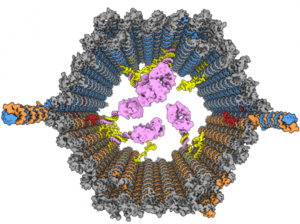
RN-DNA-closedBIn the not-so-distant future, a new kind of robot, one of the tiniest ever made, may have the ability to track down and destroy cancer cells. Films like Fantastic Voyage (1966) and Innerspace (1987) have long conjured fictional images of microscopic submarines or machinery that can travel inside the human body to cure ailments. Now Shawn Douglas, a research fellow at Harvard’s Wyss Institute for Biologically Inspired Engineering, is working on making that a reality. In a recent issue of the journal Science, Douglas described a method for creating tiny machines—roughly the size of a virus—out of strands of protein and DNA.

These devices, dubbed “DNA nanorobots,” are short hexagonal tubes made of interwoven DNA that can open along their length like a clamshell. At one end is a DNA “hinge,” and at the other, a pair of twisted DNA fragments that act as “latches” to hold the device shut. Inside the nanorobot, Douglas can enclose molecules of almost any substance, essentially turning it into a molecular “delivery truck” that can transport medication to specific cells in the body. “Our goal is to make tools that can zero in on malfunctioning cells,” he says. “We want to be able to fix things when they break—when cells go haywire due to cancer or other diseases where things just aren’t working correctly. To do that, I think it makes sense to master this kind of nanoscale construction.”

More here.

Friday, September 21, 2012

big is back

Armitage_294746h

Big history in all its guises has been inhospitable to the questions of meaning and intention so central to intellectual history. This is not simply for the banal reason that the big historians usually scrutinize such a superficial slice of recorded history at the end of their grand sweeps: the skin of paint on the top of the Eiffel Tower, in Mark Twain’s marvellous metaphor. Nor is it just because human agency dwindles in significance in the face of cosmological or even archaeological time. It is due, for the moment at least, to the essential materialism of the two main strains of big history, what we might call the biologistic and the economistic tendencies. The biologistic tendency is neurophysiologically reductive: when all human actions, including thought and culture, can be explained by brain chemistry, reflections approximate to reflexes. In the economistic strain, intellect is assimilated to interests. Each age simply “gets the thought that it needs”. For instance, whether it’s Buddhism, Christianity or Islam in the Axial Age, it’s all the same in the end: simply the product of the problem-solving capacity of some rather clever but needy chimps. In these regards, at least when it treats the questions of most concern to intellectual historians, deep history can appear to be somewhat shallow.

more from David Armitage at the TLS here.

the new burma

Schrank-1

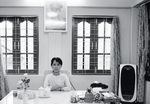
That struggle was for democracy: for choice, human rights, and basic freedoms—ideas all the more enthralling for having always been denied. But fundamentally, that struggle had always been rooted in the granular. From underground or under the chronic scrutiny of intelligence agents and informers, Thar and Nigel and Suu Kyi and dissidents across Burma’s pro-democracy movement had fought through the darkest years of military rule for a thousand daily practicalities: to earn a degree without bribing an examiner, to have electricity, to keep the rice paddy land that your family had tilled for generations, to hold an identity card if you happened not to be part of the Buddhist majority, or, if you were, to scrap the system that required one in the first place. They wanted—they believed—they had a right to assemble in groups of more than five; to use the word “nightmare” if they chose to in the lyrics of their songs; to paste a poster on a wall and not face prison for the privilege. Their concerns, the concerns of Burma’s “most passionate dissidents,” Suu Kyi had written recently, reflected “the sense of freedom as something concrete that has to be gained through practical work, not just as a concept to be captured through philosophical argument.”

more from Delphine Schrank at VQR here.

Mare nostrum

Leggewie_mediterranean_468w

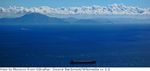
Since antiquity, the harbours of the Mediterranean have exerted a fascination over travellers and cultural researchers.[1] Visiting them today, however, one is presented with no more than a shadow – part run down, part picturesque – of their former grandeur and importance. These ports once lay at the heart of the first trans-Mediterranean phase of globalization, the central axis of which shifted to the Atlantic in the sixteenth century. Nowadays, the turnovers of even the larger Mediterranean harbours, such as Istanbul or Marseille, are easily outstripped by the container terminals in East Asia and the Gulf.[2] The Mediterranean serves as a passageway for around one third of all global transports of crude oil and natural gas. Its harbours are largely the destinations of cruise liners and ferries, just as its airports are the starting and end-points for beach holidays and city breaks.

more from Claus Leggewie at Eurozine here.