the days of digest

1356628505readersdigest

In a meeting between President Ronald Reagan and Canadian Prime Minister Brian Mulroney, when the friends were both in high office, the president asked Mulroney, “Brian, did you read that article in the Reader’s Digest that trees cause pollution?” Mulroney was exasperated. “I knew him and liked him well enough that I didn’t get into an argument. I just said, ‘I gave up reading Reader’s Digest, Ron,’” he later told a journalist. Reagan was a lifetime reader of the Digest. He once used an article from the magazine to slur the nuclear freeze movement as being comprised partly of Soviet agents. It was terrifying to contemplate the most powerful man in the world getting foreign policy ideas from a pocket-sized general-interest family magazine, but Reagan was not alone. For decades, Reader’s Digest was the primary source of information and opinions about international affairs for tens of millions of Americans. The magazine did not just run any articles about foreign policy, however; the Digest had a clear right-wing perspective, which had a tremendous, though often ignored, influence during the Cold War.

more from Jordan Michael Smith at Dissent here.

Retreat to the desert, and fight

Pieter_Bruegel_the_Elder_KINGSNORTH

Etymology can be interesting. Scythe, originally rendered sithe, is an Old English word, indicating that the tool has been in use in these islands for at least a thousand years. But archaeology pushes that date much further out; Roman scythes have been found with blades nearly two meters long. Basic, curved cutting tools for use on grass date back at least ten thousand years, to the dawn of agriculture and thus to the dawn of civilizations. Like the tool, the word, too, has older origins. The Proto-Indo-European root of scythe is the word sek, meaning to cut, or to divide. Sek is also the root word of sickle, saw, schism, sex, and science. I’VE RECENTLY BEEN reading the collected writings of Theodore Kaczynski. I’m worried that it may change my life. Some books do that, from time to time, and this is beginning to shape up as one of them.

more from Paul Kingsnorth at Orion here.

The politics of national security means that we’re all living in failed Hobbesian states

Corey Robin in Jacobin:

ScreenHunter_97 Dec. 28 15.23Political fear is universal, but its language is particular. Racism is one language of fear; risk assessment is another. There is little doubt, however, that security — whether national or domestic — is the most potent and pervasive language of all.

Security is the one good, political theorists like John Dunn and Bernard Williams agree, that the state must provide. It has the ability, like no other argument, to mobilize the resources and attention of the state and its citizens. It has arguably inspired — and, in the case of nuclear deterrence, certainly threatened — more devastation and destruction than any other ideology of the modern era.

It has also provided the single most effective and enduring justification for the suppression of rights. Why that is so — why security has furnished what appears to be the strongest reason for eliminating or otherwise limiting rights — is the question I’d like to address here.

At first glance, this may seem like a question that answers itself. When people are afraid for their lives, they will do anything to protect themselves and their families. And when the safety of the nation or the state is threatened, it too will do whatever it takes to defend itself. Limiting the rights of its citizens is the least of it.

More here.

How the FBI Spied on Edward Said

David Price in CounterPunch:

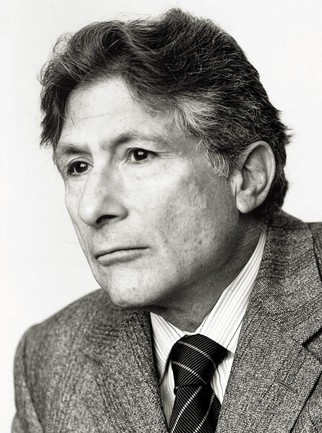
ScreenHunter_96 Dec. 28 15.17The FBI has a long, ignoble tradition of monitoring and harassing America’s top intellectuals. While people ranging from Albert Einstein, William Carlos Williams to Martin Luther King have been subjected to FBI surveillance, there remains an under-accounting of the ways in which this monitoring at times hampered the reception of their work.

In response to my request under the Freedom of Information Act, filed on behalf of CounterPunch, the FBI recently released 147 of Said’s 238-page FBI file. There are some unusual gaps in the released records, and it is possible that the FBI still holds far more files on Professor Said than they acknowledge. Some of these gaps may exist because new Patriot Act and National Security exemptions allow the FBI to deny the existence of records; however, the released file provides enough information to examine the FBI’s interest in Edward Said who mixed artistic appreciations, social theory, and political activism in powerful and unique ways.

Most of Said’s file documents FBI surveillance campaigns of his legal, public work with American-based Palestinian political or pro-Arab organizations, while other portions of the file document the FBI’s ongoing investigations of Said as it monitored his contacts with other Palestinian-Americans. That the FBI should monitor the legal political activities and intellectual forays of such a man elucidates not only the FBI’s role in suppressing democratic solutions to the Israeli and Palestinian problems, it also demonstrates a continuity with the FBI’s historical efforts to monitor and harass American peace activists.

Edward Said’s wife, Mariam, says she is not surprised to learn of the FBI’s surveillance of her husband, saying, “We always knew that any political activity concerning the Palestinian issue is monitored and when talking on the phone we would say ‘let the tappers hear this’. We believed that our phones were tapped for a long time, but it never bothered us because we knew we were hiding nothing.”

More here.

New Year’s resolutions from some famous people

From Prospect:

ScreenHunter_95 Dec. 28 15.13Nassim Nicholas Taleb Professor and author
Have a bit more randomness in my schedule—the good type of randomness.

David Steel Former Liberal Party leader
For 2013, make fewer speeches but better ones and not just in USA and South Africa. And try not to be so cross about the great coalition.

Chris Patten Chairman, BBC Trust
I’ll read Ulysses on the Tube—not.

David Sedaris Humorist and author
Make more Korean friends.

Jon Ronson Writer
My New Year’s resolution is always the same. It’s a product of the clash between two of my mental disorders—my generalised anxiety disorder and my malingering. Usually sufferers of generalised anxiety disorder don’t also suffer from malingering as it tends to make us feel quite anxious. But I am an anomaly. So my resolution is the resolution I always have: I must work harder.

Ken Livingstone Former mayor of London
I never do New Year’s resolutions—they’re crap.

More here.

Gangnam style and Romneyshambles among Collins dictionary’s words of 2012

From The Guardian:

Angelina-Jolie-010In February, Angelina Jolie's pose at the Oscars “with her right leg jutting out of her high-slit dress” led to the adoption of a new word, “legbomb”. The word makes Collins' top 12 list, but its inclusion in the online dictionary is under review, as editors study evidence of its continuing use.

April's choice of “mummy porn”, by contrast, has already made it into the online dictionary, cited as the new name for erotic fiction following the success of Fifty Shades of Grey. Author EL James is unlikely to be happy, however: in a rare interview with the Irish Independent yesterday, she called Psy-gangnam-style-1the phrase “one of the most misogynist things I've ever heard in my life”, and “derogatory”.

Following choices of “Eurogeddon”, “Zuckered” – used after the plummet in share price that followed Facebook's initial public offering, but rejected for inclusion in the dictionary – and “jubilympics”, is November's pick of “Gangnam style”.

“South Korean musician Psy's catchy song became the most viewed video on YouTube in November with close to a billion views,” said Collins. “It has since spawned many spoofs in countries across the globe.” The phrase will be added to the online dictionary in its next update.

More here.

Six Innovators to Watch in 2013

From Smithsonian:

2. One day even lamp posts won’t be dumb: As Chris Harrison sees it, the world is full of surfaces, so why are we spending so much time touching little screens or tapping on cramped keyboards. Harrison, a researcher at Carnegie-Mellon University, has been a leader in finding ways to turn everyday objects–a couch, a doorknob, a glass of water–into interactive devices. His approach is to use the natural conductivity of objects–or attach electrodes to those that aren’t–and connect them to a controller that responds to different types of signals. A couch, for instance, could be wired to turn on the TV if someone sits on it in a certain spot. Or you could turn off all the lights in your place by twisting the doorknob or tapping on a table. Almost anything with a surface could be connected to a computer and allow you to make things happen with simple gestures or touches.

3. Finally, a tatt for Grandma: There’s no questions that health tech is booming–although that’s Electronic-tattoo-largenot always a good thing considering that health apps don’t always live up to their hype. But Nanshu Lu, an engineering professor at the University of Texas, has created a product that could have a huge impact on how we monitor what’s going on inside our bodies. She has refined what are known as “epidermal electronics,” but basically they’re electronic tattoos that can track your vital signs, including your temperature, heart beat and brain and muscle activity. Lu has managed to develop ultra-thin, water-soluble silicon patches that contain tiny sensors and can actually bond with skin. No adhesives necessary. They last through showers and exercise, never losing their ability to gather your most personal data. The hope is that one day her tattoos will be able to treat diseases.

Picture: Electronic tattoo that reads vital signs

More here.

Friday Poem

Mid-life Christ

Is frankly disappointed by the gnomes
or apostles as he hears they style themselves
these days of receding gums and shorelines
in their soft-boiled rewrites of his very grain.

He mooches, half-working in the shade,
keeps taking the finished board, the flawed saw
outside, to check them in the light
that turns everything to a species of limestone.

What’s it going to take to persuade these people
that some things are meant to be a parable?
Must he drown upon a watery stroll,
rot upon a self-made cross?

He personally visited them all
after that last glorious rumour,
took Thomas to confirm there were no wounds
till he was blue in the ribs with proof.

And still they’ve spun it their several ways,
all the Jonah-come-latelies on a mission
to convert the light into a few believers
in that which they can only be and not believe.

Nothing spreads like the semblance of a truth.
Presumably Caesar would shut their mouths –
not that any fist puts out that Pentecostal glister
you get from never listening.

A lot of the old zeal has gone out of him these days,
like muscle tone or the falling water table.
He cycles a lot, just round the village,
just to keep in shape, really.

Says less and less, even to Adam
his deliberately illiterate son of a man.
.

by WN Herbert
from Omnesia
Bloodaxe Books, Northumberland, 2013

Thursday, December 27, 2012

secret Cézanne

Barnes_313693h

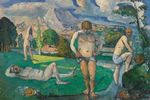
Artists are greedy to learn and art is self-devouring; the handover from the nineteenth to the twentieth century was swiftly done. As was the handover from one kind of artist to another. Cézanne was an obscure figure even when famous; he was secretive, frugal, unacquisitive; he would often go missing for weeks on end; his emotional life, such as it was, remained deeply private and protected; and he had no interest in what the world called success. Braque was a dandy with a chauffeur; while Picasso single-handedly embodied the twentieth century’s ideal of an artist – public, political, rich, successful in all the meanings of the word, camera-loving and concupiscent. And if Cézanne might have thought Picasso’s life vulgar – in the sense that it detracted from the time, and the human integrity, required to make art – how austere and high-minded Picasso would come to seem compared to the most “successful” artists of the twenty-first century, flogging their endless versions of the same idea to know-nothing billionaires.

more from Julian Barnes at the TLS here.

brain watching

I17_Jan-Estep_fMRI_web_230x173

I BEGAN THINKING ABOUT why these scientific methods and the resulting images have such a hold on our imaginations a couple of years ago, when I started shadowing a team of cognitive neuroscientists as they developed a study about the neural and cognitive bases of semantic knowledge. We eventually decided I’d be one of the test subjects. The study, which began late last spring, has given me first-hand experience with the fMRI machine and how data are collected and interpreted into usable results. Scientists are now employing fMRI technology—which has been in practical use since the 1980s—to study a wide range of neurological phenomena: visual perception, object recognition, memory, the effects of stroke and brain injury, depression, schizophrenia, degenerative diseases like Alzheimer’s and Parkinson’s, personality traits, fear, racial attitudes, deception, our relationship to food and sex, how we make financial and political decisions, and so on.

more from Jan Estep at Triple Canopy here.

Roll Over Beethoven

Cover00

In 1948, his first year of teaching at Black Mountain College, John Cage gave a lecture on Erik Satie, at the time a little-known French composer. To make his point about Satie’s significance, Cage weighed him against a composer who needed no introduction. “Beethoven was in error,” he said, “and his influence, which has been as extensive as it is lamentable, has been deadening to the art of music.” All that could be said of the German composer is that his legacy was to “practically shipwreck the art on an island of decadence.” In Indeterminacy, Cage recounted Satie’s remark that “what was needed was a music without any sauerkraut in it,” and “that the reason Beethoven was so well known was that he had a good publicity manager.” For his apostasy Cage not only alienated several friends among the Black Mountain music faculty but inspired, at least if the anecdotes can be believed, a number of students to torch their Beethoven records. Satie was correct in at least one respect: Beethoven never lacked for good publicity.

more from Eric Banks at Bookforum here.

Learning to Speak American

Tim Parks in the New York Review of Books:

ScreenHunter_95 Dec. 27 17.32In 1993 I translated all 450 pages of Roberto Calasso’s The Marriage of Cadmus& Harmony without ever using the past participle of the verb “get.” The book was to be published simultaneously by Knopf in New York and Jonathan Cape in London; to save money both editions were to be printed from the same galleys; so it would be important, I was told, to avoid any usages that might strike American readers as distractingly English or English readers as distractingly American. To my English ear “gotten” yells America and alters the whole feel of a sentence. I presumed it would be the same the other way round for Americans. Fortunately, given the high register of Calasso’s prose, “get” was not difficult to avoid.

Now in 2012 I am obliged to sign up to “gotten.” Commissioned by an American publisher to write a book that explores the Italian national character through an account of thirty years’ commuting and traveling on the country’s rail network, I am looking at an edit that transforms my English prose into American. I had already sorted out the spelling, in fact had written the book with an American spell check, and didn’t expect that there would be much else to do. Wrong. Almost at once there was a note saying that throughout the 300 pages my use of “carriage” for a passenger train car must be changed to “coach.” Since this is a book about trains and train travel there were ninety-eight such usages. There was also the problem that I had used the word “coach” to refer to a long distance bus. Apparently the twenty-four-hour clock was not acceptable, so the 17:25 Regionale from Milan to Verona had to become the 5:25 PM Regionale. Where I, in a discussion of prices, had written “a further 50 cents” the American edit required “a further 50 euro cents,” as if otherwise an American reader might imagine Italians were dealing in nickels and dimes.

More here.

America’s Unwritten Constitution

Robert P. George in the New York Times Book Review:

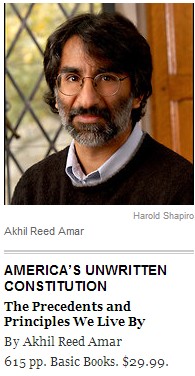
ScreenHunter_94 Dec. 27 17.29In “America’s Unwritten Constitution,” Akhil Reed Amar, a commendably unorthodox and, in some ways, iconoclastic constitutional scholar at Yale Law School, bucks dominant opinions on both sides of the political spectrum. He contends that the written Constitution points to an unwritten one, and he argues that we can interpret with both intellectual honesty and analytical rigor. Aware that the idea of an unwritten constitution has been abused by judges and scholars on both the left and right, Amar insists that the idea itself is sound — indeed indispensable to the cause of constitutional fidelity — and needs rescuing from its abusers.

Liberal jurists and legal scholars are accused, often justly, of failing to take the text of the Constitution seriously, or to seek the meaning of its written provisions by understanding them in their historical context. They treat concepts like “due process of law” and “the equal protection of the laws” as, in the words of the liberal justice William J. Brennan Jr., “majestic generalities” that can be assigned whatever meanings would best serve the cause of justice as they happen to perceive it.

Historically, it has not been only liberals who have stood under indictment for this offense. At the height of the Industrial Revolution, a conservative-dominated Supreme Court struck down a state law restricting work hours, citing an implicit right to freedom of contract between employers and workers. Critics of laissez-faire ideas about economic justice accused the court’s members of manufacturing this right to serve their ideological purposes.

More here.

Searching for truth in a post-green world

Paul Kingsnorth in Orion Magazine:

Stockphotopro_25014AYZ_no_titleI’VE RECENTLY BEEN reading the collected writings of Theodore Kaczynski. I’m worried that it may change my life. Some books do that, from time to time, and this is beginning to shape up as one of them. It’s not that Kaczynski, who is a fierce, uncompromising critic of the techno-industrial system, is saying anything I haven’t heard before. I’ve heard it all before, many times. By his own admission, his arguments are not new. But the clarity with which he makes them, and his refusal to obfuscate, are refreshing. I seem to be at a point in my life where I am open to hearing this again. I don’t know quite why. Here are the four premises with which he begins the book:

1. Technological progress is carrying us to inevitable disaster.
2. Only the collapse of modern technological civilization can avert disaster.
3. The political left is technological society’s first line of defense against revolution.
4. What is needed is a new revolutionary movement, dedicated to the elimination of technological society.

Kaczynski’s prose is sparse, and his arguments logical and unsentimental, as you might expect from a former mathematics professor with a degree from Harvard. I have a tendency toward sentimentality around these issues, so I appreciate his discipline. I’m about a third of the way through the book at the moment, and the way that the four arguments are being filled out is worryingly convincing. Maybe it’s what scientists call “confirmation bias,” but I’m finding it hard to muster good counterarguments to any of them, even the last. I say “worryingly” because I do not want to end up agreeing with Kaczynski. There are two reasons for this. Firstly, if I do end up agreeing with him—and with other such critics I have been exploring recently, such as Jacques Ellul and D. H. Lawrence and C. S. Lewis and Ivan Illich—I am going to have to change my life in quite profound ways. Not just in the ways I’ve already changed it (getting rid of my telly, not owning a credit card, avoiding smartphones and e-readers and sat-navs, growing at least some of my own food, learning practical skills, fleeing the city, etc.), but properly, deeply. I am still embedded, at least partly because I can’t work out where to jump, or what to land on, or whether you can ever get away by jumping, or simply because I’m frightened to close my eyes and walk over the edge. I’m writing this on a laptop computer, by the way. It has a broadband connection and all sorts of fancy capabilities I have never tried or wanted to use. I mainly use it for typing. You might think this makes me a hypocrite, and you might be right, but there is a more interesting observation you could make. This, says Kaczynski, is where we all find ourselves, until and unless we choose to break out. In his own case, he explains, he had to go through a personal psychological collapse as a young man before he could escape what he saw as his chains. He explained this in a letter in 2003:

I knew what I wanted: To go and live in some wild place. But I didn’t know how to do so. . . . I did not know even one person who would have understood why I wanted to do such a thing. So, deep in my heart, I felt convinced that I would never be able to escape from civilization. Because I found modern life absolutely unacceptable, I grew increasingly hopeless until, at the age of 24, I arrived at a kind of crisis: I felt so miserable that I didn’t care whether I lived or died. But when I reached that point a sudden change took place: I realized that if I didn’t care whether I lived or died, then I didn’t need to fear the consequences of anything I might do. Therefore I could do anything I wanted. I was free!

More here.

What will your next body be like?

Ian Pearson in Timeguide:

BodyMany engineers, including me, think that some time around 2050, we will be able to make very high quality links between the brains and machines. To such an extent that it will thereafter be possible (albeit expensive for some years) to arrange that most of your mind – your thinking, memories, even sensations and emotions, could reside mainly in the machine world. Some (perhaps some memories that are rarely remembered for example) may not be suited to such external accessibility, but the majority should be. The main aim of this research area is to design electronic solutions to immortality. But actually, that is only one application, and I have discussed electronic immortality a few times now :

http://timeguide.wordpress.com/2012/01/29/how-to-live-forever/

http://timeguide.wordpress.com/2012/01/21/increasing-longevity-and-electronic-immortality-3bn-people-to-live-forever/

What I want to focus on this time is that you don’t have to die to benefit. If your mind is so well connected, you could inhabit a new body, without having to vacate your existing one. Furthermore, there really isn’t much to stop you getting a new body, using that, and dumping your old one in a life support system. You won’t do that, but you could. Either way, you could get a new body or an extra one, and as I asked in passing in my last blog, what will your new body look like?

Firstly, why would you want to do this? Well, you might be old, suffering the drawbacks of ageing, not as mobile and agile as you want to be, you might be young, but not as pretty or fit as you want to be, or maybe you would prefer to be someone else, like your favourite celebrity, a top sports hero, or maybe you’d prefer to be a different gender perhaps? Or maybe you just generally feel you’d like to have the chance to start over, do it differently. Maybe you want to explore a different lifestyle, or maybe it is a way of expressing your artistic streak. So, with all these reasons and more, there will be plenty of demand for wanting a new body and a potentially new life.

More here.

Thursday Poem

You Are Not

You are not in the tulips,
not in their flailing stems
or shrivelled yellow petals
that alive you’d have painted;
not in the pearly wintry sky
or the scarred slopes of the hill
that before your legs failed
you’d have climbed;
not in the spiky firs
or eddies and swirls of the river
or in its still sandy pools
where in your youth
you’d have swum;
not in the beginning drizzle of snow,
or in the deer that hangs
in the larder with black hooves
and long delicate legs,
not in its heart or liver
that we ate last night for supper
and you would have relished.

I don’t know where you are
who loved all the things
I love; who I remember
hauling out of the bath –
tugging on arms I was afraid
of pulling from their sockets;
then drying and helping to dress
and guiding down slippery stone steps
to watch flycatcher chicks
leaving the nest, hearing
the peep peep peep
of their mother’s warning call.
.

Vicki Feaver
from Like a Fiend Hid in a Cloud
publisher: Jonathan Cape, London, 2013

The Next Left

Sunkara_37.6_bull

Jake Blumgart interviews Bhaskar Sunkara, in Boston Review:

Jake Blumgart: Who is Jacobin’s intended audience? You don’t really seem to be trying to engage with conservatives.

Bhaskar Sunkara: The intended audience is connected to the two distinct goals ofJacobin. The first is an intra-left goal to reassert the importance of class and Marxist analysis in the context of an increasingly anarchist-inflected left. We aren’t dogmatic and orthodox, we don’t think the old ways of organizing and thinking are the way forward, but we’re committed to adapting those ways of thinking to new material realities.

But there is another goal, which is more directed to the general public and—I don’t think I’ve put it this crassly before—to liberals: articulating radical left ideas and doing so in a way that is clear and accessible. The pieces are meant to be uncompromising in content but informed, accessible, and in good faith. Over the course of the project, this attempt has been wildly successful. We may get furious cries from the left for getting attention from people such as Christopher Hayes, Reihan Salam, Andrew Sullivan, and whatnot. But that’s part of our intended purpose. We don’t want a world where Hayes and Katrina vanden Heuvel are the de facto left in this country. That’s not saying anything against them; they are principled social democrats. That’s a lot for the American context. But by existing and getting the amount of mass media attention we get — fromRolling Stone to the New York Times —we’re visible reminders of a long-forgotten, and uncompromisingly socialist, political tradition. We are also trying to bring a radical perspective on politics and economics to our predominately young audience, while other publications from our generation are focused more on culture. It’s very much in the tradition of the Second International radicals—Kautsky, Lenin, Luxemburg, and their contemporaries weren’t academics.

That’s not saying that those frameworks don’t have their place, and I love publications like n+1 and the like, but I’m talking about poverty critiques that feel like they have to start with a hook from The Wire. I think that’s bullshit. I think we can just write the essay on poverty and include a few line graphs in it. I think the left can do with a dose of empiricism and that our ideas can stand-up next to others by virtue of their seriousness.

Just Deserts: An Interview with Danielle S. Allen

Hector_2

Justin E. H. Smith interviews Danielle S. Allen in Cabinet magazine:

Your book The World of Prometheus offers a perfect way of giving historical depth to this issue on punishment, but it may also be interesting to reflect on how punishment in ancient Athens is relevant to our understanding of punishment in the contemporary world and, in particular, in the US. I’ve read both Prometheus andTalking to Strangers, your more recent book on Brown v. Board of Education, and one thing that struck me is how many of the same themes run through both books. You observe in Prometheus that the value of approaching punishment through the Greeks is that we’re able to “sharpen our thinking about punishment on the stone of the unfamiliar ancient world.” Does this remain for you the ultimate reason for studying ancient conceptions of punishment: that it gives us a point of access for understanding the problem of punishment itself by looking at an unfamiliar conception of it?

I can tell you the origin story of the book, which is simply that, as an undergraduate, I took a class on Athenian politics in which we read a lot of the speeches that were given in Athenian law courts. I was really taken aback by the fact that there was very little mention of imprisonment in those speeches, and I suddenly realized that I couldn’t imagine a world where prisons weren’t a major part of how we think about punishment. That captivated me, and I wanted to understand a world where imprisonment was not the dominant mode of understanding punishment. In that regard, the origin of the book was absolutely the shock of discovering, by looking at the ancient world, that our world is contingent, and that one particular contingency is the degree to which we use incarceration. It bears some thinking as to how we got there and what a world without extensive incarceration looks like.

Well, that might be right about our contemporary context; the ancient story is somewhat different.