Thursday Poem

The Heart and the Mind

I love him with all my heart
But that is where the whole problem lies,
My mind warns me.
that the man I love
Is a man with four young children.
My heart says I will love him
As well as his four or one hundred children!
But my mind sighs and says:
What will happen if his children do not accept you?

I love him with all my heart,
And I will love him to the end of the world.
He has more wealth than we both need.
Again my mind interferes with my love:
Wealth is morning dew,
Let the sun reach the noon of its life,
The dew – the wealth of the morning
Will be nowhere to be seen.
Do I need to embarrass you with the question?

But I cannot help falling in love with such a handsome man.
So young, he will stride into the future with me.
And my mind looks desperate:
Why are you so fascinated with perishables?
Do you know of any one with perpetual youth?
Ever heard of someone who died of good health?
All men grow old and weak with time.
No one has ever leaped into the future.
Is it going to start with your handsome man?

by Paul Chidyausiku
Publisher: PIW, 2007

Wednesday, November 21, 2012

philosopher photos

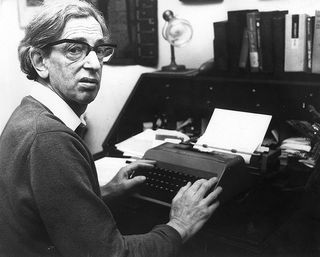
Jerry_Fodor

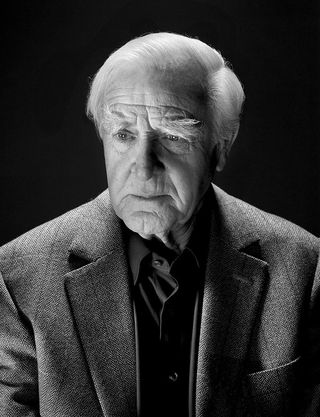
“After a certain age, every man has the face he deserves,” claims Jean-Baptiste Clamence, the self-proclaimed ‘judge-penitent’ in Albert Camus’ final novel, The Fall. A century earlier, Abraham Lincoln had decided that the all-important age was forty years, reportedly refusing to appoint someone to a post in his government because he didn’t like his appearance. Aged forty-six and on his deathbed, George Orwell more prudently proclaimed that it was at fifty that “every man has the face he deserves.” None of them seemed to have a view about women. Nor did any of them consider the altogether more plausible suggestion that it is our parents, partners, employers and government who have the most to answer for when it comes to our faces, and that, by the same token, we might ourselves be held a little accountable for the faces of those we share our lives with.

more from Constantine Sandis at Philosophy Now here.

Some Views From Jerusalem

Jerusalem-missile

I look forward to blessing my children on Sabbath eve as a highlight of each week. But this week, as missles and rockets flew back and forth between Gaza and southern Israel, the yearning for peace and well-being for children felt particularly acute, for mine and ours and theirs, all caught in the middle of a cascading political failure, a persistent vacuum of vision and leadership. I put on my jacket and stepped out of our garden gate to head to a local synagogue to hear how a Rabbi with whom I have been studying on Sun. evenings for the past few weeks would respond. A deeply kind and compassionate man, he is composing his doctoral dissertation in Philosophy on the metaphysical and theological underpinnings of John Rawls’ concept of distributive justice. As such, his commitment to traditional Judaism is deeply intertwined with a rigorous and deeply felt humanism, a combination all too rare these days. Three steps out of the gate, as I turned up the lovely, quiet street we live on, a different kind of siren sounded.

more from a 3QD friend, Strummerson, at The Motley Moose here.

The camera never lies, so we’ve been altering photographs to suit our needs since the invention of photography itself

Our own Morgan Meis in The Smart Set:

ID_IC_MEIS_FAKE_AP_001Is it a painting or a photograph? It is a harbor. Ships sit on the beach at low tide. The clouds are puffy and white in the sky. A city can be seen in the background. Lovely cliffs rise up behind. Édouard Baldus, a Frenchman, created the image in 1855. It is a photograph, but the clouds have [been] painted on to the print. The image comes to us from The Metropolitan Museum of Art in the way of an exhibit titled “Faking It: Manipulated Photography Before Photoshop,” on view through January 27th, 2013. The exhibit contains photographs that have been doctored and manipulated from the 1840s all the way up through the 1990s. The inspiration for the show is explained to us thusly:

Over the past two decades, digital technology has made us all more keenly aware of the malleability of the photographic image, and many lament a loss of faith in the testimony of the camera. What we have gained, however, is a fresh perspective on the history of the medium and its complex relationship to visual truth. Through today's eyes, we can see that the old adage “the camera never lies” has always been photography's supreme fiction.

People like to believe this about photography. They like to believe that photographs are a direct testimonial of visual truth, that the camera never lies. When it can be shown, however, that photographs are always lying, that they are always a manipulation of visual truth, it is supposed to be a great revelation. The revelation of fakery in photography thus gives us a “fresh perspective” and reveals to us that there is no reason to “lament a loss of faith in the testimony of the camera” since there was no reason to have any faith in the testimony of the camera in the first place.

In fact, this reasoning is cockamamie all over the place. That's because photography did not begin as a way to visually record the truth. Photography began as a new way to make paintings.

More here.

Meditations on life and letters

Adam Kirsch in Poetry:

The only copy of Catullus’s poems to survive from antiquity was discovered in the Middle Ages, plugging a hole in a wine barrel. One of two morals can be drawn from this fact. Either pure chance determines what survives, from which it follows that eventually every work will lose its gamble and be forgotten; or else every worthy work is registered in the eye of God, the way books are registered for copyright, so that its material fate is irrelevant. The first conclusion, which is rationally inevitable, would in time lead anyone to stop writing; anyone who continues to write somehow believes a version of the second. But surely a God who was able to preserve all human works could also preserve all human intentions—indeed, He could deduce the work from its intention far more perfectly than the writer can produce it. Thus a writer with perfect trust would not have to do any work, but simply confide his intentions and aspirations to God. His effort, the pains he takes, are the precise measure of his lack of trust.

Writers are necessarily ambivalent about any kind of recognition—honors, prizes, simple praise—because they are ambivalent about their relationship to the present. The first audience that a writer wants to please is the past—the dead writers who led him to want to write in the first place. Forced to admit that this is impossible, he displaces his hope onto the future, the posterity whose judgment he will never know. That leaves the present as the only audible judge of his work; but the present is made up of precisely the people whom the writer cannot live among, which is why he subtracts himself from the actual world in order to deposit a version of himself in his writing. The approbation of the living is thus meaningful to a writer only insofar as he can convince himself that it is a proxy for the approbation of the past or the future—insofar as it becomes metaphorical.

More here.

Wednesday Poem

i like my body when it is with your body

i like my body when it is with your
body. It is so quite new a thing.
Muscles better and nerves more.
i like your body. i like what it does,
i like its hows. i like to feel the spine
of your body and its bones, and the trembling
-firm-smooth ness and which i will
again and again and again
kiss, i like kissing this and that of you,
i like, slowly stroking the, shocking fuzz
of your electric fur, and what-is-it comes
over parting flesh . . . . And eyes big love-crumbs,

and possibly i like the thrill

of under me you so quite new

by e.e. cummings

The eclipse of feudalism in Pakistan

Arif Hasan in HimalSouthAsian:

Arif_Feudalism_sliderIn recent years, you will have heard of a lot of honour killings in Pakistan, and they have been blamed on the Taliban. I would like to present my case through another anecdote. In 1983, I worked in a taluka in rural Sindh, a province that had suffered under the Pakistan Army because of the movement for democracy. I had not returned to the district since, but read in a newspaper report in 2006 that honour killings were taking place there with regularity. So I went over to study the phenomenon.

I asked an elder from the taluka whom I had met in 1983, now much older, “Sahib, did you have honour killings before?”

He said, “Yes, we used to have one in perhaps ten years. It was a rare occurrence, and we would discuss one for ten years until another happened.”

“Then why it is happening now with such regularity?”

He said, “Now, everyone has become shameless, without honour, so honour killings are taking place.”

I asked, “Why is there no honour today?”

He responded, “The young people, they’ve gone to the city, and they’ve done all the wrong things. The girls have learned how to read and write, they’ve gone to school, some of them have gone to university as well. They have no morals left, so this is bound to happen.”

“You mean this is going to continue like this forever?”

“No, no, it will stop!”

“How and when will it stop?”

His reply was educative: “The honour killings will stop when everyone becomes shameless, then it will end.” Then he added, “But I hope that I die before that day.”

He was a man of the old, feudal rural culture, with its own pattern of behaviour and way of thinking. He was part of it, and it was dying, so he wished to die with it.

In 1992, the applications for court marriages in Karachi amounted to about 10 or 15, mainly applications from couples who were seeking the protection of the court for wedlock without familial consent. By 2006, we were seeing more than 250 applications for court marriages per day in Karachi. Significantly, more than half of the couples seeking court recognition of their betrothal came from rural areas of Sindh. This is yet another indication of how the entire feudal system and its values are in rapid collapse.

This collapse is also heralded by the advances in women’s education. According to 2006 figures, fully 72 percent of the University of Karachi student body is today female. Among medical students, 87 percent are women, and the figure for architecture and planning is as high as 92 percent. In fact, our vice chancellor was so concerned that he suggested a quota for men. I used to teach a class with one boy and 15 girls. That has changed a little now as we have tried to even it out. But the reason is simply that women do better on the entrance tests. There’s no other reason for it. In 1971, I started working in low-income settlements in Karachi, and a decade later I joined the Orangi Pilot Project (OPP). The settlements that we worked in at that time were primarily working-class, and when we went over we were met by older men who were mostly illiterate. They spoke to us in very formal, feudal language – janaab, huzoor, sahib, miyan, “We are all your children and need your protection,” and all that. At that time, in the 1980s, the women hardly worked. Things are entirely different when you go to the OPP today; it’s not what you would call a shanty settlement. It’s mostly the younger generation who will meet you, and they will address you as ‘uncle’ rather than ‘sahib’. The people you meet are bank managers, school teachers, professionals working in the service sector of Karachi. The additional phenomenon of the past decade has been the growing anarchy linked to the Afghan war, and the further demise of feudal institutions. Spending a week in northern Sindh earlier this year, I was struck by three elements. Firstly, I noticed the immense physical mobility women have gained from the end of feudalism. Nothing can control them or contain them anymore. Secondly, there are protests against the excesses both of the landlords and of the establishment. If the landlord has been harsh, or if the state has not delivered on some demand, the men come out and block the highway. Often it is women who carry out the blockade because the police action against them is not so harsh. Thirdly, the nature of landlord-ship has changed. The landlord is now married to a modern, urban woman, and that heralds significant shifts. When I asked villagers about the difference between the old landlords and the new, the reply was, “The young landlord has married into the city and stays in Karachi. His children never come here either, so we are alright.” The result is that sharecropping has given way to contracting, and this has transformed the society of rural Sindh.

More here.

What Should Teachers Say to Religious Students Who Doubt Evolution?

From Scientific American:

Origin-of-Species-208x300I’m teaching Darwin again this semester, in two separate courses, and I’m confronted with a familiar dilemma: How should I respond to students who reject evolutionary theory on religious grounds?

…I point out that some religion-bashing Darwinians exaggerate the power of evolutionary theory. For example, Richard Dawkins was wrong–egregiously wrong–when he claimed in his 1986 bestseller The Blind Watchmaker that life “is a mystery no longer because [Darwin] solved it.” Even when bolstered by modern genetics, evolutionary theory does not explain why life emerged on Earth more than 3 billion years ago, or whether life was highly probable, even inevitable, or a once in a universe fluke. The theory doesn’t explain why life, after remaining single-celled for more than 2 billion years, suddenly spawned multi-cellular organisms, including one exceedingly strange mammal capable of pondering its own origins. Some prominent thinkers—from philosopher Karl Popper to complexity theorist Stuart Kauffman–have critiqued Darwinism for purely scientific rather than religious reasons. Some of these critics have suggested that natural selection, as conventionally understood, must be supplemented by other processes, such as “self-organization” of simple chemical and biological systems. But so far none of these alternatives has gained much traction. As for proponents of intelligent design, some raise reasonable questions about the limits of biology, but their answers—which invoke some sort of divine intervention–are pathetically inadequate. The theory of evolution by natural selection is arguably the single most profound insight into reality that humanity has ever achieved, and it is supported by overwhelming evidence–mountains of evidence!–from the ever-expanding fossil record to DNA analyses of living species.

These are the sorts of things I tell my students. I feel a bit queasy, I admit, challenging their faith, from which some of them derive great comfort. Part of me agrees with one student who wrote: “Each individual is entitled to his or her own religious beliefs… Authority figures teaching America’s youth should not be permitted to say certain things such as any religion being simply ‘wrong’ due to a certain scientific explanation.” On the other hand, if I don’t prod these young people into questioning their most cherished beliefs, I’m not doing my job, am I?

More here.

Time-Reversal Violation Is Not the “Arrow of Time”

Sean Carroll in Cosmic Variance:

Bd326f6b371fb9abLooks like the good folks at the BaBar experiment at SLAC, feeling that my attention has been distracted by the Higgs boson, decided that they might be able to slip a pet peeve of mine past an unsuspecting public without drawing my ire. Not so fast, good folks at BaBar!

They are good folks, actually, and they’ve carried out an extremely impressive bit of experimental virtuosity: obtaining a direct measurement of the asymmetry between a particle-physics process and its time-reverse, thereby establishing very direct evidence that the time-reversal operation “T” is not a good symmetry of nature. Here’s thetechnical paper, the SLAC press release, and a semi-popular explanation by the APS. (I could link you to the Physical Review Letters journal server rather than the arxiv, but the former is behind a paywall while the latter is free, and they’re the same content, so why would I do that?)

The reason why it’s an impressive experiment is that it’s very difficult to directly compare the rate of one process to its precise time-reverse. You can measure the lifetime of a muon, for example, as it decays into an electron, a neutrino, and an anti-neutrino. But it’s very difficult (utterly impractical, actually) to shoot a neutrino and an anti-neutrino directly at an electron and measure the probability that it all turns into a muon. So what you want to look at are oscillations: one particle turning into another, which can also convert back.

More here.

Former Israeli Prime Minister Ariel Sharon’s Son, Gilad, on Gaza

Gilad Sharon in the Jerusalem Post:

ScreenHunter_44 Nov. 21 09.42Why do our citizens have to live with rocket fire from Gaza while we fight with our hands tied? Why are the citizens of Gaza immune? If the Syrians were to open fire on our towns, would we not attack Damascus? If the Cubans were to fire at Miami, wouldn’t Havana suffer the consequences? That’s what’s called “deterrence” – if you shoot at me, I’ll shoot at you. There is no justification for the State of Gaza being able to shoot at our towns with impunity. We need to flatten entire neighborhoods in Gaza. Flatten all of Gaza. The Americans didn’t stop with Hiroshima – the Japanese weren’t surrendering fast enough, so they hit Nagasaki, too.

There should be no electricity in Gaza, no gasoline or moving vehicles, nothing. Then they’d really call for a ceasefire.

Were this to happen, the images from Gaza might be unpleasant – but victory would be swift, and the lives of our soldiers and civilians spared.

If the government isn’t prepared to go all the way on this, it will mean reoccupying the entire Gaza Strip. Not a few neighborhoods in the suburbs, as with Cast Lead, but the entire Strip, like in Defensive Shield, so that rockets can no longer be fired.

More here.

Tuesday, November 20, 2012

pantheistic rapture

80a8a741-2bdb-4a97-ad8f-fe48cac8ed3b

Ferdinand Hodler is one of those artists who have been lazily marginalised by history because they don’t slot neatly into a national movement or an influential school. Born in Switzerland in 1853, he dipped a toe in the international currents of his time, but he mostly followed his own internal muse through byways of naturalism and symbolism. The Neue Galerie’s haunting survey of his last decade, Ferdinand Hodler: View to Infinity, reveals an artist of idiosyncratic gifts, prodigious struggles and perpetual independence. Like his fellow maverick, Vincent van Gogh (who was born the same year), he tinged his direct observations with spiritual meaning and channelled his mysticism through an uncompromising scrutiny of nature. In the people and places he faithfully transcribed, naturalism and abstraction collide with occasionally discomfiting results.

more from Ariella Budick at the FT here.

the sena

Image

The Shiv Sena (the name means “the army” of the 17th-century Marathi-speaking King Shivaji) was founded with a 1966 rally in Mumbai’s Shivaji Park that drew a crowd of 250,000 people. Bal Thackeray, the movement’s leader, denounced the government of the state of Maharashtra — created only six years earlier to unite Marathi speakers — for its failure to protect the interests of its constituents, who he said were losing jobs and housing to recent migrants. The Sena, which has explicitly invoked European fascist movements from the outset, describes itself in its founding documents as a “volunteer organization” rather than a political party or union; it was created to defend a Marathi claim to Maharashtra and to Mumbai. This claim was initially defended at the expense of South Indians and Communists. Later, as an ideology of Hindu nationalism became ascendant in national politics, the Marathi claim to Maharashtra and Mumbai was made at the expense of Muslim inhabitants. The Sena spread through the city’s neighborhoods, establishing shakhas (neighborhood organizations) in zopadpattis and chawls. For the Marathi-speaking people they represented, the shakhas succeeded in obtaining services from local officials that the state had never before provided: water connections, electricity, even employment. For non-Marathi speakers, the Sena was at best exclusionary; at worst, it boycotted their stores, harassed them on the street, and smashed their windows.

more from Anand Vaidya at n+1 here.

Amitav Ghosh: Products of Folly

5027159273_232079be0a

An interview with Emily Mkrtichian:

Guernica: In a recent speech for the European Cultural Foundation, you addressed migration and climate change as factors contributing to the “crisis” and “catastrophe” our earth is now facing. You also said, “Nationalism is indeed one of the most pernicious threads in this helix of disaster.” How does nationalism contribute to our current situation? Is this the same patriotism that Captain Mukheriji spit in the face of?

Amitav Ghosh: Yes, I think it is in many ways a perfect example of that. If you take two examples, the US and Australia, both have made perfectly clear that they will make no move on climate change. At all costs they want to preserve their own standard of living if it be at the expense of destroying the whole world. It is nationalism carried to its greatest and most absurd extreme. Essentially what we are seeing is an absolute refusal to address any of the issues, to reach any kind of compromise geared toward the world community and absolute insistence on maintaining their own standards of living which are unbelievably wasteful and which have really essentially created the problem in the first place.

Guernica: Right. We know that if everybody in in the world were to live by the same environmental standards as people in the United States or Australia, it would be completely unsustainable. You mentioned in your speech that collective ideals and sacrifice for the greater good are values that have really disappeared from the US or Australia in that sense.

Amitav Ghosh: The US and Australia are good examples—what happened was that European populations arrived in continents that were relatively underpopulated and had enormous resources. Basically, they created these extremely wealthy, but also extremely spend-thrift civilizations that are just big predators; just sucking everything up. There has been incredible resource extraction, to a point where now their own ecosystems are collapsing. Most of all in the US, where the aquifers have been drained and they are no longer able to sustain agriculture. It all grew out of this idea that everyone should pursue their own profit at all costs and no value is attached to the common good. The common good is a principle that literally doesn’t exist in the US discourse anymore.

The Confessions of Kofi Annan

Michael Ignatieff in the New York Review of Books:

ScreenHunter_43 Nov. 20 15.26How do we explain Kofi Annan’s enduring moral prestige? The puzzle is that it has survived failures, both his own and those of the institution he served for fifty years.1 Personal charisma is only part of the story. In addition to his charm, of which there is plenty, there is the authority that comes from experience. Few people have spent so much time around negotiating tables with thugs, warlords, and dictators. He has made himself the world’s emissary to the dark side.

To these often dire negotiations, he brought a soothing temperament that became second nature early in his Ghanaian childhood. His father, Henry Reginald Annan, lived across two worlds, as a senior executive with a British multinational corporation and a hereditary chieftain in a country poised on the eve of national independence. In the Ghanaian struggle, the Annan family occupied the cautious middle, supporting independence but keeping their distance from the revolutionary nationalism of Kwame Nkrumah.

From these experiences, Annan became adept at circumspection and skillful in dealing with all sides, while keeping his own cards concealed. It was a temperament perfect for the UN. When he found his career in Ghana blocked by a succession of military regimes, he enlisted in the UN and has spent all his life in its upper reaches in New York and Geneva. Like Barack Obama, he learned early to live across racial divides and to position himself as the rational and relaxed confidant of all, while belonging finally to no one but himself.

More here.

Ban ‘Killer Robots’ Before It’s Too Late

From the website of Human Rights Watch:

2012_Arms_taranisGovernments should pre-emptively ban fully autonomous weapons because of the danger they pose to civilians in armed conflict, Human Rights Watch said in a report released today. These future weapons, sometimes called “killer robots,” would be able to choose and fire on targets without human intervention.

The 50-page report, “Losing Humanity: The Case Against Killer Robots,” outlines concerns about these fully autonomous weapons, which would inherently lack human qualities that provide legal and non-legal checks on the killing of civilians. In addition, the obstacles to holding anyone accountable for harm caused by the weapons would weaken the law’s power to deter future violations.

“Giving machines the power to decide who lives and dies on the battlefield would take technology too far,” said Steve Goose, Arms Division director at Human Rights Watch. “Human control of robotic warfare is essential to minimizing civilian deaths and injuries.”

“Losing Humanity is the first major publication about fully autonomous weapons by a nongovernmental organization and is based on extensive research into the law, technology, and ethics of these proposed weapons. It is jointly published by Human Rights Watch and the Harvard Law School International Human Rights Clinic.

More here.

An Open Letter to the President

From Rabbi Brant Rosen's blog, Shalom Rav:

Dear Mr. President,

My younger brother was an early believer in you. He worked for your Senate campaign. At the age of 25, he ran the GOTV campaign in North Carolina, delivering an improbable victory for you in a Southern state that helped give you your first term. This year, slightly less bright-eyed but nonetheless a believer, he was working on your campaign again when he died suddenly, a brilliant, energetic 29 year old, dead in his tracks. You know this. You called my parents. Your campaign, to my greatest appreciation and respect, brought grief counselors for his coworkers, dedicated a corner of the office and much of your fundraising efforts to him, and bussed his coworkers to join the hundreds of others at his funeral.

You may not know that after his sudden passing, many of his friends quit their jobs, moved, changed their lives to continue working on your campaign in his memory. One of these friends ran your GOTV effort in Ohio, delivering a close swing state that resulted in the race being called for you early. My mom and I joined these efforts in Ohio, door-knocking until right before the polls closed, pounding the pavement in Alex’s memory and in hopes of your next presidency. Despite my disappointment in some of your stances, I proudly kept my Ohio for Obama sticker on my jacket.

Until yesterday. Mr. President, when the bombs began raining on Gaza again and you reiterated Israel’s “right to defend itself”, I took that sticker off my jacket.

More here.

Tuesday Poem

September 1, 1939

I sit in one of the dives
On Fifty-second Street
Uncertain and afraid
As the clever hopes expire
Of a low dishonest decade:
Waves of anger and fear
Circulate over the bright
And darkened lands of the earth,
Obsessing our private lives;
The unmentionable odour of death
Offends the September night.

Accurate scholarship can
Unearth the whole offence
From Luther until now
That has driven a culture mad,
Find what occurred at Linz,
What huge imago made
A psychopathic god:
I and the public know
What all schoolchildren learn,
Those to whom evil is done
Do evil in return.

Exiled Thucydides knew
All that a speech can say
About Democracy,
And what dictators do,
The elderly rubbish they talk
To an apathetic grave;
Analysed all in his book,
The enlightenment driven away,
The habit-forming pain,
Mismanagement and grief:
We must suffer them all again.

Read more »

Vikram Seth, a suitable passion

From The Telegraph:

Vikramseth_2402732bIt is always a pleasure when a novelist turns out in person exactly as you had expected from reading their books – doubly so when that author is Vikram Seth, who is so benevolent and linguistically agile on the page. He spoke at Hay Dhaka with his editor David Davidar, the founder of Penguin India, with whom he spent many hours editing A Suitable Boy. So closely did they work that Seth moved into Davidar’s house to make sure every detail of his 1,500-page novel was to his taste. Seth and Davidar were good enough friends to tease each other and generous enough to allow us to overhear them. Seth spoke how when he was studying economics at Stanford University in California he found Pushkin’s novel in verse Eugene Onegin. He was immediately gripped and – putting his academic thesis on the economics of seven Chinese villages – he started work on his own novel in verse written in Pushkin stanzas: The Golden Gate. Even now all his prose works are prefaced by a poem in this verse form.

The line that sparked A Suitable Boy, said Seth, was the one that became the opening: ‘You too will marry a boy I choose’. From that sentence the whole world of 1950s India unfurled. An audience member tried to tease out of him details of the sort-of sequel he is writing called A Suitable Girl. “The characters are shy,” said Seth. “If I call them out now they will fly away.” He did, though, reveal something of his work routine (always a source of fascination to readers). He worked from 2am to 8am, the silent hours allowing him full immersion in the world he created. To do this he forced himself to go to bed at 4pm.

More here.