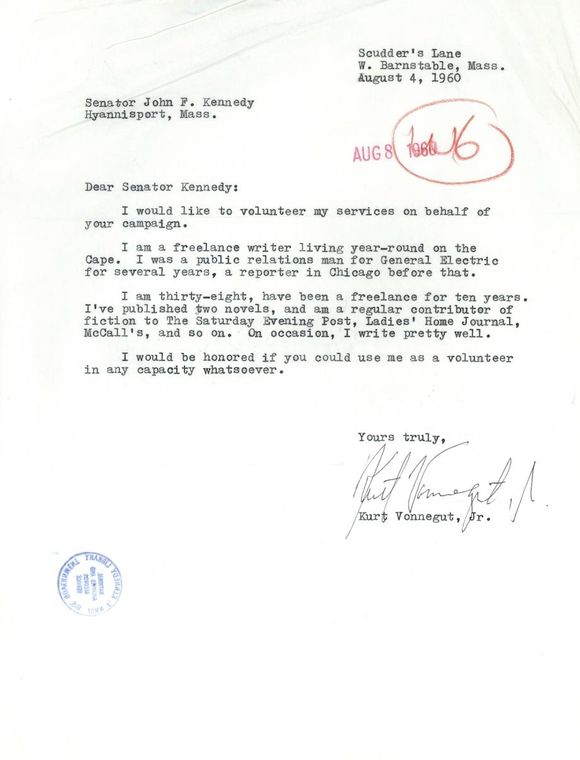
A term paper assignment from Kurt Vonnegut

From Slate:

1212_SBR_LETTERS_Vonnegut.jpg.CROP.article250-mediumThis course began as Form and Theory of Fiction, became Form of Fiction, then Form and Texture of Fiction, then Surface Criticism, or How to Talk out of the Corner of Your Mouth Like a Real Tough Pro. It will probably be Animal Husbandry 108 by the time Black February rolls around. As was said to me years ago by a dear, dear friend, “Keep your hat on. We may end up miles from here.”

As for your term papers, I should like them to be both cynical and religious. I want you to adore the Universe, to be easily delighted, but to be prompt as well with impatience with those artists who offend your own deep notions of what the Universe is or should be. “This above all …”

I invite you to read the fifteen tales in Masters of the Modern Short Story (W. Havighurst, editor, 1955, Harcourt, Brace, $14.95 in paperback). Read them for pleasure and satisfaction, beginning each as though, only seven minutes before, you had swallowed two ounces of very good booze. “Except ye be as little children …”

Then reproduce on a single sheet of clean, white paper the table of contents of the book, omitting the page numbers, and substituting for each number a grade from A to F. The grades should be childishly selfish and impudent measures of your own joy or lack of it. I don’t care what grades you give. I do insist that you like some stories better than others.

More here.

Noam Chomsky: Palestine 2012 — Gaza and the UN resolution

Noam Chomsky at his own website:

You-take-my-water2An old man in Gaza held a placard that reads: “You take my water, burn my olive trees, destroy my house, take my job, steal my land, imprison my father, kill my mother, bombard my country, starve us all, humiliate us all but I am to blame: I shot a rocket back.” [1]

The old man’s message provides the proper context for the timelines on the latest episode in the savage punishment of Gaza. They are useful, but any effort to establish a “beginning” cannot help but be misleading. The crimes trace back to 1948, when hundreds of thousands of Palestinians fled in terror or were expelled to Gaza by conquering Israeli forces, who continued to truck them over the border for years after the official cease-fire. The persecution of Gazans took new forms when Israel conquered the Strip in 1967. From recent Israeli scholarship we learn that the goal of the government was to drive the refugees into the Sinai, and if feasible the rest of the population too.

Expulsions from Gaza were carried out under the direct orders of General Yeshayahu Gavish, commander of the Southern Command. Expulsions from the West Bank were far more extreme, and Israel resorted to devious means to prevent the return of those expelled, in direct violation of Security Council orders. The reasons were made clear in internal discussion immediately after the war. Golda Meir, later Prime Minister, informed her Labor colleagues that Israel should keep the Gaza Strip while “getting rid of its Arabs.” Defense Minister Dayan and others agreed. Prime Minister Eshkol explained that those expelled cannot be allowed to return because “We cannot increase the Arab population in Israel” — referring to the newly occupied territories, already tacitly considered part of Israel. In accord with this conception, all of Israel’s maps were changed, expunging the Green Line (the internationally recognized borders), though publication was delayed to permit UN Ambassador Abba Eban to attain what he called “favorable impasse” at the General Assembly, by concealing Israel’s intentions. [2]

More here.

Is God Happy?

Kolakowski_1-122012_jpg_493x500_crop_q85A old piece by Leszek Kołakowski in the NYRB:

The question is not absurd. Our conventional view of happiness is as an emotional state of mind. But is God subject to emotion? Certainly, we are told that God loves His creatures, and love, at least in the human world, is an emotion. But love is a source of happiness when it is reciprocated, and God’s love is reciprocated only by some of His subjects, by no means all: some do not believe that He exists, some do not care whether He exists or not, and others hate Him, accusing Him of indifference in the face of human pain and misery. If He is not indifferent, but subject to emotion like us, He must live in a constant state of sorrow when He witnesses human suffering. He did not cause it or want it, but He is helpless in the face of all the misery, the horrors and atrocities that nature brings down on people or people inflict on each other.

If, on the other hand, He is perfectly immutable, He cannot be perturbed by our misery; He must therefore be indifferent. But if He is indifferent, how can He be a loving father? And if He is not immutable, then He takes part in our suffering, and feels sorrow. In either case, God is not happy in any sense we can understand.

We are forced to admit that we cannot understand the divine being—omnipotent, omniscient, knowing everything in Himself and through Himself, not as something external to Him, and unaffected by pain and evil.

The true God of the Christians, Jesus Christ, was not happy in any recognizable sense. He was embodied and suffered pain, he shared the suffering of his fellow men, and he died on the cross.

In short, the word “happiness” does not seem applicable to divine life. But nor is it applicable to human beings. This is not just because we experience suffering. It is also because, even if we are not suffering at a given moment, even if we are able to experience physical and spiritual pleasure and moments beyond time, in the “eternal present” of love, we can never forget the existence of evil and the misery of the human condition.

Contrary to Common Belief, Female Porn Stars have Great Self Esteem

Original

Or so claims so new research: Robert Gonzalez in io9:

Pornographic actresses are probably having more sex than you. No surprise there. But a newly published study suggests there's a good chance many of them have better self esteem, to boot — not to mention more enjoyable sex lives, better body images, and more positive outlooks on life. As for the widely held belief that female porn actresses share a history of sexual abuse (commonly known as the Damaged Goods Hypothesis), the researchers found the actresses were no more “damaged” than their non-pornographic counterparts.

In a study recounted in the latest issue of the Journal of Sex Research, a team of investigators led by Shippensburg University psychologist James D. Griffith surveyed 177 porn actresses on “a variety of behavioral, social, and psychological dimensions,” namely: demographic information (age, ethnicity, etc), sexual behaviors and attitudes, self-esteem, quality of life and drug use.

“Some descriptions of actresses in pornography have included attributes such as drug addiction, homelessness, poverty, desperation, being pimped out, and being victims of sexual abuse,” write the researchers. “Some have made extreme assertions, such as claiming that all women in pornography were sexually abused as children.”

But studies on women in porn are lacking. And without data, argue Griffith and his colleagues, “claims regarding the attributes of pornography actresses lack support.”

She’s Got Some Big Ideas

02POPOVA_SPAN-articleLarge

A profile of Maria Popova, the person behind the very awesome Brain Pickings, by Bruce Feiler in the NYT:

SHE is the mastermind of the one of the faster growing literary empires on the Internet, yet she is virtually unknown. She is the champion of old-fashioned ideas, yet she is only 28 years old. She is a fierce defender of books, yet she insists she will never write one herself.

At precisely 9:30 on a chilly Saturday morning, Maria Popova slips out of her apartment in Brooklyn, scurries down a few stairs and enters a small basement gym. A former recreational bodybuilder from Bulgaria, Ms. Popova is the unlikely founder of the exploding online emporium of ideas known as Brain Pickings.

Her exhaustively assembled grab bag of scientific curiosities, forgotten photographs, snippets of old love letters and mash notes to creativity — imagine the high-mindedness of a TED talk mixed with the pop sensibility of P. T. Barnum — spans a blog (500,000 visitors a month), anewsletter (150,000 subscribers) and a Twitter feed(263,000 followers). Her output, which she calls a “human-powered discovery engine for interestingness,” has attracted an eclectic group of devotees including the novelist William Gibson, the singer Josh Groban, the comedian Drew Carey, the neuroscientist David Eagleman, the actress Mia Farrow and the Twitter founders Biz Stone and Evan Williams.

“She’s a celebrator,” said Anne-Marie Slaughter, a Princeton professor and former State Department official. “You feel the tremendous amount of pleasure she takes in finding these things and sharing them. It’s like walking into the Museum of Modern Art and having somebody give you a customized, guided tour.”

Unlearning liberty

From Spiked:

As you would expect from the president of FIRE, Unlearning Liberty teems with detailed examples of campus censorship. There’s Texas Southern University’s ban on ‘inappropriate jokes’ that cause ‘physical or emotional harm’; there’s Northeastern University’s prohibition on email messages that ‘in the sole judgement of the university’ are ‘annoying’ or ‘offensive’. There’s the absurd case of a mature student at Indiana Uni-Purdue ‘found guilty of racial harassment’… for reading a history book about the defeat of the Ku Klux Klan. And there are countless more from the annals of draconian farce that are FIRE’s case files. Indeed, just how inessential the idea of free and open debate has become to the academy is revealed by the fact that many American universities have created specific so-called free-speech zones, complete with designated opening hours and booking systems. Freedom of thought is no longer installed at the centre of the academy; it’s been relegated to the margins.

It is not just the students who are trained to believe that there are things of which they must never speak; faculty members are, too. In 2005, for instance, Harvard president Larry Summers gave a speech in which he speculated that, at the highest end of the IQ spectrum, men might be genetically predisposed towards being cleverer than women. He was forced to resign. ‘If the president of Harvard can’t start a meaty, thought-provoking, challenging discussion’, notes Lukianoff, ‘who on earth can?’ The result of three decades’ worth of campus censorship, from the politically correct speech codes of the 1980s and 1990s to the anti-harassment dictata of today, has been chilling. Lukianoff tells me of a recent survey conducted by the American Association of Colleges and Universities: ‘Out of 24,000 students who were asked the question, “Is it safe to hold unpopular positions on campus?”, only 35 per cent of students strongly agreed. But, when broken down, the stat indicates something even worse. Forty per cent of freshmen strongly agreed, but only 30 per cent of seniors.’ In other words, students unlearn freedom of speech during their studies. ‘Even worse, only 16 per cent of university faculty strongly agreed with this statement. It’s not even a particularly strong statement, and if we’ve reached a point where only 16 per cent of faculty strongly agree with it, then we’re doing something wrong.’

How has this happened?

More here.

Starbucks vs the chai-wallah

Ritwik Deo in New Statesman:

ChaiThings are different in India. A blind lascivious beggar sings a bhojpuri ditty. Pregnant clouds over Bombay monsoon raindrops like the breasts of Khajuraho; heavy and laden. It is an overcast afternoon and the sun is no more. Humidity and sweat tugs at the will to go on. A long line of India’s young and trendy in Converse, in UCB, all Adidas and iPhonery wait for their turn at the recently opened Starbucks. Growing up in India, I remember queuing up outside the very first McDonalds in New Delhi for an hour to have a seven-rupee ice cream. KFC took us to giddy heights of rapture. A chicken wing in hand and a glass of frothy Coke in the other, we had arrived. We were no longer Indians any more. We were cosmopolitan Americans. It didn’t last that long. We fell out of love with the Golden Arches and the Colonel and reverted back to our cuisine. The scales fell and we realised that tandoori chicken, a bit of chilli and a pickled onion on the side was timeless. It was forever.

Similarly, this is still a nation of roadside and railway station chai-wallahs. City workers, students and manual labourers all frequent little shacks by the roadside for a spot of tea dust in hot milk. Corpulent politicians in spotless tunics, world-weary swamis and lecherous vagabonds squat under flimsy tarpaulins with a kulhad of cardamom chai and a slice of wheat rusk; a rare egalitarianism in a country riven by class and caste.The friendly chai-wallah with his muzzein-like call in the morning is a constant in an ever-changing India. Starbucks and a host other shiny coffee-wallahs will never equal the pavement camaraderie. For now, as the rainwater from the gutter turns from a trickle to a creek and then a river, eunuchs in garish red and green saris huddle together at the chai-wallah's not that far away from the new swish Starbucks in the fashionable Horniman’s Circle. Moments before the downpour they had been collecting bakshish, stopping motorbikes, manhandling pedestrians and molesting the office-wallahs A Sikh auto driver is filing his nails while a showman shares a biscuit with his pet monkey. Under his plastic sheet, the chai-wallah has a harem, his own court. He is a maharajah.

More here.

Sunday Poem

Key

The keys again.
It's back to counting steps keeping lists and still
It's elusive, something
He can't remember the ingredients for.

Then it's nothing-
Or nothing to hang onto. Good.
But there you are.
“Oh, but it's not me, I am a declaration of invisibility.”

Look.
Drifting, floating, pulse of pure consciousness
Wishful thinking, fleeing the mortal coil
Somewhere around here.

Seeing all, feeling all, and at the same time.
Hope, requiring the ubiquity
A heartbeat of love
Nearby.

Mind's eye retraces diamond-like
Cut in countless fractures, rays
There.
Finger the key

Brilliant morning light
On the steps

by Walter Burnham
.

Saturday, December 1, 2012

Hitler’s Strange Afterlife in India

1354268749741.cached

Dilip D’Souza in The Daily Beast:

My wife teaches French to tenth-grade students at a private school here in Mumbai. During one recent class, she asked these mostly upper-middle-class kids to complete the sentence “J'admire …” with the name of the historical figure they most admired.

To say she was disturbed by the results would be to understate her reaction. Of 25 students in the class, 9 picked Adolf Hitler, making him easily the highest vote-getter in this particular exercise; a certain Mohandas Gandhi was the choice of precisely one student. Discussing the idea of courage with other students once, my wife was startled by the contempt they had for Gandhi. “He was a coward!” they said. And as far back as 2002, the Times of India reported a survey that found that 17 percent of students in elite Indian colleges “favored Adolf Hitler as the kind of leader India ought to have.”

In a place where Gandhi becomes a coward, perhaps Hitler becomes a hero.

Still, why Hitler? “He was a fantastic orator,” said the 10th-grade kids. “He loved his country; he was a great patriot. He gave back to Germany a sense of pride they had lost after the Treaty of Versailles,” they said.

“And what about the millions he murdered?” asked my wife. “Oh, yes, that was bad,” said the kids. “But you know what, some of them were traitors.”

Admiring Hitler for his oratorical skills? Surreal enough. Add to that the easy condemnation of his millions of victims as traitors. Add to that the characterization of this man as a patriot. I mean, in a short dozen years, Hitler led Germany through a scarcely believable orgy of blood to utter shame and wholesale destruction. Even the mere thought of calling such a man a patriot profoundly corrupts—is violently antithetical to—the idea of patriotism.

But these are kids, you think, and kids say the darndest things. Except this is no easily written-off experience. The evidence is that Hitler has plenty of admirers in India, plenty of whom are by no means kids.

Consider Mein Kampf, Hitler’s autobiography. Reviled it might be in the much of the world, but Indians buy thousands of copies of it every month.

Questions Concerning the Murder of Benazir Bhutto

Owen Bennett-Jones in the London Review of Books:

Benazir_bhutto_1448641cIn her posthumously published book, Reconciliation, Benazir Bhutto named a man whom she believed had tried to procure bombs for an unsuccessful attempt on her life in Karachi in October 2007:

I was informed of a meeting that had taken place in Lahore where the bomb blasts were planned … a bomb maker was needed for the bombs. Enter Qari Saifullah Akhtar, a wanted terrorist who had tried to overthrow my second government. He had been extradited by the United Arab Emirates and was languishing in the Karachi central jail … The officials in Lahore had turned to Akhtar for help. His liaison with elements in the government was a radical who was asked to make the bombs and he himself asked for a fatwa making it legitimate to oblige. He got one.

Akhtar’s story reveals much about modern Pakistan. Born in 1959, he spent two years of his boyhood learning the Quran by heart and left home at the age of 18, moving to the radical Jamia Binoria madrassah in Karachi. In 1980, he went on jihad, fighting first the Soviets in Afghanistan and later the Indians in Kashmir. In both conflicts he came into contact with Pakistani intelligence agents, who were there trying to find out what was going on and to influence events. Helped by the high attrition rate among jihadis, he rose through the ranks and by the mid-1990s, after an intense power struggle with a rival commander, emerged as the leader of Harkat ul Jihad al Islami or HUJI, once described by a liberal Pakistan weekly as ‘the biggest jihadi outfit we know nothing about’.

In 1995, Akhtar committed a crime that in many countries would have earned him a death sentence: he procured a cache of weapons to be used in a coup. Putsches in Pakistan generally take the form of the army chief moving against an elected government. This one was an attempt by disaffected Islamist officers to overthrow not only Bhutto’s government but also the army leadership.

The plot’s leader was Major General Zahir ul Islam Abbasi. In 1988, as Pakistan’s military attaché in Delhi, he acquired some sensitive security documents from an Indian contact. When the Indians found out, they beat him up and expelled him. He returned to Pakistan a national hero. Seven years later, disenchanted by the secularist tendencies of both Bhutto and the army leadership, he devised a plot to storm the GHQ and impose sharia. Akhtar’s role was to supply the weapons.

More here.

Why the Art World Is So Loathsome: Eight theories

Simon Doonan in Slate:

134733125.jpg.CROP.rectangle3-large1. Art Basel Miami.

It’s baaa-ack, and I, for one, will not be attending. The overblown art fair in Miami—an offshoot of the original, held in Basel, Switzerland—has become a promo-party cheese-fest. All that craven socializing and trendy posing epitomize the worst aspects of today’s scene, provoking in me a strong desire to start a Thomas Kinkade collection. Whenever some hapless individual innocently asks me if I will be attending Art Basel—even though the shenanigans don’t start for another two weeks, I am already getting e-vites for pre-Basel parties—I invariably respond in Tourette’s mode:

“No. In fact, I would rather jump in a river of boiling snot, which is ironic since that could very well be the title of a faux-conceptual installation one might expect to see at Art Basel. Have you seen Svetlana’s new piece? It’s a river of boiling snot. No, I’m not kidding. And, guess what, Charles Saatchi wants to buy it and is duking it out with some Russian One Percent-er.”

More here.

The Brain: The Charlie Brown Effect

Carl Zimmer in Discover:

67669_10151114579187541_1187092319_nI am sitting in a darkened, closet-size lab at Tufts University, my scalp covered by a blue cloth cap studded with electrodes that detect electric signals from my brain. Data flow from the electrodes down rainbow-colored wires to an electroencephalography (eeg) machine, which records the activity so a scientist can study it later on.

Wearing this elaborate setup, I gaze at a television in front of me, focusing on a tiny cross at the center of the screen. The cross disappears, and a still image appears of Snoopy chasing a leaf. Then Charlie Brown takes Snoopy’s place, pitching a baseball. Lucy, Linus, and Woodstock visit as well. For the next half hour I stare at Peanuts comic strips, one frame at a time. The panels are without words, and while sometimes the action makes sense from frame to frame, at other times the Peanuts gang seems to be engaging in a series of unconnected shenanigans.

At the same time, a freshly minted Ph.D. named Neil Cohn is watching the readout from my brain, an exercise he has repeated with some 100 subjects to date. Many people would consider tracking Peanuts or Calvin and Hobbes comic strips unworthy of scientific inquiry, but Cohn begs to differ. His evidence suggests that we use the same cognitive process to make sense of comics as we do to read a sentence. They seem to tap the deepest recesses of our minds, where we bring meaning to the world.

More here.

stella

1202-Bogdanovich-thumbStandard

She was always concerned about the question of integrity, and would bring it up whenever we saw each other. It was, she pointed out, the central theme of “Golden Boy”: Odets “wrote it after he got back to New York from a scriptwriting job in Hollywood, when a lot of his friends on the left were criticizing him for ‘selling out.’ I think he was torn between the Hollywood movie scene and the New York theater scene in the same way Joe” — the lead in “Golden Boy” — “is torn between boxing for big money and becoming a great violinist.” Stella always grilled me to make sure I hadn’t lost my integrity; she considered this a major problem for the American artist. I wonder what she would have said about the almost total materialism of our current era? Stella Adler was a grande dame of the theater. I never met anyone remotely like her. With her mid-Atlantic accent, she was once mistaken by a London shopkeeper for English. “No,” she replied, “just affected.” And at a New York cocktail party, she once made a sweeping entrance that brought a hush to the room. A little girl turned to her mother and asked in an awed whisper, “Mommy, is that God?” I understand how the little girl felt. All Stella’s students would.

more from Peter Bogdanovitch at the NY Times here.

eagleton reads the derrida bio

Jacques-Derrida-in-His-Li-010

I suspect that one reason Derrida enjoyed travelling the world so much was because it allowed him some respite from the bitchy, sectarian, backstabbing, backscratching climate of Parisian intellectual life, which this superb biography faithfully records. What the book fails to underline quite as heavily is how waspish the maitre himself could be. Two dramatic moments stand out in Derrida’s subsequent career. Traveling to communist Prague in 1981 to address a secretly organised philosophy seminar, he was arrested and charged with drug smuggling. It seems the authorities saw the dismantling of binary oppositions as a threat to the state. The police officer who had planted the drugs in Derrida’s suitcase was himself later arrested for drug trafficking.

more from Terry Eagleton at The Guardian here.

At heart is the mystery of the universe

600

“The Higgs particle arises from a field pervading space, known as the Higgs field,” explains Caltech physicist Sean Carroll in “The Particle at the End of the Universe: How the Hunt for the Higgs Boson Leads Us to the Edge of a New World.” “Everything in the known universe, as it travels through space, moves through the Higgs field; it’s always there lurking invisibly in the background.” As to why this matters, Carroll points out that “without the Higgs, electrons and quarks would be massless, just like photons, the particles of light. They would move at the speed of light themselves, and it would be impossible to form atoms and molecules much less life as we know it…. Without it, the world would be an utterly different place.”

more from David L. Ulin at the LA Times here.

The women who dominated publishing in 2012

From The Guardian:

EL James

AbooksFour years ago a dissatisfied TV executive was inspired by Stephenie Meyer's Twilight novels to start writing steamy online fan fiction about the leading characters in which sparkly-skinned vampire Edward and bold virgin Bella were made over as an entrepreneur and a college graduate. If the narrative of the first Twilight books was powered by heavy-breathing abstinence and the revelation that good vampires wait until marriage, online forums were where readers could let rip. There were thousands of similarly sexed-up Twilight stories on the web, but in May 2011 – after some name changes and minor tweaks – a tiny Australian publisher, Writer's Coffee Shop, “talked James into” publishing her BDSM fantasies as an ebook, which was then picked up by Random House in the US. Rumours about copies being exchanged with blushes on the school run or borrowed from hairdressers snowballed into reports of New York hardware shops running out of rope as the book climbed the New York Times bestseller lists. The trilogy was rushed into print in the UK this April and by August, Fifty Shades of Grey, the story of damaged billionaire Christian Grey and eager college student Anastasia Steele, a love affair-cum-therapy session-cum-shopping spree played out against their erotic relationship, was the bestselling book in British history.

Like Harry Potter and The Da Vinci Code, it burst the banks of the publishing world; people were buying it who didn't otherwise buy books, if only to find out what the fuss was about. It single-handedly re-ignited the women's erotica market, which had withered when Black Lace covers began to look dated, as well as tapping a whole new readership who didn't know or care that – as those in the know sniffily pointed out – you could find much better erotica, for free, on the web. Thus it was a victory for the paperback, as well as for ebooks and self-publishing. The Kindle has been credited with removing the embarrassment from reading dirty books, but what Fifty Shades revealed is that erotica isn't shameful any more so long as enough people are reading it already, and it's got a tasteful jacket (James wanted restrained covers, having herself squirmed over reading lurid-looking romances on the tube).

In literary terms, the books are atrocious: whole blogs have been dedicated to pulling them apart sentence by sentence.

More here.

100 Notable Books of 2012

From The New York Times:

BooksFICTION & POETRY

ALIF THE UNSEEN. By G. Willow Wilson. (Grove, $25.) A young hacker on the run in the Mideast is the protagonist of this imaginative first novel.

ALMOST NEVER. By Daniel Sada. Translated by Katherine Silver. (Graywolf, paper, $16.) In this glorious satire of machismo, a Mexican agronomist simultaneously pursues a prostitute and an upright woman.

AN AMERICAN SPY. By Olen Steinhauer. (Minotaur, $25.99.) In a novel vividly evoking the multilayered world of espionage, Steinhauer’s hero fights back when his C.I.A. unit is nearly destroyed.

ARCADIA. By Lauren Groff. (Voice/Hyperion, $25.99.) Groff’s lush and visual second novel begins at a rural commune, and links that utopian past to a dystopian, post-global-warming future.

…NONFICTION

ALL WE KNOW: Three Lives. By Lisa Cohen. (Farrar, Straus & Giroux, $30.) The vanished world of midcentury upper-class lesbians is portrayed as beguiling, its inhabitants members of a stylish club.

AMERICAN TAPESTRY: The Story of the Black, White, and Multiracial Ancestors of Michelle Obama. By Rachel L. Swarns. (Amistad/HarperCollins, $27.99.) A Times reporter’s deeply researched chronicle of several generations of Mrs. Obama’s family.

AMERICAN TRIUMVIRATE: Sam Snead, Byron Nelson, Ben Hogan, and the Modern Age of Golf. By James Dodson. (Knopf, $28.95.) The author evokes an era when the game was more vivid and less corporate than it seems now.

More here.