Is the universe being created by a computer program?
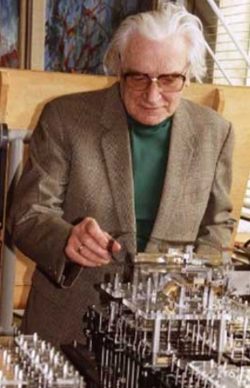
To a man with a hammer, everything looks like a nail. To a man with a computer, everything looks like a computation.
More here.

Is the universe being created by a computer program?
To a man with a hammer, everything looks like a nail. To a man with a computer, everything looks like a computation.
More here.
Malcolm Gladwell:
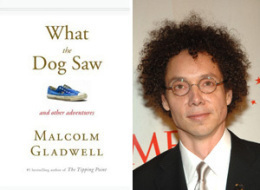
“Miss Clairol gave American women the ability, for the first time, to color their hair quickly and easily at home. But there was still the stigma — the prospect of the disapproving mother-in-law. Shirley Polykoff knew immediately what she wanted to say, because if she believed that a woman had a right to be a blonde, she also believed that a woman ought to be able to exercise that right with discretion. 'Does she or doesn't she?' she wrote, [echoing her own mother-in-law's disdainful comment 'Fahrbt zi der huer? Oder fahrbt zi nisht?' and] translating from the Yiddish to the English. 'Only her hairdresser knows for sure.' Clairol bought thirteen ad pages in Life in the fall of 1956, and Miss Clairol took off like a bird. That was the beginning. For Nice 'n Easy, Clairol's breakthrough shampoo-in hair color, she wrote, 'The closer he gets, the better you look.' For Lady Clairol, the cream-and-bleach combination that brought silver and platinum shades to Middle America, she wrote, 'Is it true blondes have more fun?' and then, even more memorably, 'If I've only one life, let me live it as a blonde!' (In the summer of 1962, just before The Feminine Mystique was published, Betty Friedan was, in the words of her biographer, so 'bewitched' by that phrase that she bleached her hair.) Shirley Polykoff wrote the lines; Clairol perfected the product. And from the fifties to the seventies, when Polykoff gave up the account, the number of American women coloring their hair rose from 7 percent to more than 40 percent.
More here.
Gareth Cook in The New Yorker:

Wi-Fi syndrome does, however, make sense in the context of a larger phenomenon: the “nocebo effect,” the placebo effect’s malevolent Mr. Hyde. With placebos (“I will please” in Latin), the mere expectation that treatment will help brings a diminution of symptoms, even if the patient is given a sugar pill. With nocebos (“I will harm”), dark expectations breed dark realities. In clinical drug trials, people often report the side effects they were warned about, even if they are taking a placebo. In research on fibromyalgia treatments, eleven per cent of the people taking the equivalent of sugar pills experienced such debilitating side effects that they dropped out.
More here. [Thanks to Aditya Dev Sood.]
“Farhad Manjoo and Evgeny Morozov debate Morozov’s new book on “the folly of technological solutionism,” over in Slate. Manjoo:
Dear Evgeny,
A few weeks ago, while traveling from my home in Palo Alto to the South by Southwest Interactive Festival—that is, between two of your favorite places in the world—I loaded up the Kindle app on my phone and began reading your new book, To Save Everything, Click Here: The Folly of Technological Solutionism. Since then I’ve cycled through a variety of devices and apps to read and jot down my reactions to your polemic against the tech industry and its windy boosters, and I’m thrilled to be chatting with you about it this week.
You and I have very different visceral reactions to technology. You keep your router and smartphone locked in a safe; I’ve quit reading books and magazines on paper. Still, I’ve long been an admirer of your work. You’re the most sensitive bullshit detector in tech punditry—when someone in this industry is talking out of his ass, I can count on you to take him down. Readers not familiar with your work should start with your masterful skewering of puffed-up blogger Jeff Jarvis, of whose book, Public Parts, you wrote: “This is a book that should have stayed a tweet.”
Not surprisingly, Jarvis is one of your main targets in To Save Everything, and what I like best about your book is that you’re still not pulling any punches. (Disclosure: You critically cite my own work in a couple of places, though, mercifully, I’m one of the few people you handle with kid gloves.) I enjoyed the many barbs you hurled at Jarvis and your other intellectual opponents, including the speculation that their ignorance stems from being “too young or inexperienced with books” and the claim that they possess a “knowledge of history … reduced to tweet-length CliffsNotes.” You’re one of those writers who likes to show off his superiority by quoting your opponents’ grammatical errors with an appended [sic]. In other words, you’re a fighter, Morozov—and it’s not without a bit of trepidation that I jump into the ring with you.
Roli Roberts in the PLOS Biologue:
Have you ever watched “Seven Brides for Seven Brothers”? There are these seven brothers and, well you get the idea… But that was complicated enough with the two sexes that we boring old humans have – what if you had seven? That’s the exotic situation that the ciliate Tetrahymena finds itself in.
We can only speculate as to how these creatures handle their private lives, but thanks to a paper just published in PLOS Biology we now know how they decide which of the seven sexes to be.
PLOS Biology recently published another example of ciliate madness – the bizarre 16,000 chromosomes of Oxytricha. Each generation that creature makes a “working copy” of its genome by a massive cut’n'paste job that results in almost one chromosome per gene. Tetrahymena does a similar thing, though not as spectacularly (a mere 225 chromosomes – as published in another PLOS Biology paper), and that’s where the sex decision is taken.
Marcella Cervantes, Eduardo Orias and colleagues now show how this happens, and it involves playing genomic roulette.
Robert Hodonyi and Helga Trüpel in Eurozine:
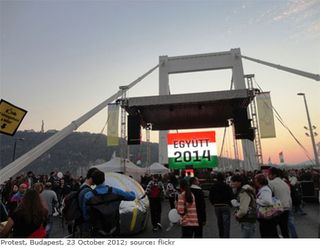
At the beginning of the year Prime Minister Victor Orbán predicted that 2013 would be the “Year of Harvest” for Hungary and that everything would be better than in 2012. To reap the fruits of his own policies, as he had already declared in a speech to Hungarian diplomats in August 2012, the path of “unorthodox” measures would be continued and further conflicts even with the EU would not be shied away from. Orbán's announcement may well impress his followers but to minorities in the country, the opposition and European institutions it must seem like a cynical threat. Although Orbán is still leading in the polls, the right-wing conservative government coalition Fidesz-KNDP has lost a significant share of the votes (41 per cent, down 12 per cent compared with 2010). The two-thirds majority is a thing of the past.
A determination to cement power
Since the “revolution at the ballot box” (in Orbán's words) the government has been pulling out all the stops to implement laws aimed at cementing its own power and in the long term preventing other political majorities. The latest example of this is the introduction of the compulsory registration of voters, which for the time being has been blocked by the Hungarian constitutional court; this is, however, only one element of the proposed electoral reform that Orbán has declared a priority for his current term in office. Compulsory registration would have barred spontaneous voters and citizens without any clear party political preferences from voting, thus favouring the Orbán camp. The government is not contesting the ruling of the constitutional court. Rather than admit defeat it is in the process of preparing a law aimed at overturning the prevailing constitutional practice and henceforth prohibiting the court from using its own rulings of the last 22 years as a basis for its judgement.With such “reforms”, Orbán's Fidesz Party is already positioning itself for the next general election to be held in the spring of 2014. And the Hungarian public is already eyeing next year's election as a “key election for the state of the nation”. In the wake of the “cold civil war” between the Left and the Right, an anti-Orbán alliance has formed and is now in the process of establishing itself as an institution and exploring possible coalitions with parliamentary oppositions for 2014. But also, profound changes are taking place in the relationship to “Brussels” and the European partners, not to mention the constant flirtation and increased economic co-operation with authoritarian regimes such as Russia, China, Kazakhstan and Azerbaijan. This article looks at both the state of the conflict with the EU on the one hand and the new awakening of civil society on the other, as well as the relation between these phenomena.
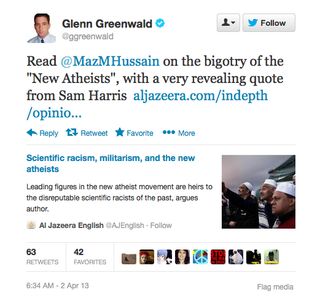
Jerry Coyne over at Why Evolution is True weighs in on the Sam Harris-Glenn Greenwald debate on the New Atheists and Islam:
The thing that distresses me the most, as I suspect it does Harris, is the fast-and-loose use of the term “Islamophobia”, intended as a brand of “racism,” to criticize those who emphasize the dangers of Islam. This puzzles me, as New Atheists have never been accused of “Christian-phobia” or “Hindu-phobia.” There is a double standard at work here—one enacted in a misguided defense of multiculturalism and moral relativism. Those who accuse others of “Islamophobia” are, I suspect, a bit bigoted themselves, for underlying it is the notion that we’re supposed to hold adherents of Islam to behavioral standards lower than those we expect from adherents to other faiths. It’s patronizing.
It is obvious to any objective person that, among all faiths, Islam poses the most danger to our world. Followers of which faith riot and kill over cartoons, subjugate women in the most offensive ways possible, send suicide bombers to weddings, blow up airplanes, buses, and embassies, advocate a form of law that would destroy democracy, issue fatwas and death threats against writers they don’t like, and espouse death to apostates, converts, and unbelievers? If you think that all religions are equally dangerous—that, for instance, Islam is no more dangerous than the Anglican Church, Quakers, or even Catholics (an invidious faith itself)—then you’re living in a fantasy world. If we had a choice to improve our world by dispelling just one brand of religious belief, I know which one I’d choose. That doesn’t mean, of course, that other faiths aren’t dangerous as well, or that we should work toward dispelling religious belief in general.
But what is Islamophobia? It’s certainly not racism, because racism is a form of bigotry against people based on things they cannot change: the genes that make them look different from others. Religious beliefs, on the other hand, are not genetically based, can be changed, and are often inherently dangerous. It’s no more “racism” to criticize Islam than it is to criticize the beliefs of Republicans or Tories.
In truth, those who hurl charges of “Islamophobia” never define it. That’s because it is, at bottom, only “criticism of the tenets of Islam,” and that doesn’t sound so bad. And it’s all in the name of multiculturalism. Indeed, ethnic diversity has good things going for it, as it exposes people to different points of view, enriches a society by exposing it to other cultures, and actually dispels racism by showing people that members of other “races” are human beings like themselves. It’s this exposure, in fact, that Peter Singer and Steve Pinker hold largely responsible for the increasing morality of our species. And I am proud to be a liberal who, like many of my kind, defends the benefits of multiculturalism.
The Cuban Missile Crisis was over in 1962. But the militarization of Florida and its national parks had only just begun. Nike Hercules Missile Site — also called Alpha Battery or HM-69 — was completed in 1964. “Nike,” like the Greek goddess of victory, was the name the United States’ government gave to a widely deployed, guided surface-to-air missile system installed to protect the country from any missile attack — threatened or real. From the mid-20th century, Nike Missile defense sites were built all over the United States in rings around cities and major industrial sites — around 260 all told. But no other state was as physically close to an “enemy” nation as Florida. Though the Cuban Missile Crisis ended with an uneasy détente, it was only after 1962 that the U.S. government realized how especially vulnerable south Florida was. HM-69 — and all south Florida — became the frontline defense against enemy attack. 146 U.S. Army soldiers and technicians made HM-69 their home. Their main task was to operate the site’s three aboveground launchers and, ostensibly, protect south Florida from Cuban air strikes. Flight time for a supersonic jet bomber launched from Cuba to Miami was very short.
more from Stefany Anne Golberg at The Smart Set here.
What I felt, however, when I opened Absalom Absalom! that winter, 1964, was that this novel indeed carried the incommensurate to extremes in the representation of human life (though I couldn’t have said such a thing). It was an ocean. An ocean of words. Those long sentences, the parentheses and the italics (all of which apparently meant something, but not always the same thing, and in any case I wasn’t sure what). The confusing characters’ names (Bond? Bon?). The confusing generations. The author’s casual refusal to explain virtually anything (you just had to pick stuff up as you hurtled along). The brooding, Learish, enigmatic figure of Thomas Sutpen, who’d crossed the eastern mountains to tame the Mississippi swamps. The uncertain thread of the whole story (was it Quentin’s?). The furious set-pieces: the Negroes chasing the French architect through the cane brakes; Wash Jones, his pulchritudinous daughter, and the randy Sutpen in the murderous scuppernong arbor; the spooky house, the great fire at the end; Miss Rosa Coldfield spooling it out because she couldn’t not. It buoyed me, it sunk me, it turned me upside down. I loved it, I loathed it. It was familiar, it was alien. But I took on faith that this was a great novel. But what I didn’t understand was why it had to represent life in this way. Why all the word-storm and turbidity? Life seemed fairly knowable to me at nineteen. Hemingway seemed to have a much clearer and truer view of things.
more from Richard Ford at Threepenny Review here.
The aim of good theology is to help the audience to live for a while in that silence. This means that at some point theology must remind us of what God is not. Apophatic or ‘speechless’ theology is often called ‘negative’, because it helps us to realise that when we encounter transcendence we have reached the end of what words can do. It is a habit of mind that we have lost sight of in our talkative age of information, and this has made what we call ‘God’ incredible to many. Diarmaid MacCulloch, Professor of the History of the Church at Oxford University, has adapted his Gifford Lectures to explain the role of silence in Christian history. With his customary verve, elegance and erudition, he starts with Elijah’s revelation of a voiced silence on Mount Horeb, the silent patience of Isaiah’s Suffering Servant, and the dread Israel felt when their God did not speak. We then progress from Jesus’s enigmatic silences to the half-hour silent interlude in the Book of Revelation, to gnostic, monastic and Platonic silence, and to the apophatic theology of the sixth-century Syrian theologian who wrote under the name of St Paul’s Athenian convert Dionysius the Areopagite.
more from Karen Armstrong at Literary Review here.
Workin' Man's Blues #2
Bob Dylan
There's an evenin' haze settlin' over the town
Starlight by the edge of the creek
The buyin' power of the proletariat's gone down
Money's gettin' shallow and weak
The place I love best is a sweet memory
It's a new path that we trod
They say low wages are a reality
If we want to compete abroad
My cruel weapons have been put on the shelf
Come sit down on my knee
You are dearer to me than myself
As you yourself can see
I'm listenin' to the steel rails hum
Got both eyes tight shut
Just sitting here trying to keep the hunger from
Creeping it's way into my gut
Meet me at the bottom, don't lag behind
Bring me my boots and shoes
You can hang back or fight your best on the front line
Sing a little bit of these workingman's blues
From The Guardian:
Horobin recalls that Tony Blair, when prime minister, misspelled tomorrow three times in a single document. For fear lest Blair be mocked, spin doctors claimed that his “toomorrow” was not in fact an error but merely a quirk of his flamboyant penmanship. Inevitably, too, Horobin mentions Dan Quayle, the 44th vice president of the United States and occasional purveyor of memorable gaffes. In 1992 Quayle was widely ridiculed for correcting a 12-year-old New Jersey schoolboy's spelling of potato – “You've almost got it … but it has an e on the end.” It was bad enough that Quayle didn't know how to spell potato, yet his graver offence was amending the efforts of someone who did – an act that seemed a symptom of a larger misplaced confidence.
More here.
From Nature:
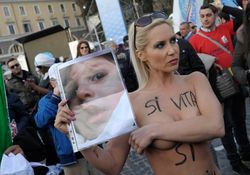
Stamina Foundation president Davide Vannoni, a psychologist at the University of Udine, says that the publicity around the treatment has won him 9,000 new patients. He hopes that further modifications to the law will allow him to expand the therapy. A month ago, an investigatory television programme, The Hyena, reported that children with incurable diseases such as spinal muscular atrophy were being denied supposedly important treatment, and Italian show-business personalities joined the call to relax rules on stem-cell treatment.
More here.
Keir A. Lieber and Daryl G. Press in Foreign Affairs:

Ironically, the risk of North Korean nuclear war stems not from weakness on the part of the United States and South Korea but from their strength. If war erupted, the North Korean army, short on training and armed with decrepit equipment, would prove no match for the U.S.–South Korean Combined Forces Command. Make no mistake, Seoul would suffer some damage, but a conventional war would be a rout, and CFC forces would quickly cross the border and head north.
At that point, North Korea’s inner circle would face a grave decision: how to avoid the terrible fates of such defeated leaders as Saddam Hussein and Muammar al-Qaddafi. Kim, his family, and his cronies could try to escape to China and plead for a comfortable, lifelong sanctuary there — an increasingly dim prospect given Beijing’s growing frustration with Kim’s regime. Pyongyang’s only other option would be to try to force a cease-fire by playing its only trump card: nuclear escalation.
More here.
Matt Schudel in the Washington Post:

She had a pulmonary disorder, said James Ivory, the film director who had worked with Mrs. Jhabvala since the early 1960s. Besides the Academy Award, her honors included the Booker Prize, Britain’s highest literary honor.
Mrs. Jhabvala’s life took many unusual turns, beginning with her exile to England from her childhood home in Germany, but none was more surprising than her journey into the world of filmmaking.
After moving to New Delhi with her Indian-born husband in the 1950s, Mrs. Jhabvala (pronounced JAHB-vah-lah) wrote a series of novels and short stories set in her new homeland. In 1961, she received a phone call asking if she would write a screenplay of her novel “The Householder.”
The call came from Ismail Merchant, a young producer from India who was making his first feature film. The director was Ivory, an American who had previously made only documentaries. Mrs. Jhabvala accepted the project, despite knowing almost nothing about screenwriting, and the film was produced in 1963.
More here.
Natalie Angier in the New York Times:

Dragonflies, by contrast, look dainty, glittery and fun, like a bubble bath or costume jewelry, and they’re often grouped with butterflies and ladybugs on the very short list of Insects People Like. Yet they are also voracious aerial predators, and new research suggests they may well be the most brutally effective hunters in the animal kingdom.
When setting off to feed on other flying insects, dragonflies manage to snatch their targets in midair more than 95 percent of the time, often wolfishly consuming the fresh meat on the spur without bothering to alight. “They’ll tear up the prey and mash it into a glob, munch, munch, munch,” said Michael L. May, an emeritus professor of entomology at Rutgers. “It almost looks like a wad of snuff in the mouth before they swallow it.”
Next step: grab more food. Dragonflies may be bantam, but their appetite is bottomless. Stacey Combes, who studies the biomechanics of dragonfly flight at Harvard, once watched a laboratory dragonfly eat 30 flies in a row. “It would have happily kept eating,” she said, “if there had been more food available.”
More here.
Evgeny Morozov in The Baffler:
While the brightest minds of Silicon Valley are “disrupting” whatever industry is too crippled to fend off their advances, something odd is happening to our language. Old, trusted words no longer mean what they used to mean; often, they don’t mean anything at all. Our language, much like everything these days, has been hacked. Fuzzy, contentious, and complex ideas have been stripped of their subversive connotations and replaced by cleaner, shinier, and emptier alternatives; long-running debates about politics, rights, and freedoms have been recast in the seemingly natural language of economics, innovation, and efficiency. Complexity, as it turns out, is not particularly viral.
This is not to deny that many of our latest gadgets and apps are fantastic. But to fixate on technological innovation alone is to miss the more subtle—and more consequential—ways in which a clique of techno-entrepreneurs has hijacked our language and, with it, our reason. In the last decade or so, Silicon Valley has triggered its own wave of linguistic innovation, a wave so massive that a completely new way to analyze and describe the world—a silicon mentality of sorts—has emerged in its wake. The old language has been rendered useless; our pre-Internet vocabulary, we are told, needs an upgrade.
Fortunately, Silicon Valley, that never-drying well of shoddy concepts and dubious paradigms—from wiki-everything to i-something, from e-nothing to open-anything—is ready to help. Like a good priest, it’s always there to console us with the promise of a better future, a glitzier roadmap, a sleeker vocabulary.
Silicon Valley has always had a thing for priests; Steve Jobs was the cranky pope it deserved. Today, having mastered the art of four-hour workweeks and gluten-free lunches in outdoor cafeterias, our digital ministers are beginning to preach on subjects far beyond the funky world of drones, 3-D printers, and smart toothbrushes. That we would eventually be robbed of a meaningful language to discuss technology was entirely predictable. That the conceptual imperialism of Silicon Valley would also pollute the rest of our vocabulary wasn’t.
The enduring emptiness of our technology debates has one main cause, and his name is Tim O’Reilly.
Gary Gutting in The Stone:
An old friend and mentor of mine, Ernan McMullin, was a philosopher of science widely respected in his discipline. He was also a Catholic priest. I don’t know how many times fellow philosophers at professional meetings drew me aside and asked, “Does Ernan really believe that stuff?” (He did.) Amid all the serious and generally respectful coverage of the papal resignation and the election of a new pope, I often detect an undertone of this same puzzlement. Can reflective and honest intellectuals actually believe that stuff?
Here I sketch my reasons for answering “yes.” What I offer is neither apologetics aimed at converting others nor merely personal testimony. Without claiming to speak for others, I try to articulate a position that I expect many fellow Catholics will find congenial and that non-Catholics (even those who reject all religion) may recognize as an intellectually respectable stance. Easter is the traditional time for Christians to reaffirm their faith. I want to show that we can do this without renouncing reason.
Toward the end of James Joyce’s “A Portrait of the Artist as a Young Man,” the protagonist, Stephen Dedalus, rejects the Roman Catholic faith he was raised in. A friend suggests that he might, then, become a Protestant. Stephen replies, “I said that I had lost the faith . . . but not that I had lost self-respect.” Factoring out the insult to Protestants, I would like to appropriate this Joycean mot to explain my own continuing attachment to the Catholic Church.
I read “self-respect” as respect for what are (to borrow the title of the philosopher Charles Taylor’s great book) the “sources of the self.” These are the sources nurturing the values that define an individual’s life. For me, there are two such sources. One is the Enlightenment, where I’m particularly inspired by Voltaire, Hume and the founders of the American republic. The other is the Catholic Church, in which I was baptized as an infant, raised by Catholic parents, and educated for 8 years of elementary school by Ursuline nuns and for 12 more years by Jesuits. For me to deny either of these sources would be to deny something central to my moral being.