
From Prospect:
Category: Recommended Reading
what is bangladesh?
The United Nations categorizes Bangladesh as a moderate Muslim democracy. Meanwhile, the current Foreign Minister called Bangladesh a secular country. She defined Bangladesh to be a “non-communal country” with a “Muslim majority population”. The Foreign Minister further added that the concept of a moderate Muslim democracy cannot be applied in the case of Bangladesh because it fought its war of independence on basis of the ideal of secularism. For Bangladesh, embracing religion or creating a secular identity has been a major contestation in the creation of its national identity. Identity questions for Bangladesh still stand: is it a country of secular Bengalis or Muslim Bangladeshis? This split personality of Bangladesh confounds the international observer. For an outsider, it makes perfect sense to call it a moderate Muslim democracy as a Muslim majority population lives in a country that recognizes Islam as the state religion. Since the Shahbag movement has erupted with the demands of the death penalty for the war criminals, international media remains substantially silent about it.
more from Lailufar Yasmin at berfrois here.
Churchill’s First War
From The Telegraph:
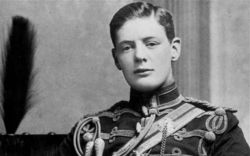
And yet there is a sense of respect here, too. Yes, Churchill was a shameless self-promoter – but he was aware his efforts would be pointless unless he had something worth promoting. While fellow subalterns lazed around the polo field, Winston pursued a gruelling course of self-improvement, quickly catching up on squandered school years. As a staff officer to General Sir Bindon Blood he worked twice as hard as any other subaltern.
More here.
My Medical Choice
Angelina Jolie in The New York Times:
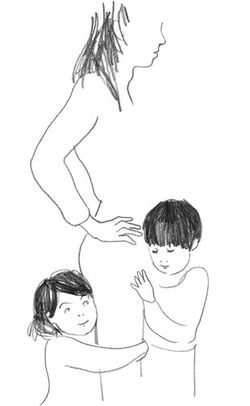
Once I knew that this was my reality, I decided to be proactive and to minimize the risk as much I could. I made a decision to have a preventive double mastectomy. I started with the breasts, as my risk of breast cancer is higher than my risk of ovarian cancer, and the surgery is more complex. On April 27, I finished the three months of medical procedures that the mastectomies involved. During that time I have been able to keep this private and to carry on with my work.
More here.
Monday, May 13, 2013
perceptions
Sughra Raza. “Statue of Liberty – after Giacometti” 2013.
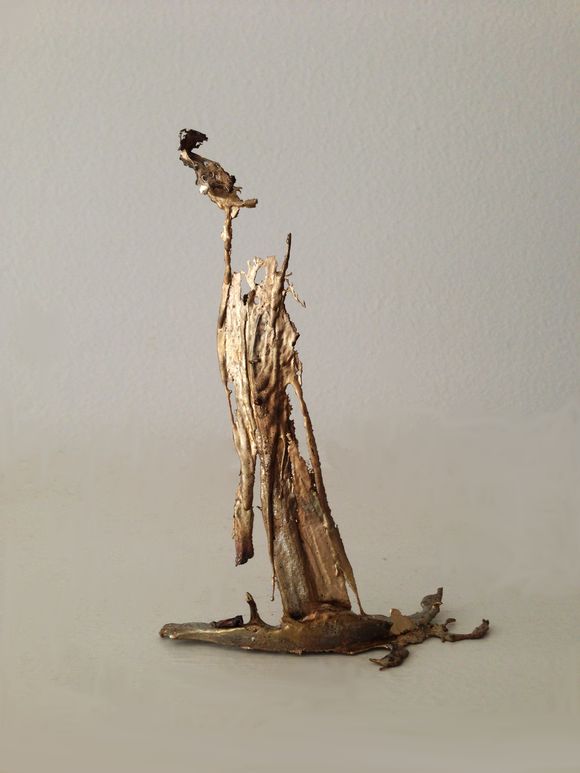
Digital photograph of a piece of casting bronze found in a heap of discarded scraps.
A North American’s Guide to the Use and Abuse of the Modern PhD
by Colin Eatock
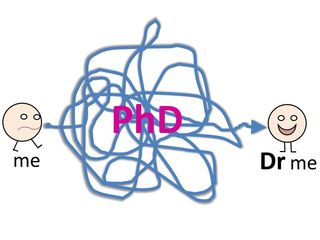
You got through it all, somehow – and now it's yours. You walked across the stage at a graduation ceremony, and an Important Person in a robe gave you the paper scroll that made it official. You are no longer a Mr. or a Ms. Now, you are a Doctor. You have a PhD.
A PhD isn't just something you've acquired, it's something you've become. It's part of who you are – and you're proud that you've transformed yourself in a way that's meaningful to you. Now that you can hold it in your hands, you feel you are someone special, and you want to tell the whole world.
But can you – or should you? And if so, how?
This is where it gets tricky. Indeed, knowing when it is professionally and socially acceptable to “use” your PhD – to call yourself Doctor, and to hope to be addressed as such in return – is a minefield where values, conventions and contexts intersect in fluid and intricate ways. And nowhere has the question ever been more perplexing than in North America today.
Ironically, this issue is often less troublesome in parts of Europe, Asia and Latin America. In many societies, scholarship and professional rank are highly respected things – and terms of address are an art form, requiring subtlety and precision. It would be tantamount to an insult to fail to address any kind of a doctor as Doctor.
But in North America – where traditions are discarded, hierarchies are flouted, and everything is supposed to be so much easier as a result – the rules surrounding the PhD designation are as clear as mud. Today's freshly minted scholars stand on shifting sands, and often have no idea when or where – or even if – it is acceptable to casually slip the initials Dr. in front of their name.
The skies and scenes of Südtirol: Photographs
by S. Abbas Raza
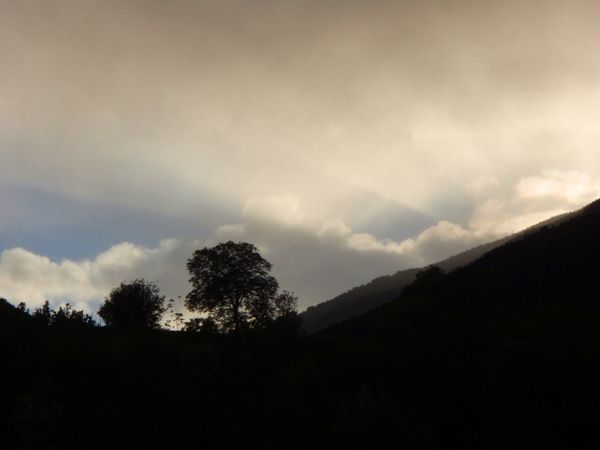
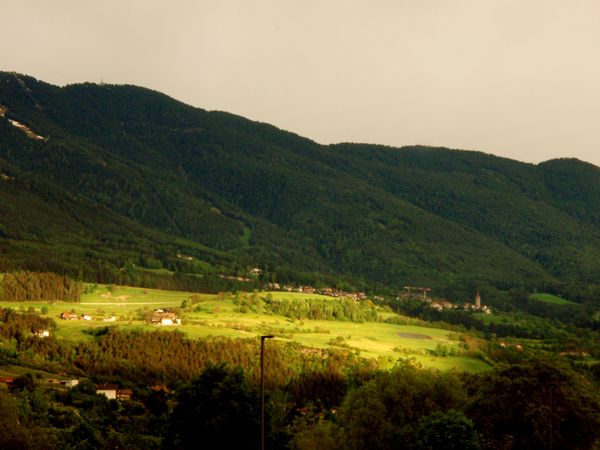
The light is very dramatic in the mountains of the Eisacktal at sunrise and sunset and changes from minute to minute. Even at a given time the sky can often look completely different in different directions. Yesterday evening I took a walk from my house in Brixen to the nearby village of Neustift and took some photographs along the way. Here they are without further commentary:

Sunday, May 12, 2013
Behind the News: Mark Blyth on Austerity
Dough Henwood interviews Mark Blyth:
Assad’s Castaways
J. Malcolm Garcia in Guernica:
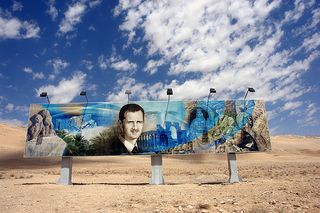
Moutasem and Sarah watch their breath in the frigid February air. We are in the principal’s office of Muhammad al-Fatih, a secondary school for teenagers of Syrian refugees in Antakya, Turkey. The school has no heat, but it is better to freeze here than to be in Syria right now, my Syrian translator Hazim tells me. There, the army patrols villages and cities, killing suspected activists. Men, women, children. No one is safe. If the army could arrest the air, he says, it would.
Hazim is a Sunni Muslim, as are the students in the school and the rebels in the Free Syrian Army (FSA). The rebels have been battling the troops of President Bashar al-Assad since March 2011.
Syria’s Alawite minority and Sunni majority have been at odds for hundreds of years. The minority Alawites, like Assad, dominate Syria’s government, hold key military positions, and enjoy a disproportionate share of the country’s wealth.
Moutasem and Sarah, and other children I will meet in the coming days, have had their lives upended by a war made more complicated by centuries of ethnic rivalry.
Moutasem, fifteen, wears black shoes, pressed blue jeans, and a red wool sweater, and slouches, relaxed, in his chair. His eyes stare intently. When he sees me shiver in the cold, he offers me his coat.
Without Concepts
Richard Marshall interviews Edouard Machery in 3:AM Magazine:
3:AM: I think one way that we can immediately see the importance of your approach to philosophy and cognitive science is by discussing your work on racism. Racism has traditionally been thought of as either a question of nature – roughly, the thought that we’re born to think in racial terms– or nurture – roughly, our culture, upbringing, environment constructs races, and that they don’t exist in nature. You took the two research traditions, the nature tradition and the nurture tradition, and combined them. Can you say something about why you thought this combined approach was important at the time and what difference such an approach has made on research into this? Has it been an approach that has been well received by those in the previously opposing camps?
EM: Many social phenomena, such as racism, have been studied by, one the one hand, cultural anthropologists, sociologists, and historians, and on the other hand, by biologists and by evolutionary-minded behavioral scientists (anthropologists and psychologists). Sadly, these two traditions have failed to engage with one another, and, as a result, our understanding of many social phenomena remains incomplete. In my opinion, it is uncontroversial that social and psychological phenomena like racism or morality result from evolved cognitive structures, whose understanding requires an evolutionary perspective, but that many of their properties are the product of contingent historical trajectories. Integrating the two explanatory traditions is what I called the “integration challenge.” In my view, the theory of cultural evolution provides a framework for this integration.
[Photo of Gil-White from his home page.]Racism is a case in point. As I have argued, following in part Gil-White’s groundbreaking work, we have evolved a sensitivity to “ethnic markers” (roughly, to markers such as clothes, accent, etc., that indicate what cultural group one belongs to) and a motivation to interact preferentially with members of own our cultural group. Racism is a by-product of this evolved sensitivity and motivation, and it emerges when skin color and other physical properties trigger our sensitivity to ethnic markers.
This hypothesis is useful to understand the unity of a large range of social and psychological phenomena, whose fundamental identity has often been ignored, or even denied, by historians and cultural anthropologists. On the other hand, research in history and cultural anthropology is needed to understand the peculiarities of racism in different historical contexts.

Leslie Green on Same Sex Marriage
Over at Philosophy Bites:
How did the conservative ideas of Friedrich Hayek and the Austrian school become our economic reality?
Corey Robin in The Nation:
In the last half-century of American politics, conservatism has hardened around the defense of economic privilege and rule. Whether it’s the libertarianism of the GOP or the neoliberalism of the Democrats, that defense has enabled an upward redistribution of rights and a downward redistribution of duties. The 1 percent possesses more than wealth and political influence; it wields direct and personal power over men and women. Capital governs labor, telling workers what to say, how to vote and when to pee. It has all the substance of noblesse and none of the style of oblige. That many of its most vocal defenders believe Barack Obama to be their mortal enemy—a socialist, no less—is a testament less to the reality about which they speak than to the resonance of the vocabulary they deploy.
The Nobel Prize–winning economist Friedrich Hayek is the leading theoretician of this movement, formulating the most genuinely political theory of capitalism on the right we’ve ever seen. The theory does not imagine a shift from government to the individual, as is often claimed by conservatives; nor does it imagine a simple shift from the state to the market or from society to the atomized self, as is sometimes claimed by the left. Rather, it recasts our understanding of politics and where it might be found. This may explain why the University of Chicago chose to reissue Hayek’s The Constitution of Liberty two years ago after the fiftieth anniversary of its publication. Like The Road to Serfdom (1944), which a swooning Glenn Beck catapulted to the bestseller list in 2010,The Constitution of Liberty is a text, as its publisher says, of “our present moment.”
But to understand that text and its influence, it’s necessary to turn away from contemporary America to fin de siècle Vienna.
More here.
this train
Got A Letter This Morning
Intricate Blueprints of Flowers
From Smithsonian:

Using 3D computer graphics software, the artist then creates models of the full blossom as well as of the stigma, sepals and other parts of the bloom. He cleans up his composition in Photoshop and adds measurements and annotations in Illustrator, so that in the end, he has created nothing short of a botanical blueprint.
More here.
the flea
The Radical History Of Mothers Day
From The Huffington Post:
Arise then…women of this day!
Arise, all women who have hearts! Whether your baptism be of water or of tears!
Say firmly…
“Disarm! Disarm!
The sword of murder is not the balance of justice.”
Blood does not wipe our dishonor,
Nor violence indicate possession.
As men have often forsaken the plough and the anvil
At the summons of war,
Let women now leave all that may be left of home
For a great and earnest day of counsel.
Let them meet first, as women, to bewail and commemorate the dead.
Let them solemnly take counsel with each other as to the means
Whereby the great human family can live in peace…
Each bearing after his own time the sacred impress, not of Caesar, But of God –
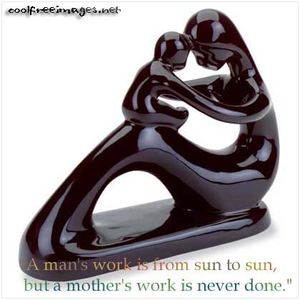
Years later, Anna Jarvis intended the new holiday to honor all mothers beginning with her own–Anna Reeves Jarvis, who had died in 1905. Although now largely forgotten, Anna Reeves Jarvis was a social activist and community organizer who shared the political views of other progressive women like Julia Ward Howe.
More here.
Saturday, May 11, 2013
the algerian camus
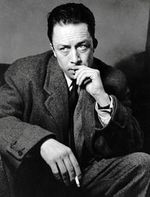
As the writings in “Algerian Chronicles” make clear, Camus’s position in “no man’s land” left him increasingly isolated: hated by the right for his condemnation of government policies, scorned by the left for his inability to imagine an independent Algeria from which the French would be absent. Kaplan’s introduction traces the evolution of Camus’s positions on the Algerian conflict, as well as the ups and downs of critics’ judgments of them. While Camus’s first readers saw him as a philosopher concerned with universal questions of human existence, some influential critics writing after the 1970s considered him a typical pied noir (the usual, sometimes pejorative designation for French people from Algeria), whose works present a colonialist perspective. In recent years, however, the pendulum has swung back; Kaplan notes that the bloody civil war of the 1990s in Algeria has made many Algerian intellectuals appreciate Camus’s steadfast rejection of violence, even when it is committed in the name of high principles. Obviously, this does not apply only to Algeria. Some of the most memorable pages here restate an argument Camus had already developed at length in “The Rebel”: not all means are acceptable, even when employed for noble ends; terrorism and torture destroy the very goals they are supposed to serve.
more from Susan Rubin Suleiman at the NY Times here.
everest

Since it was first climbed, Everest has generated a mountain of books that would take a determined character, backed by a team of hardy librarians, to conquer. From the first flurry by expedition members – John Hunt’s The Ascent of Everest (1953); Wilfrid Noyce’s South Col: One Man’s Adventure on the Ascent of Everest 1953 (1954); Edmund Hillary’s High Adventure (1955) and their embedded Times reporter Jan Morris’s Coronation Everest (1958) – to the current blizzard of books, what all have sought to do in their way is make sense of the achievement: why it matters, what it says about those who took part and what it means to the rest of us. Everest has long been a very British obsession. The deaths of George Mallory and Sandy Irvine near the top in 1924 had only made it more so: there was a corner of a foreign mountain that was forever England. As Wade Davis explored in Into the Silence (2011), his Samuel Johnson Prize-winning account of the expeditions of the early 1920s, those years saw climbers with a very militaristic mindset – an outlook born of their experiences in the trenches – attempt to conquer the mountain.
more from Carl Wilkinson at the FT here.
easy is back

When last we saw Walter Mosley’s detective Easy Rawlins, he had just lost control of a car he was driving on the Pacific Coast Highway north of Malibu. This was in the closing pages of the 11th (and apparently final) Rawlins book, “Blonde Faith,” published in 2007. “The back of my car hit something hard,” Easy tells us, “a boulder no doubt. Something clenched down on my left foot and pain lanced up my leg. I ignored this, though, realizing that in a few seconds, I’d be dead.” And yet, six years later, Easy is back, narrating a new novel, “Little Green” (Doubleday: 292 pp., $25.95), that picks up where “Blonde Faith” left off. He is, if not entirely alive, then at least present, navigating a 1967 Los Angeles he barely recognizes in the wake of both the Watts riots and the Summer of Love. “It was great,” Mosley enthuses, “because for all intents and purposes, Easy was dead. And when he came back to consciousness, he felt dead. … Most of my novels are about redemption. But ‘Little Green’ is about resurrection. And so, I naturally followed it, from having him wake up dead to, at the end of the book, actually being alive.”
more from David L. Ulin at the LA Times here.