Salman Rushdie on Chinese Censorship

From The Atlantic:

RushdieWhy do governments fear literature? Wouldn't, say, the Chinese Communist Party be better off letting its writers write fiction without harassment?

I've always thought of it this way: Politicians and creative writers both try and shape visions of society, they both try and offer to their readers or to the public a view of the world, or a vision of the world, and these visions of the world are at odds with authoritarian regimes. Those regimes attempt to shut down the limits of the possible while fiction tries to push out the limits of the possible. So in effect their visions are in opposition to each other.

Last year, you criticized the Nobel laureate Mo Yan for being a “patsy”. Do writers living in regimes such as China's have a responsibility to oppose censorship? Or simply not to defend it?

I don't feel that writers should be pushed into corners, and there are many writers who aren't temperamentally suited to political engagement in whatever society they happen to be in, so you wouldn't want to make such a writer feel obliged to make a decision. But the reason that so many are upset with Mo Yan isn't that he didn't oppose censorship, but that he went out of his way to defend it. That was the problem.

Nearly a quarter century has passed since you were forced into hiding by the Ayatollah's fatwa. In the ensuing years, how would you assess the worldwide climate for censorship? Have things generally gotten better, or worse?

I'd say that, in general, they've gotten worse. But one of the things our report highlights is that people have more tools to resist censorship using new media. For instance, in China, while there's increased repression in the form of arbitrary arrests, artists held incommunicado and put under house arrest, and increasing hostility towards literature and free expression, there is at the same time a growing willingness of Chinese citizens to find ways to express themselves. In spite of all the repression, there's been a growth of independent, non-state publishers to print things that wouldn't be approved by state houses, and people have shown the willingness to post things online even if they're not to the liking of the state.

More here.

Pesticides aren’t the biggest factor in honeybee die-off

From MSNBC:

BeeThe report says that a complex combination of causes is behind colony collapse disorder, or CCD, a term that applies to the difficult-to-explain losses that have hit U.S. honeybee colonies since 2006. In the worst cases, entire colonies have disappeared within a few weeks. That's a big problem, because the government says an estimated one-third of all food and beverages are made possible by pollination, mainly by honeybees. Pollination is said to be worth more than $20 billion in agricultural production annually. The relatively light bee colony losses during the winter of 2011-2012 gave some experts reason to hope that the CCD situation was getting better, but experts say that last winter's losses look as if they were worse than ever.

“The decline in honeybee health is a complex problem caused by a combination of stressors, and at EPA we are committed to continuing our work with USDA, researchers, beekeepers, growers and the public to address this challenge,” acting EPA Administrator Bob Perciasepe said in a statement. Deputy Agriculture Secretary Kathleen Merrigan promised that “key stakeholders will be engaged in addressing this challenge.” The report draws upon a gathering of officials and stakeholders that took place in Alexandria, Va., last October. It says that the parasitic Varroa mite is the “major factor” behind CCD in the United States and other countries. Varroa mites latch onto the bees and feed on their fluids, weakening the insects. The mites have developed widespread resistance to the chemicals that have been used to control them. The report says more attention should be given to breeding bees that can weather the mites, and notes that gene-sequencing projects focusing on honeybees as well as Varroa mites may provide fresh insights. Beekeepers have long known about the mite problem, as well as the other causes listed in the EPA-USDA report: poor nutrition, reduced genetic diversity, the Nosema gut parasite, emerging viruses and a bacterial disease called European foulbrood. But figuring out the role played by pesticides has posed the biggest challenge for researchers as well as policymakers.

Picture: A worker bee carries a Varroa mite, visible in this close-up view

More here.

Thursday, May 2, 2013

I Dreamed I Was a Very Clean Tramp

Steve Danziger in Open Letters Monthly:

HellTramp-198x300Richard Hell changed the world with a t-shirt and a haircut. The legend goes that Malcolm McLaren, hanging around New York after managing the New York Dolls in their waning days, saw Hell, his hair chopped and spiky, wearing a torn t-shirt with “Please Kill Me” scrawled on it. McLaren, who knew an icon for ruined youth when he saw one, returned to England, and one day in 1976, Chris Stein of Blondie showed Hell a picture in a European rock magazine:

Everybody in the band had short, hacked-up hair and torn clothes and there were safety pins and shredded suit jackets and wacked-out T-shirts and contorted defiant facial expressions. The lead singer had changed this name to something ugly…. I thought, “This thing is really breaking out.”

The band was the Sex Pistols, the “thing” was Punk, and in any history of the music written since, Hell has as much claim to starting the movement as anyone else. He’s that breed of celebrity revered in certain sub-cultures and utterly unknown otherwise, but for those whose lives were changed by the punk/new wave movement in mid-1970s New York City, he’s a bit of a legend. In a five year period, he defined the look and attitude for a new international youth culture, was instrumental in turning the Bowery dive bar CBGB’s into a breeding ground for groups like Television, Talking Heads, Patti Smith Group, and the Ramones, and with his band the Voidoids, produced Blank Generation, one of the seminal, and most enduring, albums of the new wave zeitgeist. Then, alas, came heroin. I Dreamed I Was a Very Clean Tramp is Hell’s memoir of his rise and fall, an eccentric testament to the powers and limitations of self-invention, and like his career, a hodgepodge of singular achievement and dwindled potential.

More here.

‘Time Crystals’ Could Upend Physicists’ Theory of Time

Natalie Wolchover in Wired:

View-into-ion-trap-apparatusIn February 2012, the Nobel Prize-winning physicist Frank Wilczek decided to go public with a strange and, he worried, somewhat embarrassing idea. Impossible as it seemed, Wilczek had developed an apparent proof of “time crystals” — physical structures that move in a repeating pattern, like minute hands rounding clocks, without expending energy or ever winding down. Unlike clocks or any other known objects, time crystals derive their movement not from stored energy but from a break in the symmetry of time, enabling a special form of perpetual motion.

“Most research in physics is continuations of things that have gone before,” said Wilczek, a professor at the Massachusetts Institute of Technology. This, he said, was “kind of outside the box.”

Wilczek’s idea met with a muted response from physicists. Here was a brilliant professor known for developing exotic theories that later entered the mainstream, including the existence of particles called axions and anyons, and discovering a property of nuclear forces known as asymptotic freedom (for which he shared the Nobel Prize in physics in 2004). But perpetual motion, deemed impossible by the fundamental laws of physics, was hard to swallow. Did the work constitute a major breakthrough or faulty logic? Jakub Zakrzewski, a professor of physics and head of atomic optics at Jagiellonian University in Poland who wrote a perspective on the research that accompanied Wilczek’s publication, says: “I simply don’t know.”

Now, a technological advance has made it possible for physicists to test the idea. They plan to build a time crystal, not in the hope that this perpetuum mobile will generate an endless supply of energy (as inventors have striven in vain to do for more than a thousand years) but that it will yield a better theory of time itself.

More here.

Debtors Prisons Are Punishing the Poor Across America

Bill Berkowitz in AlterNet:

PrisonThe jailing of people unable to pay fines and court costs is no longer a relic of the 19th century American judicial system. Debtors' prisons are alive and well in one-third of the states in this country.

In 2011, Think Progress' Marie Diamond wrote: “Federal imprisonment for unpaid debt has been illegal in the U.S. since 1833. It's a practice people associate more with the age of Dickens than modern-day America. But as more Americans struggle to pay their bills in the wake of the recession, collection agencies are using harsher methods to get their money, ushering in the return of debtor's prisons.”

In 2010, the ACLU did a study titled In for a Penny: The Rise of America's New Debtors' Prisons, which revealed the use of debtors prison practices in five states, Louisiana, Michigan, Ohio, Georgia and Washington.

More here.

the work of grief

P5_Oates_341144h

“ How do you turn catastrophe into art?” This bold question, posed by Julian Barnes in a fabulist exegesis of Géricault’s great painting “The Raft of the Medusa”, in A History of the World in 10½ Chapters (1989), might be said to be answered by his new book, Levels of Life, a memoir of his wife of thirty years, Pat Kavanagh, who died of a brain tumour in 2008. With few of the playful stratagems and indirections of style typical of his fiction, but with something of the baffled elegiac tone of his Booker Prize-winning short novel The Sense of an Ending (2011), Levels of Life conveys an air of stunned candour: “I was thirty-two when we met, sixty-two when she died. The heart of my life; the life of my heart”. The end came swiftly and terribly: “Thirty-seven days from diagnosis to death”. The resulting memoir, a precisely composed, often deeply moving hybrid of non-fiction, “fabulation”, and straightforward reminiscence and contemplation, is a gifted writer’s response to the incomprehensible in a secular culture in which “we are bad at dealing with death, that banal, unique thing; we can no longer make it part of a wider pattern”.

more from Joyce Carol Oates at the TLS here.

raghu rai’s bangladesh

Raghu-rai-page_98

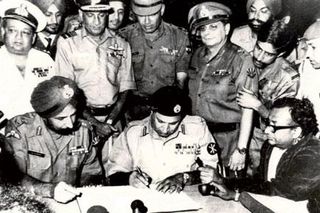
FOR A PHOTOGRAPHER, what sets apart a war zone from other locations is the imminence of danger. Raghu Rai had gone along with the first column of Indian troops entering what was still officially East Pakistan from the Khulna border in early December 1971. Pakistani forces had retreated to defend the capital, Dacca, as it was then known. But after they had travelled about 50 km, Pakistanis attacked with artillery fire. Rai shot photographs of wounded soldiers being taken away. After the situation subsided, Rai was relieved to find a teashop and decided to have a moment’s respite, although the Indian army major told him to be careful. Just as Rai ordered tea and biscuits, a bullet whizzed past him. “The major shouted for me to lie down,” Rai wrote. “I did, and another bullet went past me. I crawled back to the shop and was told by the shopkeeper that the Pakistani army was on the other side of the railtrack, just half a kilometer away.” Photographers are meant to be impartial observers, or witnesses. But to the Pakistani sniper, Rai was a participant, entering enemy territory, accompanied by a foreign army. He was a target, fair game. He may have come to record, but he was intervening.

more from Salil Tripathi at Caravan here.

the real spartacus

20130426-spartacus

Only in the radical literary atmosphere of the 1760s did Spartacus start to become the popular figure we now know from film and fiction—above all, of course, from the classic Stanley Kubrick movie of 1960 starring Kirk Douglas. One of the first attempts, if not the first, to create this “new Spartacus” was a lengthy dramatic eulogy to human liberty by Bernard-Joseph Saurin, entitled Spartacus: une tragédie en cinq actes et en vers. This play premiered in Paris in 1760, was revived after the French Revolution, and (as Maria Wyke has spotted) was still well enough known to be mentioned, albeit slightly inaccurately, in the publicity material for the Kubrick film (“taking our influence from the sublime verses of Bernard Joseph Sauria [sic],” as it claimed).1 Saurin added a personal side to the story. Where Plutarch in the second century AD had referred in passing to Spartacus’ wife (an ecstatic prophetess from Spartacus’ original homeland of Thrace, in northern Greece), Saurin concocted a much more implausible romance. He tragically paired the rebel slave with Emilie, the daughter of Crassus, the Roman commander, who finally managed—after a series of humiliating defeats under other generals—to secure victory for the Romans. But more important, the plot focuses on debates about freedom of various kinds, and different costs.

more from Mary Beard at the NYRB here.

Thursday Poem

Unfocused
.

we start to talk about
primary school essays
for the eighth of March
I always wrote about my mother
and her calloused hands
it was the wrong description
but, I thought you have to write in that style

in my class, she said
there was a motherless boy
so he could write
about whomever he wanted
his aunt, his granny, his . . .

the teacher told him so
she was tactful
even so: he was uncomfortable
he was looking around
unfocused

did he ever write about his mother, I ask
no, she said

I can see him
sitting in his class
and thinking that others are really writing about their mothers

like a lover, daydreaming about those words

and once I thought a poem must be just like that
.
.

by Robert Perišić
from Jednom kasnije
publisher: Sandorf, Zagreb, 2012
translation: Milos Djurdjevic
First published on Poetry International, 2013

Read more »

The XX Factor: How Working Women Are Creating a New Society

From The Guardian:

Alison-wolf-010Is there, Alison Wolf asks, such a thing as “a female paradise on Earth”? If there were, you'd expect it to be in the Scandinavian countries, with their Borgen and their Killing and their excellent state-supported childcare. And yet, Wolf has discovered, “the labour markets of egalitarian welfare-state Scandinavia” display yawning gaps between higher paid and lower paid women, not to mention “the highest levels of gender segregation anywhere in the developed world”. And the reason is obvious, once you know how to look at labour-market data. In top jobs – law, finance, homicide detection – gender segregation, right across the rich world, has more or less disappeared; but in low-paid jobs, such as care work, it mostly hasn't. So the more women you have out there smashing the glass ceiling, the more nursery nurses, cleaners and care-home assistants those women need to – as Wolf puts it – free them up at home. “Scandinavian countries hold the record for gender segregation because they have gone the furthest in outsourcing traditional female activities and turning unpaid home-based 'caring' into formal employment.” Yes, childminders are paid more in Denmark than they are in Britain. But it's not a Birgitte Nyborg lifestyle.

Wolf, a British economist and social policy wonk, was the author of the 2011 Wolf Report on vocational education. But for readers interested in feminism, she's mostly known for “Working Girls”, an essay published in 2006 in Prospect magazine. In it, she wrote: “For the first time, women, at least in developed societies, have virtually no career or occupation closed to them … This marks a rupture in human history.” This new freedom, however, applies only to “young, educated, full-time professionals” – for “the majority of women”, nothing much has changed at all. This, Wolf wrote, opens a huge gulf in experience between the different classes, and has uncomfortable consequences. Now that clever women can get glamorous jobs as bankers, who fills the gaps left in teaching, nursing and voluntary work? And you can only keep up as a banker if you take as little time off as possible for having babies etc. What's this doing to birth rate and family dynamics among the new elite? Wolf's essay was a brilliant piece of popular social-science polemic, a stark and confident joining of unexpected dots, statistically sophisticated and with a copper-bottomed evidence base. This isn't to say its conclusions were beyond argument, as plenty of critics have shown. But it did, decisively, move on the terms of those arguments. “The feminism of the 1960s and 1970s, reflecting and feeding into a revolution in women's lives, spoke the language of sisterhood – the assumption that there was a shared female experience that cut across class, ethnic and generational lines. The reality was that at that very moment, sisterhood was dying.” Her book expands the 4,500 words of the Prospect essay into more than 400 pages. Around half develop the thesis with material that augments and/or complicates the original argument. The other half takes on other popular debates in gender and workplace economics. The erotic capital one, for example – do good-looking people get promoted faster? The time-use one – why do working women still seem to do much more housework than their men? And of course the one about prostitution. If it's as well paid as people say it is, why is it still the profession of last resort?

More here.

A little brain training goes a long way

From Nature:

CogPeople who use a ‘brain-workout’ program for just 10 hours have a mental edge over their peers even a year later, researchers report today in PLoS ONE1. The search for a regimen of mental callisthenics to stave off age-related cognitive decline is a booming area of research — and a multimillion-dollar business. But critics argue that even though such computer programs can improve performance on specific mental tasks, there is scant proof that they have broader cognitive benefits. For the study, adults aged 50 and older played a computer game designed to boost the speed at which players process visual stimuli. Processing speed is thought to be “the first domino that falls in cognitive decline”, says Fredric Wolinsky, a public-health researcher at the University of Iowa in Iowa City, who led the research. The game was developed by academic researchers but is now sold under the name Double Decision by Posit Science, based in San Francisco, California. (Posit did not fund the study.) Players are timed on how fast they click on an image in the centre of the screen and on others that appear around the periphery. The program ratchets up the difficulty as a player’s performance improves.

Participants played the training game for 10 hours on site, some with an extra 4-hour ‘booster’ session later, or for 10 hours at home. A control group worked on computerized crossword puzzles for 10 hours on site. Researchers measured the mental agility of all 621 subjects before the brain training began, and again one year later, using eight well-established tests of cognitive performance. The control group’s scores did not increase over the course of that year, but all the brain-training groups significantly upped their scores in the Useful Field of View test — which requires a subject to identify items in a scene with just a quick glance — and four others. When they compared the study participants' scores to those expected for people their ages, the researchers found improvements that translated to 3-4.1 years of protection in age-related decline for the field-of-view test and from 1.5-6.6 years for the other tasks. “It was interesting that it didn’t matter whether you were on site at the clinic or just did this at home — you got basically the same bang for your buck,” says Frederick Unverzagt, a neuropsychologist at the Indiana University School of Medicine in Indianapolis, who was not involved with the study.

More here.

Wednesday, May 1, 2013

Michael Sandel: This much I know

Michael Sandel in The Guardian:

ScreenHunter_176 May. 01 18.54In the past few years we have moved from having a market economy to living in a market society, in which just about everything is up for sale.

I am fortunate to have enough money not to have to worry about the necessities of life. Beyond that I try to think about money as little as possible.

I grew up in a Jewish family, and we have raised our children in a Jewish tradition. Religion gives a framework for moral enquiry in young minds and points us to questions beyond the material.

If you pay a child a dollar to read a book, as some schools have tried, you not only create an expectation that reading makes you money, you also run the risk of depriving the child for ever of the value of it. Markets are not innocent.

I almost became a political journalist, having worked as a reporter at the time of Watergate. The proximity to those events motivated me, when I wound up doing philosophy, to try to use it to move the public debate.

Philosophy can be debilitating. It demands a critical sensibility, and to try to apply that to everything can be a very disquieting thing – the disquiet is necessary, even if you are unmoored by it.

More here.

George W. Bush’s leaked paintings may seem out of character, but they remind us that he is first and foremost a realist

Our own Morgan Meis in The Smart Set:

ID_IC_MEIS_BUSH_CO_001George W. Bush has finally found WMDs. That's what a commenter on the website Gawker recently noted. But these WMDs are Watercolors Mostly of Dogs. George W. Bush, you see, has taken up painting. His favorite subject is dogs. It is said that he has already painted over 50 paintings of dogs. He also paints landscapes and, disturbingly, scenes of himself in the bath and shower. Luckily, these are not really nudes but mostly studies of his own feet.

The idea of George W. Bush, Painter has unleashed a great wave of amusement. Even Bush is in on the joke. He quipped that it will be hard for many people to accept him as an artist when they don't even think he can read. An anonymous hacker hacked into Bush's cell phone and then released the pictures Bush had snapped of the canvases he’s been working on. This inspired Bush himself officially to release photos of his paintings. For better or worse, George W. Bush has never been one to hide in shame.

The paintings are not nearly as bad as you might want them to be. In fact, they show some natural talent. Bush has picked up, in a relatively short period of time, the basics of handling a brush and depicting scenes in three-dimensional space. If nothing else, it’s one hell of an advertisement for the woman (Bonnie Floor) who taught him to paint.

Yet, the more you look at Bush's paintings, the more you see a painterly sensibility. He has, for instance, an innate flair for perspective and point-of-view.

More here.

paradox

28stone-img-blog427

For an observer to perceive an entity, he or she must be capable of distinguishing it from the succession of impressions preceding and following it; in order to grasp those impressions as pertaining to the same entity, however, the same observer must be able to take them as a unity despite the differences that succession implies. This ineluctable fact of observation underlies the paradoxes of motion, the antinomies, and the uncertainty principle. For in all cases, some minimum of motion, distance or velocity — namely, change over time — is required for any observation to take place, even as the observer posits an unchanged point or particle as being subject to that change. At the level of normal, physical sensation, the fact that these necessary elements of observation exclude one another passes unnoticed. It is only at the highly focused, granular level of quantum physics or in the extreme situations of philosophical fictions that this mutual exclusivity emerges.

more from William Egginton at The Opinionater here.

camus on algeria

Cover00

“People expect too much of writers,” Albert Camus lamented in the late 1950s. At the time Camus was writing, the Algerian rebellion had grown into a full-scale guerrilla war for independence, and while his initial sympathy for the uprising led the French Right and the French Algerian settlers to denounce him as a traitor, he also came in for frequent polemical attacks from the French Left for not energetically and unequivocally supporting the insurgents. Criticism also came from the Algerian militants themselves. Frantz Fanon, the best-known Algerian writer, derided him as a “sweet sister.” Sartre, formerly his close friend, mocked Camus’s “beautiful soul.” Camus’s complaint does him credit. He agonized over his political pronouncements in a way that the more brilliant, mercurial, doctrinaire Sartre never had to. In 1957, as the war ground on and positions hardened on both sides, Camus was awarded the Nobel Prize for Literature. Despairing of the Algerian situation but determined to answer his critics and, with the prestige of the Nobel behind him, make one final effort for peace and reconciliation, Camus assembled a short collection of his writings about Algeria, which was published in 1958. It appears now in English for the first time, ably translated by Arthur Goldhammer.

more from George Scialabba at Bookforum here.

geologic time

Jimgordon_grandcanyon-e1366641121411

Any serious conversation about the planet’s climate and our energy future must begin, paradoxically, with a backward look at geologic time. The reason for this is that the way forward is fogged by misunderstandings about the earth. Experts are little help in the constant struggle in this conversation to separate myth from reality, because they have the same difficulty, and routinely demonstrate it by talking past each other. Respected scientists warn of imminent energy shortages as geologic fuel supplies run out. Wall Street executives dismiss their predictions as myths and call for more drilling. Environmentalists describe the destruction to the earth from burning coal, oil, and natural gas. Economists ignore them and describe the danger to the earth of failing to burn coal, oil, and natural gas. Geology researchers report fresh findings about what the earth was like millions of years ago. Creationist researchers report fresh findings that the earth didn’t exist millions of years ago. The only way not to get lost in this awful swamp is to review the basics and decide for yourself what you believe and what you don’t.

more from Robert B. Laughlin at The American Scholar here.

the courage and selflessness with which Siân Busby battled cancer

Robert Peston in The Telegraph:

Siân Elizabeth Busby died on September 4 2012 after a long illness. A few days later I transcribed her handwritten manuscript for the end of A Commonplace Killing, her final novel. My motive was selfish: I wanted to keep talking to her. I still do.

Robert-peston_2550669b…For the proud spouse it matters that she finished the book after she had received her death sentence. On August 3 2012, the consultant oncologist at the Royal Marsden, Sanjay Popat, a compassionate, assiduous and expert physician whom we came to think of as a friend during the years he was in charge of Siân’s treatment, gave us the latest in a succession of scan results. Medical science could no longer help Siân, except – perhaps – to take the edge off acute and constant pain. “This is where I say goodbye,” he said. It was almost exactly five years to the day after Siân – who is probably the only person I know who never smoked a cigarette – was diagnosed with lung cancer. In the ensuing years, she never despaired or resorted to self-pity, even as the cancer spread, on a couple of occasions to the brain, later to the liver and spine. The cycle of surgery, body-racking chemicals and radiation was relentless. Life became punctuated by terrible shocks and emergencies. Yet those who met her at pretty much any point in this ordeal encountered the Siân they had always known: solicitous, supportive, witty, insightful, unselfish. Through the sheer force of her will, Siân remained poised and beautiful. She eschewed drama.

Most of our friends had no idea how ill she really was. Siân did not wish to be seen by others as someone who was suffering from a lethal cancer. She did not want to be classified as infirm and she did not need maudlin sympathy. The priority was that our boys, Max and Simon, should not be constantly bothered and worried by friends and neighbours asking for the latest prognosis on her health. Siân just got on with living. Her huge, magnificent novel, McNaughten – which for me is the last great Victorian novel, a symphony of fantastical stories, rich in disquisitions on the absurdity of life – was written when Siân’s illness had become for us just one of those things. I know this may seem odd, but these were wonderful years for Siân, Max, Simon and me. The cancer did not haunt us. If anything, it helped us to understand what matters in life: family, first and foremost; work that fulfils; friends, beauty and fun. By the time Siân was completing A Commonplace Killing, the cancer could no longer be confined to the background. It was a monster laying waste to our family.

More here.

Video reveals cancer cells’ Achilles’ heel

From Manchester:

Rituximab_cancer_cellsProfessor Daniel Davis and his team used high quality video imaging to investigate why the drug rituximab is so effective at killing cancerous B cells. It is widely used in the treatment of B cell malignancies, such as lymphoma and leukaemia – as well as in autoimmune diseases like rheumatoid arthritis. Using high-powered laser-based microscopes, researchers made videos of the process by which rituximab binds to a diseased cell and then attracts white blood cells known as natural killer (NK) cells to attack. They discovered that rituximab tended to stick to one side of the cancer cell, forming a cap and drawing a number of proteins over to that side. It effectively created a front and back to the cell – with a cluster of protein molecules massed on one side. But what surprised the scientists most was how this changed the effectiveness of natural killer cells in destroying these diseased cells. When the NK cell latched onto the rituximab cap on the B cell, it had an 80% success rate at killing the cell. In contrast, when the B cell lacked this cluster of proteins on one side, it was killed only 40% of the time.

Professor Davis says: “These results were really unexpected. It was only possible for us to unravel the mystery of why this drug was so effective, through the use of video microscopy. By watching what happened within the cells we could clearly identify just why rituximab is such an effective drug – because it tended to reorganise the cancerous cell and make it especially prone to being killed.” He continues: “What our findings demonstrate is that this ability to polarise a cell by moving proteins within it should be taken into consideration when new antibodies are being tested as potential treatments for cancer cells. It appears that they can be up to twice as effective if they bind to a cell and reorganise it.”

More here.