
Category: Recommended Reading
Sunday Poem
It is Autumn
It is autumn
a plum is falling, apples,
the fruit falls
and the soul's engineer
is measuring the universe with a teaspoon
It snows in the snow, snows in the rain,
it snows in your back
Stars falling.
.
by Tone Hødnebø
from Mørkt kvadrat
publisher, Aventura forlag , Oslo, 1994
translation: Cecilie Dahl and Tone Hødnebø
First published on Poetry International, 2013
.
.
Friendship
Stuart Kelly in The Guardian:

…Friendship does have a political dimension – Aristotle said: “When men are friends there is no need for justice.” This idea was taken up by Jacques Derrida in The Politics of Friendship, a book absent from Grayling's bibliography. Derrida argues, to my mind convincingly, that the discourse around friendship has surreptitiously promoted it as a private, not public, virtue. There is a chasm between EM Forster's “If I had to choose between betraying my country and betraying my friend I hope I should have the guts to betray my country” and Carl Schmitt's notorious idea that “every totality of people looks for friends because it has already enemies”.
More here.
The Man Who Would Teach Machines to Think
James Somers in The Atlantic:

The idea that changed Hofstadter’s existence, as he has explained over the years, came to him on the road, on a break from graduate school in particle physics. Discouraged by the way his doctoral thesis was going at the University of Oregon, feeling “profoundly lost,” he decided in the summer of 1972 to pack his things into a car he called Quicksilver and drive eastward across the continent. Each night he pitched his tent somewhere new (“sometimes in a forest, sometimes by a lake”) and read by flashlight. He was free to think about whatever he wanted; he chose to think about thinking itself. Ever since he was about 14, when he found out that his youngest sister, Molly, couldn’t understand language, because she “had something deeply wrong with her brain” (her neurological condition probably dated from birth, and was never diagnosed), he had been quietly obsessed by the relation of mind to matter. The father of psychology, William James, described this in 1890 as “the most mysterious thing in the world”: How could consciousness be physical? How could a few pounds of gray gelatin give rise to our very thoughts and selves? Roaming in his 1956 Mercury, Hofstadter thought he had found the answer—that it lived, of all places, in the kernel of a mathematical proof. In 1931, the Austrian-born logician Kurt Gödel had famously shown how a mathematical system could make statements not just about numbers but about the system itself. Consciousness, Hofstadter wanted to say, emerged via just the same kind of “level-crossing feedback loop.” He sat down one afternoon to sketch his thinking in a letter to a friend. But after 30 handwritten pages, he decided not to send it; instead he’d let the ideas germinate a while. Seven years later, they had not so much germinated as metastasized into a 2.9‑pound, 777-page book called Gödel, Escher, Bach: An Eternal Golden Braid, which would earn for Hofstadter—only 35 years old, and a first-time author—the 1980 Pulitzer Prize for general nonfiction.
More here.
Saturday, October 26, 2013
Post-Postwar
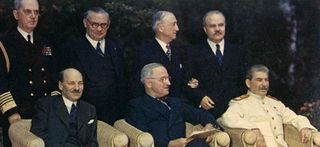
Eric Rauchway on Joshua Freeman’s American Empire in Dissent:
Joshua Freeman’s American Empire is the second volume in Penguin’s History of the United States, after Alan Taylor’s American Colonies. If this publication schedule suggests a lack of chronological discipline, it makes for a pleasing set of bookends: the nation that emerged from imperialism became an empire of its own, as diverse and difficult to characterize as the colonies from which it developed. But the history of the modern United States, unlike the history of the colonial era, is not over. We do not know how or why it ends. We do not even know when it ends.
Until the 1980s it made sense to teach courses titled “The History of the United States Since 1945.” Normally, lecturers and professors taught such twentieth-century surveys as the history of “what happened to the New Deal?” In classrooms around the country, students heard that the limited program of social insurance adopted under Franklin Roosevelt expanded under presidents of both parties until it began to encompass the civil rights of African Americans in the mid-1960s. And then, or perhaps a little later, the program for social democracy became something called the “rights revolution”: not a series of rights at all, but a set of querulous demands that the nation could not afford to recognize. Once women, Hispanics, and gays began asking recognition for their particular rights, middle (also known as “straight, white, male”) America took a step back toward what textbooks call “The Age of Limits.” Suddenly the expansions of the New Deal became expensive and Americans had to learn to live more modestly (or so their white, southern president told them in the 1970s).
In this story, foreign relations mattered inasmuch as the Cold War was also terribly expensive.
More here.
Questions for Free-Market Moralists

Amia Srinivasan in the NYT's the Stone:
In 1971 John Rawls published “A Theory of Justice,” the most significant articulation and defense of political liberalism of the 20th century. Rawls proposed that the structure of a just society was the one that a group of rational actors would come up with if they were operating behind a “veil of ignorance” — that is, provided they had no prior knowledge what their gender, age, wealth, talents, ethnicity and education would be in the imagined society. Since no one would know in advance where in society they would end up, rational agents would select a society in which everyone was guaranteed basic rights, including equality of opportunity. Since genuine (rather than “on paper”) equality of opportunity requires substantial access to resources — shelter, medical care, education — Rawls’s rational actors would also make their society a redistributive one, ensuring a decent standard of life for everyone.
In 1974, Robert Nozick countered with “Anarchy, State, and Utopia.” He argued that a just society was simply one that resulted from an unfettered free market — and that the only legitimate function of the state was to ensure the workings of the free market by enforcing contracts and protecting citizens against violence, theft and fraud. (The seemingly redistributive policy of making people pay for such a “night watchman” state, Nozick argued, was in fact non-redistributive, since such a state would arise naturally through free bargaining.) If one person — Nozick uses the example of Wilt Chamberlain, the great basketball player — is able to produce a good or service that is in high demand, and others freely pay him for that good or service, then he deserves to get rich.
More here.
The Beatles play Happy Birthday (For Abbas)
What’s Behind the Notion That Nonfiction Is More ‘Relevant’ Than Fiction?
Pankaj Mishra in The New York Times:
Some prominent literary fictionists in Europe and America were plunged into a no less demoralizing sense of irrelevance by the terrorist attacks of 9/11, which shattered what Reinhold Niebuhr once called “the paradise of our domestic security . . . suspended in a hell of global insecurity.” Many readers of fiction, too, found reportage and memoir better equipped to allay their bewilderment and sate their reality hunger. Americans may “think this was . . . the end of civilization. In the third world, this sort of thing happened every day,” Dexter Filkins wrote in “The Forever War,” one of the recent works of narrative nonfiction about geopolitical and economic disasters that appeared to suggest a sturdier relation to reality than etherealized literary fiction. But then, as Robert Musil pointed out in “The Man Without Qualities,” “most people” seeking “refuge from chaos” long for “narrative order, the simple order that enables one to say: ‘First this happened and then that happened.’ ”
More here.
Saturday Poem
I’ve posted this poem before, but think it deserves a periodic reading
because its one of the finest little poems I’ve ever read. —Jim
Ring of Bone
I saw myself
a ring of bone
in the clear stream
of all of it
and vowed
always to be open to it
that all of it
might flow through
and then heard
“ring of bone” where
ring is what a
bell does
.
by Lew Welsh
from Ring of Bone
.
.
Unlikely Martyr: Mikhail Khodorkovsky as Noble Dissident in Putin’s Russia
Julia Ioffe in Tablet:
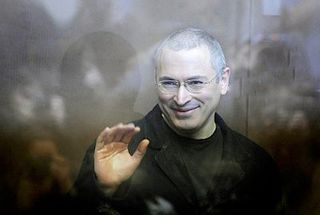
Instead of defending his innocence at the final day of his trial on nebulous charges last November, Mikhail Khodorkovsky, once Russia’s richest man and now imprisoned in a Siberian labor camp near a radioactive mine, read to the court a political manifesto that lambasted the stagnation and corruption into which contemporary Russia has sunk. “The obvious conclusion a thinking person can make is chilling in its stark simplicity,” he intoned in the tiny courtroom packed with reporters and the pensioners who’d come to show their support. “The silovikibureaucracy can do anything,” he said, referring to the powerful faction in the Russian government whose roots are in the security forces. “A person who collides with ‘the system’ has no rights whatsoever.” He added: “I am ashamed for my country.” It was a moving speech that laid out, powerfully and clearly, everything that is wrong with Russia today; it made even my sober male Russian friends tear up.
When the judge handed down the guilty verdict just before the New Year, hundreds protested outside the courtroom. German Chancellor Angela Merkel condemned the ruling, as did Secretary of State Hillary Clinton. The White House issued astatement condemning “abuse of the legal system for improper ends.”
Five months later, the case still hasn’t receded from Russian headlines. The press secretary of the court that heard Khodorkovsky’s case revealed to an opposition newspaper that the judge in the case didn’t write the verdict and that he was pressured from the outside. (She has since been made to take a lie detector test—she passed—and been forced out of her job.) Fifty-five “official” celebrities have signed a controversial open letter praising the verdict in the case, and 45 others signed one opposing it.
More here.
Wu Chen’en’s “Journey to the West”
Julia Lovell in the LA Review of Books:
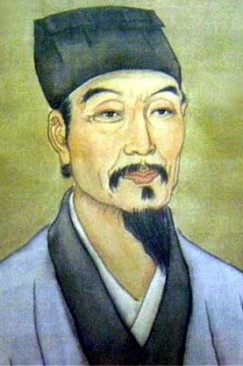
Journey to the West (c. 1580) is one of the masterworks of classical Chinese writing. It recounts a Tang Dynasty monk’s quest for Buddhist scriptures in the 7th century AD, accompanied by an omni-talented, kung fu-practicing Monkey King called Wukong (one of the most memorable reprobates of world literature); a rice-loving pig-spirit able to fly with its ears; and a depressive man-eating monster from a sand dune. It is a cornerstone text of Eastern fiction: its stature in Asian literary culture may be compared with that of The Canterbury Tales or Don Quixote in European letters.
The novel commences with a spirited prologue — seven chapters long — recounting the Monkey King’s many attempts to achieve immortal sagehood, in the course of which he acquires knowledge and weapons that will serve him well through the book as a whole: the ability to perform “cloud somersaults” that carry him 30,000 miles in one leap, a gold-hooped staff (weighing almost 20,000 pounds) that can shrink to the size of a needle. He becomes a master of subterfuge by learning to transform himself into 72 different varieties of creature (though his human disguises lack perfect authenticity due to his inability to lose his tail). He studies demon-freezing spells and how to turn each of the 84,000 hairs on his body into other animals (including clones of himself) or objects. Yet time and again he is brought low by his irrepressible love of mischief. Finally, after taking up a bureaucratic sinecure in the heavenly government of the Jade Emperor, he commits the unforgivable crime of gorging himself on the peaches, wine, and elixirs of immortality.
More here.
Transitive Measures: Tragedy and Existentialism in African Literature

Ato Quayson in Berfrois:
Readers of Things Fall Apart will recall the moment in the penultimate chapter of the novel when the gathering of the people of Umuofia is rudely interrupted by messengers from the white man. The messengers are confronted by Okonkwo, who happens to have taken a position at the very edge of the gathering. We have already identified the central protagonist as a man of few words and a volatile disposition:
‘What do you want here?’
‘The white man whose power you know too well has ordered this meeting to stop.’
In a flash Okokwo drew his matchet. The messenger crouched to avoid the blow. It was useless. Okonkwo’s matchet descended twice and the man’s head lay beside his uniformed body.The waiting backcloth jumped into tumultuous life and the meeting stopped. Okonkwo stood looking at the dead man. He knew Umuofia would not go to war. He knew because they had let the other messengers escape. They had broken into tumult instead of action. He discerned fright in the tumult. He heard voices asking: ‘Why did he do it?’
He wiped his matchet on the sand and went away (145).
The salience of this momentous event is not so much in the evidence it provides of Okonkwo’s final severance from his society, as in the peculiar contrast suggested in his “knowing” that the tribe will not go to war set against their bewildered question: “Why did he do it?’ For the contrast amounts to the difference between a profound Aristotelian anagnorisis (recognition) and an insuperable epistemological impasse. The recognition is private but the impasse is communal.
More here.
Friday, October 25, 2013
Citizen Marx
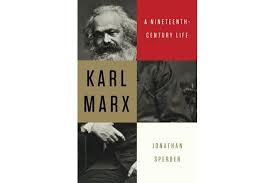
Sam Stark in The Nation:
A New York Times obituary for Karl Marx used verbs like these—born, began, edited (theRheinische Zeitung), suppressed, fled, arrested, sent (across the frontier!), found (refuge!), occurred (revolution!), hastened, revived, remained, expelled, proceeded, supported (himself!), labored (hard!), conceived (the International!)—to show that he had led a life “full of adventure, like all political conspirators.” The paper was impressed by Marx’s productivity as a journalist—Capital hadn’t yet been translated—but it identified him first and foremost as “the ostensible leader of the famous International Society in Europe.” This International Society, it explains, was “originally intended to work for the benefit of working men in general, partially on the trade-union system,” but then “became a purely political organization, which has since grown to formidable dimensions throughout Europe.” What happens when working men meddle in politics? “It is believed by many that the Commune in France was really inspired by the International Society, though the charge has been strenuously denied.”
Although it was erroneously published in 1871, twelve years before Marx died, this obituary already shows the paranoid circumlocution that is still used to implicate him in historical events without clearly defining his role. By the same logic that holds Marx responsible for several twentieth-century revolutions, he appears here as the “ostensible” leader of a shadowy group that meant well but went wrong and inspired some catastrophe. Each step in this argument is speculative and muddled, beginning with the first. Marx was officially a coordinating secretary to the International Workingmen’s Association (1864–1876), a loose-knit network of many different kinds of groups that mostly worked together on labor issues like the organization of strikes and the regulation of the working day. Marx himself staunchly opposed revolutionary conspiracies: “There is no mystery to clear up, dear sir,” he is reported to have told a curious interviewer for the New York World, “except perhaps the mystery of human stupidity in those who perpetually ignore the fact that our Association is a public one, and that the fullest reports of its proceedings are published for all who care to read them.”
More here.
What Kind of Problem is the ACA Rollout for Liberalism?
Mike Konczal over at Rortybomb (via Rick Perlestein):
People are naturally asking about the practical and political implications of this disaster. Is it a problem for the Affordable Care Act as a whole, with its mixture of individual mandates and risk-pooling? Is it a political disaster for President Obama and the Democrats? Does this show us major problems in the way that government procures its contractors?
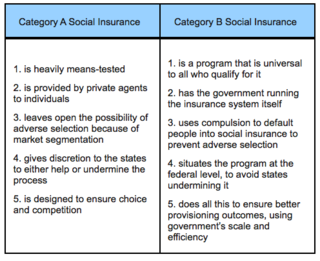
These are important questions, but some are asking a bigger one: is this a problem for liberalism as a political governance project? Does this rollout failure discredit the core goals of a liberal project, including that of a mixed economy, a regulatory state, and social insurance?
Conservatives in particular think this website has broad implications for liberalism as a philosophical and political project. I think it does, but for the exact opposite reasons: it highlights the problems inherent in the move to a neoliberal form of governance and social insurance, while demonstrating the superiorities in the older, New Deal form of liberalism. This point is floating out there, and it turns out to be a major problem for conservatives as well, so let's make it clear and explicit here.
So what has gone wrong? People are still trying to figure this out. There are the general problems of doing too much with too little time and resources and rolling out a big final product rather than smaller incremental pieces. These are things that, while problematic, don’t particularly have a political story to tell.
However, four bigger problems jump out.
More here.
Daljit Nagra: re-writing Punjabi epics for a modern audience
Sameer Rahim in The Telegraph:
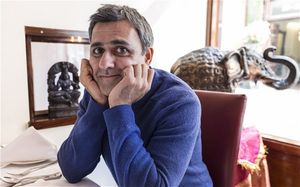
In the late Eighties in India, a 78-part television adaptation of The Ramayana brought the country to a standstill. “Shops would shut, people who didn’t have a telly, they’d find a telly in the village and gather around.” For some it was a religious experience: “People would do prayers and execute rituals, watch it with incense on.” Channel 4 also broadcast the series, and Nagra tells me that as a British Asian teenager he found the bright costumes and over-the-top acting a bit embarrassing. But there was also pride that this remarkable story was being presented to a wider public. Nagra’s version is fizzy and up-to-date. Rather than solely relying on Indian speech patterns, he uses global English to make the story universal. A king is compared to a CEO with “tough-guy leadership skills”; Raavana, the lord of the underworld, is like a Bollywood villain supplied with “assassins, ghazis, nabobs/riff-raff doolallys”; and there is even a hint of Yoda-speak – “Raavana was now a supreme being becoming!”
More here.
New insight into why each human face is unique
From MedicalXpress:

…In all, Visel, Attanasio and their colleagues identified more than 4,000 candidate enhancer sequences predicted to be active in fine-tuning the expression of genes involved in craniofacial development, and created genome-wide maps of these enhancers by pin-pointing their location in the mouse genome. The researchers also characterized in detail the activity of some 200 of these gene enhancers and deleted three of them. A majority of the enhancer sequences identified and mapped are at least partially conserved between humans and mice, and many are located in human chromosomal regions associated with normal facial morphology or craniofacial birth defects.
More here.
Friday Poem
A Footptint
Long ago
a fox ran along a clay river bank.
After an interim
of tens of thousands of years
a footprint turned fossil remains.
Looking at it, you'll see
what the fox was thinking while running.
.
.
by Shinjiro Kurahara
from Iwana
publisher, Dowaya, Tokyo, 2010
translation byMariko Kurahara, William I. Elliott, Katsumasa Nishihara
.
.
On Meat-eating

Antti Nylén in Eurozine:
There's a certain type of conservatism that takes on an almost elegiac quality in its statements on the ultimate inexplicability of the world. The myth of complexity is the salvation of the conservative thinker; it is the object of his love, his praise and his undying gratitude. When the background noise of the unbridled, indistinct, mystical “forces” of sin, nature and capitalism reaches a crescendo, the conservative can be sure of feeling at one with himself, serene on the uncomplicated foreground of the world at large. His affairs are all in order, because the rest of the world is in shambles. Or as Alain Badiou has it: “Our world is in no way as 'complex' as those who wish to ensure its perpetuation claim.”
In fact, the most difficult things are those that are held to be difficult – in the sense of being “preserved” (Lat. conservare). Nobody's making us. It's a maxim that applies often, if not always.
Veganism, for instance, a practice commonly held to be blisteringly difficult, is actually ridiculously easy. To be idle while others act.
Then there are downright arduous things, like building the Great Wall or translating the Iliad, but I am not concerned with those.
An impossible thing is a phenomenon unto itself. You can no more transform yourself into a millipede than you can spontaneously grow an extra arm, because human nature is simple: it is physical. Therein lies the beginning and the end of any and all metaphysical significance. The world, too, is simple and physical; the world = the Earth.
More here.
The Counterreformation in Higher Education
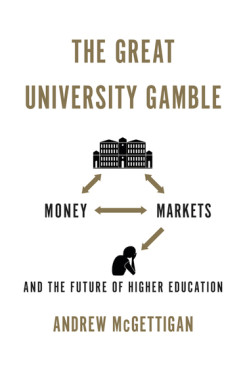
Christopher Newfield reviews Andrew McGettigan's The Great University Gamble : Money, Markets, and the Future of Higher Education, in the LA Review:
AMERICANS WHO WONDER what the heck is happening to their public colleges can find answers in the British case. While American educational and political leaders deny the negative outcomes of the actions they barely admit to be taking, the United Kingdom’s Tory government has offered explicit rationales for the most fundamental restructuring of a university system in modern history. The stakes are very high. Both countries have been downgrading their mass higher education systems by shrinking enrollments, reducing funding for educational quality, increasing inequality between premier and lower-tier universities, or all three at once.
Oddly, policymakers are doing this in the full knowledge that mass access to high-quality public universities remains the cornerstone of high-income economies and complex societies. The public has a right to know what politicians and business leaders are really doing to their higher education systems, why they are doing it, and how to respond.
Those who tried to follow the British drama through scattered newspaper articles and government reports will be glad to know that we now have a one-stop comprehensive guide to the whole affair. It is Andrew McGettigan’s The Great University Gamble: Money, Markets, and the Future of Higher Education. No one has assembled the political and financial pieces of the story as he has, and the book has started to reanimate discussion of higher education policy in Britain.
More here.
How science goes wrong
From The Economist:
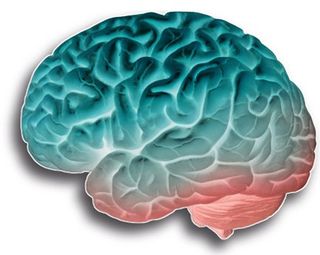
But success can breed complacency. Modern scientists are doing too much trusting and not enough verifying—to the detriment of the whole of science, and of humanity.
Too many of the findings that fill the academic ether are the result of shoddy experiments or poor analysis (see article). A rule of thumb among biotechnology venture-capitalists is that half of published research cannot be replicated. Even that may be optimistic. Last year researchers at one biotech firm, Amgen, found they could reproduce just six of 53 “landmark” studies in cancer research. Earlier, a group at Bayer, a drug company, managed to repeat just a quarter of 67 similarly important papers. A leading computer scientist frets that three-quarters of papers in his subfield are bunk. In 2000-10 roughly 80,000 patients took part in clinical trials based on research that was later retracted because of mistakes or improprieties.
More here.