
[Thanks to Ruchira Paul.]
Category: Recommended Reading
a history of alchemy

Alchemy’s significance has altered radically in the three centuries since this heyday, Principe argues, after professionalizing Enlightenment scholars rejected the suitability of Decknamen, pseudonyms and dreams of transmutation to a properly rigorous, public science. Denied knowledge of their physical references, Victorian occultists and Jungian psychologists mythologized the arcana of alchemical texts as autonomous allegories, as symbols for occult forces or a psychological manifestation of the collective unconscious. Meanwhile, historians of science dismissed its practitioners as gullible fools. Many recognized that the quest for the Stone involved work at the forge, but alchemists were still frequently portrayed as credulous dupes who begged God’s favour as they wishfully tossed arbitrary heaps of plants and metals into their fires.
For Principe, such flawed interpretations stem from projecting post-Enlightenment meanings of alchemy onto the earlier period and assuming that earlier alchemists’ spiritual declarations wholly governed their coded recipes. Scholars now equipped with revelatory chemical expertise, he insists, will recognize that these reflected a context in which all knowledge was described as a divine gift – a claim strengthened by his lucid deciphering of esoteric images and fascinating replications of experiments purporting to transmute silver into gold, revivify dead bodies, and grow trees of gold.
more here.
talking with Greeks in thessaloniki
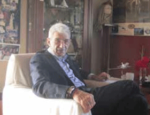
In One Step Ahead, Dimitris Athyridis’s documentary on the 2010 municipal elections in Thessaloniki, the then–mayoral candidate, Yiannis Boutaris, talks frankly about his alcohol dependency, his marital problems, and his conflict with Anthimos, the archbishop of the city, whom he accuses of hate-mongering because of Anthimos’s outspokenly nationalistic speeches. It’s hard not to feel sympathy for Boutaris after watching the documentary, even though it’s clear that the mayor, after the electoral close call, has not been able to solve all the problems before him. Garbage continues to pile up on street corners.
The mayor is not a career politician; he’s a vintner. He got his first diploma in chemistry in 1965 from the Aristotle University of Thessaloniki, and another—in oenology—in 1969 from the Athens Wine Institute. I recognize the tattoos on his fingers from other articles I’ve read about him.
Boutaris is now seventy-one, his voice smoky.
more here.
looking back at the nuclear era

The Arkansas incident, in 1980, is well chosen as an illustration of Schlosser’s point. Objects fall inside silos all the time, he says. The chance that a falling socket would puncture the skin of a Titan II missile was extremely remote—but not impossible. When it happened, it triggered a set of mechanical and human responses that quickly led to a nightmare of confusion and misdirection. Once enough oxidizer leaked out and the air pressure inside the tank dropped, the missile would collapse, the remaining oxidizer would come into contact with the rocket fuel, and the missile would explode. Because a nineteen-year-old airman performing regular maintenance accidentally let a socket slip out of his wrench, a Titan II missile became a time bomb, and there was no way to turn off the timer. And the missile was armed. Schlosser says that the explosive force of the warhead on a Titan II is nine megatons, which is three times the force of all the bombs dropped in the Second World War, including the atomic bombs that destroyed Hiroshima and Nagasaki. If it had detonated, most of the state of Arkansas would have been wiped out.
more here.
Thursday Poem
A Tender Agony of Parting
.
A craftsman pulled a reed from the reedbed,
cut holes in it, and called it a human being.
Since then, it has been wailing
a tender agony of parting,
never mentioning the skill
that gave it life as a flute.
.
.
by Rumi
from A Year with Rumi
Harper-Collins 2006
ANTHONY BOURDAIN: HOW TO TRAVEL
From Esquire:
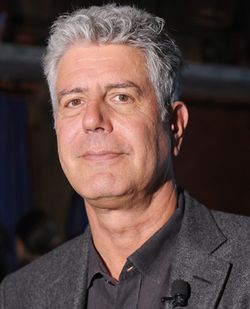
I don't get jet lag as long as I get my sleep. As tempting as it is to get really drunk on the plane, I avoid that. If you take a long flight and get off hungover and dehydrated, it's a bad way to be. I'll usually get on the plane, take a sleeping pill, and sleep through the whole flight. Then I'll land and whatever's necessary for me to sleep at bedtime in the new time zone, I'll do that.
There's almost never a good reason to eat on a plane. You'll never feel better after airplane food than before it. I don't understand people who will accept every single meal on a long flight. I'm convinced it's about breaking up the boredom. You're much better off avoiding it. Much better to show up in a new place and be hungry and eat at even a little street stall than arrive gassy and bloated, full, flatulent, hungover. So I just avoid airplane food. It's in no way helpful.
More here.
Wednesday, September 25, 2013
Human Nature and the Moral Economy
Economics is inextricably tied to moral behavior, though few economists will say that. It’s time someone did.
Eric Michael Johnson in Scientific American:
But why is it that businesses that are “too big to fail” don’t seem bound by the same moral economy as the rest of us? It turns out that anthropologists may have some insight, not only on this question, but also how we might integrate our economic and moral values that so often appear at odds. Researchers have found that the interconnection between economics and morality is seen most clearly in small communities where everybody knows each other, everyone has a free choice in who they deal with, and gossip can make or break reputations. This is even the case forsocieties that look very different from our own.
More here.
James Fadiman’s studies of the effects of LSD
Tim Doody in The Morning News:
For this particular experiment, the couched volunteers had each brought along three highly technical problems from their respective fields that they’d been unable to solve for at least several months. In approximately two hours, when the LSD became fully active, they were going to remove the eyeshades and earphones, and attempt to find some solutions. Fadiman and his team would monitor their efforts, insights, and output to determine if a relatively low dose of acid—100 micrograms to be exact—enhanced their creativity.
It was the summer of ’66. And the morning was beginning like many others at the International Foundation for Advanced Study, an inconspicuously named, privately funded facility dedicated to psychedelic drug research, which was located, even less conspicuously, on the second floor of a shopping plaza in Menlo Park, Calif.
More here.
The Life and Times of Noam Chomsky: A Brief History of America’s Leading Dissident
What does George Orwell have in common with Edward Snowden?
Our own Morgan Meis in The Smart Set:
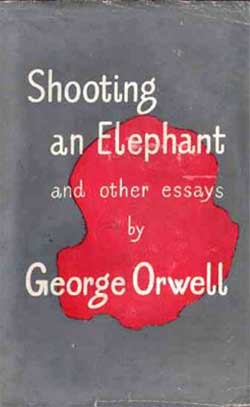
The power of Orwell’s writing came from his honesty about the actions and motivations of human beings making decisions in a messy world. So maybe it is best to say that Orwell was thinking about politics without being a political scientist. He wasn’t good at looking at politics from a distanced, objective point of view in order to suss out general laws. That’s why one of his best political essays is a story about shooting an elephant in Burma. It is a story of Orwell himself.
As a young man, Orwell got a job as an imperial policeman in Burma. He was working for the British crown. This was the 1920s. The British Empire still lorded over many parts of East Asia. Orwell realized quickly that he was a symbol of oppression to most Burmese. He was harassed in the streets, especially by the young Buddhist priests who seemed to have nothing to do, “except stand on street corners and jeer at Europeans.” This bothered Orwell, a sensitive chap with little taste for flexing his authority as a policeman. In short, Orwell felt immensely guilty about his role as a tiny cog in the British imperial machine. The guilt made him angry and the anger tore him in two. He wrote that he was “stuck between my hatred of the empire I served and my rage against the evil-spirited little beasts who tried to make my job impossible.”
Then, one day, an elephant went berserk and started smashing things up in the village.
More here.
Mumbai Moment
Jil Wheeler in The Morning News:

As we strolled up Marine Drive, we congratulated ourselves for being the lucky few expats in a city where Things Were Happening, New Yorkers living through the early days of the next Jazz Age. We watched the long line of streetlights come on along Marine Drive, nicknamed “The Queen’s Necklace” for the way the lights resemble jewels on a chain. Mumbai was then, and still is now, a city that pushes itself forward. Religion, caste, gender, and tradition fall by the wayside as millions of people flock to the city to try their luck in business or Bollywood. Despite—or perhaps because of—the striving, struggling, and severe overcrowding, people remain happy, considerate enough, more concerned with tomorrow than yesterday. I fell in love with Mumbai not because I belonged there but because no one really belonged there. The city and its residents were heading into uncharted waters, me included. Walking along Marine Drive, chatting with a vegetable seller in the market, watching a Hindi film, I felt a satisfying combination of promise, acceptance, and adaptability. I was happy and free in a way I hadn’t felt in the U.S.
More here.
james salter, né horowitz
James Salter changed his name from Horowitz for the same reason the Turks renamed Constantinople: He liked it better that way. His career, which began with spare war stories in the mid-1950s, has culminated, just now, with his magnum opus, All That Is, an autumnal novel that caps a stunning body of work. More than any other artist’s, Salter’s career, intentionally or not, has perfectly described the situation of many American Jews, who feel at once free and not free, liberated from Judaism yet stubbornly defined by it. Salter speaks to all those who intermarried and joined the club, donned white bucks and seersucker, who, lost in Sag Harbor and Hilton Head, have spent years trying to slip the shackles as Houdini, né Weiss, slipped his shackles before the multitudes. Between Salter’s most elegant lines, I can still hear Horowitz scream.Neither Bellow nor Roth, it’s Salter—defined by what he’s left out—whose art depicts the Jew who has tried to dissolve the ancient in the American quotidian but still feels a pang of difference.
more here.
victor serge’s Mexican notebooks 1940-47
Marseille, winter 1940–41. Narrow back streets dingy by day, lost in the shadows by night, criss-crossed by washing lines draped with clothes strung from the windows. Narrow and slippery, the stone oozing poverty, magnificent ancient mansions now lairs with vast entrances like caverns (carved gates, rue de la Prison). Stench. Pizzas, Greek, Russian, Annamite, Chinese restaurants. Rue de la Bouterie, the brothels with their lights out, Chat Noir, Magdeleine, Lucy, locked doors for the rush of sailors, notices in several languages. At the bottom of the alleyway, the port’s bright lights, spindly masts, Notre-Dame-de-la-Garde on the golden rock in the distance, the azure sky.
An Annamite or Chinese procession (funeral, festival?) files past in the rain under banners of cloth and coloured paper. Scampering, the thin, sallow faces of smart but sad coolies.
Lively square, ancient fine houses, baths, the church below the hospital. We go inside to admire the Easter crèche, with all its little figurines at work, sawing wood, shoeing horses, etc. For twenty sous, the figures move.
more here.
Pynchon’s new book
 Leo Robson at The New Statesman:
It is probably fair at this advanced stage to note that Pynchon has an incurable obsession with language: its capacity for behaving like glass or gauze. The opening paragraph of Gravity’s Rainbow (1973) – “A screaming comes across the sky. It has happened before, but there is nothing to compare it to now” – makes a point of stating where eloquence can’t go, either because we don’t hear V-2 rockets any more, or we no longer hear anything that resembles them, or because the only people who might have heard them were dead by the time they got the chance (being supersonic, the V-2 announces its arrival after it has already landed). But then “screaming” is already a comparison, a clarifying anthropomorphic metaphor. Fastforward more than half a century – from 1944 to 2001 – and there are even more phenomena to describe or half describe, more slang to borrow from espionage and economics, erotica and psychiatry. One of the things that Pynchon wants to expose is the way we massage things into metaphor and then forget that we’ve done it.
The book’s title, though a term in its own right (meaning new technology with risks attached), is repurposed here as a pun on a metaphor – the word “pun” being, as Gottlob Frege points out in Pynchon’s novel-beforelast Against the Day (2006), “und” upside down and back to front and a good way of bringing things together.
more here.
Naps Nurture Growing Brains
Jennifer Couzin-Frankel in Science:
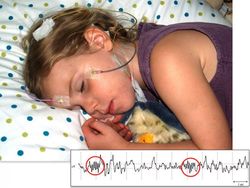 Few features of child-rearing occupy as much parental brain space as sleep, and with it the timeless question: Is my child getting enough? Despite the craving among many parents for more sleep in their offspring (and, by extension, themselves), the purpose that sleep serves in young kids remains something of a mystery—especially when it comes to daytime naps. Do they help children retain information, as overnight sleep has been found to do in adults? A study published today in the Proceedings of the National Academy of Sciences provides the first evidence that daytime sleep is critical for effective learning in young children.
Psychologist Rebecca Spencer of the University of Massachusetts (UMass), Amherst, had more than a passing interest in the subject: Her daughters were 3 and 5 when she began chasing answers to these questions. She also wondered about growing enthusiasm for universal public preschool, where teachers don’t necessarily place much emphasis on naps. “There is a lot of science” about the best curriculum for preschool classrooms, “but nothing to protect the nap,” Spencer says. Still, data to support a nap’s usefulness were scarce: Studies in adults have found that sleep helps consolidate memories and learning, but whether the same is true of brief naps in the preschool set was unknown. So Spencer approached the first preschool she could think of that might help her find out: her daughters’. She later added other local preschools to her sample, for a total of 40 children ranging from nearly 3 to less than 6 years old. The goal of Spencer, her graduate student Laura Kurdziel, and undergraduate Kasey Duclos of Commonwealth Honors College at UMass, was to compare each child against him or herself: How well did a child learn when she napped, and what happened when she didn’t?
To test this, the trio first taught the children a variant of the popular game Memory or Concentration. They were shown a series of cards with pictures on them, such as a cat or umbrella. The cards were then flipped over, hiding the pictures. Each child was offered another picture card and asked to recall where in the matrix its match lay. Then, about 2 hours later, it was naptime—or nap-free time, depending. Kurdziel and Duclos developed various “nap promotion” techniques, resting a hand on a child’s back, rubbing their feet (this was surprisingly effective), or simply sitting next to them. “If they know that someone’s got their eye on them then they can’t wiggle around as much,” Spencer says. The average nap was about an hour and 15 minutes. Soon after the children woke up, the memory game was repeated. On a different day, they learned the game in the morning, were deprived of a nap, and then tested again. All participants repeated the memory game the next morning, too. A nap made a notable difference in how the preschoolers performed, especially among those who were used to getting one.
More here.
Wednesday Poem
To My Heart On Sunday
Thank you, my heart:
you don't dawdle, you keep going
with no flattery or reward,
just from inborn diligence.
You get seventy credits a minute.
Each of your systoles
shoves a little boat
to open sea
to sail around the world.
Thank you, my heart:
time after time
you pluck me, separate even in sleep,
out of the whole.
You make sure I don't dream my dreams
up to that final flight,
no wings required.
Thank you, my heart:
I woke up again
and even though it's Sunday.
the day of rest,
the usual preholiday rush
continues underneath my ribs.
.
by Wislawa Szymborska
from Poems New and Collected 1957-1997
Harcourt Brace, 1998
Ten years since the death of Edward W. Said
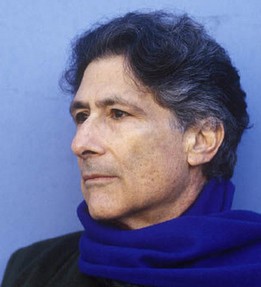
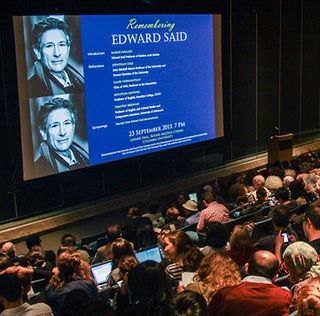
This past Monday night there was an event in remembrance of Edward at Columbia. Here is an account by Allie O'Keefe in the Columbia Spectator:
Said, a professor of English and comparative literature, gained fame through his books, especially “Orientalism” and “Culture and Imperialism,” and for his advocacy for Palestinian statehood. He died of leukemia in 2003 at the age of 67.
Presenters at the event, which was sponsored by the Center for Palestine Studies, the Department of English and Comparative Literature, the Heyman Center for the Humanities, and the Middle East Institute, lauded Said’s academic and political accomplishments and spoke of his intelligence, courage, and charm.
More here.
And here is an article by Vijay Prasad in The Hindu, “He said so 10 years ago“.
Also this: “Ten years after his death: remembering Edward Said and his quest for a just peace“.
And this: “Paying tribute to Edward W. Said“.
And here is an excellent remembrance of Edward by my nephew Asad Raza which was published at 3QD in 2005 to commemorate his second death anniversary, “Optimism of the Will“.
I collected some articles by and about Edward on the first anniversary of his death here.
And here is the complete last interview:
Tuesday, September 24, 2013
How We Learn To See Faces
Virginia Hughes in National Geographic:
Our fascination with faces exists, to some extent, on the day we’re born. Studies of newborn babies have shown that they prefer to look at face-like pictures. A 1999 studyshowed, for example, that babies prefer a crude drawing of a lightbulb “head” with squares for its eyes and nose compared with the same drawing with the nose above the eyes. “I believe the youngest we tested was seven minutes old,” says Cathy Mondloch, professor of psychology at Brock University in Ontario, who worked on that study. “So it’s there right from the get-go.”
These innate predilections for faces change and intensify over the first year of life (and after that, too) as we encounter more and more faces and learn to rely on the emotional and social information they convey. Scientists have studied this process by looking mostly at babies’ abilities as they age. But how, exactly, our brains develop facial expertise — that is, how it is encoded in neurons and circuits — is in large part a mystery.
Two new studies tried to get at this brain biology with the help of a rare group of participants: children who were born with dense cataracts in their eyes, preventing them from receiving early visual input, and who then, years later, underwent corrective surgery.
More here.
The Drone Philosopher
Marco Roth in n + 1:
I can make out a bit of wide-striped collegiate tie, a white collar, and the padded shoulders of a suit jacket in the photograph. I know I’m being unfair, but I don’t trust his looks. Since Republicans have become so successful at branding themselves the party of white men, I now suspect that any white guy in a suit may harbor right-wing nationalist tendencies, much as the CIA’s rules governing drone strikes have determined that groups of “military age” men in certain regions of Pakistan and Yemen may be profiled as terrorists. Even more unkindly, I catch myself thinking the drone philosopher’s portrait looks like it was taken for the high school debate club he surely belonged to. Maybe that was where — for competitions in dim auditoria from state to regional to national level, prepping in a series of carbon-copy cheap motels, four to a room — he first learned to be rewarded for making audacious arguments. It was like a job or a sport. Maybe there was one particularly formative debate, “Resolved: The United States was right to use the atomic bomb against Japanese civilians.” He would have parsed this proposition into a value, such as “Right Action” or “Justice,” made up of a checklist of criteria: saving American lives, the primary but not sole duty of the deciders; weighing potential lives lost or saved on both sides when contrasted with the alternative policy of full-scale invasion of Japan.
More here.
How Johnnie Walker conquered the world
Afshin Molavi in Foreign Policy:

From a small town in the Scottish Lowlands, the Striding Man has come a long way — and he's still walking.
Ask anyone who travels in emerging markets or developing economies, and chances are they've been offered Johnnie Walker. These are just some of the places I've seen it poured: at a Beijing gathering of techies, a four-day wedding in Jaipur, countless bars in Dubai, a Nile cruise in Egypt, the home of an Arab diplomat in Bangkok, private homes in Tehran, a middle-class Istanbul house, and diplomatic parties in Riyadh.
Journalists who spent time in Baghdad during the Iraq war marveled at the easy availability of Johnnie Walker Black Label, even when food staples were scarce. The late writer Christopher Hitchens — who fondly referred to the drink as “Mr. Walker's amber restorative” — accurately noted that Black Label was “the favorite drink of the Iraqi Baath Party.” In Saddam Hussein's era, a smuggler could make a good living taking crates across the border for thirsty Iranians.
More here.