
T Magazine in The New York Times:
 “My friend is a late-in-life medical student with a graduate degree in art history. His hobbies include feeling sad on rainy nights, wearing expensive pajamas and reading the same John Cheever stories over and over again. He knows every smoking-allowed dive bar in Philadelphia. He sculls before class, plays tennis on the city courts and has an encyclopedic knowledge of Bill Evans recordings. His favorite things are small, impractical and impossible to find: a paperback edition of Lydia Davis’s “The Cows,” a pair of hand-painted Qajar dynasty equestrian tiles and a trompe l’oeil pen holder in the shape of a daikon radish.” — Michael, Philadelphia; budget: $75 to $100
If I hadn’t been hypnotized to quit smoking in 2019, I’d have sworn you were describing me. I, too, love being a sad little cozy snob. Just last night, as Smog played quietly in the background and my dog, whose name is Ennui, slept on my lap, I was reading Elif Batuman’s “The Idiot” in a waffle robe and Hästens slipper boots. At the risk of oversharing, I will admit that I was running the hair dryer, which I often use to warm my bare legs and feet. For lighting cigarettes or candles, I’d give your friend one of two lighter holders: a brightly colored plastic sheath from Resin at the Disco or a more opulent option by the New York-based jewelry brand Fry Powers, which comes in 14-karat gold, sterling silver or unlacquered brass and was inspired by the work of the Italian architect and designer Gio Ponti. (Your friend sounds a bit like a Bret Easton Ellis character — a compliment — so the second option might be your better bet.) When I’m indulging in the emptiness of adulthood, I like to rewatch the movies that formed me: earlier this year, the Criterion Collection released Gregg Araki’s “Teen Apocalypse” Trilogy — “Totally F***ed Up” (1993), “Doom Generation” (1995) and “Nowhere” (1997) — as a box set. It’s the perfect eye roll to everyone and everything. (If he doesn’t have a DVD or Blu-ray player, how about a one-year subscription to the Criterion Channel?) For an alternative to a novel, I suggest “Cat Full of Spiders,” a guidebook and tarot deck by the actress Christina Ricci. Each of the 78 cards is illustrated with one of her many mordant characters. Finally, since your friend likes trompe l’oeil, I think he might enjoy this 3-D-printed plastic wallet, which the artist Stefan Gougherty has hand-detailed to look like a cuneiform tablet. If that won’t impress him, try a hair dryer. (For my money, there’s none better than the Dyson Supersonic in Prussian blue.) — Nick Haramis
More here.
Enjoying the content on 3QD? Help keep us going by donating now.
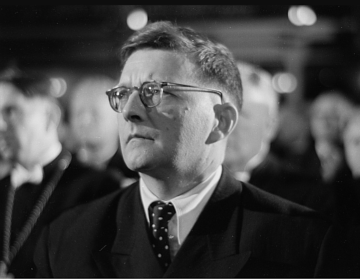 Dmitri Shostakovich’s Fifth Symphony, one of the mainstays of the twentieth-century orchestral repertory, ends with an unapologetic display of musical bombast. The coda consists of thirty-five triple-forte bars in the key of D major, anchored on grandiloquent, fanfare-like gestures in the brass. The strings saw away at the note A, playing it no fewer than two hundred and fifty-two times, the winds piping along with them. The timpani pound relentlessly on D and A, the final notes accentuated by elephantine bass-drum thwacks. It is the pum-pum-pum-pum of “Also Sprach Zarathustra” run amok. The audience invariably springs to its feet.
 Throughout his career as a historian of science, Shapin has shown that scientific authority rests not simply on established fact but also on what people consider truth—and truth has a fundamentally social character. He has done this in books such as Leviathan and the Air-Pump: Hobbes, Boyle, and the Experimental Life (co-written with Simon Schaffer, 1985), A Social History of Truth: Civility and Science in Seventeenth-Century England (1994), The Scientific Life: A Moral History of a Late Modern Vocation (2008), and the admirably subtitled collection Never Pure: Historical Studies of Science as If It Was Produced by People with Bodies, Situated in Time, Space, Culture, and Society, and Struggling for Credibility and Authority (2010). These works have made him a leading scholar of the Scientific Revolution, which supplies many of his case studies (see Shapin’s The Scientific Revolution, 1996). How do scientists (or “natural philosophers”) earn each other’s trust and the public’s trust? How do they establish what counts as scientific truth, and why do we believe them? These questions go far beyond the institutional settings of the sciences. They extend, Shapin argues in Eating and Being, into our kitchens and dining rooms.
 For decades, Big Food has been marketing products to people who can’t stop eating, and now, suddenly, they can. The active ingredient in Ozempic, as in Wegovy, Zepbound and several other similar new drugs, mimics a natural hormone, called glucagon-like peptide-1 (GLP-1), that slows digestion and signals fullness to the brain. Around seven million Americans now take a GLP-1 drug, and Morgan Stanley estimates that by
  The Secretary of Health and Human Services oversees an enormous federal agency in charge of Medicare, Medicaid, federally funded biomedical research, public health, and drug approval. In other words, it’s a very important job—and the health of the American people is in that person’s hands.
 By 1140, when the Italian monk Gratian compiled the first collection of ecclesiastical laws, the Corpus Juris Canonici, the last Olympic Games were 747 years in the past, held in the same year that the Oracle of Delphi delivered its last prophecy, a little more than a century before the Byzantine emperor Justinian I closed Plato’s Academy, in 529 CE. Ever since Rome became Christian, starting with its legalization by Constantine I in 313 and then its establishment as the religion of the empire by Theodosius 380, Europe had existed in the long dusk of its classical past, the ancient rites discarded or suppressed, the oracles made mute, the gods gone silent. Yet within Gratian’s compendium, with its stipulations for restitution and penitence, there is a curious section that mandates a “penance for forty days on bread and water” for those who have “observed Thursday in honor of Jupiter.” In another section, there is discussion of the punishment warranted for those caught worshipping Diana, the Roman goddess of the hunt. If these penitentials reflect a reality in the twelfth century, are we then to imagine that in the age of Peter Abelard and Hildegard von Bingen and of the Cathedrals at Notre Dame and Westminster Abbey, that there were people still genuflecting before Jupiter?
 G
G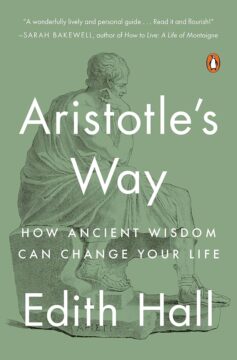 I’m an Aristotle scholar but also an enthusiast for his ideas. I’ve studied his work in the original Greek, and even made a pilgrimage to his birthplace and the various places he lived. He was the most brilliant philosopher ever to have lived. I believe that his Nicomachean Ethics offers us a guide for how to live good lives and flourish. Oddly, though, for a writer whose thinking was so clear and, in many ways, modern, people with radically different stances have tried to claim him for
 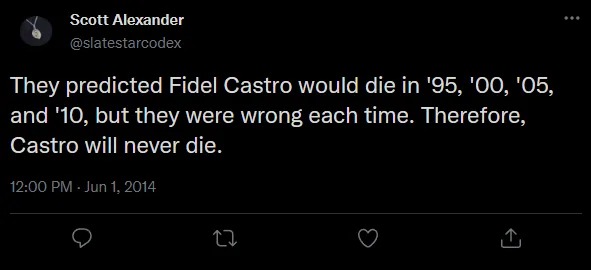 Suppose something important will happen at a certain unknown point. As someone approaches that point, you might be tempted to warn that the thing will happen. If you’re being appropriately cautious, you’ll warn about it before it happens. Then your warning will be wrong. As things continue to progress, you may continue your warnings, and you’ll be wrong each time. Then people will laugh at you and dismiss your predictions, since you were always wrong before. Then the thing will happen and they’ll be unprepared.
 Are hurricanes getting more intense due to climate change? This is one of those questions that seems straightforward—almost banal—but gets weirder the closer you look into it. The discussion atmospheric scientists are having about the drivers of the trend towards stronger hurricanes has shockingly little in common with the simplified story you get in the press.
 3:00 a.m., parked in a public lot across the street from the town beach in Westerly, Rhode Island. Just woke up, sleep evasive. It’s my first week out here. I pour an iced coffee from my cooler. I’m walking around the front of the Toyota I’m now living in when a car pulls into the lot, comes toward me. I see only headlights illuminating my fatigue and the red plastic party cup in my hand. Must be a cop. Someone gets out and approaches. It is a cop, young. I’m not afraid, exactly, but I’m also not yet used to being homeless.
 T
T