Shadi Ghadirian. Qajar Serieos, No 13.

Currently showing as part of the show:
She Who Tells a Story – Women Photographers from Iran and the Arab World
At the Boston Museum of Fine Arts.

Lynn Stuart Parramore in AlterNet:
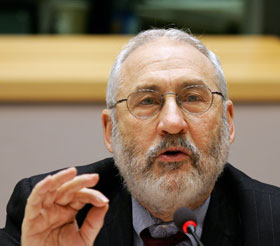
Lynn Parramore: An argument has been made, particularly since the end of the Cold War, that capitalism is great at producing things that can improve our lives, and so we ought to therefore tolerate some unfairness. What's wrong with that narrative?
Joseph Stiglitz: Well, capitalism does have a lot of strengths, including producing things that are very innovative. But what drives capitalism is the profit motive. You can profit not only by making good things, but also by exploiting people, by exploiting the environment, by doing things that are not so good. The narrative that you describe ignores the extent to which a lot of the inequalities in the United States are not the result of creative activity but of exploitive activity. And if you look at the people at the top, what is so striking is that the people who've made the most important creative contributions are not there.
More here.
Adrienne Rich in The Guardian:
In “The Defence of Poetry” 1821, Shelley claimed that “poets are the unacknowledged legislators of the world”. This has been taken to suggest that simply by virtue of composing verse, poets exert some exemplary moral power – in a vague unthreatening way. In fact, in his earlier political essay, “A Philosophic View of Reform,” Shelley had written that “Poets and philosophers are the unacknowledged” etc. The philosophers he was talking about were revolutionary-minded: Thomas Paine, William Godwin, Voltaire, Mary Wollstonecraft.
And Shelley was, no mistake, out to change the legislation of his time. For him there was no contradiction between poetry, political philosophy, and active confrontation with illegitimate authority. For him, art bore an integral relationship to the “struggle between Revolution and Oppression”. His “West Wind” was the “trumpet of a prophecy”, driving “dead thoughts … like withered leaves, to quicken a new birth”.
I'm both a poet and one of the “everybodies” of my country. I live with manipulated fear, ignorance, cultural confusion and social antagonism huddling together on the faultline of an empire. I hope never to idealise poetry – it has suffered enough from that. Poetry is not a healing lotion, an emotional massage, a kind of linguistic aromatherapy. Neither is it a blueprint, nor an instruction manual, nor a billboard. There is no universal Poetry, anyway, only poetries and poetics, and the streaming, intertwining histories to which they belong. There is room, indeed necessity, for both Neruda and César Valléjo, for Pier Paolo Pasolini and Alfonsina Storni, for both Ezra Pound and Nelly Sachs. Poetries are no more pure and simple than human histories are pure and simple. And there are colonised poetics and resilient poetics, transmissions across frontiers not easily traced.
More here.
Steven Levy in Wired:
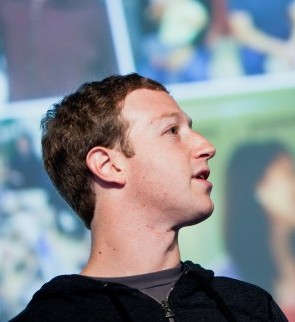
Reaction was mixed, both to the white paper and to the accompanying video, which used a John F. Kennedy speech to amplify a visual message that connectivity leads to better human relations. So WIRED welcomed the opportunity to discuss the plan face-to-face with Zuckerberg on the company’s Menlo Park, California campus. Here is the interview, edited for space and clarity.
WIRED: Why form a coalition to spread global connectivity?
Zuckerberg: The Internet is an important foundation in improving the world, but it doesn’t build itself. Over the past few years, we’ve invested more than a billion dollars in connecting people in developing countries. We have a product called Facebook for Every Phone, which provides our service on feature phones; it has 100 million users. But no one company or government can build out a full stack of infrastructure to support this around the world. So you need to work together with folks. Since we’ve announced Internet.org, we’ve heard from operators around the world and governments who want to work with us. This is going to provide momentum to make this work over the next 3 to 5 years, or however long it’s going to take.
More here.
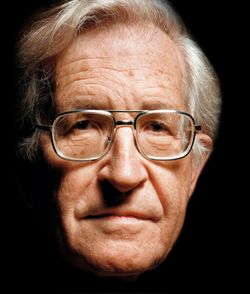
Mohammed Attar Interviews Noam Chomsky at the website of the Heinrich Böll Stiftung:
Your discourse unambiguously states that America and Israel have no desire to see the regime fall and that their actions are determined by the “better the devil you know” principle. How do you explain a counter-discourse, promulgated by analysts and intellectuals, especially among Leftist circles in Europe the US and the Arab world, which is based on the supposition of an American/Israeli/imperialist plot? For some people, the revolution in Syria has been a conspiracy from the outset. For others it was hijacked by the conspiracy.
More here. [Thanks to Omar Ali.]
Tim Parks in Aeon:

…The process is neither that of a single switch being turned, nor of a steady continuum, but of a series of small gains and losses; perhaps a larger step forward, then a small relapse. If one is persistent, undaunted, in one’s attempts to concentrate, if one is successful in showing neither aversion to pain nor indulgence in pleasure, then, very slowly, the stillness and silence deepen in an atmosphere of beatitude that is simultaneously and indivisibly both physical and mental. It is as if, as the body is slowly put together and all its component parts unite in an intense present, so the historical self is taken apart and falls away. At no point is it experienced as a loss, but rather as a fullness of existence; something brimful, very ordinary and very beautiful. The words we constantly use and the narratives we write reinforce a drama of selfhood that we in the West complacently celebrate. There is also much consolation taken in the way in which writing and narrative can transform emotional pain into a form of entertainment, wise and poignant in its vision of our passage through the world, intense and thrilled by its own intensity. Narrative is so often the narrative of misery and of the passage through misery. What silence and meditation leaves us wondering, after we stand up, unexpectedly refreshed and well-disposed after an hour of stillness and silence, is whether there isn’t something deeply perverse in this culture of ours, even in its greatest achievements in narrative and art. So much of what we read, even when it is great entertainment, is deeply unhelpful.
More here.
From MSNBC:
“Nah,” “eh,” “no” and “ugh”: These are the familiar sounds of people who don't seem to like much and conjure negative quips for just about anything. While people with more positive dispositions may try to shake enthusiasm unto these downers, new research helps to explain why this often doesn't work. That certain people like more things than others may seem obvious, but, until now, nobody has ever tested whether such dispositions operate as distinct personality traits, separate from other traits such as optimism/pessimism or extroversion/introversion. A team of researchers from the University of Illinois at Urbana-Champaign and the University of Pennsylvania have now conducted the first quantitative analysis of dispositional attitude, finding that it is, in fact, distinct from these other traits. “Optimists tend to have generalized beliefs usually about the future, such as 'Things are going to turn out well,'” said Justin Hepler, a professor of psychology at the University of Illinois at Urbana-Champaign and an author on the study. “We were interested in whether people liked or disliked things, in general, and had people report their attitude about different things.”
…The researchers found that people's dispositional attitudes often correlated with other similar traits, but were still statistically distinct, meaning that some optimists have a tendency to dislike many things, and some pessimists, likewise, might like lots of things. As with all personality traits, dispositional attitudes develop through a combination of one's biology and environment. The team has not yet assessed how therapy could help mediate these traits, but suggests that adjusting one's external stimuli, such as surrounding oneself with positive people, could ultimately sway a person from one side of the spectrum to the other.
More here.
Höfn
The three-tongued glacier has begun to melt.
What will we do, they ask, when boulder-milt
Comes wallowing across the delta flats
And the miles-deep shag ice makes its move?
I saw it, ridged and rock-set, from above,
Undead grey-gristed earth-pelt, aeon-scruff,
And feared its coldness that still seemed enough
To iceblock the plane window dimmed with breath,
Deepfreeze the seep of adamantine tilth
And every warm, mouthwatering word of mouth.
.
by Seamus Heaney
Zeeya Merali in Nature News:
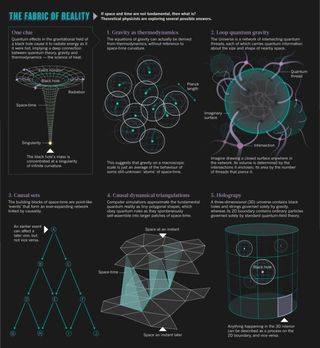
“Imagine waking up one day and realizing that you actually live inside a computer game,” says Mark Van Raamsdonk, describing what sounds like a pitch for a science-fiction film. But for Van Raamsdonk, a physicist at the University of British Columbia in Vancouver, Canada, this scenario is a way to think about reality. If it is true, he says, “everything around us — the whole three-dimensional physical world — is an illusion born from information encoded elsewhere, on a two-dimensional chip”. That would make our Universe, with its three spatial dimensions, a kind of hologram, projected from a substrate that exists only in lower dimensions.
This 'holographic principle' is strange even by the usual standards of theoretical physics. But Van Raamsdonk is one of a small band of researchers who think that the usual ideas are not yet strange enough. If nothing else, they say, neither of the two great pillars of modern physics — general relativity, which describes gravity as a curvature of space and time, and quantum mechanics, which governs the atomic realm — gives any account for the existence of space and time. Neither does string theory, which describes elementary threads of energy.
Van Raamsdonk and his colleagues are convinced that physics will not be complete until it can explain how space and time emerge from something more fundamental — a project that will require concepts at least as audacious as holography. They argue that such a radical reconceptualization of reality is the only way to explain what happens when the infinitely dense 'singularity' at the core of a black hole distorts the fabric of space-time beyond all recognition, or how researchers can unify atomic-level quantum theory and planet-level general relativity — a project that has resisted theorists' efforts for generations.
Peter Suderman in Reason's Hit and Run blog:
1. If the rebels win, it’s bad news for the U.S. Assad is no friend to the U.S. But neither are the rebel groups leading the charge against the Syrian dictator. Indeed, many of the rebel factions have strong ties to Al-Qeada. If the rebels successfully oust Assad, it’s entirely possible that they will attempt to set up a new regime that is intensely hostile to the United States. Intervention on the side of the rebels would also complicate America's already-fraught relationship with Russia, which is close with the Assad regime.
2. If Assad wins, it’s bad news for the U.S. Especially if the U.S. is seen to have openly sided with the rebels. A win for Assad is a win for anti-American forces Iran, which would see its influence in the region strengthened. It’s also a win for Hezbollah, which is closely linked with Iranian extremists. With no good option, then, the U.S. is better off staying out of the conflict entirely.
3. It’s far from certain that any “limited” actions would actually be effective. Most of the talk right now revolves around the possibility of limited cruise missile strikes and/or no-fly zone enforcement. But as the Chairman of the Joint Chiefs of Staff Martin Dempsey told NPR last month, the possible results of enforcing a no-fly zone could “include the loss of U.S. aircraft, which would require us to insert personnel recovery forces. It may also fail to reduce the violence or shift the momentum because the regime relies overwhelmingly on surface fires — mortars, artillery, and missiles.”
Arvind Subramanian in the NYT:
Structural problems were inherent in India’s unusual model of economic development, which relied on a limited pool of skilled labor rather than an abundant supply of cheap, unskilled, semiliterate labor. This meant that India specialized in call centers, writing software for European companies and providing back-office services for American health insurers and law firms and the like, rather than in a manufacturing model. Other economies that have developed successfully — Taiwan, Singapore, South Korea and China — relied in their early years on manufacturing, which provided more jobs for the poor.
Two decades of double-digit growth in pay for skilled labor have caused wages to rise and have chipped away at India’s competitive advantage. Countries like the Philippines have emerged as attractive alternatives for outsourcing. India’s higher-education system is not generating enough talent to meet the demand for higher skills. Worst of all, India is failing to make full use of the estimated one million low-skilled workers who enter the job market every month.
More from Simon Johnson in the NYT's Economix here.
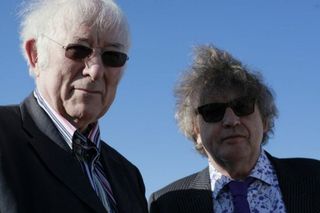
Paul Muldoon on Seamus Heaney in The Daily Beast:
If, as Eliot suggested, the mark of a great poet is that she or he will develop the milieu in which her or his work is seen to matter, then Heaney certainly had an educator’s gift for drawing out his readers and transporting them to places where they simply wouldn’t have expected to be. The truth is that he developed into a much more complex poet than anyone might have imagined, one who was increasingly recognized as having insights into not only plows, horses, and frogs, but international politics, human rights, and the attack on the World Trade Center. He was the only poet I can think of who was recognized worldwide as having moral as well as literary authority and, as such, may be the last major poet to even entertain such a possibility.
Sameer Rahim in The Telegraph:
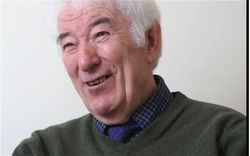
…Works of art often sparked his imagination. There were fine translations of Dante and Sophocles and an acclaimed version of Beowulf. European literature was in his bones. In an essay on three English poets – his close friend Ted Hughes, Philip Larkin and Geoffrey Hill – he wrote of the “cultural depth-charges latent in certain words and rhythms, the binding secret between words in poetry that delights not just the ear but the whole backward and abysm of mind and body”. The phrase “backward and abysm” recalls The Tempest: Prospero’s question to his daughter Miranda about her early years. Heaney was in deep touch with his childhood memories out of which he made beautiful poetry. But he also plunged into dark corners of the human heart and the well of ancient literature. He felt like a wise sage as well as a great poet. Though I can hear him gently recoiling from such praise: “The gift of writing is to be self-forgetful,” he told me, ”to get a surge of inner life or inner supply or unexpected sense of empowerment, to be afloat, to be out of yourself.”
More here.
From The New York Times:

More here.
From the Boston Review:
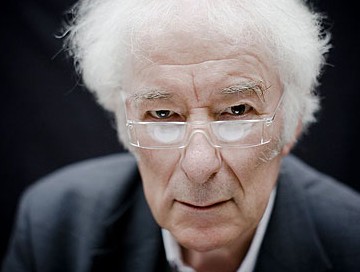
Seamus Heaney, as I’ve often said, was a mensch as well as a great poet. When he sent me a poem for the first issue of Slate (his wonderful “Little Canticles of Asturias”), I don't think he had any notion what an “internet magazine” might be. He gave me the poem because I asked him for one, and we were friends. Readers of Boston Review should know that his attachment to this place was deep. I think Boston and Cambridge supplied, a little, some haven from the central, sometimes fierce spotlight, for him, of being in Dublin or London. Here, there was a little refuge in being an outsider, as well as in the glare. He handled it all with class and generosity. When reading lives of writers, many great writers often behaving in ways that were petty or worse, I've thought to myself, “Thank god for Chekhov—a great writer who was also a decent, generous, good person.”
Well, thank god for Seamus.
More here. And here's the NYT obituary by Margalit Fox.
Huw Price in Medium of Expression:
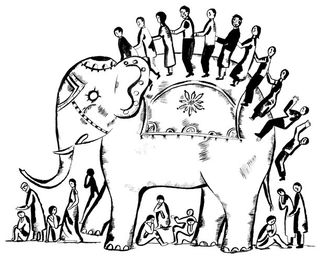
I’ll come back to that question, but first to the dispute itself, which is one of philosophy’s oldest feuds. One team thinks of time as we seem to experience it, a locus of flow and change, centered on the present moment – “All is flux”, as Heraclitus put it, around 500BC. The other team, my clan, are loyal instead to Heraclitus’s near contemporary, Parmenides of Elea. We think of time as it is described in history: simply a series or “block” of events, lined up in a particular order, with no distinguished present moment. For us, “now” is like “here” – it marks where we ourselves happen to stand, but has no significance at all, from the universe’s point of view.
Which side is right? Both teams have supporters in contemporary philosophy, but we Parmenideans claim powerful allies in modern physics, commonly held by physicists themselves to favour the block picture. Einstein is often quoted as one of our champions.
More here.
For Azra and Sughra: