
Category: Recommended Reading
Montana: Big Sky country at an environmental crossroads
Nate Schweber at Al Jazeera America:

“Most jobs won't last after the pipeline's built, and what happens if there's a spill?” said Moffett, 77. “Why should we put up with the pollution, the disruption of agricultural lands? What's in it for Montana?”
Across this massive state, with scenery ranging from snowy mountains to virgin prairies, a diverse collection of Montanans, in love with their land, is opposing new transportation infrastructure for coal and oil.
Three proposed projects — the Keystone XL pipeline, a new coal railroad and a trucking route for mining equipment the size of apartment buildings — have triggered protests in different regions of the state, and not just from people who dislike fossil fuels.
Ranchers, Native Americans, farmers and environmentalists say they don't want the industrialization of the land that comes with moving the fuels and with the equipment needed for their extraction.
More here.
Tuesday Poem
Loss
Something in me repeats in an obsessive beat
that I may have lost something
or left it behind
in the café or the bookstore
where I’d been
I searched my possessions
and no loss was found
nor did I discover what had been lost
but the loss
kept asserting its existence
through palpitations and minor fits
Athenian sophists philosophized:
“A thing you haven’t lost
is necessarily in your possession
you haven’t lost a tail—therefore, you have a tail
or vice versa
what you’ve lost was necessarily yours”
but what have I lost?
I must look for my loss
in order to know what I’m looking for
is it an object or a thing or the thing
and was it mine before it was lost
or is it that some inner authority
is trying to bequeath me, like a Hellenistic sophist,
something I had never possessed
as for example a chance
as if I ever stood a chance
.
.
by Mordechai Geldman
from Halachti Shanim Le-Tzidcha
publisher: Hakibbutz Hameuchad, Mossad Bialik, Tel Aviv, Jerusalem, 2011
translation: 2013, Tsipi Keller
GIVING MAKE-UP A SLAP
Rebecca Willis in More Intelligent Life:

…In her fascinating book “Bodies” (Profile Books), Susie Orbach describes how the culture we live in determines the marks we make—or “inscribe”— on ourselves. The world we live in is literally written on our bodies. The objective of make-up nowadays seems to be to mimic the smooth, even-toned skin of youth, and, to quote make-up artists and shop assistants, to “open up the eye” (singular). They all talk about opening up the eye; this is not a surgical procedure, thank goodness, but seems to mean making it look brighter and above all bigger. No one could tell me why that should be so desirable. Then I read that the distance between eyeball and eyebrow is a key factor in gender perception, and is much greater in women than men. To enlarge that distance is to exaggerate your femininity. And when the eye itself is widened it is a sign of submission, so opening up the eye makes us kittenishly vulnerable. No wonder early feminists went bare-faced. Narrowing my eyes, I picked up a book on body language. “The use of lipstick”, it read, “is a technique thousands of years old that is intended to mimic the reddened genitals of the sexually aroused female.” Was ever a sentence more likely to give you pause before whipping a stick of Chanel’s Rouge Allure out of your handbag? We might just want to reflect a moment on these things before we hand over the contents of our wallets to the billion-dollar cosmetic industry, and slap our purchases, in the name of improvement, onto our party-going faces.
More here.
Learning to Defuse the Aorta
Gina Kolata in The New York Times:

…About 10 years ago, he and his colleagues discovered the answer in another protein, T.G.F.-beta, short for transforming growth factor beta, which tells cells how to behave during development and is used in repairing wounds. The protein’s function depends on fibrillin-1, the very protein that is altered in Marfan syndrome. Normally, fibrillin-1 hooks T.G.F.-beta to connective tissue. But in someone with Marfan, the researchers discovered, the fibrillin-1 is defective, and the process goes awry. Instead of attaching to the connective tissue, T.G.F.-beta drifts away from it. Floating free in the bloodstream, it makes cells behave abnormally, leading to many of the problems caused by Marfan, including excessive growth of the aorta. In short, the rivet model was entirely wrong. “That,” Dr. Dietz said, “was one of the few ‘aha’ moments in my life.” He tested his theory in mice, giving them the mutated fibrillin-1 gene. Sure enough, levels of the T.G.F. protein were very high. The mice showed Marfan symptoms, including emphysema, weak skeletal muscles and a thickening of the mitral valve in the heart. He sought a way to block the function of T.G.F.-beta and found a widely used blood pressure drug, losartan, that did just that.
More here.
Humanism for a Globalised World

A segment of Priyamvada Gopal's forthcoming article in New Humanist:
While he was a fierce critic of empire, Said was profoundly interested in what could be done with a concept like humanism, laden as it is with the baggage of colonial civilisational missions and Eurocentrism, the worldview that assesses the rest of the world through the lens of European and white superiority. Perhaps surprisingly, at least for those who (despite his vocal protestations) read him as the originator of a postmodern and postcolonial approach to culture, Said describes himself as a humanist, insisting that “attacking the abuses of something is not the same thing as dismissing or entirely destroying that thing.” He himself remained unaffected by the antihumanism that characterised academic postmodernism with its “dismissive attitudes” to ideas such as enlightenment and emancipation. What then is the humanism that Said wishes to not have thrown out with the bathwater of discredited colonial or racist projects? For him, “the core of humanism is the secular notion that the historical world is made by men and women, and not by God and that it can be understood rationally … Or to put it differently, we can really only know what we make.”
Given that terms like “reason” and “secularism” have often been and continue to be used as sticks with which to beat apparently backward cultures and communities, what would prevent this reclaimed project of “critical humanism” from falling prey to precisely the same abuses that bedevilled a more familiar Western “high humanism”? Integral to Said’s advocacy of a critical and democratic humanism is the understanding that the ideas underpinning humanist practice are not, in fact, exclusive to one culture or the other; they are part of a “collective human history”. Engaging carefully with a variety of traditions and contexts across the world will make clear that aspirations to liberty, learning, justice and equality are genuinely universal. All societies are capable of change and change is always enacted by those who resist the depredations of power, whether in the form of despotism and tyranny or unjust war and military occupation.
Humanism has also to be wrenched from its association with and deployment by selective elites, “be they religious, aristocratic, or educational”, and returned to its democratic provenance because it is ultimately about the capacity of the human mind to free itself. The human capacity for discovery, self-criticism and engaging in “a continuous process of self-understanding” means that no one is incapable of humanistic thinking and nothing is exempt from humanism’s critical reach, whether religious fanaticism, atheist dogmatism or “manifestly imperial plans for domination” that might otherwise pass for entirely rational and necessary. Those who use humanism or secularism as weapons for asserting dominance or superiority over other cultures generally miss “what has long been a characteristic of all cultures, namely, that there is a strong streak of radical antiauthoritarian dissent in them.” What makes all cultures and civilisations interesting is actually “their countercurrents, the way that they have had of conducting a compelling dialogue with other civilisations”.
More here.
Monday, December 2, 2013
perceptions
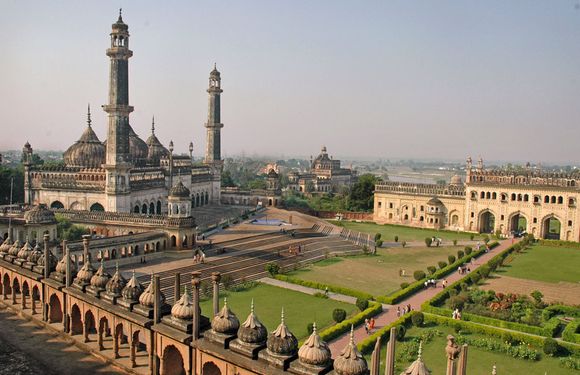
Bara Imambara, Lucknow. A “complex built by Asaf-ud-daulah, Nawab of Lucknow, in 1784, also called the Asafi Imambara.” Architect Hafiz Kifayat ullah Shahjahanabadi.
In honor of Syed Ali Raza, who would have been 100 on November 29th, 2013. He was born just outside this “city of Nawabs” and attended Shia College in Lucknow maturing into a most exceptionally gifted, unique, and principled man. Abbas, Azra, and I, along with our 4 older siblings are exceedingy fortunate to be his children!
Do read about the then novel idea of “Food for Work” and the bold architectural design of this amazing structure here and here.
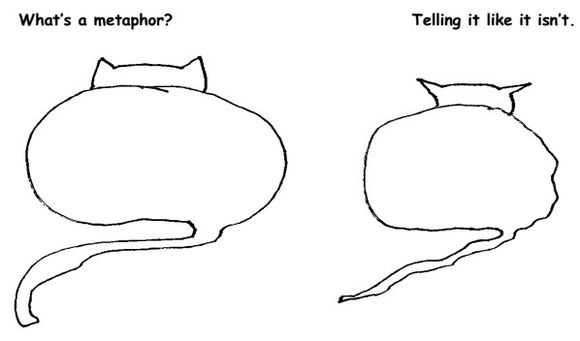
CATSPEAK
by Brooks Riley
Sunday, December 1, 2013
The Man Who Designed Pakistan’s Bomb
Pervez Hoodbhoy in Newsweek:
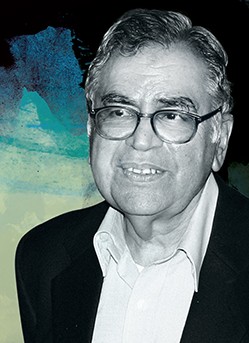
Riazuddin never laid any claim to fathering the bomb—a job that requires the efforts of many—and after setting the nuclear ball rolling, he stepped aside. But without his theoretical work, Pakistan’s much celebrated bomb makers, who knew little of the sophisticated physics critically needed to understand a fission explosion, would have been shooting in the dark.
A bomb maker and peacenik, conformist and rebel, quiet but firm, religious yet liberal, Riazuddin was one of a kind. Mentored by Dr. Abdus Salam, his seminal role in designing the bomb is known to none except a select few.
More here.
How to Burst the “Filter Bubble” that Protects Us from Opposing Views
From the MIT Technology Review:
Pariser used the example of two people who googled the term “BP”. One received links to investment news about BP while the other received links to the Deepwater Horizon oil spill, presumably as a result of some recommendation algorithm.
This is an insidious problem. Much social research shows that people prefer to receive information that they agree with instead of information that challenges their beliefs. This problem is compounded when social networks recommend content based on what users already like and on what people similar to them also like.
This the filter bubble—being surrounded only by people you like and content that you agree with.
And the danger is that it can polarise populations creating potentially harmful divisions in society.
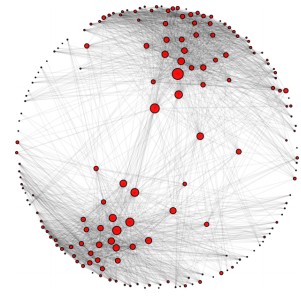
Today, Eduardo Graells-Garrido at the Universitat Pompeu Fabra in Barcelona as well as Mounia Lalmas and Daniel Quercia, both at Yahoo Labs, say they’ve hit on a way to burst the filter bubble. Their idea that although people may have opposing views on sensitive topics, they may also share interests in other areas. And they’ve built a recommendation engine that points these kinds of people towards each other based on their own preferences.
More here.
Must We Give Up Understanding to Secure Knowledge in Economics?
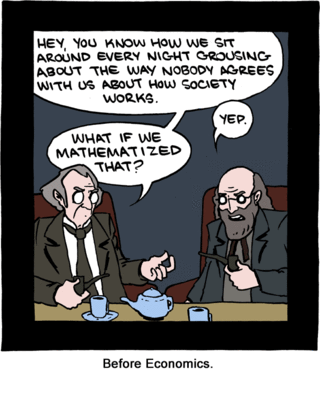
Alex Rosenberg and Tyler Curtain in 3:AM Magazine:
In physics our knowledge exceeds our understanding. In economics the reverse is true. Seeing why helps us make sense of both of these disciplines.
In physics we’ve reached the point where we know the nature of things to twelve decimal places. We reached that point by starting with common sense and correcting its predictions until we arrived at quantum mechanics—a theory that we literally can’t understand, despite the fact that we know it to be as close to the truth as any theory we have in any science. It took about 350 years—from Newtonian gravity to Schrödinger’s cat—to get to the point where knowledge exceeds understanding in physics.
Economics is harder than physics. It must be. It’s not much younger a science, having gotten its start with Adam Smith in 1776, a good 83 years before Darwin was able to put biology on a scientific footing. If economics were as easy as physics, it would have made more progress by now.
As far back as John Stuart Mill philosophers of science have been trying to figure out exactly why economics is harder than physics. They have given a variety of answers.
We think a large part of the reason is that unlike the physicists, the economists have been unwilling or unable to let go of the notion that their understanding of economic affairs counts as knowledge about economic behavior. Like physics, economics starts with common sense—in this case firm convictions about how we are driven to make choices by our desires and our beliefs, which the economists label preferences and expectations.
Giving up firmly held convictions isn’t just a problem for economics. Physics had the same problems: humans have difficulty relinquishing the conviction that motion requires force, that there is a preferred direction in space, that every event has a cause. But progress—as measured by prediction—required relinquishing our sense that we already know how things work. In the social sciences, it’s been almost impossible to give up trying to explain things by making sense of them in the form of stories we understand.
More here.
Some Damn Foolish Thing
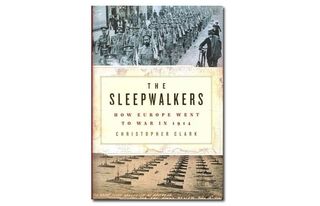
Thomas Laqueur reviews Christopher Clark's The Sleepwalkers: How Europe Went to War in 1914, in the LRB:
Fifty years ago, Barbara Tuchman’s bestseller The Guns of August taught a generation of Americans about the origins of the First World War: the war, she wrote, was unnecessary, meaningless and stupid, begun by overwhelmed, misguided and occasionally mendacious statesmen and diplomats who stumbled into a catastrophe whose horrors they couldn’t begin to imagine – ‘home before the leaves fall,’ they thought. It was in many ways a book for its time.
Tuchman’s story begins with Edward VII’s funeral on 20 May 1910. The king’s sister-in-law, the empress consort of Russia, Maria Feodorovna, wife of Alexander III, was there. So was the Archduke Franz Ferdinand, heir apparent to the aged Emperor Franz Joseph of Austria. And so was Edward’s least favourite nephew, Wilhelm II of Germany. Wilhelm loved and admired the British and they loved the kaiser: to him, the Timessaid, belongs ‘the first place among all the foreign mourners’; even when relations were ‘strained’, he ‘never lost his popularity amongst us’. Four years before Armageddon the German emperor was decidedly not the antichrist he would become. The book ends with the Battle of the Marne – ‘one of the decisive battles of the war’ – which ended the German hope for a quick victory and set the stage for four years of deadlock and misery.
Tuchman says nothing about Austria-Hungary and Serbia on the eve of the war, and nothing about the Russo-Austrian and Serbo-Austrian fronts once it began. ‘The inexhaustible problem of the Balkans divides itself naturally from the rest of the war,’ she thinks, and in any case nothing much happened there in the period she covers. More surprising is that in the first third of the book there isn’t a word about Serbia. The assassination of the archduke in Sarajevo on 28 June 1914 goes by in two sentences, one of which, a quotation from the oracular Bismarck, may be all she needs: ‘some damn foolish thing in the Balkans’ would ignite the next war.
Why was this story so compelling in the 1960s? I think because at the height of the Cold War the world needed and embraced a morality tale of the sort Tuchman offered.
More here.
There Will Be Blood / Through Numbers
Via io9:
There Will Be Blood / Through Numbers from Ali Shirazi on Vimeo.
The Threat to British Curry
Huma Yusuf in The New York Times:
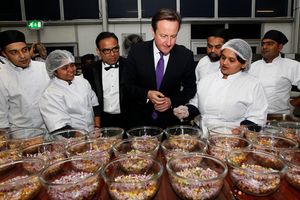
But now curry is under threat, both from the state and the market. Cameron’s favorite curry house in Oxfordshire was raided by border officials last month, and three Bangladeshis suspected of immigration infractions were arrested. Stringent laws have made it nearly impossible for restaurants to bring chefs from India, Pakistan and Bangladesh, creating a shortfall of qualified talent. Acknowledging the scale of the problem at the curry awards ceremony, the prime minister pledged to help: “So let me promise you this: We will work through this together. We’ll continue to help you get the skilled Asian chefs you need.”
More here.
the ascent of man
Horowitz – Scarlatti Sonata L33
“Nay but you, who do not love her..”
Newlyweds’ gut feelings predict marital happiness
Regina Nuzzo in Nature:
The researchers, led by psychologist James McNulty of Florida State University in Tallahassee, tapped into these implicit attitudes by seeing how fast newlyweds could correctly classify positively and negatively themed words after being primed by a photo of their spouse for a fraction of a second. If seeing a blink-of-the-eye flash of a partner’s face conjures up immediate, positive gut-level associations, for example, the participant will be quicker to report that 'awesome' is a positive word and slower to report that 'awful' is a negative one. Researchers used the difference between these two reaction times as a measurement of a participant’s automatic reaction.
More here.
Saturday, November 30, 2013
Photographs Tell a History of Palestinians Unmoored
Isabel Kershner in the New York Times:

These are a few of the black and white images, many of them powerful and haunting, that will eventually constitute a digital archive compiled by the United Nations Relief and Works Agency, the first part of which was unveiled Thursday at a gallery in the Old City here. Together, they capture the Palestinian refugee experience from the 1948 war onward, giving form to a seminal chapter in Palestinian history, identity and collective memory.
For decades, about half a million negatives, prints, slides and various forms of film footage have been hidden away in the archive of UNRWA, the organization that assists Palestinian refugees. Stored in buildings in Gaza and Amman, Jordan, the materials had begun to grow moldy.
More here.
Reverse-Engineering a Genius (Has a Vermeer Mystery Been Solved?)
David Hockney and others have speculated—controversially—that a camera obscura could have helped the Dutch painter Vermeer achieve his photo-realistic effects in the 1600s. But no one understood exactly how such a device might actually have been used to paint masterpieces. An inventor in Texas—the subject of a new documentary by the magicians Penn & Teller—may have solved the riddle.
Kurt Anderson in Vanity Fair:
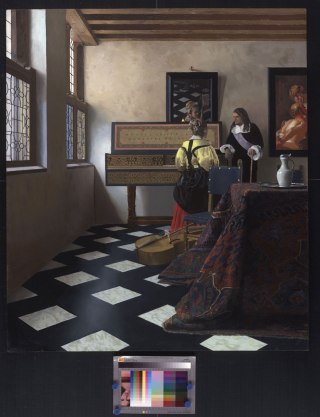
Despite occasional speculation over the years that an optical device somehow enabled Vermeer to paint his pictures, the art-history establishment has remained adamant in its romantic conviction: maybe he was inspired somehow by lens-projected images, but his only exceptional tool for making art was his astounding eye, his otherworldly genius.
At the beginning of this century, however, two experts of high standing begged to differ. Why, for instance, did Vermeer paint things in the foreground and shiny highlights on objects slightly out of focus? Because, they say, he was looking at them through a lens.
More here.