
Category: Recommended Reading
Can America face up to the terrible reality of slavery in the way that Germany has faced up to the Holocaust?
Susan Neiman in Aeon:

Working through Germany’s criminal past was not an abstract exercise; it involved confronting one’s own parents and teachers and calling their authority rotten. The 1960s in Germany were more turbulent than the 1960s in Paris or Prague — not to mention Berkeley — because they were focused not on crimes committed by someone in far-off Vietnam but considerably closer to home, by the people from whom one had learnt life’s earliest lessons.
More here.
Thursday, September 19, 2013
Review of Richard Dawkins’s ‘Appetite for Wonder,’ a Memoir
Janet Maslin in the New York Times:
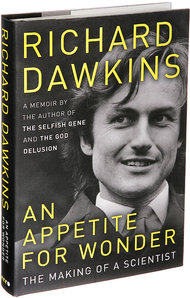
The family history also includes Clinton George Augustus Dawkins, son of the eloped couple, who earned his place in family lore during the Austrian bombardment of rebel Venice in 1849, when a cannonball hit his bed.
“A cannonball penetrated the bed covers and passed between his legs, but happily did him no more than superficial damage,” reads the inscription that accompanies a cannonball in Mr. Dawkins’s possession. The story may not be 100 percent true, but it does underscore this family’s staying power.
More here.
J002E3

From Wikipedia:
J002E3 is the designation given to a supposed asteroid discovered by amateur astronomer Bill Yeung on September 3, 2002. Further examination revealed the object was not a rock asteroid but instead the S-IVB third stage of the Apollo 12 Saturn V rocket (serial S-IVB-507).[1]
When it was first discovered it was quickly found that the object was in an orbit around Earth. Astronomers were surprised at this as the Moon is the only large object in orbit around the Earth[note 1] and anything else would have been ejected long ago due to perturbations with the Earth, the Moon and the Sun.
Therefore it must have entered into Earth orbit very recently, yet there was no recently-launched spacecraft that matched the orbit of J002E3. One explanation could have been that it was a 30-meter wide piece of rock, but University of Arizona astronomers found that the object's electromagnetic spectrum was consistent with white titanium dioxide paint, the same paint used by NASA for the Saturn V rockets. Back-tracing its orbit showed that the object had been orbiting the Sun for 31 years and had last been in the vicinity of the Earth in 1971. This seemed to suggest that it was a part of the Apollo 14 mission but NASA knew the whereabouts of all hardware used for this mission; the third stage, for instance, was deliberately crashed into the Moon for seismic studies.
The only other explanation was that it was the S-IVB third stage for Apollo 12. NASA had originally planned to direct the S-IVB into a solar orbit, but an extra long burn of the ullage motors meant that venting the remaining propellant in the tank of the S-IVB did not give the rocket stage enough energy to escape the Earth–Moon system, and instead the stage ended up in a semi-stable orbit around the Earth after passing by the Moon on November 18, 1969. The Apollo 12 S-IVB eventually vanished.
It is thought that J002E3 left Earth orbit in June 2003, and that it may return to orbit the Earth in about 2032.
The Apollo 12 S-IVB unit had a dry weight of about 23,000 pounds (10,000 kgf)[citation needed] and is in unstable Earth orbit, which may result in eventual collision with Earth. An object with a mass of 10,000 kg collides with earth approximately every 1-5 years.
gerald kersh: a neglected writer of ghosts, monsters, Shakespeare, mermaids and Martians
“No mortal can write this well” marvels Harlan Ellison in his introduction to Nightshade and Damnations – nor, one might add, this much. Gerald Kersh was astonishingly prolific, hammering out twenty novels, twenty collections of short stories and thousands of articles in different publications, hacking pseudonymously as Piers England, Waldo Kellar, Mr Chickery, Joe Twist, George Munday, and others. He is a bibliographer’s nightmare – or dream. Born into a Jewish family in Teddington, South-west London, in 1911, he became an American citizen in 1959 and died in New York in 1968, by which point he had largely been forgotten. These reissues are signs of a revival of interest in this strange and compelling writer whose ramshackle cv included stints as a cinema manager, bodyguard, debt collector, fish frier, travelling salesman, teacher of French and all-in-wrestler. His literary career likewise avoided any taint of respectability. He was a mainstay of popular periodicals such as John O’London’s Weekly, Argosy and Lilliput, specializing in tales of war, freakishness, horror and science fiction.
more here.
Marville’s photographs of 19th century paris
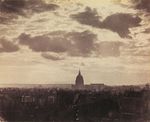
Charles Marville is best known for his government commission to photograph the neighborhoods of Paris slated for demolition during Baron Haussmann’s reconfiguration of the city between 1853 and 1870. In fact, that is virtually all he has been known for, a matter the authors of Charles Marville: Photographer of Paris are eager to rectify. Among the basic but previously unknown facts they have unearthed are his real name (Charles-François Bossu—which means “hunchback”) and his date of birth (1813). They have also delved into his early career as an illustrator for the popular press and his pre-commission work as a photographer. The latter includes delicate salted-paper prints that inevitably evoke Fox Talbot, inventor of the process; a great deal of urban landscape work, in Paris and elsewhere, that make it clear why he was given his commission; and a few intriguing stabs at photojournalism taken at the very threshold of photography’s ability to record crowds, such as a glimpse of the pageantry and extraordinary decorations attending the baptism of the Imperial Prince in 1856.
more here.
thoughts on Arendt, McCarthy, Hardwick, and Sontag

I’ve always been sorry that I did not recognize Hannah Arendt at the memorial service for W. H. Auden at the Cathedral of St. John the Divine in October of 1973, but then I could not have, because at the time I still had not heard of her. In 1971, I’d read James Baldwin’s “Open Letter to My Sister, Angela Davis,” in the New York Review of Books. His conclusion, “For if they come for you in the morning, they will be coming for us that night,” had for me the romance of “Since there is no help, come let us kiss and part,” even though Baldwin was talking about the death chamber in California, not an Elizabethan love given up. I didn’t hold another issue of the New York Review of Books until the autumn of 1973, when I was a student in Elizabeth Hardwick’s creative writing class at Barnard College, along with Mona Simpson, Tama Janowitz, and Daphne Merkin.
I once came to class with a vodka gimlet in a Styrofoam coffee cup. Somehow Lizzie—it would be years before I called her that—needed a sip of something restorative. To accept a cup from a student, she must have been desperate. Her eyes blazed. She left the room. She did not forget the incident. Much later she confessed that she’d had the worst hangover that afternoon, having been up the previous night drinking with Barbara Epstein.
more here.
Thursday Poem
The Leveret
This is your first night in Carrigskeewaun.
The Owennadornaun is so full of rain
You arrived in Paddy Morrison’s tractor,
A bumpy approach in your father’s arms
To the cottage where, all of one year ago,
You were conceived, a fire-seed in the hearth.
Did you hear the wind in the fluffy chimney?
Do you hear the wind tonight, and the rain
And a shore bird calling from the mussel reefs?
Tomorrow I’ll introduce you to the sea,
Little hoplite. Have you been missing it?
I’ll park your chariot by the otters’ rock
And carry you over seaweed to the sea.
There’s a tufted duck on David’s lake
With her sootfall of hatchlings, pompoms
A day old and already learning to dive.
We may meet the stoat near the erratic
Boulder, a shrew in his mouth, or the merlin
Meadow-pipit-hunting. But don’t be afraid.
The leveret breakfasts under the fuchsia
Every morning, and we shall be watching.
I have picked wild flowers for you, scabious
And centaury in a jam-jar of water
That will bend and magnify the daylight.
This is your first night in Carrigskeewaun.
.
by Michael Longley
from Poetry International
why W H Auden still matters
Alexander McCall Smith in New Statesman:
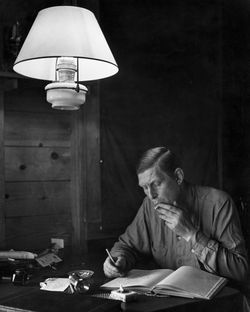 When I started to write novels set in Edinburgh, the characters in these books – unsurprisingly, perhaps – began to show an interest in Auden. In particular, Isabel Dalhousie, the central character in my Sunday Philosophy Club series, thought about Auden rather a lot – and quoted him, too. A couple of years after the first of these novels was published, I received a letter from his literary executor, Edward Mendelson, who is a professor of English at Columbia University in New York. Unlike those writers who appoint coevals to look after their work, with the result that their executors either predecease them or do not last much longer, Auden made the wise move of appointing a young man to watch over his literary legacy. Mendelson was then a junior academic at Yale – and this gave him the opportunity to devote much of a long and distinguished career to producing commentary on Auden’s writing. It transpired that he was a reader of my Botswana novels and he wrote to me to tell me that, in his opinion, Auden and Mma Ramotswe would have agreed on practically every subject. However, what particularly pleased him, he said, was the attachment my other fictional characters had to the poet. The letter led to a friendship. I then wrote Professor Mendelson into an Isabel Dalhousie novel, creating a scene in which he comes to Edinburgh to deliver a public lecture on the sense of neurotic guilt in Auden’s verse. A year later, we translated fiction into reality by bringing Mendelson to Edinburgh to deliver before a real audience the lecture that he had previously given to a group of fictional characters. Such is the interest in Auden that almost 400 people came to hear him speak.
That is not bad for a poet who died 40 years ago this month. What explains the continuing appeal of his work? The language he used probably goes some way towards it. Auden had an ear for the rhythmic possibilities of English – at one time or another he used virtually every metre available to a poet writing in English. It is the syllabic verse, though, that he consistently used for so many of his later poems that has the strongest and most consistent appeal. It appears effortless – rather like the steady flow of a clever lecture – but it is really very skilfully constructed and has an extraordinary capacity to resonate with the reader. Yes, we think. This is exactly how it is. This is true.
More here.
Parasite makes mice lose fear of cats permanently
Eliot Barford in Nature:

In humans, studies have linked Toxoplasma infection with behavioural changes and schizophrenia. One work found an increased risk of traffic accidents in people infected with the parasite2; another found changes in responses to cat odour3. People with schizophrenia are more likely than the general population to have been infected with Toxoplasma, and medications used to treat schizophrenia may work in part by inhibiting the pathogen's replication. Schizophrenia is thought to involve excess activity of the neurotransmitter dopamine in the brain. This has bolstered one possible explanation for Toxoplasma’s behavioural effect: the parasite establishes persistent infections by means of microscopic cysts that grow slowly in brain cells. It can increase those cells’ production of dopamine, which could significantly alter their function. Most other suggested mechanisms also rely on the presence of cysts.
More here.
Physics student makes amazing Bohemian Rhapsody cover
[Thanks to Pablo Policzer.]
A Jewel at the Heart of Quantum Physics
Natalie Wolchover in Quanta:

“This is completely new and very much simpler than anything that has been done before,” said Andrew Hodges, a mathematical physicist at Oxford University who has been following the work.
The revelation that particle interactions, the most basic events in nature, may be consequences of geometry significantly advances a decades-long effort to reformulate quantum field theory, the body of laws describing elementary particles and their interactions. Interactions that were previously calculated with mathematical formulas thousands of terms long can now be described by computing the volume of the corresponding jewel-like “amplituhedron,” which yields an equivalent one-term expression.
“The degree of efficiency is mind-boggling,” said Jacob Bourjaily, a theoretical physicist at Harvard University and one of the researchers who developed the new idea. “You can easily do, on paper, computations that were infeasible even with a computer before.”
The new geometric version of quantum field theory could also facilitate the search for a theory of quantum gravity that would seamlessly connect the large- and small-scale pictures of the universe. Attempts thus far to incorporate gravity into the laws of physics at the quantum scale have run up against nonsensical infinities and deep paradoxes. The amplituhedron, or a similar geometric object, could help by removing two deeply rooted principles of physics: locality and unitarity.
More here.
Wednesday, September 18, 2013
Tariq Ali: Wishing for the Syrian civil war to be a revolution doesn’t make it so
Tariq Ali in Guernica:
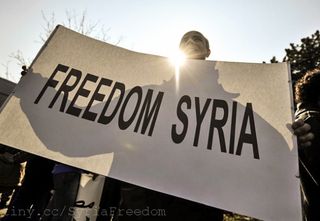
Egypt is the clearest example in recent years. No organs of autonomous power ever emerged. The Muslim Brotherhood, a conservative social force, one that belatedly joined the struggle to overthrow Mubarak, emerged as the strongest political player in the conflict and, as such, won the elections that followed. The Brotherhood’s factionalism, stupidity, and a desire to reassure both Washington and the local security apparatuses that it would be business as usual led it to make several strategic and tactical errors from its own point of view. New mass mobilizations erupted, even larger than those that had led to the toppling of Mubarak. Once again they were devoid of politics, seeing the army as their savior and, in many cases, applauding the military’s brutality against the Muslim Brothers. The result was obvious. The ancient régime is back in charge with mass support. If the original was not a revolution, the latter is hardly a counter-revolution. Simply the military reasserting its role in politics. It was they who decided to dump Mubarak and Morsi. Who will dump them? Another mass mobilization? I doubt it very much. Social movements incapable of developing an independent politics are fated to disappear.
More here.
The Storytellers: 150 years after the death of Jacob Grimm, here’s what really happened with that princess and the pesky frog
Our own Morgan Meis in The Smart Set:
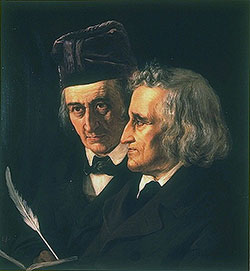
The story of the Brothers Grimm begins in a small town, Henau, in what is now the western part of Germany. But Germany was not yet a country in 1785, the year when little Jacob Ludwig Carl Grimm was born. Germany was a disorganized collection of principalities and fiefdoms. And Germans were still recovering from the Thirty Years’ War, which had wreaked much havoc in the middle of the 17th century. It is impossible to explain the Thirty Years War briefly or clearly. Let’s just say that the War left many regions of Germany devastated, depopulated, divided and unstable. It was a condition that would continue through the 18th century.
In the early 19th century, just when it seemed that Germans might be coming out of their funk, Napoleon came along. Young Jacob and Wilhelm Grimm were to see their region turned into a French satellite state in 1806. At the time of the initial publication ofGrimm’s Fairy Tales, the Brothers Grimm were living under a kind of military occupation.
More here.
Burning Man 2013 Time Lapse
Why Rachel Wetzsteon is her generation’s best love poet

The type of writer who falls prey to the “not quite,” who thinks deeply about it and makes it a major theme of her work, tends to be at the same time sentimental and ironic. The sentiment comes from her longing for the ordinary, for un-self-conscious emotion and experience; her irony comes from her secret feeling of superiority to that kind of simplicity. (Mann, again, is the classic example of this kind of artist—Tonio Kröger says just about everything there is to say on the subject.) For of course, if you were to offer the artist the chance to stop writing and start living, she would never take it; she is too deeply defined by her own distance from life to dare to close it.
Rachel Wetzsteon, who died in 2009 at the age of 42, was her generation’s best poet of the “not quite.” During her tragically brief career, Wetzsteon earned her share of the small honors that are in the poetry world’s gift: her debut collection, The Other Stars (1994), was chosen for the National Poetry Series by John Hollander; she won prizes, and was the poetry editor of the New Republic (where I was proud to be her colleague). But she had produced only three books of poetry before she died—a fourth, Silver Roses, came out posthumously—and she had not yet reached the level of seniority or acclaim where her work was much reviewed.
more here.
King Krule’s lineage

Last week, Marshall played the Bowery Ballroom with his current band, made up of bass, guitar, and drums. He emerged in a suit jacket that looked three sizes too big, as most clothing does on him, and carrying a Fender Telecaster guitar. When playing it, he looked slightly hemmed in, as if he sensed that the band might be getting too close to a familiar entity. When he put down the guitar and just sang, gripping the microphone and doubling over as he yelled, the sound came into focus. He introduced each of the musicians in the band, as if it were a genuine jazz ensemble, but that’s not what has drawn people to King Krule. Though Marshall sounds as if he had stumbled into a recording studio by accident (and confesses that he likes many of his demos better than the final studio versions), he manages to be a confirmed, dedicated romantic. His voice curls around his lyrics as if he were disgusted with everything, but the words fight his delivery. In “Borderline,” which features one of his loveliest choruses over a swift series of chord changes, he sang, “And the soul chokes to cause the tide to enforce divide—this whole devotion has morphed in time. I’ll escort her mind to solve my crimes, reach slow motion to con the mind.”
more here.
in Gaudí’s great cathedral

Casey N. Cep at The Paris Review:
Gaudí wanted the interior of Sagrada Família to look like a forest. The columns of the nave stretch like tree trunks from the floor to the ceiling, branching to support the heavy weight of the ceiling, but also sprawling, reaching like tendrils for the sky. The church is beautiful because of its continual incompletion, its revelation that human construction is not so unlike natural construction: you plant a sapling as a child, then years later it is still growing into something taller, something more; your grandparents planted daffodils that decades later you see still returning every spring; you sit reading the newspaper on a bench in a park that your father tells you was once under water, the river having receded miles from its ancient reaches.
Cathedrals reveal human construction for what it is. In “The Cathedral,” Rainer Maria Rilke wrote “Their birth and rise, / as our own life’s too great proximity / will mount beyond our vision and our sense / of other happenings.” The poet disdains the possibility that cathedrals eclipse their makers: “as though that were history, / piled up in their immeasurable masses / in petrifaction safe from circumstance.” Life, Rilke argued, was on the streets beneath the cathedral’s spires, while death was “in those towers that, full of resignation, / ceased all at once from climbing.”
more here.
The New Deal We Didn’t Know
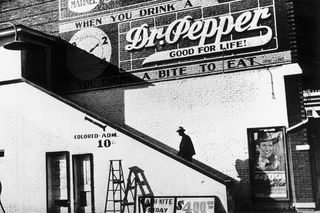
Nicholas Lemann reviews Ira Katznelson's Fear Itself: The New Deal and the Origins of Our Time, in the NYRB:
The New Deal, the apogee of liberal political power in American history and a story with a relatively happy ending—the Great Depression vanquished, World War II won—has usually had its history presented, except by conservatives who disapprove of the expansion of central government and taxation in the 1930s and 1940s, as an uplifting, inspiring one. That is not how Ira Katznelson presents it. There is only one very brief personal note in his long, scholarly book—a snip of memory about having to wear military-style dogtags and practice responses to a nuclear attack as a schoolchild in the early 1950s—but all of Fear Itself is suffused with the same sense of pure terror during the Roosevelt and Truman years as, say, Philip Roth’s The Plot Against America. It’s easy to forget not just how dangerous the situation was, at home and abroad, during the New Deal, but how palpable were outcomes far worse than what we got.
Another difference between Fear Itself and most of the familiar histories of the New Deal is that Katznelson thinks like a political scientist. That means that, although he defines the period presidentially, as the twenty years when Franklin Roosevelt and Harry Truman were in the White House, Roosevelt and Truman themselves are spectral presences. They are not the primary determiners of the course of government, and Katznelson has no interest in their personal qualities or their methods of leadership. Instead his focus is on Congress and government agencies, and more broadly on political systems, voting, and interest groups. This gives Fear Itself the feeling of a fresh look at a familiar story; what Katznelson loses in ignoring the inherent force of the hero narrative, he gains in being able to make an argument that largely ignores the presidency.
The argument bears laying out in some detail. Katznelson begins, usefully, by placing the New Deal in a global setting: the severity of the Great Depression presented an existential threat to liberal democracy everywhere, both as an ideal and as a reality. In response to the same economic crisis that confronted the United States, Germany turned to National Socialism, Italy to Fascism, and the Soviet Union already had a form of communism that no liberals except willfully blind ones could believe in. During Roosevelt’s first term, these alternate systems were on the verge of imposing themselves by force on many other countries.
It was not at all clear that democracy would survive here.
More here.
Pakistan in perpetual tension
From The Hindu:
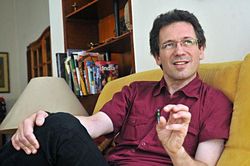
In what sense is your book, published in France this week by Fayard under the title Le Syndrome Pakistanais, an essay or a pamphlet, and what is the thesis or the central point of the book?
The book argues that Pakistan is facing three contradictions since 1947 — and even, sometimes, since its very project emerged during the Raj. Primarily, there is the tension between a unitary notion of the Muslim nation state that is Pakistan and the diversity of the country in ethno-linguistic terms. This tension was there before Partition and it has remained after Partition with at least three provinces that never reconciled themselves fully with the Pakistani project: Bengal — Bengalis went in 1971, and the Baluchistan, which has been repeatedly on the warpath vis-à-vis the centre, and the Pashtuns, who have a very peculiar trajectory. There's been a demand for Pashtunistan, even a kind of irredentism with the Afghan Pashtuns for years, but the Pashtun trajectory has been more complicated since sections of the Pashtun elite — especially among the military — have rallied around the Pakistani project.
More here.