
Category: Recommended Reading
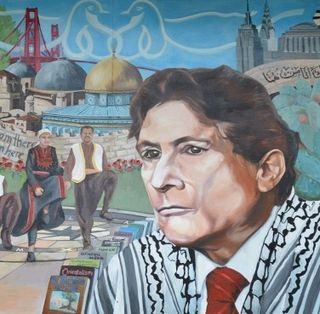
Salman Rushdie, Edward Said, and Moral Courage
Sarah Waheed in the Asian American Writers' Workshop:
More here.
Thomas Jefferson’s Quran: How Islam Shaped the Founders
Richard B. Bernstein in The Daily Beast:
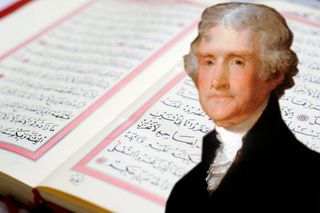
Thomas Jefferson’s Qur’an examines the intersection during the nation’s founding era of two contentious themes in the culture wars—the relationship of Islam to America, and the proper relationship between church and state. The story that it tells ought to be familiar to most Americans, and is familiar to historians of the nation’s founding. And yet, by using Islam as her book’s touchstone, Spellberg brings illuminating freshness to an oft-told tale.
Spellberg, associate professor of history and Middle Eastern Studies at the University of Texas at Austin, seeks to understand the role of Islam in the American struggle to protect religious liberty. She asks how Muslims and their religion fit into eighteenth-century Americans’ models of religious freedom. While conceding that many Americans in that era viewed Islam with suspicion, classifying Muslims as dangerous and unworthy of inclusion within the American experiment, she also shows that such leading figures as Thomas Jefferson, James Madison, and George Washington spurned exclusionary arguments, arguing that America should be open to Muslim citizens, office-holders, and even presidents. Spellberg’s point is that, contrary to those today who would dismiss Islam and Muslims as essentially and irretrievably alien to the American experiment and its religious mix, key figures in the era of the nation’s founding argued that that American church-state calculus both could and should make room for Islam and for believing Muslims.
More here.
Science vs. the Humanities, Round III
In TNR, Steven Pinker, on one side:
In his commentary on my essay “Science is Not your Enemy,” Leon Wieseltier writes, “It is not for science to say whether science belongs in morality and politics and art.” I reply: It is not for Leon Wieseltier to say where science belongs. Good ideas can come from any source, and they must be evaluated on their cogency, not on the occupational clique of the people who originated them.
Wieseltier’s insistence that science should stay inside a box he has built for it and leave the weighty questions to philosophy is based on a fallacy. Yes, certain propositions are empirical, others logical or conceptual or normative; they should not be confused. But propositions are not academic disciplines. Science is not a listing of empirical facts, nor has philosophy ever confined itself to the non-empirical.
Why should either discipline stay inside Wieseltier’s sterile rooms? Does morality have nothing to do with the facts of human well-being, or with the source of human moral intuitions? Does political theory have nothing to learn from a better understanding of people’s inclinations to cooperate, aggress, hoard, share, work, empathize, or submit to authority? Is art really independent of language, perception, memory, emotion? If not, and if scientists have made discoveries about these faculties which go beyond received wisdom, why isn’t it for them to say that these ideas belong in any sophisticated discussion of these topics?
And Leon Wieseltier on the other:
What Pinker cannot bring himself to accept is that his beloved sciences, even when they do shed some light on aspects of art and literature, may shed little light and—for the purpose of understanding meaning (Pinker’s scare quotes around “meaning” may indicate a scare)—unexciting or inconsequential light. I gave the examples of the chemical analysis of a Chardin painting and the linguistic analysis of a Baudelaire poem. Many other examples could be given. “The theory of parent-offspring conflict”—I hope the grants for that particular breakthrough were not too large—is quite superfluous for the explication of Turgenev or Gosse. Nothing in the physical world, in the world of the senses, in the world of experience, can be immune from or indifferent to the categories of the sciences; but there are contexts in which scientific analysis may be trivial. That is not to say that science is trivial, obviously. But the belief that science is supreme in all the contexts, or that it has the last word on all the contexts, or that all the contexts await the attentions of science to be properly understood—that is an idolatry of science, or scientism. Pinker is wrong: I am not censoring scientists. They can say anything they want. But everything they say may not be met with grateful jubilation. So let the scientists in—they are already swarming in—to the humanities, but not as saviors or as superiors. And those swaggering scientists about whose intentions Pinker wants humanists to “relax”: they had better prepare themselves for a mixed reception over here, because over here the gold they bring may be dross.
More here. (Also see Daniel Dennett's comments on the earlier round of Pinker v. Wieseltier over at Edge.)
The Writer as Reader: Melville and his Marginalia

William Giraldi in The LA Review of Books:
Melville remains one of the best American examples of how every important writer is foremost an indefatigable reader of golden books, someone who kneels at the altar of literature not only for wisdom, sustenance, and emotional enlargement, but with the crucial intent of filching fire from the gods.
How might Melville react to today's writers' conferences and creative writing workshops in which so many have no usable knowledge of literary tradition and are mostly mere weekend readers of in-vogue books? An untold number of Americans will finish a book manuscript this year, and the mind-numbing majority of them will be confected by nonreaders. How can a nonreader imagine himself an author, the creator of an artifact that he himself admittedly would have no interest in? Can you fathom an architect who's not fond of impressive buildings, or a violinist who has never listened to music? The erroneous assumption among the multitude is that writing doesn't demand specialized skills. In The War Against Cliché, Martin Amis offers this explanation why so many wish to “join in” the game of literature: “Because words (unlike palettes and pianos) lead a double life: we all have a competence.”
The Austrian journalist Karl Kraus, an aphorist as scathingly accurate as Oscar Wilde and H.L. Mencken, once quipped: “So many people write because they lack the character not to.” By “character” Kraus meant the good sense to know that not every story is worth telling; not everyone can muster the intellectual, emotional, and narrative equipment needed to succeed as a novelist. But the abracadabra of the internet has transformed us into a society of berserk scribblers; now anyone can have a public voice and spew his middling stories and thoughts at will. Forget that blog is just one letter away from bog, or that the passel of burgeoning “literary” websites is largely a harvest of inanity with only the most tenuous hold on actual literature. Our capacity for untamed, ceaseless communication has convinced us that we have something priceless to say.
More here.
Mario Banana I and II
william gaddis in conversation
Sergiu Celibidache in Rehearsal with London Symphony Orchestra
There’s More Than Meets the Eye: A René Magritte Survey
Holland Cottor in The New York Times:
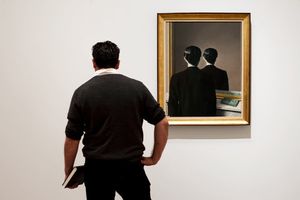
One thing’s for sure: We’re unlikely ever to see Magritte look better than he does in the MoMA show. Its organizers, Anne Umland, a curator of painting and drawing at the museum, and Danielle Johnson, a curatorial assistant, have zeroed in on a single — and I would say the only — consistently fresh and interesting decade in his long career, when he was inventing the artist he wanted to be and when his art was all over the place in a good way: witty, nasty, brilliant and bad at the same time.
More here. (Note: Saw the show. Loved it. Recommend highly.)
What are the rules of polygamy?
Julia Layton in How Stuff Works:

More here.
Sunday Poem
Dream Tales From the Barn
The white rooster is too new at this,
too newly glorious, victorious, to notice
how the west wind has flattened
its hand against the barnboards.
Yesterday's hero, named Choochoo,
still flaunting the sheen of his plumage
minus the prize green tail feathers, waiting
for his red crest to rise bravely
from the ashes of frostbite,
has taken it all in, flat wind and flimsy wood,
but he's too busy stewing about the hens
gone over to the other side, and the bald spot
on his back pecked larger by the day.
The flea-bitten brown cock who never stood a chance,
never sees the light of day, sits drilled into his lonely corner,
smugly aware of the wind's highly organized goings-on
cheering for it in his sad, airless heart, waiting
for the barn to cave in on a wild feathered frenzy,
waiting for the dust to settle, one chance in three.
.
by Ellen Doré Watson
from We live in Bodies
Alice James Books 1997
Rafiq Kathwari wins Kavanagh poetry award
From the Irish Times:
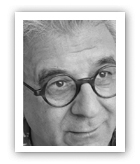
He graduated from the University of Kashmir in 1969 before studying at the New University in New York and Columbia University. Most of his working life has been spent with Ethan Allen, a large manufacturer and retailer of home furnishings based in the United States. He has also worked as photojournalist. Mr Kathwari has published poems in print and online in the US, Ireland and Asia.
More here.
Saturday, September 28, 2013
Building India’s “Shock City of the Twentieth Century” from the Top Down

Samantha Christiansen in Berfrois reviews Howard Spodek's Ahmedabad: Shock City of Twentieth-Century India:
The field of South Asian urban history has a rich history of examining India’s major urban centers. Numerous astute studies of Delhi, Bombay (Mumbai), and Calcutta (Kolkata), for example, have contributed to our understanding of not only the rapid urbanization (and later suburbanization, as explored in the remarkable collection of essays that appeared in a recent special edition of Urban History [February 2012]) of the subcontinent, but the human and economic development that has shaped the region as well.[1] Yet while the field is rich, there are noticeable silences around relatively large swaths of the region. Cities outside of the Indian national border, such as Karachi or Dhaka, rest quietly in the periphery of the historiography; others within the border, such as Ahmedabad, while mentioned in virtually all historical discussions of the subcontinent (being the site of Mahatma Gandhi’s ashram after all), have received little focused attention. Howard Spodek’s Ahmedabad thus provides an important contribution to the field as both an examination of a place conspicuously underrepresented in the urban history of the region and as an excellent piece of urban history that not only greatly informs our understanding of South Asian development, but also has application to a number of cities globally.
Spodek presents a compelling sketch of the last hundred or so years in a city that has been called the “Manchester of India.” In Spodek’s presentation of the city, we see a microcosm of some of India’s major political, economic, and social trajectories: the rise of Gandhi and the independence movement, the drive for modernity and industrialization in postcolonial India, the collapse of the labor unions and the restructuring of the economy within new global markets, and struggles with communal violence and corruption. Spodek successfully balances his portrayal of a city shaped by a concentrated body of power elites within a larger global context, placing Ahmedabad at the center, but recognizing the external forces playing out in the process. In this way, as a case study in urban history, Ahmedabad is instructive both in content and method.
More here.
The History of Fear
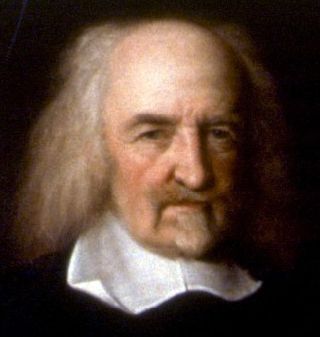
Corey Robin discusses fear in political philosophy, over at his blog:
It was on April 5, 1588, the eve of the Spanish Armada’s invasion of Britain, that Thomas Hobbes was born. Rumors of war had been circulating throughout the English countryside for months. Learned theologians pored over the book of Revelation, convinced that Spain was the Antichrist and the end of days near. So widespread was the fear of the coming onslaught it may well have sent Hobbes’s mother into premature labor. “My mother was filled with such fear,” Hobbes would write, “that she bore twins, me and together with me fear.” It was a joke Hobbes and his admirers were fond of repeating: Fear and the author ofLeviathan and Behemoth—Job-like titles meant to invoke, if not arouse, the terrors of political life—were born twins together.
It wasn’t exactly true. Though fear may have precipitated Hobbes’s birth, the emotion had long been a subject of enquiry. Everyone from Thucydides to Machiavelli had written about it, and Hobbes’s analysis was not quite as original as he claimed. But neither did he wholly exaggerate. Despite his debts to classical thinkers and to contemporaries like the Dutch philosopher Hugo Grotius, Hobbes did give fear special pride of place. While Thucydides and Machiavelli had identified fear as a political motivation, only Hobbes was willing to claim that “the original of great and lasting societies consisted not in mutual good will men had toward each other, but in the mutual fear they had of each other.”
But more than Hobbes’s insistence on fear’s centrality makes his account so pertinent for us, for Hobbes was attuned to a problem we associate with our postmodern age, but which is as old as modernity itself: How can a polity or society survive when its members disagree, often quite radically, about basic moral principles? When they disagree not only about the meaning of good and evil, but also about the ground upon which to make such distinctions?
More here and the second part here.
The Pantheon of Animals
Justin E. H. Smith in his own blog:
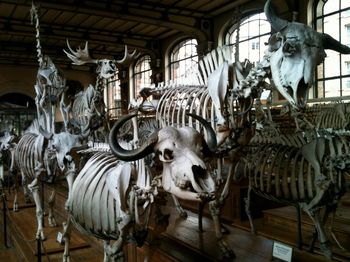
I’m next in line. I’m at the Gallery of Comparative Anatomy, the ground floor of a three-storey building also housing the Gallery of Paleontology, both of which are part of the vast complex of galleries, greenhouses, and gardens at the Paris Muséum d’Histoire Naturelle, in the Jardin des Plantes on the Left Bank of the Seine. “Un billet,” I manage to say. “Plein tarif.” I shouldn’t really be here, I know. But it's the only place I really want to be, in this foreign, difficult city, at this puzzling stage of life. I am not a boy, but it is where I belong: among the many bones, whose collectors hoped to lay bare through them the very order of nature.
More here.
Why nearly every sport except long-distance running is fundamentally absurd
David Stipp in Slate:
Hear me out, sports fans—I'm a basketball nut myself, and so the joke is as much on me as anyone. To see where I’m coming from, you can’t do better than examining basketball’s most physically talented player, Michael Jordan. He was hailed as nearly repealing the law of gravity, and during his prime he made rival players look as if they were moving in slow motion. But Air Jordan wasn't in the same league as a house cat when it comes to leaping. Consider how casually young cats can jump up onto refrigerators. To match that, a man would have to do a standing jump right over the backboard. And a top-notch Frisbee dog corkscrewing through the air eight feet up to snag a whizzing disc makes Jordan look decidedly human when it comes to the fantastic quickness, agility, strength, and ballistic precision various animals are endowed with.
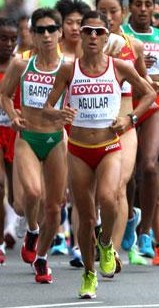
There's no denying it—our kind started substituting brains for brawn long ago, and it shows: We can't begin to compete with animals when it comes to the raw ingredients of athletic prowess. Yet being the absurdly self-enthralled species we are, we crowd into arenas and stadiums to marvel at our pathetic physical abilities as if they were something special. But there is one exception to our general paltriness: We're the right honorable kings and queens of the planet when it comes to long-distance running.
More here.
Fireman Saves Kitten
Winthrop Kellogg Edey: the man who collected time

You’ve heard the phrase, “a man out of step with his time.” We use it to talk about a man that should have existed in another era as, for instance, a man with Victorian sensibilities who happens to live in the present day. But we also use the phrase to talk about a man who exists outside of time altogether. Winthrop K. Edey was such a man. He was hyper-punctual but highly anachronistic. Untimely. The qualities were two sides of the same coin. “Mr. Edey… favored old-fashioned fountain pens over ballpoints and maintained his town house in such 19th century purity that it still has its original working gas jets, tapestries, stove, and marble-slab kitchen table,” said The New York Times. When Edey wanted to take a snapshot he “would lug a huge wooden turn-of-the-century view camera complete with tripod and 11-by-14-inch glass plates” out into the streets. It was a lifestyle of a man living just to the side of time. And the more punctual Edey made his life, the more he arranged time according to his individual whim, the less he was part of the ordinary world. He was like a monk except that a monk arranges his life around a schedule that he does not choose. Winthrop K. Edey’s time was solely his own — or, at least, he tried to make it so. Orson Welles once said that an artist is always out of step with time. This truth is both the beauty and melancholy of the artist. Winthrop K. Edey was an artist of time. He was thus a man destined to be not merely out of step with time, but dislocated in it.
more here.
jorge louis borges as professor

A groundbreaking new volume published by New Directions, Professor Borges: A Course on English Literature, offers unprecedented insight into the writer’s lifelong relationship to the English language, as well as an affecting portrait of the Argentine master as lecturer. These twenty-five classes on English literature were recorded by a small group of students in 1966 and later edited by two leading Borges scholars, Martín Arias and Martín Hadis. They have now finally been rendered into English by the incomparable Katherine Silver. Naturally, “English literature” as defined by Borges is highly idiosyncratic and inescapably, well, Borgesian: the book opens with a study of the Norse and Anglo-Saxon inheritance and go on to deal with central figures of English literature proper—Samuel Johnson and Samuel Coleridge, William Wordsworth, and William Blake—before bottlenecking into character studies of Borges’s all-stars: Thomas Carlyle, Robert Browning, William Morris, and Robert Luis Stevenson.
Reading this book, one gathers that Borges’s initial fears of lecturing—he had to overcome both stammer and shyness—eventually gave way to genuine enthusiasm. Colloquial expressions—“Let’s dig into Beowulf”—help convey a sense of what it must have been like listening to him.
more here.
The case against the global novel

Between 1952 and 1957, Naguib Mahfouz did not write any novels or stories. This was not a case of writer’s block. Mahfouz, who had completed his masterwork, The Cairo Trilogy, in the early 1950s, later explained that he had hoped Egypt’s revolutionary regime would fulfil the aims of his realist novels, and focus public attention on social, economic and political ills. Disenchantment would drive him back to fiction, of a more symbolic and allegorical kind. In 1967, Israel’s crushing defeat of Egypt would force Mahfouz to stop again, and then resume with some explicitly political work.
In recent months, Ahdaf Soueif and Alaa al-Aswany, among other Egyptian authors, have been found on the barricades of Cairo. Such a close and perilous involvement of writers in national upheavals may surprise many contemporary readers in the west, who are accustomed to think of novelists as diffident explorers of the inner life – people very rarely persuaded to engage with public events. Literature today seems to emerge from an apolitical and borderless cosmopolis. Even the mildly adversarial idea of the “postcolonial” that emerged in the 1980s, when authors from Britain’s former colonial possessions appeared to be “writing back” to the imperial centre, has been blunted. The announcement this month that the Man Booker, a literary prize made distinctive by its Indian, South African, Irish, Scottish and Australian winners, will henceforth be open to American novels is one more sign of the steady erasure of national and historical specificity.
more here.