David Byrne: If the 1% stifles New York’s creative talent, I’m out of here

David Byrne in The Guardian:
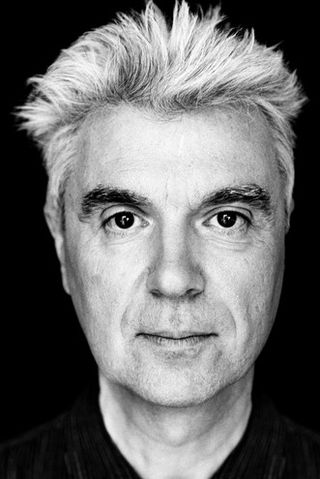
ScreenHunter_353 Oct. 10 18.03I'm writing this in Venice, Italy. This city is a pleasantly confusing maze, once an island of fortresses, and now a city of tourists, culture (biennales galore) and crumbling relics. Venice used to be the most powerful city in Europe – a military, mercantile and cultural leader. Sort of like New York.

Venice is now a case study in the complete transformation of a city (there's public transportation, but no cars). Is it a living city? Is it a fossil? The mayor of Venice recently wrote a letter to the New York Review of Books, arguing that his city is, indeed, a place to live, not simply a theme park for tourists (he would like very much if the big cruise ships steered clear). I guess it's a living place if you count tourism as an industry, which I suppose it is. New York has its share of tourists, too. I wave to the doubledecker buses from my bike, but the passengers never wave back. Why? Am I not an attraction?

New York was recently voted the world's favorite city – but when you break down the survey's results, the city comes in at No 1 for business and only No 5 for living. Fifth place isn't completely embarrassing, but what are the criteria? What is it that attracts people to this or any city? Forget the business part. I've been in Hong Kong, and unless one already has the means to live luxuriously, business hubs aren't necessarily good places for living. Cities may have mercantile exchange as one of their reasons for being, but once people are lured to a place for work, they need more than offices, gyms and strip clubs to really live.

More here.
Thursday Poem

The Homeland

To the faces that harden behind a mask of gloom
I bow, and to streets where I left behind my tears;
To a father who died, green as a cloud
With a sail on his face, I bow,
And to a child that is sold
In order to pray and clean shoes
(In our land we all pray and clean shoes);
To a stone I inscribed with my hunger,
Saying it was lightning and rain, drops rolling under my eyelids,
And to a house whose dust I carried with me in my loss
I bow—all these are my homeland, not Damascus.
.

by Adunis
translation by M.M. Badawi

Wednesday, October 9, 2013

Some Belated Thoughts on the Pedagogy of Lewd Jokes

Justin E. H. Smith in his own blog:

6a00d83453bcda69e2019affd45e49970d-350wiI have, up until now, mostly held back my views on l'affaire McGinn, which shook the philosophy community in the United States some months ago. But there comes a point when discretion starts to feel uncomfortably similar to cowardice, and this is a moral failure I would like to avoid even more than the consternation of my peers.

I don't really want to discuss McGinn himself. I want to discuss the response to the affair offered by Louise Antony in a New York Times 'Stone' piece of September 5, 2013, entitled “Academia's Fog of Male Anxiety.” In particular, I want to respond to the suggestion that 'lewd conversation', including not least doubles entendres about handjobs, can be eliminated from the repertoire of possible topics of discussion between professors and students without any danger of compromising the educational experience.

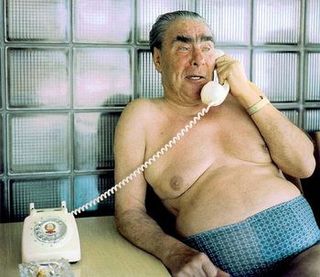
We sometimes hear grumblings about an encroaching Stalinism in academia, where good folk are rubbed out of memory for failing to follow, in every respect, the party line. This does not get it right, and indeed goes much too far. The current era is not Stalinist, but Brezhnevite: where dull-minded, rule-loving functionaries move in to manage the legacy of a glorious revolution.

To continue the analogy, I declare that I remain loyal to what I take to be the core principles of the revolution in question –the sexual revolution–, which had already begun to degenerate by the time I was born, and which in the broad sense in which I understand it began long before the era of rock-and-roll, and includes, inter alia, the life-affirming effulgences of the Montanan libertine Mary MacLane, and Walt Whitman's celebration of his own beard and musk and semen: of his own infinite desire and his freedom to express it in words.

I believe lewd jokes are a crucial part of what brings joy in life, and I believe the sexual revolution was important in enabling people in free societies to seize this joy.

More here.

The pseudo-profundity of Malcolm Gladwell

Steven Poole in The Guardian:

ScreenHunter_352 Oct. 10 11.37Gladwell is a brilliant salesman for a certain kind of cognitive drug. He tells his readers that everything they thought they knew about a subject is wrong, and then delivers what is presented as a counterintuitive discovery but is actually a bromide of familiar clichés. The reader is thus led on a pleasant quasi-intellectual tour, to be reassured at the end that a flavour of folksy wisdom was right all along. Little things really can make a big difference; trusting your gut can be better than overthinking; successful people work hard.

The art here lies in making the platitudinous conclusion seem like a revelatory place to end up, after one has enjoyed the colourful “stories” about carefully described plucky individuals with certain hairstyles and particular kinds of trousers. (Actual quote: “He is a tall young man with carefully combed dark-brown hair and neatly pressed khakis.”) Such books must thus be constructed with a certain suspenseful cunning. Gladwell likes first to tell an apparently convincing story and then declare that it’s not true, like a magician pulling an empty hat out of a rabbit. Thus does his book begin, relaying the standard version of David and Goliath – plucky shepherd defeating fearsome giant with fortunately slung pebble – and then announcing that “almost everything about it is wrong”.

More here.

I am Malala

Baroness Sayeeda Warsi in The Telegraph:

Malala22_2696060aMalala Yousafzai’s story begins with her parents being commiserated with after producing a baby girl. In their part of northern Pakistan, she says, rifle shots ring out in celebration of a baby boy’s arrival. But there is no such fanfare for females: their destiny is to cook and clean, to be neither seen nor heard. When Mr and Mrs Yousafzai were married, a small boy was placed on their laps to encourage the birth of a son. It didn’t work: their first-born was a girl who “popped out kicking and screaming”. Her father was mocked by relatives for bothering to add her name to the family tree, which only featured men. So how did Malala, who barely warranted a mention in her family’s genealogy, become destined for the history books as a powerful symbol for girls’ universal right to an education? Her memoir I am Malala tells us how. Almost a year ago, the world became aware of Malala when she was shot by the Taliban for what they deemed a crime: going to school, and fighting for that right.

…Malala and her family have an answer to some of the man-made problems: education. As she says, describing her father: “Education had been a great gift to him. He believed that lack of education was the root of all Pakistan’s problems. He believed schooling should be available for all, rich and poor, boys and girls.” That is why the UK government is working with the government of Pakistan to deliver better quality and more widely available education. This will put four million children in school by 2015, recruit and train new teachers, and construct or rebuild more than 20,000 classrooms. She may not have warranted an entry on her family tree, but today Malala is known across the world. “I’m one of the few fathers known by his daughter,” Mr Yousafzai is quoted as saying towards the end of the book. She has turned a potential tragedy into a positive – bringing to the world’s attention that crucial issue of a girl’s right to an education. This is certainly not the last we have heard from Malala.

More here.

Well-connected hemispheres of Einstein’s brain may have contributed to his brilliance

From KurzweilAI:

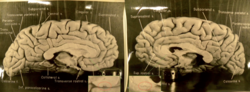
Einsteins-brainThe left and right hemispheres of Albert Einstein’s brain were unusually well connected to each other and this may have contributed to his brilliance, according to a new study [1], the first to detail Einstein’s corpus callosum. The corpus callosum is the brain’s largest bundle of fibers that connects the two cerebral hemispheres and facilitates interhemispheric communication. The study was published in the journal Brain. Lead author Weiwei Men of East China Normal University’s Department of Physics developed a new technique to conduct the study. Men’s technique measures and color-codes the varying thicknesses of subdivisions of the corpus callosum along its length, where nerves cross from one side of the brain to the other. These thicknesses indicate the number of nerves that cross and therefore how “connected” the two sides of the brain are in particular regions, which facilitate different functions depending on where the fibers cross along the length. For example, movement of the hands is represented toward the front and mental arithmetic along the back.

In particular, this new technique permitted registration and comparison of Einstein’s measurements with those of two samples — one of 15 elderly men and one of 52 men Einstein’s age in 1905. During his “miracle year” at 26 years old, Einstein published four articles that contributed substantially to the foundation of modern physics and changed the world’s views about space, time, mass and energy. The research team’s findings show that Einstein had more extensive connections between certain parts of his cerebral hemispheres compared to both younger and older control groups.

More here.

the forbidden painting

A_560x0Jerry Saltz at New York Magazine:

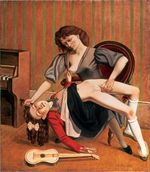
Henry Darger’s little girls, Gustave Courbet’s genital close-up, even Picasso’s explicit depiction of fellatio: You might think we had passed the point where a major painting by a first-tier artist is still taboo. Nonetheless, The Guitar Lesson, from 1934, by (the bogusly named) Count Balthasar Klossowski de Rola, better known as Balthus, is just such a forbidden work. At its 1934 debut in Paris, it was shown for fifteen days, covered, in the gallery’s back room. In 1977, it appeared for a month at Pierre Matisse’s 57th Street gallery. It has never been exhibited again, as if it were some metaphysical equivalent of the cursed videotape in The Ring that kills anyone who views it.

In his review of that 1977 show in New York Magazine, Thomas Hess lamented that it “can’t be illustrated in the pages of New York.” (Well, times change.) Alas, you also won’t see it in the scintillating “Balthus: Cats and Girls,” opening at the Metropolitan Museum of Art this week. The exhibition’s organizer, Sabine Rewald, is by far the greatest Balthus scholar ever, and her show’s theme and focus may justify its exclusion. So it remains frustratingly, heartbreakingly hidden from view.

more here.

Love Letters Between Christopher Isherwood and Don Bachardy

2823058Olivia Laing at The New Statesman:
In 1952, the then 48-year-old Christopher Isherwood met a beautiful teenage boy on the beach in Santa Monica. None of his friends thought the liaison would last but it proved unexpectedly durable. Despite a 30-year age gap and affairs on both sides, the two men remained emphatically together until Isherwood’s death in 1986 – a relationship considerably longer-lasting than most Hollywood marriages.
Like many couples, they communicated in a private language, a sort of nursery camp in which they were cast as the “Animals”, sometimes beleaguered by the human world (the “Others”) and sometimes resplendent in their difference. The Animals were evidently well established by the time written communication began, on a trip to London in the winter of 1956. They make their inaugural appearance not in the first, rather shy letter from Isherwood but in Bachardy’s reply. “I miss rides through London on old Dobbin,” he writes, “and think a lot about him, sleeping in a strange stable, eating cold oats out of an ill-fitting feed bag and having no cat fur to keep him warm . . . And tell him an anxious Tabby is at the mercy of the RSPCA and counting the days till his return.”
more here.

Julia Margaret Cameron: photography in the 19th century

ID_VS_POLCH_CAMER_CO_003James Polchin at The Smart Set:

The camera her daughter and son-in-law gave her that winter was a heavy machine, awkward to move around, made of wood and the size of a large birdhouse. It was the most modern of its time. We can easily forget today how arduous and dangerous the process of photographing was back then. The glass plates used to expose the image (the forerunner to film) were there own chemistry lab, requiring a coating of a thick and flammable collodion solution, followed by a quick dash to the camera to insert the class behind the lens and expose it to the light before the plate dried. Then, through a series of sliver nitrate washes (the fumes could be deadly) and drying, washing and drying again, the glass negative was ready to transfer its image to the prepared albumen paper that was brushed with a frothy mixture of egg white and silver nitrate to give the paper a glossy texture. The plate was placed on the paper, exposed to the sun, and then, it too was washed and let dry. At any one point in this process, the photographs could easily be destroyed. This mixture of science and art burdened these practices with certain standards of skill. Photography was still considered a scientific experiment; it’s practitioners more akin to chemist than artists. What constituted a good photograph was as much about the process as the composition.

While there is little evidence that she was much interested in visual art before the 1860s, Cameron took to this process with her usual energy. Her interest was in what this process can create more than what it should create.

more here.

AN OPEN LETTER TO OPEN LETTER WRITERS: STOP WRITING OPEN LETTERS

Stephen Marche in Esquire:

ScreenHunter_351 Oct. 09 13.05To all open letter writers,

First of all, hello. I've never met you, but I've been reading a lot of your open letters lately. Sinead O'Connor, just recently, you posted your third open letter to Miley Cyrus. That's about three too many, but I want you to know that I understand why you write open letters and I sympathize with your motives. I'm saying that because all open letters begin with this false sense of intimacy and the bogus claim that the writer really wants the best for the person he or she is addressing.

The time has come, open letter writers, to sit back and ask yourself why everybody is writing open letters. You all have your own explanations of course. Sinead, you opened your first letter to Miley Cyrus with the following justification:

“I wasn't going to write this letter, but today I've been dodging phone calls from various newspapers who wished me to remark upon your having said in Rolling Stone your 'Wrecking Ball' video was designed to be similar to the one for 'Nothing Compares' … So this is what I need to say … And it is said in the spirit of motherliness and with love.”

I'm sorry but the spirit of motherliness cannot really be enough of an answer to why you're writing. I think even you can see that attacking somebody publicly for what they're wearing isn't exactly the definition of “motherly love.”

More here.

You don’t normally expect to find Jesus Christ at The Jewish Museum in New York City, but there he is

Our own Morgan Meis in The Smart Set:

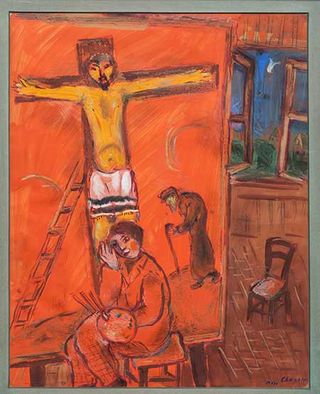
ID_IC_MEIS_CHAGA_CO_001Jesus is hanging on the cross, or floating in the sky all over the second floor of the museum. This is all because of Marc Chagall.

Many critics have called Chagall the preeminent Jewish artist of the 20th century. Yet, Chagall had about a five-year period during the Second World War in which he became utterly obsessed with painting Jesus Christ. Mostly, Chagall painted Crucifixion scenes. A number of these paintings, along with Chagall’s work just before and after the war, can be seen as part of The Jewish Museum’s Chagall: Love, War and Exile show, which runs through February 2, 2014.

Looking at the paintings, one thing is clear right away. The paintings have little to do with Jesus as we usually see him — the central figure in the Christian Passion narrative. Chagall’s Jesus is a Jewish Jesus through and through. In many of the Crucifixion scenes (like The Artist with Yellow Christ, 1938 and Persecution, c. 1941) Jesus’ nether parts are covered with a tallit, a Jewish prayer shawl. In Study for The Yellow Crucifixion(1942), Jesus is wearing tefillin, little black boxes containing verses from the Torah that are wrapped around the head and arm, with black straps going down to the hand.

More here.

Tuesday, October 8, 2013

How Prisons Have Changed America’s Electoral Politics

Heather Ann Thompson on politics and incarceration in The Atlantic:

Prisons thomasWith so many powerful arguments being made against our current criminal justice system, why then does it persist? Why haven’t the American people, particularly those who are most negatively affected by this most unsettling and unsavory state of affairs, undone the policies that have led us here? The answer, in part, stems from the fact that locking up unprecedented numbers of citizens over the last forty years has itself made the prison system highly resistant to reform through the democratic process. To an extent that few Americans have yet appreciated, record rates of incarceration have, in fact, undermined our American democracy, both by impacting who gets to vote and how votes are counted.

The unsettling story of how this came to be actually begins in 1865, when the abolition of slavery led to bitter constitutional battles over who would and would not be included in our polity. To fully understand it, though, we must look more closely than we yet have at the year 1965, a century later—a moment when, on the one hand, politicians were pressured into opening the franchise by passing the most comprehensive Voting Rights Act to date, but on the other hand, were also beginning a devastatingly ambitious War on Crime.

More here.

The Thistle and the Drone: How America’s War on Terror Became a Global War on Tribal Islam

Malise Ruthven reviews Akbar Ahmed's book in the New York Review of Books:

9789351160007Tolstoy’s novella Hadji Murad opens with the image of a beautiful thistle flower, wrenched from a ditch, that the narrator seeks to add to his bouquet. His effort to pluck it, however,

proved a very difficult task. Not only did the stalk prick on every side—even through the handkerchief I wrapped round my hand—but it was so tough that I had to struggle with it for nearly five minutes, breaking the fibres one by one; and when I had at last plucked it, the stalk was all frayed, and the flower itself no longer seemed so fresh and beautiful…. But what energy and tenacity! With what determination it defended itself, and how dearly it sold its life!

This late masterpiece, written in 1904 but never published in Tolstoy’s lifetime, was based on a real-life episode. In 1851 the Avar warlord Hajimurad al-Khunzaki, a confederate of the Imam Shamil, who led the resistance to Russia’s annexation of the Caucasus, betrayed his ally and went over to the Russians. In Tolstoy’s story he is driven by ambition, hoping to govern the Caucasian tribes under the “white tsar.”

More here.

Demon and Craftsman: On D.H. Lawrence

D_H_Lawrence_passport_photographJames Longenbach at The Nation:

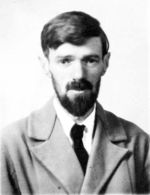
On November 13, 1915, following a hearing at London’s Bow Street magistrates’ court, D.H. Lawrence’s The Rainbow was suppressed under the Obscene Publications Act of 1857. The magistrate, Sir John Dickinson, ordered that the 1,011 copies of the novel seized from the publisher be destroyed. Speaking for the prosecution, Herbert Muskett expressed “the most profound regret that it should have been necessary…to bring this disgusting, detestable and pernicious work under the notice of the Court.” The publisher was ordered to pay court costs of £10, 10s.

By the time The Rainbow was pulped, its 30-year-old author had published four novels, a play, a book of short stories and a volume of poems. Undaunted by the novel’s suppression, David Herbert Lawrence would in the next decade alone publish another play; two more books of stories; two travel books about Italy; two translations of the Sicilian novelist Giovanni Verga; a groundbreaking work of criticism about a national literature of which not only most Englishmen but many Americans were unaware (Studies in Classic American Literature); two works of speculative psychology (Psychoanalysis and the Unconscious and Fantasia of the Unconscious); five novels, including his greatest, a sequel to The Rainbow called Women in Love; and five books of poems, including one of the most brilliant books written by an English-language poet in the twentieth century, Birds, Beasts and Flowers.

more here.

can whale teeth be money?

Spread_tabua_FINAL_1D. Graham Burnett at Cabinet:

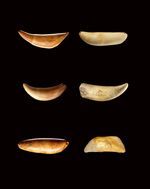
Back to the sperm whale teeth. Were they money or not? They could certainly have that feel to a sandalwood trader trying to acquire a lucrative cargo of the fragrant lumber. But it didn’t take long before even those most nuts-and-bolts anthropologists noticed all kinds of un-money-like attributes of the local currency. You couldn’t quite count on your ivories to do what you thought they would do under all circumstances. That troubling randomizer of human behavior—meaning—seemed to inhere in the teeth, and generate various bizarre misunderstandings and conditions. There seemed surfeits of signification in the things—excess powers and unpredictable deficiencies.

For instance, while it was clear that some teeth (the larger, older, amber-hued specimens) received special attention (occupying pride of place in family treasuries and occasioning tenderly solicitous polishing), it did not follow, as one might expect, that such noble tabua traded hands at a consistent premium. Rather, for the preponderance of occasions in which the presentation of a tooth was required by custom (the building of a house, a diplomatic envoy, the death of an elder), it appeared that any tooth would do. Moreover, the “market” in teeth often behaved in what appeared a most irrational fashion. How could it be that a tooth acquired for less than one pound sterling in town could, a short distance away, secure a monster porker that would retail locally for ten? Where were the arbitrageurs?

more here.

For 3 Nobel Winners, a Molecular Mystery Solved

Lawrence K. Altman in The New York Times:

NobelThree Americans won the Nobel Prize in Physiology or Medicine on Monday for discovering the machinery that regulates how cells transport major molecules in a cargo system that delivers them to the right place at the right time. The Karolinska Institute in Stockholm announced the winners: James E. Rothman, 62, of Yale University; Randy W. Schekman, 64, of the University of California, Berkeley; and Dr. Thomas C. Südhof, 57, of Stanford University. Their basic research solved the mystery of how cells, which are factories producing molecules, organize a system to transport the molecules within cells and export them outside. As it turns out, the molecules are moved around the cell in small packages called vesicles, and each scientist discovered different facets of what is needed to ensure that the right cargo is shipped to the correct destination at precisely the right time. For example, pancreatic cells make insulin and release it in the blood. Chemical signals called neurotransmitters are sent from one nerve cell to another to allow people to walk, talk, sing, pull their hand away from a hot stove and communicate. The molecular traffic within cells is as complicated as rush hour in any city, as the discoveries by the three Nobel winners revealed.

The world’s most prestigious scientific award arrived at a particularly dark time for federal science research: the National Institutes of Health, the agency that paid an estimated $49 million to help underwrite the winners’ work, has been forced to send home most of its staff because of the government shutdown. Basic research of the type that just won the Nobel is seen as particularly vulnerable to Capitol Hill budget cutters. “This is a stark reminder of how these are the best of times and the worst of times for American biomedical research,” Dr. Francis Collins, the N.I.H. director, said in an interview on Monday. “Today we celebrate the three N.I.H.-supported Nobel Prize winners, but we’re being slammed by sequestration and a government shutdown.”

More here.

Francois Englert And Peter Higgs Win Nobel Prize In Physics

Dina Spector in Business Insider:

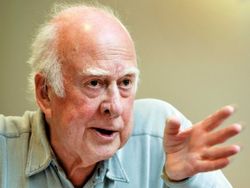
Peter-higgsFrancois Englert, 80, and Peter Higgs, 84, won the Nobel Prize in physics on Tuesday for the theory of how particles acquire mass. Englehart and Higgs separately proposed this theory —what became known as the Higgs mechanism — in 1964. The theory also rests on the existence of the Higgs particle — a subatomic particle that provides proof of an invisible field that gives mass to matter.

But nearly five decades would pass before scientists could confirm the existence of a Higgs boson. On July 4, 2012, physicists using the Large Hardon Collider at CERN announced they had found a new particle that had the properties of the long-sought boson. The discovery was hailed at the biggest scientific breakthrough of this century. Higgs, now a professor emeritus at the University of Edinburgh, is notoriously modest about his involvement with the particle that bears his name.

More here.

looking for the real dante

Harrison_1-102413_jpg_470x717_q85Robert Pogue Harrison at the New York Review of Books:

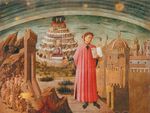
Professionally trained Dante scholars—I am one of them—believe we have special access to The Divine Comedy’s deeper layers of meaning, yet judged by Dante’s criteria, we are self-deceived. In Inferno 9, Dante challenges his audience with a direct address:

You readers, who are of sound mind and memory,
Pay attention to the lessons woven into the fabric
Of these strange poetic lines.

Who among the members of the Dante Society believes in good faith that he or she possesses the “sound mind” that Dante appeals to here? No one reconstructed the Christian doctrines that supposedly underlie the Comedy’s veils of allegory more piously than the great American Dante scholar Charles Singleton. Yet Singleton was an agnostic who took his own life, and one hopes for his sake that he was right when he declared, “The fiction of the Comedy is that it is not a fiction.” If the poem contains an arcane truth that is predicated on faith—not only in the medieval Christian God but also in Dante’s version of history, with its Holy Roman Emperors and all—then none of us will ever gain full access to it.

more here.