Gerald Dworkin’s Philosophy Commonplace Book: A Review

Justin E. H. Smith in his blog:
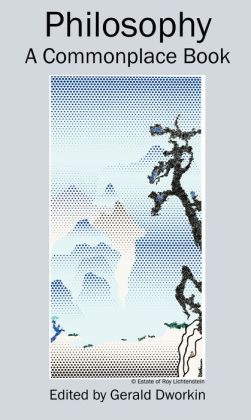
2940044565791_p0_v1_s260x420Jerry Dworkin might not be hands-down the funniest person in the history of philosophy, but he's probably the funniest Dworkin. Not that he's had much competition. There was that one who had the line about 'clerking for Learned Hand', which always made me snicker but was probably just a one-off sort of thing, and there was that other who… well, never mind. As for Jerrys, there he's had some stiff competition indeed, and in the same broadly borschty category. But this much can be said with certainty: Jerry Dworkin has survived all the other Jerrys and all the other Dworkins, and now, with this rich epoch-making e-tome, has singlehandedly revived the genre of the commonplace book, and bequeathed to the generations a fine collection that is bound to survive its author. At least if anyone can figure out how to download the damned thing. I had to write and request a review copy, which was duly sent along. Which in turn compelled me, morally, to either fork over the $5.97 a Kindle download would have cost me, or to do a little write-up. Since I am now an employee of a French university and therefore am basically worrying at this point about stocking up enough coal for the coming winter, I decided to do the writing thing.

Let's get something straight right away. Philosophy humour is generally awful: dismal vocational coping, and nothing more, substantially no different from the bumpersticker you might spot on a sagging Econoline that reads 'Electricians Conduit Better'. And if anyone ever again suggests to me that awful Monty Python sketch about the philosophers' football match, I am just going to come clean and tell them that my ideal of humour is rather closer to Redd Foxx's classic routine, You've Got to Wash Your Ass.

More here.

The Last of the Sheiks?

Christopher M. Davidson in the New York Times:

ScreenHunter_364 Oct. 20 17.33This summer, disgruntled Saudis took their grievances online in droves, complaining of ever-growing inequality, rising poverty, corruption and unemployment. Their Twitter campaign became one of the world’s highest trending topics. It caused great alarm within elite circles in Saudi Arabia and sent ripples throughout the region. The rallying cry that “salaries are not enough” helped to prove that the monarchy’s social contract with its people is now publicly coming unstuck, and on a significant scale.

Many experts believe that the Gulf states have survived the Arab Spring because they are different. After all, they’ve weathered numerous past storms — from the Arab nationalist revolutions of the 1950s and ’60s to Saddam Hussein’s 1990 invasion of Kuwait to an Al Qaeda terror campaign in 2003.

But they are not different in any fundamental way. They have simply bought time with petrodollars. And that time is running out.

The sheiks of the Persian Gulf might not face the fate of Col. Muammar el-Qaddafi of Libya or Hosni Mubarak of Egypt next year, but the system they have created is untenable in the longer term and it could come apart even sooner than many believe.

More here.

The Searing, Visceral “12 Years a Slave”

Christopher Orr in The Atlantic:

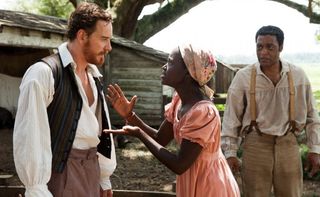
12yearsAslave650“All right now, y’all fresh niggers,” a white overseer in the antebellum South tells his charges in the opening scene of 12 Years a Slave. “Y’all gonna be in the cuttin’ gang.”

We soon discover what this entails, as the slaves take machetes in hand and begin hacking their way through an almost endless expanse of sugar cane; they might as well be trying to empty the ocean using teacups. The physicality of their labor is not merely extreme, it is extravagant. We immediately understand that what we are witnessing is an economy predicated on the idea that human—that is, black—sweat and sinew are not merely cheap resources, but essentially inexhaustible ones, subject to careless squander.

The scene establishes the searing, visceral tone that will characterize director Steve McQueen’s audacious third feature. Moments later we watch as the film’s protagonist, Solomon Northup (Chiwetel Ejiofor), lies awake in a bunkhouse surrounded by fellow slaves. When he turns to the woman next to him, she takes his hand roughly to her breast, and then between her legs, grimacing with joyless urgency before she twists away from him. Day and night, a perpetuity of toil and a pantomime of love—it all comes down to this: to flesh and blood, to individual endurance in a solitary prison of pain.

More here.

The psychology of spiritualism: science and seances

The idea of summoning the spirits took thrilling hold of the Victorian imagination – and has its adherents now. But the psychology behind spiritualism is more intriguing.

David Derbyshire in The Guardian:

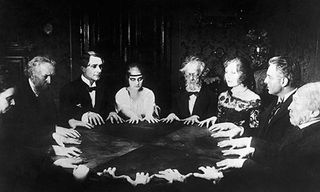
Seance-Scene-in-Dr.-Mabus-008As the evenings get darker and the first hint of winter hangs in the air, the western world enters the season of the dead. It begins with Halloween, continues with All Saints' and All Souls' days, runs through Bonfire Night – the evening where the English burn effigies of historical terrorists – and ends with Remembrance Day. And through it all, Britain's mediums enjoy one of their busiest times of the year.

People who claim to contact the spirit world provoke extreme reactions. For some, mediums offer comfort and mystery in a dull world. For others they are fraudsters or unwitting fakes, exploiting the vulnerable and bereaved. But to a small group of psychologists, the rituals of the seance and the medium are opening up insights into the mind, shedding light on the power of suggestion and even questioning the nature of free will.

Humanity has been attempting to commune with the dead since ancient times. As far back as Leviticus, the Old Testament God actively forbade people to seek out mediums. Interest peaked in the 19th century, a time when religion and rationality were clashing like never before. In an era of unprecedented scientific discovery, some churchgoers began to seek evidence for their beliefs.

Salvation came from two American sisters, 11-year-old Kate and 14-year-old Margaret Fox. On 31 March 1848, the girls announced they were going to contact the spirit world. To the astonishment of their parents they got a reply.

More here.

Seduction and Power: Cathedrals and Capitalism

Alexander Strecker in lensculture:

Seduction-porchet

In his two-part series, “Seduction” and “Meeting”, Cyril Porchet examines the nature of spectacle, comparing Baroque churches to the modern-day corporate shareholder meeting. Porchet created “Seduction” by photographing from the choirs of Baroque churches across Europe. In person, these places feel enormous. And indeed, Porchet’s prints are giant, 1.2 m x 1.6 m, allowing the viewer to fall into the details almost as if they were present at the churches themselves. But Porchet’s works are not mere re-creations. His photographs transform these massive spaces into a series of flat, but still nearly infinite, displays of extravagance. Although these churches, as physical structures, took decades to build and remain with us today, they were also spectacles, designed to elicit a much more immediately felt sense of wonder and piety.

More here.

This “Death Watch” Allegedly Counts Down the Last Seconds of Your Life

Tuan C. Nguyen in Smithsonian:

Tikker-death-watch2There’s now a watch that reminds us of the one appointment that we won’t be able to cancel. It’s called the Tikker. And it counts down the minutes, and even seconds, we have before we will likely meet our demise. Currently being sold on the crowd-sourcing website Kickstarter, the concept for a so-called “death watch” isn’t as morbidly depressing as it may appear on the surface. In fact, the watch’s creator, Fredrik Colting, believes his invention does exactly the opposite by inspiring and motivating people to “live better.” For Colting, the cold finality of death had only fully set in when his grandfather passed away several years ago. Tikker was born out of his desire to figure out a way to use this acceptance to spur positive changes in one’s life. “It’s my belief that if we are aware of death, and our own expiration,” says Colting, “that we will have a greater appreciation for life.”

To arrive at an estimation of how much longer someone has to live, users fill out a questionnaire that’s designed to add or subtract years based on current age, exercise habits and other health related factors. That exact time can then be programmed into the watch, at which point the final countdown begins. However, the method in which Tikker calculates each person’s individualized expiration date is superficially scientific at best. Though the use of so-called longevity calculators have gained some credibility among researchers, some experts, such as actuary Steve Vernon of the Stanford Center on Longevity, have warned that people shouldn’t rely too much on these kind of approximations since there’s a “50 percent chance you’ll live beyond this estimate.” As an example of how inexact these kind of formulas are, Vernon tested popular online calculators from the Northwestern Mutual Life Insurance Company, livingto100.com and bluezones.com. His results were 95, 101 and 95.6 years, respectively. In any case, it’s probably best not to view this generated date as a hard deadline. Instead, Colting says, the notion of a “use by” time stamp is supposed to have more of a symbolic meaning and can serve as a practical reminder to pay heed to some of the often-echoed existential epiphanies such as”Carpe Diem!” and “You only live once!”

More here.

Sunday Poem

.
In Plain Sight

When my son closes his eyes
and cups his hands over them,
he thinks he's hiding from me.

It doesn't work that way, I say.
You can't see me, but I can
still see you. He repeats

his Morse Code of peeking
and closing his eyes
a few more times in a mix

of shyness and regret.
I finally get it out
he didn't want me home yet,

he had five more math problems,
and hoped to be finished
before I walked in with the world.

I'm glad it's only math, I say.
Here, maybe this will help,
and cover my eyes,

announce I'm not home,
wishing I were seven again,
living in plain sight.

wanting to promise him
a simple plan, to show
how to live with all illusions intact,

living inside my dreams,
instead of dying inside my life.
.

by Jim Gwyn
from The Red Wheelbarrow 6

Saturday, October 19, 2013

Love in the Gardens

Zadie Smith in the New York Review of Books:

ScreenHunter_363 Oct. 19 16.10When my father was old and I was still young, I came into some money. Though it was money “earned” for work done, it seemed, both to my father and me, no different than a win on the lottery. We looked at the contract more than once, checking and rechecking it, just like a lottery ticket, to ensure no mistake had been made. No mistake had been made. I was to be paid for writing a book. For a long time, neither of us could work out what to do about this new reality. My father kept on with his habit of tucking a ten- or twenty-pound note inside his letters to me. I took the rest of my family (my parents having separated long before) to a “resort” back in the “old country” (the Caribbean) where we rode around bored in golf carts, argued violently, and lined up in grim silence to receive a preposterous amount of glistening fruit, the only black folk in line for the buffet.

It took a period of reflection before I realized that the money—though it may have arrived somewhat prematurely for me—had come at the right time for my father. A working life launched when he was thirteen, which had ended in penury, old age, and divorce, might now, finally, find a soft landing. To this end, I moved Harvey from his shabby London flat to a cottage by the sea, and when the late spring came we thought not of Cornwall or Devon or the Lake District but of Europe.

Outrageous thought! Though not without precedent. The summer before I went to college, my father, in his scrupulous way, had worked out a budget that would allow the two of us to spend four days in Paris. Off we went. But it is not easy for a white man of almost seventy and a black girl of seventeen to go on a mini-break to Europe together; the smirks of strangers follow you everywhere.

More here.

mary beard confronts the classics

ConfrontingTheClassicsHCJoanna Scutts at The Washignton Post:

The essays that make up most of “Confronting the Classics” are as much about what happens in the gap between antiquity and modernity as they are about the ancient works of art, literature, history and architecture themselves. Beard has no time for misty-eyed idealizing of the culture of Greece and Rome (or the era when it was more widely studied), beyond what it may reveal about those doing the looking back. Classical study has been lamented as “in decline” since at least Thomas Jefferson, as she points out, and such laments “are in part the expressions of the loss and longing and the nostalgia that have always tinged classical studies.” The scholars whose books she praises most highly are therefore those who do not try to smooth over the gaps in the record but to jump into them and peek about.

In the past few years, Beard has become the public face of modern classical scholarship in Britain, fronting BBC television shows about Pompeii and Caligula. Her high profile has made her the target of some vicious online attacks, which she has discussed in a blog she writes for the Times Literary Supplement. In light of her experience, her examinations of the misogyny and mythmaking surrounding powerful women such as Boadicea,Cleopatra and Augustus’s wife Livia are particularly trenchant.

more here.

Skull of Homo erectus throws story of human evolution into disarray

Homo-erectus-skull-found--003Ian Sample at The Guardian:

The spectacular fossilised skull of an ancient human ancestor that died nearly two million years ago has forced scientists to rethink the story of early human evolution.

Anthropologists unearthed the skull at a site in Dmanisi, a small town in southern Georgia, where other remains of human ancestors, simple stone tools and long-extinct animals have been dated to 1.8m years old.

Experts believe the skull is one of the most important fossil finds to date, but it has proved as controversial as it is stunning. Analysis of the skull and other remains at Dmanisi suggests that scientists have been too ready to name separate species of human ancestors in Africa. Many of those species may now have to be wiped from the textbooks.

The latest fossil is the only intact skull ever found of a human ancestor that lived in the early Pleistocene, when our predecessors first walked out of Africa. The skull adds to a haul of bones recovered from Dmanisi that belong to five individuals, most likely an elderly male, two other adult males, a young female and a juvenile of unknown sex.

more here.

the death of letter writing

6e3dc8d8-f4ec-461f-b618-a3948c95eabbAndrew Hill at the Financial Times:

For more than 200 years from its beginnings in the 1770s, the Dead Letter Office was where Americans’ letters and parcels were sent if they were unclaimed or undeliverable. Some items were redirected: the DLO had a “blind reading” department trained to decipher illegible or vague addresses (“To my Son he lives out West he drives a red ox the rale rode goes By Thar”). The office would incinerate the others or auction their contents, which included, according to one sale list, anything from wedding rings to “False Bosoms” and quack medicines, such as “the cure-all Tennessee Swamp Shrub”. It was estimated that 6bn pieces of mail were posted in the US in 1898, of which 6.3m ended up at the DLO in Washington, DC. “What romance was to be had in an undelivered or undeliverable letter!” Simon Garfield writes in To The Letter. “And what mystery and sadness too.”

Well, the romance and mystery have certainly gone. The US Postal Service has renamed the DLO the Mail Recovery Center, consolidated four locations into one in Atlanta, Georgia, and is pushing through a “Lean Six Sigma” process improvement project to make it more efficient. Asked if they write letters, most people would echo the DLO’s famous fictional former clerk Bartleby in the Herman Melville story: “I would prefer not to.”

more here.

Saturday Poem

Yangon 2010

Parents and guardians jostle over the quality of education available to their children, it’s been observed. People work on mutual trust and understanding; it is important to avoid abuses, it’s been observed. Black (e)mailing and threats that undermine the social integrity and propriety of girls online are commonplace, it’s been observed. Certain teenagers now patronise and pirate barnyard videos and obscene images, it’s been observed. Youths are now overtly into neoteric fashion and luxury items, it’s been observed. Those about to leave for jobs overseas need to systematically prep themselves in every possible way before departure, it’s been observed. Documents and certificates are forged, bogus offices are set up to con the people, it’s been observed. The anti-plastic ecological campaign has not really caught on among the general populace, it’s been observed. To minimise the risk of molestation on public transport most ladies now choose special bus services, it’s been observed. The unemployment rate is on the increase and salaries are on the decrease, compared to last year; this has put migrant workers from rural areas in reverse immigration, it’s been observed. Movies that feature pleasant backdrops with an array of actors and comedies that poke fun of people tripping over, falling face down in the cow dung, are increasingly popular among the Yangon film buffs, it’s been observed.

by Maung Yu Py
from Bones Will Crow: Fifteen Contemporary Burmese Poets
publisher: Arc, Todmorden, UK, 2012
translation: ko ko thett and James Byrne

A psychological history of the NSA

Joe Kloc in The Daily Dot:

5024eda30399eefe0a7486aee2eec748Before the NSA came to life on the eve of Dwight Eisenhower's election, its job was done by a loose group of three independent intelligence outfits in the Army, Navy, and Air Force. The groups came into their own during World War II, as Washington began to see that significant signals intelligence, or SIGINT, could be invaluable in wartime: On the Western front, British cryptographer Alan Turing’s Enigma machine had been able to decode German movements during the Allied forces invasion of Normandy. On the Pacific front, U.S. intelligence became so crucial that Admiral Chester Nimitz said SIGINT deserved credit for the Allied victory during the Battle of Midway.

But just as the American SIGINT program’s successes came into focus during the war, so did its weaknesses. The three groups, two of which were run out of separate, converted women's schools, often viewed one another as competitors. At one point, the Army and Navy went so far as to divide up intelligence work based on whether the day of the month was odd or even. (NSA historian Thomas Johnson would describe this peculiar practice as a “Solomonic Solution.”) The British government—in many ways superior in those days in terms of intelligence gathering—would later liken dealing with the American intelligence community to dealing with the colonies after the Revolutionary War.

More here.

My love affair with Scarlett O’Hara

Hannah Betts in The Telegraph:

New Zealand Cousin Carol entered my life when I was a gauche eight-year-old, she a barely less gauche (being from NZ) 22. She stayed with my family at weekends, the two of us becoming unlikely room-mates. At her hands I was initiated in such feminine arcana as scouring my face off with a Buf-Puf (tick), giggling about boys (fail), and the merits of sexy underwear (happily then something of a pass). On one score, however, she proved the oracle. During one of our late-night conferences, she handed me a heavy tome, with a cover of a dancing girl in a jet crinoline. She was the most ravishing woman I had ever seen. “This is something you will need,” NZCC intoned, the weight of womanhood behind her. “Read it and you will understand why.” In one bound, I had been both Scarletted and Viviened.

…One learns that great love may be merely an idea – and a wrong idea, at that. Scarlett World exemplifies the principle that no one can rescue you but yourself: that life means taking responsibility for – then clawing one’s way out of – a series of monumental mistakes; tomorrow, as ever, being another day. Better be all woman than some sappy lady. Not all heroines are blonde. Charm is more important than beauty (as the novel’s opening line asserts: “Scarlett O’Hara was not beautiful, but men seldom noticed it when caught by her charm…”) Flirting can be a girl’s most powerful weapon, for which the right outfit is key, even when one has to drag down one’s late mother’s curtains. Bosoms may indeed be strategically bared before noon.

More here.

His Subject, Himself: Claudia Roth Pierpont’s ‘Roth Unbound’

Martin Amis in The New York Times:

RothAmerican anti-Semitism, which was running high throughout the 1930s, steadily increased after the onset of war. During the entire period, polls showed, well over a third of the populace stood ready to back discriminatory laws. Nor was this a mere offshoot of the general xenophobia spawned by isolationism. Every synagogue in Washington Heights was desecrated (and some were smeared with swastikas); in Boston, beatings, wreckings and defilements had become near-daily occurrences by 1942. The disgraceful fever, which ruled out all but a trickle of immigration and so cost countless lives, reached its historic apogee in 1944 — by which time the Holocaust was more or less complete. And what of the media? News of the killings emerged in May/June 1942: a verified report with a figure of 700,000 already dead. The Boston Globe gave the story the three-column headline “Mass Murders of Jews in Poland Pass 700,000 Mark,” and tucked it away at the foot of Page 12. The New York Times quoted the report’s verdict — “probably the greatest mass slaughter in history” — but gave it only two inches. We may venture to say that such reticence is slightly surprising, given that the historiography of the events outlined above now runs to many tens of thousands of volumes.

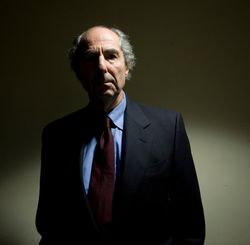
Philip Roth would use this soiled and feckless backdrop in “The Plot Against America” (2004), his 26th book; but ­anti-Semitism and its corollary, anti-anti-­Semitism, wholly dominated the publication of his first, “Goodbye, Columbus and Five Short Stories” (1959). “What is being done to silence this man?” asked a rabbi. “Medieval Jews would have known what to do with him.” Roth’s cheerful debut, some thought, shored up the same “conceptions . . . as ultimately led to the murder of six million in our time.” So he wasn’t only contending with a “rational” paranoia; he was also ensnared in the ongoing anguish of comprehension and absorption, as the sheer size of the trauma inched into consciousness. After a hate-filled public meeting at Yeshiva University in New York in 1962, Roth solemnly swore (over a pastrami sandwich) that he would “never write about Jews again.”

It was a hollow vow.

More here.