
Justin Taylor in Bookforum:
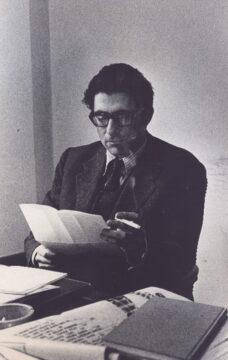
 YOU OPEN BOX 34, take the typescript from its folder. You can see right away that the song is pretty much finished. He’s got the first four verses locked in, save one lingering question about Ma. Should she be forty but say she’s twenty-four, or eighty claiming sixty-four? Or what if she’s twenty but wants you to think she’s sixty-four? Is that better? Nah. But this is small potatoes, a distraction from the real problem, which is the fifth and final verse, which is still stumping him.
He writes it longhand in the white space below the typing: “I ain’t gonna work on Maggie’s farm no more.” Makes sense that after dealing individually with Maggie’s brother, Pa, and Ma over the last three verses, he’d finish by returning to the farm itself. But now what? He writes “You” on its own line. Adds nothing. He leaves some space, gives it a fresh go:
if you ain’t like everyone else
they think they’ve been insulted
everybody try keep track of the
He pauses. This isn’t working. Maybe he takes a break, stays away for a while, because what’s written next is written with a different implement, something darker and thicker. Could be charcoal pencil but who knows. In the white space beside the abandoned fragment, he writes:
I try My best t be just the way I am
but everybody wants me to be just like them
theythey SAY SING WHILE YOU SLAVE
/ I just bored
And there it is.
More here.
Enjoying the content on 3QD? Help keep us going by donating now.
 Thousands of new genes are hidden inside the “dark matter” of our genome. Previously thought to be noise left over from evolution,
 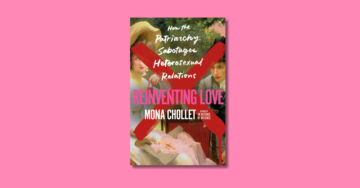 Though it’s not presented as such in her introduction or conclusion, femicide, as the ne plus ultra of patriarchal logic, is at the core of Chollet’s analysis in Reinventing Love. In a chapter entitled “Real Men,” Chollet argues that intimate partner violence should be thought of not as an aberration but rather as the most logical outcome of gender norms. She quotes feminist therapist Elisende Coladan in suggesting that, instead of calling abusive partners “narcissists,” such men should more readily be called the “healthy children of patriarchy.” Taking this logic further, Chollet spends a large chunk of this chapter analyzing with great curiosity what’s going on with the women who fall in love with known serial killers, from
  It can be argued, with some important caveats and qualifications, that Peter Schjeldahl was the most inventive, entertaining, and self-observing art critic to have ever worked in the English language. For 60 years, give or take, he struck himself like a tuning fork against works of art and attempted to transcribe the way his nerves vibrated to the aesthetic. These transcriptions involved dense, epigrammatic sentences, zany metaphors, and a chatty authority that was both deceptively approachable and disarmingly smart. Although he put himself in the bloodline of poet-critics like Baudelaire and Frank O’Hara, their prose never approaches anything like the constant, look-at-me lexical wizardry of an exhibition review by Schjeldahl. His writing credo: “Concentrated. At least one idea per sentence. Melodious, I hope. With jokes.”
 ‘F
‘F A hypothesis called “The Silurian hypothesis” wins the title of “most interesting hypothesis most likely to be false” for all of science. In brief, the hypothesis postulates that previously a species different from ours had achieved high intelligence and technological civilization on this planet. The Silurian hypothesis (named after “Silurian” aliens in the brainy British TV series “Doctor Who”) was initially proposed by two astronomers, Gavin A. Schmidt and Adam Frank, as a thought experiment, to see if it would even be feasible to detect the traces of such a hypothetical civilization which had existed many millions of years ago. Would there still be detectable changes in the sedimentation patterns if someone (not human) had built cities and military bases a hundred million years ago? Would ancient trash dumps be conserved somewhere, somehow? Would there be changes in the patterns of radioisotopes in the rocks as a result of an ancient nuclear war?
 Mysterious drones have been swarming the night skies above New Jersey and other nearby states for a month. They have been spotted over
  “November is a mournful month in the history of Palestine,” Edward Said began his
 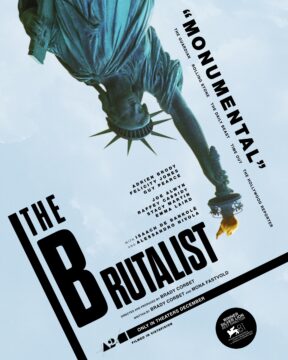 “Cinema is frequently associated with glamour, but the reality is that it’s labor,” Corbet told me. In the case of “The Brutalist,” his work seemed to be paying off. Initial reactions had been ecstatic. At Venice, where the film premièred, in early September, viewers had applauded for somewhere between twelve minutes (according to Variety) and thirteen minutes and five seconds (according to Deadline), longer than for any other festival entry but Pedro Almodóvar’s, and Corbet won the Silver Lion for Best Director. The film, which will be released in late December, was already being discussed as a Best Picture contender, and Brody as a Best Actor front-runner. (This week, it was nominated for both awards, plus five more, by the Golden Globes.)