Is Absolute Secularity Conceivable?

6564296735_0de7b5f03a_z

Simon During over at The Immanent Frame:

Is absolute secularity conceivable? The question arises from the paradoxical intuition that the secularization thesis is simultaneously both right and muddled. Perhaps the most fundamental problem with the broader secularization thesis (which I take to claim that, over the past half-millennium or so, Western society has undergone a systemic diminution of religious practice) is that it isn’t clear what the non-secular is. After all, it can be extended from those beliefs and practices that avowedly depend on religious revelation to those that affirm some form of transcendentalism, though they may make no room for God as such. But for a long time both radical atheists and Christian apologists have argued that what looks as if it is secular through and through may not, in fact, be secular at all. From this point of view, important elements of enlightened secularity in particular can be understood, not as Christianity’s overcoming, but as its displacement. Thus, for instance, in his Scholasticism and Politics (1938), Jacques Maritain, following Nietzsche, speaks of the “Christian leaven fermenting in the bosom of human history” as the source of democratic modernity. Here the secular, political concept of human equality is seen to have a Christian origin and to bear a continuing Christian charge, even though its purposes and contexts have changed.

Numerous applications of the displacement model of secularization are current, but here I will point to just one. It concerns philosophical anthropology. The argument is that certain post-Enlightenment concepts of the human (or of “man”) remain Christian in their deep structures. Of these, the most important is the philosophical anthropology of negation (to use Marcel Gauchet’s term), according to which human nature is not just appetitive but necessarily incomplete, that is to say, inadequate to its various ecologies and conditions, and for that reason beset by fear, uneasiness, anxiety, and so on. For those who accept the displacement model, this anthropology, even in its modern forms, remains dependent on the revealed doctrine that human nature as such is fallen.

More here.

The Mammoth Cometh

02cover-16x9-master675-v3

Nathaniel Rich in the NYT Magazine:

[Ben] Novak is tall, solemn, polite and stiff in conversation, until the conversation turns to passenger pigeons, which it always does. One of the few times I saw him laugh was when I asked whether de-extinction might turn out to be impossible. He reminded me that it has already happened. More than 10 years ago, a team that included Alberto Fernández-Arias (now a Revive & Restore adviser) resurrected a bucardo, a subspecies of mountain goat also known as the Pyrenean ibex, that went extinct in 2000. The last surviving bucardo was a 13-year-old female named Celia. Before she died — her skull was crushed by a falling tree — Fernández-Arias extracted skin scrapings from one of her ears and froze them in liquid nitrogen. Using the same cloning technology that created Dolly the sheep, the first cloned mammal, the team used Celia’s DNA to create embryos that were implanted in the wombs of 57 goats. One of the does successfully brought her egg to term on July 30, 2003. “To our knowledge,” wrote the scientists, “this is the first animal born from an extinct subspecies.” But it didn’t live long. After struggling to breathe for several minutes, the kid choked to death.

This cloning method, called somatic cell nuclear transfer, can be used only on species for which we have cellular material. For species like the passenger pigeon that had the misfortune of going extinct before the advent of cryopreservation, a more complicated process is required. The first step is to reconstruct the species’ genome. This is difficult, because DNA begins to decay as soon as an organism dies. The DNA also mixes with the DNA of other organisms with which it comes into contact, like fungus, bacteria and other animals. If you imagine a strand of DNA as a book, then the DNA of a long-dead animal is a shuffled pile of torn pages, some of the scraps as long as a paragraph, others a single sentence or just a few words. The scraps are not in the right order, and many of them belong to other books. And the book is an epic: The passenger pigeon’s genome is about 1.2 billion base pairs long. If you imagine each base pair as a word, then the book of the passenger pigeon would be four million pages long.

There is a shortcut. The genome of a closely related species will have a high proportion of identical DNA, so it can serve as a blueprint, or “scaffold.” The passenger pigeon’s closest genetic relative is the band-tailed pigeon, which Shapiro is now sequencing. By comparing the fragments of passenger-pigeon DNA with the genomes of similar species, researchers can assemble an approximation of an actual passenger-pigeon genome. How close an approximation, it will be impossible to know. As with any translation, there may be errors of grammar, clumsy phrases and perhaps a few missing passages, but the book will be legible. It should, at least, tell a good story.

More here.

On “We Real Cool”

An interview with Gwendolyn Brooks by George Stavros in English.Illinois:

Q. How about the seven pool players in the poem “We Real Cool”?

A. They have no pretensions to any glamor. They are supposedly dropouts, or at least they're in the poolroom when they should possibly be in school, since they're probably young enough, or at least those I saw were when I looked in a poolroom, and they. . . . First of all, let me tell you how that's supposed to be said, because there's a reason why I set it out as I did. These are people who are essentially saying, “Kilroy is here. We are.” But they're a little uncertain of the strength of their identity. [Reads:]

Gwendolyn_Brooks_cropped We real cool. We
Left school. We

Lurk late. We
Strike straight. We

Sing sin. We
Thin gin. We

Jazz June. We
Die soon.

The “We”—you're supposed to stop after the “We” and think about their validity, and of course there's no way for you to tell whether it should be said softly or not, I suppose, but I say it rather softly because I want to represent their basic uncertainty, which they don't bother to question every day, of course.

Q. Are you saying that the form of this poem, then, was determined by the colloquial rhythm you were trying to catch?

A. No, determined by my feeling about these boys, these young men.

More here. (Note: One post throughout February will be dedicated to Black History Month.)

LIT UP BY THE LUMINARIES

Robert Macfarlane in More Intelligent Life:

CattonI first read “The Luminaries” as a judge of the Man Booker prize for fiction last year. Without that compulsion I might never have picked it up, put off by its cubical bulk and astrological armature. What a loss that would have been! I have now read it three times—2,496 pages in sum—and each reading has yielded new dividends. And its consequences enact its concerns, for Catton takes such pains not only for the joy of evocation, but also to carry out a huge thought-experiment into the nature of value. Almost everyone in Hokitika is dedicated to the acquisition of wealth and the maximisation of profit. It is a community driven by capital, in which relationships are ruled by cost-benefit analysis. One of the few transactions to defeat this fierce logic is the unconditional love that develops between two characters: a young prospector and a “whore”. Their love eventually emerges as a gold standard: a touchstone with which to test the value of all things.

And so this phenomenal book, apparently about digging into the Earth's innards in search of wealth, ends up delving into the heart's interior to find true worth. All the while the landscape goes about its business: rain clatters fatly onto the roofs of Hokitika's 100 pubs, storms pummel the sand-bars, the snowmelt of the high peaks swells the rivers, and the rivers crash down towards the sea, carrying gold which shines in their eddy-pools, as one early prospector put it, “like the stars of Orion on a dark, frosty night”.

More here.

Who’s Afraid of Walter Mitty?

Liam Heneghan in the Los Angeles Review of Books:

Mitty1-243x366In those days, over 30 years past, when it was not unusual in Dublin bookshops for patrons to discuss books with each other, a youth not very much older than I was at the time told me that James Thurber's writing was “total shite.” I glowered, bought My World and Welcome to It (1942), and shuffled out onto Nassau Street with the book stuffed into a paper bag. I was mainly interested in the pictures anyway.

By that time I was already fairly progressed in my reading of Thurber, who was a favorite of my father’s and consequently whose books, some of them at least, were strewn about the house. My mother claimed that Thurber was the only writer that made had her laugh out loud on a Dublin bus. Thurber’s best known story The Secret Life of Walter Mitty, which had first appeared in The New Yorker in 1939, was assigned reading for Ireland’s intermediate certificate English course (the “intercourse” as we called it), the national curriculum for students aged 12 to 15 years old. The story was therefore known to most Irish youth.

I have been rereading Thurber in recent months, more than 35 years after I first encountered him, partly in anticipation of the release of Ben Stiller’s film version of the Walter Mitty story, and partly because I had picked up a copy of the excellent compilation of Thurber’s Writings and Drawings (1996) in the Library of America series. In the intervening years since my early reading of Thurber I lived for a long time in the United States, first in New York, then a brief stint in Georgia, and now in Chicago where it snows a lot. Having more familiarity with locations and situations that once seemed exotic and urbane to me, at least when viewed from Dublin in the 1970s, I can now assess Thurber’s work with more culturally attuned eyes and significantly older ones.

More here.

Thursday Poem

Miller Moth

.
Promises were made
that dress of yours
yellow as a Miller moth
batting about the bulb
of a painted porch light
yearning on hanger
to caress a slope of shoulder
ride a swell of hip
bell the well-turned ankle
pleat and dart pooled about
first one foot
then the other
rose to lip
a halting smile of neckline
assumed an aspect
of sail gathered wind
sung vows in the rigging
where I madly batted
drawn, ensnared.
.

by Dave Hardin
from The Lost Country, Fall 2013

A Fluid New Path in Grand Math Challenge

Jet-eddies-web_cropped

Erica Klarreich in Quanta:

In Dr. Seuss’s book “The Cat in the Hat Comes Back,” the Cat makes a stain he can’t clean up, so he calls upon the help of Little Cat A, a smaller, perfect replica of the Cat who has been hiding under the Cat’s hat. Little Cat A then calls forth Little Cat B, an even smaller replica hidden under Little Cat A’s hat. Each cat in turn lifts his hat to reveal a smaller cat who possesses all the energy and good cheer of the original Cat, just crammed into a tinier package. Finally, Little Cat Z, who is too small to see, unleashes a VOOM like a giant explosion of energy, and the stain disappears.

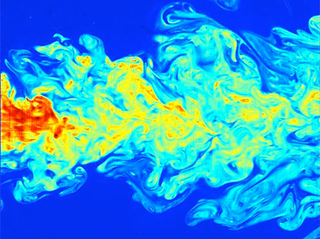
A similar process lies at the heart of a speculative new approach to a problem that has bedeviled mathematicians for more than 150 years: understanding the solutions to the Navier-Stokes equations of fluid flow, which physicists use to model ocean currents, weather patterns and other phenomena. These equations are so complex that in most cases, no one knows whether the solution will be smooth and well-behaved, without any sudden shifts of direction or explosions of energy, for instance. And computer models of the solutions run aground, unable to accurately capture the behavior of small eddies.

Now, in a paper posted online on February 3Terence Tao of the University of California, Los Angeles, a winner of the Fields Medal, mathematics’ highest honor, offers a possible way to break the impasse. He has shown that in an alternative abstract universe closely related to the one described by the Navier-Stokes equations, it is possible for a body of fluid to form a sort of computer, which can build a self-replicating fluid robot that, like the Cat in the Hat, keeps transferring its energy to smaller and smaller copies of itself until the fluid “blows up.” As strange as it sounds, it may be possible, Tao proposes, to construct the same kind of self-replicator in the case of the true Navier-Stokes equations. If so, this fluid computer would settle a question that the Clay Mathematics Institute in 2000 dubbed one of the seven most important problems in modern mathematics, and for which it offered a million-dollar prize. Is a fluid governed by the Navier-Stokes equations guaranteed to flow smoothly for all time, the problem asks, or could it eventually hit a “blowup” in which something physically impossible happens, such as a non-zero amount of energy concentrated into a single point in space?

More here.

Redistribution, Inequality, and Growth

IMF paper table

Jonathan D. Ostry, Andrew Berg, and Charalambos G. Tsangarides over at the (seemingly very different) IMF:

Economists are increasingly focusing on the links between rising inequality and the fragility of
growth. Narratives include the relationship between inequality, leverage and the financial
cycle, which sowed the seeds for crisis; and the role of political-economy factors (especially
the influence of the rich) in allowing financial excess to balloon ahead of the crisis. In earlier
work, we documented a multi-decade cross-country relationship between inequality and the
fragility of economic growth. Our work built on the tentative consensus in the literature that
inequality can undermine progress in health and education, cause investment-reducing political
and economic instability, and undercut the social consensus required to adjust in the face of
shocks, and thus that it tends to reduce the pace and durability of growth.

That equality seems to drive higher and more sustainable growth does not in itself support
efforts to redistribute. In particular, inequality may impede growth at least in part because it
calls forth efforts to redistribute that themselves undercut growth. In such a situation, even if
inequality is bad for growth, taxes and transfers may be precisely the wrong remedy.

While considerable controversy surrounds these issues, we should not jump to the conclusion
that the treatment for inequality may be worse for growth than the disease itself.

More here. Also see here.

Wednesday, February 26, 2014

Moral Panics, Sex Panics and the Production of A Lebanese Nation

ScreenShot2014-02-22at12.02.26PM

Maya Mikdashi in Jadaliyya:

In the past few months sex panics and moral panics, centered on gendered bodies and abuses, have rocked Lebanon. In this article I want to revisit three of these panics: photos of a semi-nude Lebanese Olympic Skier’s body and reactions to it; the impunity of wife murderers and wife abusers; and the razing of a Syrian makeshift refugee camp after (ultimately false) accusations of sex abuse by a camp resident of a mentally disabled Lebanese man. I bring these three cases together in order to think about the political work that the moral/sex panicdoes in making and remaking Lebanese national identity and in articulating its gendered architecture. I do so in order to avoid thinking each separately under the rubrics of sexual discrimination or abuse in Lebanon.

Jackie Chamoun is a skier representing Lebanon at the Winter 2014 Olympics. Her qualification for the premier international sporting event is itself a success, given the lack of training infrastructures and support for athletes (particularly females) in Lebanon. Recently, photos a friend of Chamoun’s took for a calendar, featured the athlete in various poses (though not full frontal) and topless. The photos spread through the Internet like wildfire. In response, the Caretaker Lebanese minister for Youth and Sports, Faisal Karami, ordered an investigation into the photos. He stated that they, and by extension Chamoun, were damaging to the country’s image. In a country with chronic youth unemployment and a widely corrupt professional sports system, as well as the lack of support for sports and youth more broadly, it was these photos that were just too much for the good minister. Almost immediately, people reacted, both positively and negatively, to Karami’s announcement. But what was the image of Lebanon that Karami wanted to protect, and why was the site of a female athletic body—and athletes, given that their bodies are their work, are rightly proud and confident in them— so threatening to that image?

More here.

How to Talk about Climate Change, Part 1: The Blame Game

Stephanie Bernhard in Full Stop:

Shutterstock_83447575-1024x681If you want to see an expression of pure despair, ask a college freshman to parse Rachel Carson’s rhetorical choices at 8:00 in the morning. That’s what I’m doing this semester for a composition class I’m teaching at the University of Virginia. The course is called “Representing Climate Change,” and our collective goal is to discover and deploy effective methods of talking and writing about our looming environmental crisis. The task is daunting. Climate change is at once really easy and really hard to write about. It’s easy because there is so much to say, and hard because progress toward a solution is so slow.

But what do I know about the fossil fuel industry? I study literature. I am not a scientist. My specialties are agrarian novels and Modernist aesthetics, not cloud formation or sea ice. When making arguments, I have to trust the vast majority of scientists who agree that humans are changing the climate, that the changes will have huge and unpleasant effects, and that we should really get our act together and fix the problem. The scientists’ job is to perform and publish the research that supports these claims. My job — and my students’ job — starts where peer review ends: we need to make scientific evidence digestible and believable to a general audience. Since solving climate change requires mass engagement, how we talk about the problem matters as much as the science that confirms its urgency.

More here.

Alec Baldwin: Good-bye, Public Life

Alec Baldwin in New York Magazine:

ScreenHunter_540 Feb. 26 14.23I flew to Hawaii recently to shoot a film, fresh on the heels of being labeled a homophobic bigot by Andrew Sullivan, Anderson Cooper, and others in the Gay Department of Justice. I wanted to speak with a gay-rights group that I had researched and admired, so I called its local Honolulu branch.

The office number turned out to be some guy’s cell phone. I left him a message—I said, “I’m from out of town, I’m visiting Hawaii on business, I’d like to get some information on your group.” After two or three more calls, he answered the phone. I said, “Yeah, I’m the guy that called about your organization.” And he said, somewhat impatiently, “Okay, well, what did you want?” I said, “Well, let me put it to you this way, Nick. Your name is Nick? Nick, let me begin by asking you a question. Who would you say, by your estimation, is the most homophobic member of the entertainment industry currently in the media?” And he paused for a long count of four and said, “Um … Alec Baldwin?”

And I said, “Ding, ding, ding, ding! Bingo, Nick, bingo! That’s who you’re talking to.”

He said, “C’mon!”

I said, “Nick, I want to come in and talk.”

I met with Nick and others from two LGBT organizations. We talked for a while about the torment of the LGBT life many of them have lived while growing up in traditional Hawaiian families. Macho fathers. Religious mothers. We talked a lot about words and their power, especially in the lives of young people.

One young man, an F-to-M tranny, said, “Are you here to get dry-cleaned, like Brett Ratner?” Meaning I could do some mea culpa, write them a six-figure check, go to a dinner, sob at the table, give a heartfelt speech, beg for forgiveness.

More here.

Wednesday Poem

When All This Is Over

After all the heads have rolled
and the young insurgents put up against the wall
by the firing squads
when the puppet masters
have taken their seats in the boardroom
and the bombardiers are sipping drinks
with the chiefs of police
when the journalists change sides again
and the commentators
redefine what they meant in the first place
and the judges sell their shares
in revolutionary understanding
and the clergy decide
that forgiveness was always forgiven
and educators rediscover
the meaning behind the meaningless
when poets grow tired
of too long battling futility
when arrogant financiers
have poisoned all the blood banks
and the drug companies
have rendered us venomous
unfit for social consumption
when we see that things have returned again to how they are
we want to believe
that the ruthless men in the big black cars
are lonely as sin
behind their bullet proof glass
and that it means something
that they may have doubts
in the middle of the night like we have
only worse
we pray
because maybe they can do something about it
before the eagle
stoops and tears their liver out
.
by Macdara Woods

Physicists find a new ‘state of matter’ in the eyes of chickens

George Divorsky in io9:

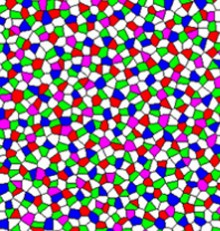
ScreenHunter_539 Feb. 26 13.31An unusual arrangement of particles has been discovered in the cells of chicken eyes. It's the first time scientists have seen such a system in a biological system — one that allows materials to behave like both a crystal and a liquid.

The unique arrangement is called “disordered hyperuniformity,” and it could help researchers design advanced materials, such as optics that can transmit light with the efficiency of a crystal and the flexibility of a liquid.

When matter is organized into states of disordered hyperuniformity, it exhibits order over large distances and disorder over small distances. At one level, it's like a crystal that greatly suppresses differences in the density of particles across large spatial distances. But at another scale, it's liquid-like in that it exhibits similar physical properties in all directions.

More here.

Bigotry in the USA: Photos From a Ku Klux Klan Initiation

Ben Cosgrove in Life:

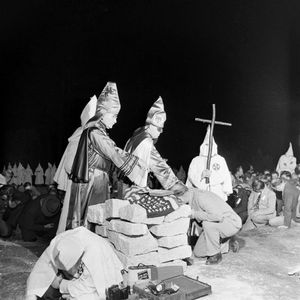
KkkIn May 1946, LIFE magazine ran a series of remarkable pictures from a Klan initiation in Georgia, at the start of the Third Klan era. Titled “The Ku Klux Klan Tries a Comeback,” the article noted that the KKK pledged initiates “in a mystic pageant on Georgia’s Stone Mountain.” The language that accompanied photographer Ed Clark’s pictures, meanwhile, made clear that, as newsworthy as the story of this particular initiation might have been, LIFE’s editors considered the figures in their white robes and hoods to be rather laughable — if their rhetoric and arcane, pseudo-mystic shenanigans weren’t so unsettling.

On the evening of May 9 at 8 p.m. a mob of fully grown men solemnly paraded up to a wide plateau of Stone Mountain outside Atlanta, Ga., and got down on their knees on the ground before 100 white-sheeted and hooded Atlantans. In the eerie light of a half-moon and a fiery cross they stumbled in lockstep up to a great stone altar and knelt there in the dirt while the “Grand Dragon” went through the mumbo jumbo of initiating them into the Ku Klux Klan. Then one new member was selected from the mob and ceremoniously “knighted” into the organization in behalf of all the rest of his fellow bigots. This was the first big public initiation into the Klan since the end of World War II. It was put on at a carefully calculated time. The anti-Negro, anti-Catholic, anti-Semitic, anti-foreign, anti-union, anti-democratic Ku Klux Klan was coming out of wartime hiding just at the time when the CIO and the A.F. of L. were starting simultaneous campaigns to organize the South. . . . But it is doubtful that the Klan can become as frighteningly strong as it was in 1919. One indication of the Klan’s impotence was its lack of effect on Negroes, who were once frightened and cowed by the white-robed members. More than 24,000 Negroes have already registered for next July’s primaries in the Atlanta vicinity alone, where the Stone Mountain ritual was held.

As mentioned in one of the captions in the gallery above, the Stone Mountain ceremony was put off several times during the preceding year because of wartime sheet shortages. Or at least that’s what LIFE reported at the time. The magazine also made a point of characterizing the garb and actions of members at Klan meetings (slides #10 through 15) as both creepy and pathetic. “Childish ritual and secretiveness,” the magazine noted, “have always been the great attractions for the kind of people who make good Klansmen.”

The more things change. . . .

More here. (Note: One post throughout February will be dedicated to Black History Month.)

The Brain’s Inner Language

James Gorman in The New York Times:

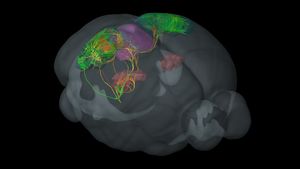
Brain-seattle-videoSixteenByNine1050To crack the code of the brain, Dr. Reid said, two fundamental problems must be solved. The first is: “How does the machine work, starting with its building blocks, cell types, going through their physiology and anatomy,” he said. That means knowing all the different types of neurons in the mouse visual cortex and their function — information that science doesn’t have yet. It also means knowing what code is used to pass on information. When a mouse sees a picture, how is that picture encoded and passed from neuron to neuron? That is called neural computation.

“The other highly related problem is: How does that neural computation create behavior?” he said. How does the mouse brain decide on action based on that input? He imagined the kind of experiment that would get at these deep questions. A mouse might be trained to participate in an experiment now done with primates in which an animal looks at an image. Later, seeing several different images in sequence, the animal presses a lever when the original one appears. Seeing the image, remembering it, recognizing it and pressing the lever might take as long as two seconds and involve activity in several parts of the brain. Understanding those two seconds, Dr. Reid said, would mean knowing “literally what photons hit the retina, what information does the retina send to the thalamus and the cortex, what computations do the neurons in the cortex do and how do they do it, how does that level of processing get sent up to a memory center and hold the trace of that picture over one or two seconds.” Then, when the same picture is seen a second time, “the hard part happens,” he said. “How does the decision get made to say, ‘That’s the one’?” In pursuit of this level of understanding, Dr. Reid and others are gathering chemical, electrical, genetic and other information about what the structure of that part of the mouse brain is and what activity is going on.

More here.

A Star in a Bottle

140303_r24681_p233

Raffi Khatchadourian in The New Yorker:

Years from now—maybe in a decade, maybe sooner—if all goes according to plan, the most complex machine ever built will be switched on in an Alpine forest in the South of France. The machine, called the International Thermonuclear Experimental Reactor, or iter, will stand a hundred feet tall, and it will weigh twenty-three thousand tons—more than twice the weight of the Eiffel Tower. At its core, densely packed high-precision equipment will encase a cavernous vacuum chamber, in which a super-hot cloud of heavy hydrogen will rotate faster than the speed of sound, twisting like a strand of DNA as it circulates. The cloud will be scorched by electric current (a surge so forceful that it will make lightning seem like a tiny arc of static electricity), and bombarded by concentrated waves of radiation. Beams of uncharged particles—the energy in them so great it could vaporize a car in seconds—will pour into the chamber, adding tremendous heat. In this way, the circulating hydrogen will become ionized, and achieve temperatures exceeding two hundred million degrees Celsius—more than ten times as hot as the sun at its blazing core.

No natural phenomenon on Earth will be hotter. Like the sun, the cloud will go nuclear. The zooming hydrogen atoms, in a state of extreme kinetic excitement, will slam into one another, fusing to form a new element—helium—and with each atomic coupling explosive energy will be released: intense heat, gamma rays, X rays, a torrential flux of fast-moving neutrons propelled in every direction. There isn’t a physical substance that could contain such a thing. Metals, plastics, ceramics, concrete, even pure diamond—all would be obliterated on contact, and so the machine will hold the superheated cloud in a “magnetic bottle,” using the largest system of superconducting magnets in the world. Just feet from the reactor’s core, the magnets will be cooled to two hundred and sixty-nine degrees below zero, nearly the temperature of deep space. Caught in the grip of their titanic forces, the artificial earthbound sun will be suspended, under tremendous pressure, in the pristine nothingness of iter’s vacuum interior.

For the machine’s creators, this process—sparking and controlling a self-sustaining synthetic star—will be the culmination of decades of preparation, billions of dollars’ worth of investment, and immeasurable ingenuity, misdirection, recalibration, infighting, heartache, and ridicule. Few engineering feats can compare, in scale, in technical complexity, in ambition or hubris. Even the iterorganization, a makeshift scientific United Nations, assembled eight years ago to construct the machine, is unprecedented. Thirty-five countries, representing more than half the world’s population, are invested in the project, which is so complex to finance that it requires its own currency: the iter Unit of Account.

More here.

Is Venezuela Burning?

Screen-Shot-2014-02-25-at-9.13.18-AM

Mike Gonzalez in Jacobin:

Between 2002 and 2014, the Right failed to dislodge Chavez; on the contrary, Chavez’s electoral support rose consistently until his death early last year. After that, his nominated successor, Maduro, won the presidential elections in April 2013. But this time the right-wing candidate, Henrique Capriles Radonski, came within 250,000 votes (under one percent) of winning.

It was a clear expression of the growing frustration and anger among Chavez supporters. 2012 had seen inflation rates hovering around fifty percent (officially) and the level has risen inexorably throughout the last year. Today the basic basket of goods costs 30% more than the minimum wage — and that is if the goods are to be found on the increasingly empty shelves of shops and supermarkets. The shortages are explained partly by speculation on the part of capitalists — just as happened in Chile in 1972 — and partly by the rising cost of imports, which make up a growing proportion of what is consumed in Venezuela. And that means not luxuries, but food, basic technology, and even gasoline.

All of this is an expression of an economic crisis vigorously denied by the Maduro government but obvious to everyone else. Inflation is caused by the declining value of the bolivar, Venezuela’s currency, itself the result of economic paralysis. The truth is that production of anything other than oil has ground to a virtual halt. The car industry employs 80,000 workers, yet since the beginning of 2014 it has produced 200 vehicles — what would normally be produced in half a day.

How is it possible that a country with the world’s largest proven reserves of oil (and possibly of gas, too) should now be deeply in debt to China and unable to finance the industrial development that Chavez promised in his first economic plan?

The answer is political rather than economic: corruption on an almost unimaginable scale, combined with inefficiency and a total absence of any kind of economic strategy. In recent weeks, there have been very public denunciations of speculators, hoarders, and the smugglers taking oil and almost everything else across the Colombian border. And there have been horrified reports of the “discovery” of thousands of containers of rotting food. But all of this has been common knowledge for years. Equally well known is the involvement of sectors of the state and government in all these activities.

More here.

What’s Wrong with Inequality?

Over at Philosophy Bites:

Why do so many people object to inequality? Is there something intrinsically wrong with it? Is it wrong because it has bad consequences? Or is there nothing wrong with it? Harvard philosopher Tim Scanlon discusses these questions with Nigel Warburton in this episode of the Philosophy Bites podcast.

Listen to Tim Scanlon on What's Wrong with Inequality?