
Category: Recommended Reading
Wednesday Poem
The Doctor –Exceprt from A Boxing Story
No more boxers for me.
Bar room brawlers,
that's another story.
They don't train
to destroy people.
No one pays to watch
a couple of drunks
demolish furniture.
Four and a half hours
inside this kid's head
and I'll fight anyone
who calls this sport.
Prize fighting?
You want to know
this kid's prize?
Bifrontal craniotomy,
three subdural hematomas,
possible embolisms,
possible skull fracture,
total left hemiplegia.
Let me translate.
If he ever wakes up
half life in the cabbage patch,
maybe complete loss
of his whole left side,
years of therapy
so he can shuffle,
drool and gawk about.
No more boxers for me.
I'm a neurosurgeon
not a bloody botanist.
by Garry Hyland
from After Atlantis
Thistledown Press, 1991.
Europe’s Slow Surrender to Intolerance
Jeffrey Goldberg in The Atlantic:

But I find myself most bothered by what seems to have been, on the surface, a relatively minor incident. The episode took place last weekend at a Sainsbury’s supermarket in central London. Protesters assembled outside the store to call for a boycott of Israeli-made goods. Quickly, the manager ordered employees to empty the kosher food section. One account suggests that a staff member, when asked about the empty shelves, said “We support Free Gaza.” Other reports suggest that the manager believed that demonstrators might invade the store and trash it. (There is precedent to justify his worry.)
More here.
E-cigarettes: The lingering questions
Daniel Cressey in Nature:

E-cigarettes — also known as personal vaporizers or electronic nicotine-delivery systems among other names — are perhaps the most disruptive devices that public-health researchers working on tobacco control have ever faced. To some, they promise to snuff out a behaviour responsible for around 100 million deaths in the twentieth century. Others fear that they could perpetuate the habit, and undo decades of work. Now, a group once united against a common enemy is divided. “These devices have really polarized the tobacco-control community,” says Michael Siegel, a physician and tobacco researcher at Boston University School of Public Health in Massachusetts. “You now have two completely opposite extremes with almost no common ground between them.” Evidence is in short supply on both sides. Even when studies do appear, they are often furiously debated. And it is not just researchers who are attempting to catch up with the products now pouring out of Chinese factories: conventional tobacco companies are pushing into the nascent industry, and regulators are scrambling to work out what to do.
More here.
I will build columns to support your roof / If need be, with my bones
Douglas Martin in the New York Times:

Her death was announced by the Iranian Republic News agency, the country’s official information service.
Ms. Behbahani wrote more than 600 poems, collected in 20 books, on subjects as diverse as earthquakes, revolution, war, poverty, prostitution, freedom of speech and her own plastic surgery. In poems and public speeches, she confronted Iran’s religious authorities, challenging them on practices like the stoning of women who commit adultery.
“She became the voice of the Iranian people,” Farzaneh Milani, a University of Virginia professor who translated many of her poems into English, said in an interview on Thursday. “She was the elegant voice of dissent, of conscience, of nonviolence, of refusal to be ideological.”
More here.
Forum: Against Empathy
Paul Bloom in the Boston Review:

This reaction surprised me at first, but I’ve come to realize that taking a position against empathy is like announcing that you hate kittens—a statement so outlandish it can only be a joke. And so I’ve learned to clarify, to explain that I am not against morality, compassion, kindness, love, being a good neighbor, doing the right thing, and making the world a better place. My claim is actually the opposite: if you want to be good and do good, empathy is a poor guide.
The word “empathy” is used in many ways, but here I am adopting its most common meaning, which corresponds to what eighteenth-century philosophers such as Adam Smith called “sympathy.” It refers to the process of experiencing the world as others do, or at least as you think they do. To empathize with someone is to put yourself in her shoes, to feel her pain. Some researchers also use the term to encompass the more coldblooded process of assessing what other people are thinking, their motivations, their plans, what they believe. This is sometimes called “cognitive,” as opposed to “emotional,” empathy. I will follow this convention here, but we should keep in mind that the two are distinct—they emerge from different brain processes; you can have a lot of one and a little of the other—and that most of the discussion of the moral implications of empathy focuses on its emotional side.
More here.
Tuesday, August 26, 2014
Reading Hamilton From the Left

Christian Parenti in Jacobin:
In the American political imagination, Jefferson is rural, idealistic, and democratic, while Hamilton is urban, pessimistic, and authoritarian. So, too, on the US left, where Jefferson gets the better billing. Michael Hardt recently edited a sheaf of Jefferson’s writings for the left publisher Verso.
Reading “Jefferson beyond Jefferson,” Hardt casts him as a theorist of “revolutionary transition.” We like Jefferson’s stirring words about “the tree of liberty” occasionally needing “the blood of patriots and tyrants,” and his worldview fits comfortably with a “small is beautiful” style localism. We recall Jefferson as a great democrat. When Tea Partiers echo his rhetoric, we dismiss it as a lamentable misunderstanding.
But in reality, Jefferson represented the most backward and fundamentally reactionary sector of the economy: large, patrimonial, slave-owning, agrarian elites who exported primary commodities and imported finished manufactured goods from Europe. He was a fabulously wealthy planter who lived in luxury paid for by slave labor. Worse yet, he raised slaves specifically for sale.
“I consider the labor of a breeding woman,” Jefferson wrote, “as no object, and that a child raised every 2 years is of more profit than the crop of the best laboring man.”
Even if it could somehow be dislodged from the institution of slavery, Jefferson’s vision of a weak government and an export-based agrarian economy would have been the path of political fragmentation and economic underdevelopment. His romantic notions were a veil behind which lay ossified privilege.
Hamilton was alone among the “founding fathers” in understanding that the world was witnessing two revolutions simultaneously. One was the political transformation, embodied in the rise of republican government. The other was the economic rise of modern capitalism, with its globalizing networks of production, trade, and finance. Hamilton grasped the epochal importance of applied science and machinery as forces of production.
More here.
What I’ve Learned from Two Years Collecting Data on Police Killings

D. Brian Burghart in Gawker:
Nowhere could I find out how many people died during interactions with police in the United States. Try as I might, I just couldn't wrap my head around that idea. How was it that, in the 21st century, this data wasn't being tracked, compiled, and made available to the public? How could journalists know if police were killing too many people in their town if they didn't have a way to compare to other cities? Hell, how could citizens or police? How could cops possibly know “best practices” for dealing with any fluid situation? They couldn't.
The bottom line was that I found the absence of such a library of police killings offensive. And so I decided to build it. I'm still building it. But I could use some help. You can find my growing database of deadly police violence here, at Fatal Encounters, and I invite you to go here,research one of the listed shootings, fill out the row, and change its background color. It'll take you about 25 minutes. There are thousands to choose from, and another 2,000 or so on my cloud drive that I haven't even added yet. After I fact-check and fill in the cracks, your contribution will be added to largest database about police violence in the country. Feel free to check out what has been collected about your locale's information here.
The biggest thing I've taken away from this project is something I'll never be able to prove, but I'm convinced to my core: The lack of such a database is intentional. No government—not the federal government, and not the thousands of municipalities that give their police forces license to use deadly force—wants you to know how many people it kills and why.
It's the only conclusion that can be drawn from the evidence.
More here.
The Mysterious World of Stefan Zweig
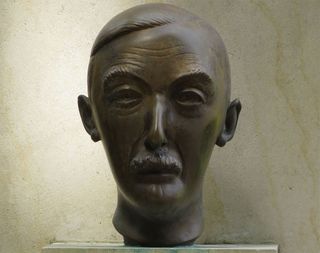
Jacob Heilbrunn in The National Interest:
IN JOSEPH Roth’s novel Radetzky March, Count Chojnicki drives district captain Franz von Trotta and his son Carl Joseph, a lieutenant in the Austrian infantry, in a straw-yellow britska to his small hunting lodge in the Galician forest near the border with Ukraine. After pouring glasses of 180 proof, Chojnicki disconcerts his two guests by declaring that the Habsburg Empire is doomed:
With great effort Herr von Trotta asked another question: “I don’t understand! Why shouldn’t the monarchy still exist?” “Of course,”Chojnicki answered, “taken literally, it continues to exist. We still have an army”—the count motioned to the lieutenant—“and officials”—the count pointed to the district captain. “But it is disintegrating. . . . An aged one, whose number is up, endangered by each sniffle, hangs onto his throne simply by the miracle that he can still sit upon it. How much longer, how much longer! This era doesn’t want us any longer! This era wants to create nation-states! No one believes in God. The new religion is nationalism. . . . The monarchy, our monarchy, is based on piety: in the belief that God elected the Habsburgs. . . . Our Emperor is a secular brother of the Pope. . . . The Emperor of Austria-Hungary cannot be abandoned by God. But now God has abandoned him!”
Chojnicki’s lament reflects the profound sense of abandonment that assailed not only Roth, but also his compatriot Stefan Zweig. Both mourned the collapse of the Habsburg monarchy and the loss of the comforting stability it had represented, not least for Jews like themselves. Both became refugees, going into exile years before the Anschluss, or annexation, of Austria by Nazi Germany in March 1938—in a 1933 letter, Roth warned Zweig that it was all over once Hitler had been appointed chancellor by the senescent President Hindenburg. And both ended up destroying themselves—the alcoholic Roth, dependent on handouts from Zweig, perished of delirium tremens in a Paris hospital in 1939 at the age of forty-five; Zweig, together with his young second wife, Lotte, swallowed poison in a little bungalow in 1942 in Petropolis, a lovely mountain resort located near Rio de Janeiro. Unlike Roth, however, Zweig’s literary star dimmed after his death, even though he was one of the most popular authors in the world during the 1930s, an era when books, like the cinema, could command a mass audience.
Now, in his beguiling study The Impossible Exile, George Prochnik examines Zweig’s odyssey. Prochnik, who is the author of In Pursuit of Silence, sets Zweig in the context of literary and social Vienna. It’s very much a life and times rather than a discussion of the old boy’s oeuvre, which was rather vitriolically attacked as “just putrid” by Michael Hofmann in 2010 in the London Review of Books. That his works don’t measure up to Thomas Mann’s or Roth’s almost goes without saying.
But Zweig, a compulsive collector whose possessions included Goethe’s pen and Beethoven’s desk, makes for a fascinating subject (Wes Anderson’s charming new film The Grand Budapest Hotel was inspired by him). Prochnik mines both Zweig’s memoir The World of Yesterday as well as his letters to offer numerous insights. He suggests that Zweig, who was friends with everyone from Richard Strauss to Sigmund Freud, provides an acute lens through which to examine not only the cultural contradictions of the imperial city, but also the plight of the numerous cultural émigrés from Central Europe whom Nazi propaganda minister Joseph Goebbels ridiculed as “cadavers on leave.”
More here.
Who Will Pay Reparations on My Soul?
Jesse McCarthy in The Point:
In the summer of 1960, James Baldwin wrote an essay he styled “Fifth Avenue, Uptown: A Letter from Harlem.” Among the host of ills he observed in the neighborhood where he was born and raised, he gave a prominent place to the dynamics of racialized policing:
The only way to police a ghetto is to be oppressive … Rare, indeed, is the Harlem citizen, from the most circumspect church member to the most shiftless adolescent, who does not have a long tale to tell of police incompetence, injustice, or brutality. I myself have witnessed and endured it more than once.
Like so many of us watching events unfold on the live feed from Ferguson, Missouri, I thought about how depressingly familiar it all looked. How many times has this very script played out in our lives? What year wasn’t there a prominent slaying of a black citizen under dubious circumstances, followed by an outbreak of rioting? Here is Baldwin in 1960, describing the archetype in his characteristically lucid way, with empathy but also a stern moral clarity:
It is hard on the other hand to blame the policeman… he too, believes in good intentions and is astounded and offended when they are not taken for the deed… He moves through Harlem, therefore, like an occupying soldier in a bitterly hostile country; which is precisely what, and where, he is. … He can retreat from his unease in only one direction: into a callousness which very shortly becomes second nature. He becomes more callous, the population becomes more hostile, the situation grows more tense, and the police force is increased. One day, to everyone’s astonishment, someone drops a match in the powder keg and everything blows up. Before the dust has settled or the blood congealed, editorials, speeches and civil-rights commissions are loud in the land, demanding to know what happened. What happened is that Negroes want to be treated like men.
The vulnerability of racially marked bodies to power, particularly police power, and the lack of justice—the singular and persistent evidence of gross unfairness where race and the law intersect—reveals a bloody knot in the social fabric that is as vivid in Ferguson, Missouri today as it was in Baldwin’s Harlem half a century ago.
More here.
The Fantastical Panama Canal
Morgan Meis in The Smart Set:
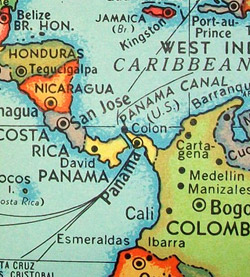
268,000,000 cubic yards of earthy stuff was moved to create the Panama Canal. Something like 27,000 people died from accidents and disease during construction. (The French, who started the project, did not keep accurate death records). A three-mile-long peninsula jutting out into the Pacific Ocean was created with material dug from the Canal. There are 46 gates along the Panama Canal, each of them weighing between 354 and 662 tons. 101,000 cubic meters of water are needed to fill a Panama Canal lock chamber. An average of 52 million gallons of fresh water are used in each transit.
These are just some of the raw numbers that tell the tale of the Panama Canal. Building the Canal took about 35 years. The French began the project in 1881. But there were so many problems (human and mechanical) that the project was abandoned. In 1904, the Americans took over the task. The Panama Canal was officially opened on August 15, 1914. One hundred years ago.
More here.
Attica prison riot poem by Muhammad Ali
Vote now for an entry in the 3QD Science Prize 2014

Go here to browse through the 85 nominees for this year's science prize and vote. Voting ends on Monday, September 1, at 11:59 pm NYC time.
[New posts below.]
Women in Dark Times: an explosive kind of feminism
Frances Wilson in The Telegraph:
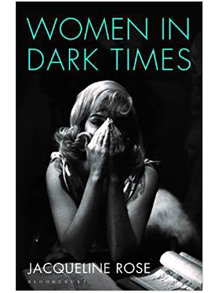
Rosa Luxemburg, the tiny Polish Jew who walked with a limp, is the glue that binds the book together: “I want to affect people like a clap of thunder,” she writes to her lover, “to inflame their minds not by speechifying but with the breadth of my vision, the strength of my conviction, and the power of my expression.” Luxemburg, says Rose, still has a lot to teach us, but for many readers the most compelling figure will be Marilyn Monroe. Why are women so drawn to her story? Rose does not argue that Monroe was a feminist, but that she had “something urgent to say to feminism today”. Written across her face and body were the desires of America; Monroe represented capitalism to itself. “I don’t look on myself as a commodity,” she said in her last interview, “but I’m sure a lot of people have.” Her beauty was the foil of her country’s moral decay, and she knew it.
More here.
The Decisive Marriage
Tara Parker-Pope in The New York Times:
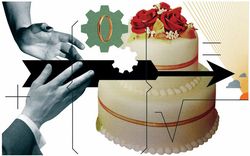
The research stems from a study that began with 1,294 young adults ages 18 to 34 recruited to the Relationship Development Study in 2007 and 2008. Over the next five years, 418 of the individuals in the study married, offering the researchers a glimpse into the lives and decision-making of couples before and after marriage. The researchers collected data on prior romantic experiences, whether the relationship started by “hooking up” in a casual relationship, whether the couple had a big or small wedding, and what the overall quality of the marriage was. Notably, they found that the decisions and experiences with others before marriage had a lasting effect on the relationship.
More here.
Tuesday Poem
Burcu, Yonka and Defne
I walk down the Dordtselaan almost every day
to buy bread and cigarettes at Albert Heijn’s,
and malodorous French cheese, dark
Belgian beers and cold pork products.
Once, Burcu was the girl at the checkout,
before her Yonca, and Defne before her.
Each with shiny a name-tag on a lapel.
The only words I say are “Dank je wel”.
Today, Burcu saw my many packs of ham,
looked at me, stammered, was unsure, then
deciding finally that I must be Turkish,
“I’m sorry,” she said, “this is all pork.”
“I know, as we can’t buy it back home
I often yearn for it, that’s why” I said.
“Who is ‘we’?” I thought to myself
as I slowly made my way to the flat.
Would the thought have crossed her mind,
looking with tired eyes as I walked away:
“He’s not Dutch, I can tell, that’s easy.
But what is he? That’s a harder code to crack.”
by Roni Margulies
Monday, August 25, 2014
Vote for one of the nominees for the 3QD Science Prize 2014
Browse the nominees in the list below and then go to the bottom of the post to vote.
Alphabetical list of nominated blog names followed by the blog post title:
(Please report any problems with links in the comments section below.)
For prize details, click here.
- 3 Quarks Daily: The Dictionary is not Literature
- Action Science Theater: How to fall and miss the ground
- Aeon: Cows Might Fly
- American Science: The Curious History of the Paleo-Diet, and its Relationship to Science & Modernity
- An Evolutionist's Perspective: The Woes of Capitalism: Kinship, Sociality and Economy
- Ars Technica: Could dark matter be hiding in plain sight in existing experiments?
- Babies Learning Language: Shifting our cultural understanding of replication
- BBC: The quest to save the Hollywood bison
- Beach Chair Scientist: Mother Nature vs. Santa Claus
- Brainwaves: Searching For The Elephant’s Genius Inside the Largest Brain on Land
- Charismatic Minifauna: Bats have sparkly poop
- Chemically Cultured: That love-hate supervisor relationship
- Cocktail Party Physics: Seen and Unseen: Could There Ever Be a “Cinema Without Cuts”?
- Comparatively Psyched: The Robin's Song
- Curious Meerkat: Eating Insects
- Eat Your Brains Out: Science and the Supernatural
- Ecology & Evolution: And to the victor the spoiled
- Ecology & Evolution: The Heat and Light of Science Communication
- Ecology & Evolution: The Science of Scientific Whaling
- Ecology & Evolution: What is(n’t) palaeontology like?
- Ecology & Evolution: What’s it like to study Zoology?
- Errant Science: Tradition, in Science
- Eruptions: So, You Think Yellowstone Is About to Erupt
- Genotopia: Hail Britannia! (Dorkins Reviews Wade)
- Genotopia: On city life, the history of science, and the genetics of race
- Grrlscientist: Influenza: How the Great War helped create the greatest pandemic ever known
- Hawkmoth: On Wildness
- Huffpost: A Few Short Rules on Being Creative
- Illumination: GMO Leukemia Outbreak in China
- Inkfish: Scientists Ask Why There Are So Many Freaking Huge Ants
- Leaving Plato's Cave: The Meta-lympics: a catalyst for scientific discovery
- Limulus: Living Fossils
- Napoli Unplugged: Procida: Picture Perfect
- Napoli Unplugged: Vesuvius at Night
- Nautilus: The Math Trick Behind MP3s, JPEGs, and Homer Simpson’s Face
- Neurobabble: Parasitic wasps vs. zombie cockroaches
- Neurobabble: Technology and the adolescent brain
- Neurobabble: What sign languages have taught us about our brains
- Nothing in Biology Makes Sense: When the going gets tough, mutualism gets going
- Pacific Standard: Your Genome Is a Post-Apocalyptic Wasteland
- Patrick F. Clarkin, PhD: Developmental Plasticity and the “Hard-Wired” Problem
- Pen Sapiens: Monkey See, Monkey Yawn
- Peter Pearsal: A Desert Orogeny
- Planetizen: The Wicked Problem of Urban Biodiversity, pt 1
- Psychology Today: Love, Love Medulla: The Neuroscience of Beatlemania
- Preposterous Universe: How Quantum Field Theory Becomes “Effective”
- Preposterous Universe: Why the Many-Worlds Formulation of Quantum Mechanics Is Probably Correct
- Prophage: Modest Data Reported From Oxford Nanopore's Exciting MinION Sequencing Platform
- Scicurious: Addiction showcases the brain's flexibility
- Science Explained: Knock, Knock Who’s there?
- Science Sushi: Did Allergies Evolve To Save Your Life?
- Science Sushi: Muscles Love Oxytocin: So-Called “Hug Hormone” Important In Muscle Regeneration
- Sexual Selection and Life History Evolution: Aesthetics, mathematics, physics and biology
- Skulls in the Stars: How *do* cats land on their feet when falling, anyway?
- Slate: Promiscuity Is Pragmatic
- Space: Hazard, Risk, and the Steelhead (Oso) Landslide in Washington
- Space: Real Atmospheric Science in Stargate: Atlantis
- Starts With A Bang: 22 Messages of Hope (and Science) for Creationists
- Starts With A Bang: How is the Universe bigger than its age?
- Stuff About Space: The Strangest Star: A Neutron Star Inside a Red Giant
- Synthetic Daisies: Playing the Long Game of Human Biological Variation
- Synthetic Daisies: The game of evolution
- The Bleeding Edge: Butterflies
- The Book of Science: Photosynthesis
- The Conversation: Despite metamorphosis, moths hold on to memories from their days as a caterpillar
- The Conversation: The ancient Greek riddle that helps us understand modern disease threats
- The Conversation: Why cold-blooded animals don’t need to wrap up to keep warm
- The Last Word On Nothing: What Luis Alvarez Did
- The Loom: The Wisdom of (Little) Crowds
- The Mermaid's Tale: Are bees intelligent?
- The Mermaid's Tale: The visible colors and the falseness of human races as natural categories
- The Mermaid's Tale: Whooza good gurrrrrl? Whoozmai bayyyy-bee boy?
- The Neurocritic: Existential Neuroscience: a field in search of meaning
- The Neurocritic: When Waking Up Becomes the Nightmare: Hypnopompic Hallucinatory Pain
- The New Yorker: The Power of the Hoodie-Wearing C.E.O.
- The Philosopher's Beard: Love's Labours Lost: How Robots Will Transform Human Intimacy
- The Trenches of Discovery: The human machine: obsolete components
- Things We Don't Know: Squid Lady Parts
- Too Long For Twitter: New neuroscience on why we dream
- Tree Town Chemistry: How One Scientist Broke in to Professional Craft Brewing
- Unthink: Five Things Scientists Know About Romance
- Weekend Adventure: The Wild Inside
- Wired: Have We Been Interpreting Quantum Mechanics Wrong This Whole Time?
- Wired: What is brain death?
- You've Got Some Science On You: Infection: It's all a matter of perspective
If you are new to 3 Quarks Daily, we welcome you and invite you to look around the site after you vote. Learn more about who we are and what we do here, and do check out the full site here. Bookmark us and come back regularly, or sign up for the RSS feed. If you have a blog or website, and like what you see here, we would very much appreciate being mentioned there or added to your blogroll. Please don't forget!
Voting ends on September 1st at 11:59 pm NYC time.
Results of the voting round (the top twenty most-voted-for posts) will be posted on the main page on September 3rd. The finalists will be announced on September 5th and winners of the contest will be announced on September 22nd, 2014.
PLEASE BE AWARE: We have multiple ways of detecting fraud such as multiple votes being cast by the same person. We will disqualify anyone attempting to cheat.
Now click here to vote.
Thank you.
Perceptions

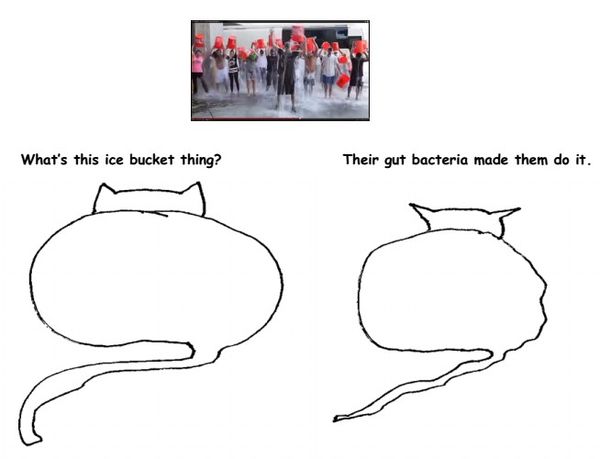
Catspeak
by Brooks Riley
Sunday, August 24, 2014
Saying No! to Jack Bauer: Mainstreaming Torture

Richard Marshall interviews Rebecca Gordon in 3:AM Magazine:
3:AM: Are you approaching this via virtue ethics, four cardinal virtues and Alisdair MacIntyre and what is the best way to understand what torture is?
RG: I’m going to reverse the order of these questions, because I think that once we understand what institutionalized state torture is, it becomes clearer why I think MacIntyre’s contemporary virtue ethics provide a useful way of understanding torture’s moral implications.
The torture that I am concerned with is institutionalized state torture – the kind of organized, intentional program carried on by governments. It’s not Jack Bauer saving Los Angeles on24. It’s not some brave person preventing a ticking time-bomb from going off by torturing the one person who can stop it. We must stop thinking of torture as a series of isolated actions taken by heroic individuals in moments of extremity, and begin instead to understand it as a socially embedded practice. A study of past and present torture regimes suggests that institutionalized state torture has its own histories, its own traditions, its own rituals of initiation. It encourages, both in its individual practitioners and in the society that harbors it, a particular set of moral habits, call them virtues or vices as you prefer.
Here’s my definition of institutionalize state torture: It is the intentional infliction of severe mental or physical suffering by an official or agent of a political entity, which results in dismantling the victim’s sensory, psychological, and social worlds, with the purpose of establishing or maintaining that entity’s power. This definition can be expanded to reveal its legal, phenomenological, and political dimensions.
The language about “intentional infliction of severe mental or physical suffering by an agent of a political entity” mirrors the definition found in the UN Convention against Torture and Other Cruel, Inhumane, or Degrading Treatment, to which the U.S. is a signatory. A phenomenological definition describes the ways in which torture reduces and distorts its targets’ orientation in time and space, its effects on language, and its destruction persons’ social connections. The “political” portion deals with the purposes of torture, which when it is institutionalized by a state, has much less to do with “intelligence gathering” than it does with political and social control.
So what does this understanding of torture have to do with virtue ethics and Alasdair MacIntyre? I would argue that when we understand torture as an ongoing practice, we can begin to see how it affects moral habits.
More here.