Category: Recommended Reading
Culture and the Death of God
Jonathan Sacks at the Jewish Review of Books:
We are meaning-seeking animals. And if we can no longer believe in God we will find other things to worship. Eagleton’s book is a brisk, intelligent, and provocative tour of Western intellectual history since the Enlightenment, understood as a series of chapters in the search for a God-substitute. The Enlightenment found it in reason, the Idealists in the human spirit, the Romantics in nature and culture, the Marxists in revolution, and Nietzsche in the Übermensch. Others chose the nation, the state, art, the sublime, humanity, society, science, the life force, and personal relationships. None of these had entirely happy outcomes, and none was self-sustaining.
The end result was postmodernism, a systematic subversion of meaning altogether. Postmodernism is Nietzsche without the anguish, tragedy, or will to power—all the things that made Nietzsche worth reading. Now, in place of the revaluation of values, we have their devaluation. We are surrounded by choices with no reason to choose this rather than that. Postmodern consciousness, in Perry Anderson’s phrase, is “subjectivism without a subject.” Eagleton calls it “depthless, anti-tragic, non-linear, anti-numinous, non-foundational and anti-universalist, suspicious of absolutes and averse to interiority.”
more here.
joking in ancient rome
Mary Beard at The New Statesman:
One evening at a palace dinner party, in about 40AD, a couple of nervous aristocrats asked the emperor Caligula why he was laughing so heartily. “Just at the thought that I’d only have to click my fingers and I could have both your heads off!” It was, actually, a favourite gag of the emperor (he had been known to come out with it when fondling the lovely white neck of his mistress). But it didn’t go down well.
Laughter and joking were just as high-stakes for ancient Roman emperors as they are for modern royalty and politicians. It has always been bad for your public image to laugh in the wrong way or to crack jokes about the wrong targets. The Duke of Edinburgh got into trouble with his (to say the least) ill-judged “slitty-eyed” quip, just as Tony Abbott recently lost votes after being caught smirking about the grandmother who said she made ends meet by working on a telephone sex line. For the Romans, blindness – not to mention threats of murder – was a definite no-go area for joking, though they treated baldness as fair game for a laugh (Julius Caesar was often ribbed by his rivals for trying to conceal his bald patch by brushing his hair forward, or wearing a strategically placed laurel wreath). Politicians must always manage their chuckles, chortles, grins and banter with care.
more here.
world cup 2014
Rowan Ricardo Phillips & Jonathan Wilson at Paris Review:
Thursday has turned to Monday. The World Cup has blossomed. The opening gameseemed intent on mocking any potential pleasure or faith you may have had in this tournament—but now it’s become so good, so quickly, that some people are already calling it the best World Cup they’ve ever seen. Eleven games thus far and not a single draw; the matches have been, for the most part, tightly contested. The Swiss threw in a last-gasp winner against an extremely naïve Ecuador; teams have sought to be positive, to attack, sometimes without thinking before rushing forward. But enough of that, Jonathan will no doubt be writing about England; his memoir is called Kick and Run, after all.
Almost all the big players have played up to their lofty status. Almost.
Spain, as you likely know by now, was atomized by the Netherlands to the tune of 5-1. The score flattered Spain: Holland could have, and really should have, scored a few more.
more here.
The Most Dangerous Book: the Battle for James Joyce’s Ulysses
AN Wilson in The Telegraph:
Can there ever have been a book with a more dramatic publishing history than James Joyce’s Ulysses – written in abject poverty and over a period of seven years during and just after the First World War; printed in Paris (at first, just two copies); vilified as obscene; burnt and impounded at British and American docks; and smuggled like forbidden hooch? (Amusing to read here of Ernest Hemingway’s part in the smuggling.) Kevin Birmingham has a deep love of the novel, and knows everything about Joyce. His learned book is a gripping page-turner. Ulysses might have been indecent – if graphic language and an obsession with lavatorial and sexual functions is rightly so described. But, whether or not the book is indecent, the sheer decency of its early defenders will be what strikes the reader of this story.
There was demure English heiress Miss Weaver – who published early extracts from the book in an avant-garde journal, The Egoist, and gave Joyce £2,000 – a sum that provided him with an income of £350 (the equivalent today of £11,000). There were Margaret Anderson and Jane Heap in New York, whose Little Review published the first half of the novel in episodic pamphlets – until the notorious “Circe” episode was impounded by the authorities. There was the famous Sylvia Beach, proprietress of the Shakespeare and Company bookshop in Paris, who published the first edition of Ulysses in book form. There was Arnold Bennett, a novelist of such a different complexion from Joyce’s, who could see, in an early review, that Joyce was “dazzlingly original. If he does not see life whole he sees it piercingly”.
More here.
Secrets of ant rafts revealed
Emma Marris in Nature:
To negotiate floods and cross streams, fire ants band together — literally — linking together to form rafts and bridges in a feat of social cooperation and biophysics. Now, engineers have made a close study1 of the ants' architectural technique, pointing the way towards new approaches for robot designers and materials scientists. To understand the properties of the ant structures, David Hu, a mechanical engineer at the Georgia Institute of Technology in Atlanta, sought to observe not just the surface of the ant clumps but the structure and joints underneath. First, Hu and his team collected ant colonies — shovelling them, dirt and all, into buckets. After separating out the ants from the dirt, they then put 100 or so ants into a cup and swirled, causing the ants to form into a ball (no water necessary — they come together almost like dough). The researchers then froze the ball with liquid nitrogen so they could examine it in a micro-computed-tomography scanner to come up with a 3-D picture.
But the heat of the scanner melted the ball into a heap of dead ants. After months of experimenting with techniques to keep it together, lead author Paul Foster, now at the University of Michigan, found an unlikely source of inspiration in crack cocaine — specifically, in a method of vaporizing the drug to inhale it. “We did the same process — not with crack, but glue,” says Hu, adding that the authors decided against calling it the ‘crack-pipe method’ in their paper. The researchers heated the glue in an aluminium pot over a flame, with the frozen ant ball suspended on mesh above. The glue vapour rose and lightly coated the ants.Hu and his team found that the ants had grabbed hold of one another with adhesive pads on their legs, which they stretched out to create pockets of air. They also tended to orient themselves perpendicularly to one another, distributing their weight and creating a light, buoyant structure. The formation seems to take advantage of the ants’ different sizes, with smaller ants slotting neatly in between larger ones to add more connections. Each ant averaged 14 connections to fellow ants.
More here.
Tuesday Poem
i like my body when it is with your
body. It is so quite new a thing.
Muscles better and nerves more.
i like your body. i like what it does,
i like its hows. i like to feel the spine
of your body and its bones,and the trembling
-firm-smooth ness and which i will
again and again and again
kiss, i like kissing this and that of you,
i like, slowly stroking the, shocking fuzz
of your electric fur, and what-is-it comes
over parting flesh….And eyes big love-crumbs,
and possibly i like the thrill
of under me you so quite new
.
by e.e. cummings
from Complete Poems 1904-1962
Monday, June 16, 2014
3QD Arts & Literature Prize Finalists 2014
Hello,
The editors of 3QD have made their decision. The 21 semifinalists have been winnowed down to six, and three wildcard entries added. Thanks again to all the participants.
Once again, Carla Goller has provided a “trophy” logo that our finalists may choose to display on their own blogs.
So, here it is, the final list that I am sending to Mohsin Hamid, who will select the 1st, 2nd, and 3rd prize winners: (in alphabetical order by blog name here)
- 3:AM Magazine: Honest work: an experimental review of an experimental translation
- 3 Quarks Daily: The Short Bus
- Gilded Birds: Kwame Anthony Appiah
- Los Angeles Review of Books: How Auden Was Modified in the Guts of the Living
- Medium: The Death of the Urdu Script
- n + 1: Everywhere and Nowhere
- Northeast Review: Mofussil Junction
- Paris Review: Drinking in the Golden Age
- The Millions: The Fictional Lives of High School Teachers
We'll announce the three winners on June 23, 2014.
Good luck!
Abbas
P.S. The editors of 3QD will not be making any comments on our deliberations, or the process by which we made our decision, other than to simply say that we picked what we thought were the best posts out of the semifinalists, and added three others which we also liked.
perceptions
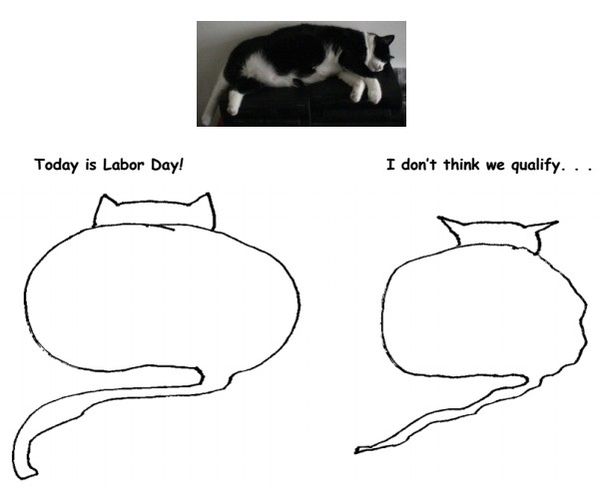
Catspeak
by Brooks Riley
Sunday, June 15, 2014
Have You Hugged a Concrete Pillar Today?
Bill Gates in his blog, Gates Notes:
The car I drive to work is made of around 2,600 pounds of steel, 800 pounds of plastic, and 400 pounds of light metal alloys. The trip from my house to the office is roughly four miles long, all surface streets, which means I travel over some 15,000 tons of concrete each morning.
Once I’m at the office, I usually open a can of Diet Coke. Over the course of the day I might drink three or four. All those cans also add up to something like 35 pounds of aluminum a year.
I got to thinking about all this after reading Making the Modern World: Materials and Dematerialization, by my favorite author, the historian Vaclav Smil. Not only did I learn some mind-blowing facts, but I also gained a new appreciation for all the materials that make modern life possible.
This isn’t just idle curiosity. It might seem mundane, but the issue of materials—how much we use and how much we need—is key to helping the world’s poorest people improve their lives. Think of the amazing increase in quality of life that we saw in the United States and other rich countries in the past 100 years. We want most of that miracle to take place for all of humanity over the next 50 years. As more people join the global middle class, they will need affordable clean energy. They will want to eat more meat. And they will need more materials: steel to make cars and refrigerators; concrete for roads and runways; copper wiring for telecommunications.
More here.
How To Respond To Criticism
Mallory Ortberg in The Toast:
Fall in love with whoever criticized you. Don’t walk away until you’ve ruined their marriage.
Whisper their criticism every night to yourself until you have it memorized, word for word. Remember it forever. Have the words stitched into the shroud that covers your body before you’re lowered into the tomb so you and your criticism can embrace one another for eternity.
Do not rise above it. Never rise above anything. The sky is no place for a human.
Be sure not to separate the tone of the criticism from the content. If it was said ungracefully, it cannot be true. If it was said reasonably, it cannot be false.
Send an email explaining why you don’t deserve to be criticized, then another six emails after that, each one explaining the last, like a set of Russian nesting dolls that don’t think it’s your fault.
Set fire to something that was once beautiful.
More here.
Philosopher Undine Sellbach discusses sex, flies and fairy tales
Joe Gelonesi at The Philosopher's Zone:
Insects don’t seem to count for much. They bite, buzz around, and wreck picnics. They don’t trigger our moral sensibilities in the way that higher order animals might. In fact, for some, insects generate downright moral revulsion. Yet these small presences are closer to our lives than we care to consider.
Not only are they in the rooms we inhabit, but also in our food. At a special event held at the Melbourne Museum in 2012 diners were given an unusual menu. Courses at Bugs for Brunch included scorpions, mealworms and crickets. Also on the menu was a packet of polenta, described as containing ‘up to 10 insects per packet’ and a chocolate bar with ‘up to 80 microscopic insect fragments’.
In the audience that day was Launceston-based philosopher and performer Undine Sellbach. For her, it was the start of some big thinking on small things.
‘What fascinated me is that what appeared to be an event about science and philosophical argument had this very powerful other level where children and their parents were connecting disgust with ambivalence, making new connections and affinities with the bugs,’ she says.
In this moment of realisation a strange reversal came into view, which Sellbach terms an ‘upside- down ethics’.
More here.
Do animals have sex for pleasure?
Jason G Goldman at the BBC:
Sex, we are told, is pleasurable. Yet you probably wouldn’t think that if you waded through the scientific literature. That's because most scientific accounts of sexual behaviour rest upon evolutionary explanations rather than the more immediately relevant mental and emotional experiences. To say that we have sex because it helps us to preserve our genetic legacies would be entirely accurate, but the more fleeting, experiential, pleasurable aspects of that most basic of social urges would be missing. It would be like staring at a painting with half the colour spectrum removed from it.
One thing we have been curious about, though, is whether we are the only species that experiences sexual pleasure. The question of whether non-human animals enjoy it too is a perennial – and scientifically legitimate – question to ask.
In the last 10 to 15 years, scientific evidence has begun to accumulate that animals do experience a general sensation of pleasure – as anybody who has stroked a cat will know. In 2001, for example, psychologists Jeffrey Burgdorf and Jaak Panskepp discovered that laboratory rats enjoyed being tickled, emitting a sort of chirpy laugh outside the range of human hearing. And not only that, they would actively seek out the feeling.
But does that include carnal pleasure too? One way to find out is to study instances of sex that can't possibly result in procreation – for instance, among two or more males, or females; where one or more individual is sexually immature, or sex that occurs outside of the breeding season.
More here.
theofanidis: on the edge of the infinite
Poem For People That Are Understandably Too Busy To Read Poetry
rik mayall (1958-2014)
Baghdad: sublime beauty, unimaginable horror
Anthony Sattin in The Guardian:
Justin Marozzi's new book is the first English-language history of Baghdad for nearly 80 years. The previous history was subtitled “City of Peace”, a tag without a hint of irony, taking the name by which the city by the Tigris was known to its first inhabitants. Marozzi's additional subtitle – city of blood – is there to keep you from yawning and also to present a more rounded image of what is to come. Because what emerges from this impressive book is that whatever else it has been, Baghdad has always been a city of peace and love, and blood and spilled guts.
The city of peace was born out of blood, created following one of the perennial bloodlettings between Sunni and Shia Muslims that have occurred with depressing regularity since the untimely death in 632AD of the prophet Muhammad. The previous rulers of the Arab world, the Sunni Umayyad caliphs, had been based in Damascus. But with the ascendancy of the Abbasids in the 8th century, their Shia leader, al-Mansur – the Victorious – decided to create a new capital on the Tigris. The site was an inspired choice as it has good access via the Mesopotamia river system and along the Persian Royal Road to the markets of the Silk Road, the Arab Mediterranean and the Indian Ocean. The cliche that history repeats itself may well have been coined in this city for few places on earth have enjoyed such relentlessly inevitable cycles of prosperity, cultural outpouring and descent into bloodletting. Perhaps no one has expressed this duality better than al-Mansur's grandson, Harun al-Rashid. Harun is famous for being the caliph of The Arabian Nights, and is celebrated for having overseen one of the most glorious of all the city's booms. While the empire was run by the grand vizier, Harun filled his magnificent palace with scholars and poets, his gold goblet with Shirazi wine and his bed with some of 40 or so gorgeous courtesans from his harem. Marozzi weighs this image against another side of the pleasure-loving aesthete, for Harun, who made the pilgrimage to Mecca eight times, was also capable of leaving his friends briefly at a banquet to go and behead two girls caught in bed together. When he returned with their jewel-bedecked heads on a platter, one of his courtiers recorded that he “found this a horrific sight”.
More here.
Iraq’s Long Unraveling
Nicholas Slayton in The Atlantic:
When Sunni militants seized the Iraqi city of Mosul at the start of the week, instantaneously creating half a million refugees and an existential crisis for the country, it came as a surprise. The Islamic State of Iraq and Syria (ISIS) has been terrorizing Iraq for months now, but when it along with other jihadi forces and Baathists still loyal to Saddam Hussein’s regime took the nation’s second-largest city, the threat became more serious. As ISIS pledges to advance south toward Baghdad, Iraqi soldiers are in many cases abandoning their posts and stripping off their uniforms to escape. It’s a terrifying development, but it shouldn’t come as a complete shock. Iraq is disintegrating, and ISIS’s success is just a distillation of the problems the country has been struggling with for some time now.
The roots of the current violence go at least as far back as Iraq’s 2006-2007 civil war, which didn’t so much end as get put on hiatus. The spate of sectarian violence pitted the Shiite-majority government against Sunni militias and al-Qaeda in Iraq (a group from which ISIS emerged). The U.S. troop “surge” halted the bloodshed and got Sunni groups to side with the government against foreign jihadists. But it failed to produce a greater political resolution. With the departure of American forces from the country in 2011, these grave tensions reemerged.
More here.
Sunday Poem
Do Not Go Gentle Into That Good Night
Do not go gentle into that good night,
Old age should burn and rave at close of day;
Rage, rage against the dying of the light.
Though wise men at their end know dark is right,
Because their words had forked no lightning they
Do not go gentle into that good night.
Good men, the last wave by, crying how bright
Their frail deeds might have danced in a green bay,
Rage, rage against the dying of the light.
Wild men who caught and sang the sun in flight,
And learn, too late, they grieved it on its way,
Do not go gentle into that good night.
Grave men, near death, who see with blinding sight
Blind eyes could blaze like meteors and be gay,
Rage, rage against the dying of the light.
And you, my father, there on the sad height,
Curse, bless, me now with your fierce tears, I pray.
Do not go gentle into that good night.
Rage, rage against the dying of the light.
.
by Dylan Thomas
from The Poems of Dylan Thomas
published by New Directions, 1952