
Category: Recommended Reading
Why Max Weber matters

As Ghosh notes, Weber had always been a superb political analyst. His “probability” theory about when peace would come and the possibilities of German victory was as ruthlessly realistic as anything else he wrote. Yet if objectivity in the midst of war set him apart, one of Ghosh’s major points is that politics for Weber, although a grand human ideal, had been on the decline for centuries as the crucial arbiter of human conduct. Now, it meant nothing more or less than earthly Herrschaft, so that there were only so many ways one could talk about its development, or think about its valences. For those who hold fixed ideas about Weber the political animal, Ghosh’s claims will be hard reading. But part of the problem with seeing him as a straightforward nationalist was that even incandescent rage about national shame was allied to a profound understanding of geopolitics and political responsibility. This made it clear to him that “reaction” and public retribution, or power politics without content, were futile modes of engagement. Subtler and more “responsible” policy was required if long-term success was to be achieved, and that would have to take place in diplomatic back channels by “responsible” statesmen. Germany was actually quite successful at this when seen in comparative perspective, a point amplified recently by Adam Tooze in The Deluge: The Great War and the remaking of global order(2014).
Weber’s well-known refrains about the dangers of a politics of national vanity (Eitelkeit), made most famously in his lecture on the vocation of politics, were in fact extant in his writings from the start. For example, in a perspicacious essay realistically assaying the prospects of Germany against the European world powers during the war, he once more stated his belief that “objective politics” was not a “politics of vanity”, but one whose actions necessarily took place in the shadows.
more here.
Guantánamo Diary by Mohamedou Ould Slahi
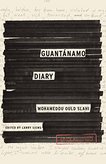
A few reviews have likened Guantánamo Diary to Memoirs from the House of the Dead, written after Dostoyevsky’s four years in Siberian exile. Diary does share that book’s vignette structure. But while Dead’s narrator draws on his observation of the lives of his fellow prisoners to create a mounting sense of existential despair, the frequently isolated Slahi—who spent a decade in Germany and easily communicates without culture clash—turns his attention to Gitmo’s guards and interrogators. These figures are generalized through redaction and turn out to be, rather than ominous symbols of spiritual dislocation, merely thoughtless and careless—stupidly cruel in ways that only a late-stage empire (or maybe a fraternity) can accommodate.
The guards beat him and tried to convert him to Christianity. They taught him chess and then got angry when he won. “That is not the way I taught you,” one guard scoffed. (Slahi learned his lesson: It really is better to let the Wookiee win.) They threatened to “bring in black people” if he continued refusing to cooperate. “I don’t have any problem with black people, half of my country is black people!” he writes. They asked him to do an interview with “a moderate journalist from The Wall Street Journal and refute the wrong things we’re suspected of.” “Well,” Slahi replied, “I got tortured and I am going to tell the journalist the truth.” The interview was canceled.
more here.
How an irritable Danish author left an enduring mark on the national character

“Jante Law is just as normal as the law of gravity,” newspaper editor and anthropologist Anne Knudsen assured me. “You find it everywhere, especially in peasant societies, and back [in Sandemose’s day] there were peasants peasants peasants all over the place in Denmark. This kind of ideology became the State ideology when democracy was established in the country [in 1849] and it got a second life with Social Democracy, and all of this was transmitted from generation to generation by propaganda and by a unified school system.” She added, “But, you know, the envy part is not the important part. The important part is the inclusiveness: we want to include you, but that is only possible if you are equal. It’s what peasants do.”
I opened a newspaper to see if I could spot signs of Jante Law in action today, and, what do you know, there was a story about the Swedish Tetra Pak packaging heir Hans Rausing’s drug-fueled downfall: the gloating headline reads HIS BILLIONS COULD NOT SAVE HIM. Another concerns the bankruptcy of a flamboyant Danish businessman from a humble background who amassed a collection of snazzy cars and foreign homes and made the mistake of parading them in the media over the years. Again, the article is dripping with Jante revenge, detailing the luxuries he has had to give up: “Three years ago he told this newspaper proudly of his Bugatti, his Lamborghini, and the Porsche he was about to buy,” the article read. “Now he has run dry of cash.”
more here.
14 Books to Read This Black History Month

February is not only Black History Month, but it is also the month when many titles by Black authors are released. 2015 kicked off with a wide selections of books and stories to settle into. From history, to biography to great fiction storytelling here are a few gems to propose to your book club.
God Help the Child by Toni Morrison
Nobel Laureate, Toni Morrison, does her literary magic with God Help the Child, an emotional story of a woman called Bride, and the way childhood trauma shaped her life and her loves.
The Crossover by Kwame Alexander
The Crossover is the story of twin brothers who have skills on the basketball court. One of the twins sees a life beyond the hoops, with his love of beats and music. The story in verse book, that took home the 2015 Newbery Award is a great book for the middle school reader.
More here. (Note: One post throughout February will be dedicated to Black History Month.)
New software analyzes human genomes for disease-causing variations in 90 minutes
From KurzweilAI:

“It took around 13 years and $3 billion to sequence the first human genome,” says Peter White, PhD, principal investigator and director of the Biomedical Genomics Core at Nationwide Children’s and the study’s senior author. “Now, even the smallest research groups can complete genomic sequencing in a matter of days. However, once you’ve generated all that data, that’s the point where many groups hit a wall. … Scientists are left with billions of data points to analyze before any truly useful information can be gleaned for use in research and clinical settings.” To overcome the challenges of analyzing that large amount of data, White and his team developed a computational pipeline called “Churchill.” By using novel computational techniques, Churchill allows efficient analysis of a whole genome sample in as little as 90 minutes, the researchers claim. “Churchill fully automates the analytical process required to take raw sequence data through a series of complex and computationally intensive processes, ultimately producing a list of genetic variants ready for clinical interpretation and tertiary analysis,” White explains. “Each step in the process was optimized to significantly reduce analysis time, without sacrificing data integrity, resulting in an analysis method that is 100 percent reproducible.” The output of Churchill was validated using National Institute of Standards and Technology (NIST) benchmarks. In comparison with other computational pipelines, Churchill was shown to have the highest sensitivity at 99.7 percent, highest accuracy at 99.99 percent, and the highest overall diagnostic effectiveness at 99.66 percent, according to the researchers.
More here.
Wednesday, February 11, 2015
A triumphalist history of psychiatry seeks to vindicate the profession
Gary Greenberg in Bookforum:
To the diagnostic chaos was added the spectacle of treatments. Psychiatrists superintended horrifyingly squalid asylums; used insulin and electricity to send patients into comas and convulsions; inoculated them with tuberculin and malaria in the hope that fever would cook the mental illness out of them; jammed ice picks into their brains to sever their frontal lobes; placed them in orgone boxes to bathe in the orgasmic energy of the universe; psychoanalyzed them interminably; primal-screamed them and rebirthed them and nursed their inner children; and subjected them to medications of unknown mechanism and unanticipated side effects, most recently the antidepressant drugs that we love to hate and hate to love and that, either way, are a daily staple for 11 percent of adults in America.
It’s not just diagnostic uncertainty or therapeutic disasters that cast suspicion on the profession.
More here.
Elise Crull on Philosophy of Physics
Over at the Rationally Speaking podcast:

 Elise CrullFeynman famously said that a philosopher of science is as much use to scientists as an ornithologist is to birds. This episode of Rationally Speaking features philosopher of physics Elise Crull, who explains why Feynman is misguided, and what philosophers have to say about important issues in physics — like quantum mechanics, physical laws, and whether anything “really” exists at all.
Does the Punishment Fit the Crime?

Gil Garcetti in The LA Review of Books:
ON MY FIRST READING of An Eye for an Eye, Mitchel P. Roth’s new book, I recall closing it and asking myself a series of questions: “What have I learned?,” “How do I feel about what I had read?,” “Was it worth my time and effort?” This book is not a quick read, not a book where you can quickly turn to the next page. Often you have to, and want to, ponder what you’ve just read. But if you are interested in the subject matter, or if you are a judge, lawyer, elected official, or a “student” of jurisprudence, reading this book will be worth your time and effort.
My dominant feeling was when I finished my first read of the book was disappointment — but it was not the content of the book that disappointed me. The book is the first I have read that attempts to chronicle and dispassionately explore the world history of crime and punishment. Professor Roth’s effort is forceful, scholarly yet easily readable, informative, sometimes even entertainingly informative, and, lastly, provocative. Roth has said it was not written with the purpose of being a university textbook, but it easily could be the bones of a very interesting class for students of history or those interested in the law, government, philosophy, or criminology. The book is crammed with interesting facts and statistics and dozens of fascinating and sometimes gory anecdotes that have been brought together through disciplined and thorough research by the author (and probably others working with him). Roth, who teaches criminal justice and criminology at Sam Houston State University in Huntsville, Texas, has done an admirable job of scholarship.
My disappointment stemmed from the conclusion I drew, based on the facts Roth presents: that there is not one nation in the history of the world whose people, government, or rulers haven’t been responsible for perpetrating horrific acts of cruelty, sadism, and savagery on other human beings. Is this the nature of man? Are we any safer today than 100, 500, 1,000, or 5,000 years ago? Roth could persuasively argue that we are indeed much safer — at least from the common street criminal. When you put aside acts of terrorism and accept that crime statistics in some countries are at best woefully inadequate, I think he is probably correct.
More here.
rubens at the royal academy

Rubens was a truly European figure. Not for nothing is the preface to the RA catalogue penned by Herman Van Rompuy. A passion for Rubens spanned the political and religious borders of 17th-century Europe. He worked for the King of Spain, the court of France, the Grand Duke of Tuscany and Charles I. His energy and industriousness were astonishing. In addition to his work as an artist, he spent time and effort on diplomacy — he was in London to negotiate a treaty on behalf of Philip IV of Spain and his regent, Rubens’s patron, the Archduchess Isabella in Brussels.
Then, as Ben van Beneden says, he was ‘one of the great collectors of his time, with a collection that could rival those of princes’ — of his own pictures and other people’s, and most of all of classical antiquities about which he corresponded with scholars in France and Italy. Rubens mixed with the most powerful individuals of his day — despite some aristocratic resentment — on something like an equal footing. He ended up with not only a mansion in Antwerp, stuffed with artistic riches, but also a country house.
Yet despite his immense achievements and success, Rubens’s personality remains a little elusive. A large number of his letters survive, mainly written in Italian, the lingua franca of the day, but there is little intimate or revealing in them. Most are concerned with politics and diplomacy: the public persona, not the private man. Another oddity of his career was the extent to which — quite apart from the output of his workshop — Rubens collaborated with other artists.
more here.
A dark time in the city of light
Transitory, confusing, hopeless, the Paris Commune of 1871 is easily ignored or misunderstood. The title of John Merriman’s new book gets right to the point he wants us to remember: that it ended in an orchestrated genocide. Soldiers slaughtered tens of thousands of Parisians, both combatants and civilians, while the rest of France looked away or cheered the killers on.
The Commune’s misbegotten spasm of early people power lasted just 64 days and occurred in the political and social vacuum left by three successive French humiliations—the catastrophic Franco-Prussian War, the crushing Siege of Paris, and the ignominious dissolution of Napoleon III’s Second Empire.
When the siege ended, in January 1871, with the French government’s capitulation, better-off Parisians in the central and western parts of the city sought to shake the blues by reverting to habits of prewar gaiety, jamming the brasseries, departments stores, and boulevards.
In the northern and northeastern arrondissements, meanwhile, a miserable population seethed in crowded slums. The building of Haussmann’s Paris that so dazzled the world had drawn cheap labor in quantity from the provinces and beyond. Many of these people were now out of work. The war had brought refugees to join them. Their suffering was acute, their anger directed at the business classes, the political leadership, and the Catholic clergy. It boiled over almost overnight.
more here.
alice munro’s domestic gothic

In a foreword to the collection, Jane Smiley describes the paradox in Munro’s writing as, “simultaneously strange and down to earth, daring and straightforward”. Laid out in the chronological order in which the stories were published, Family Furnishings reveals Munro’s lifelong fascination for the mundane and the freakish. Her characters, often taken from life, often drawn with autobiographical authority, seem to live in a kind of reality where the extreme facts co-exist in the same non-hysterical breath with the most banal.
Talk of scrubbing a floor, for example, is given a strange parity with the disposal of a murdered man’s body in “The Love of a Good Woman”, the opening story in this collection. The discovery of the body in the lake is described through the innocent gaze of a group of young boys who hardly understand the true import of the events, only the unforgettable underwater image of the dead man’s arm, as though he is waving. Munro’s great skill here, as in so much of her work, is the conscious undervaluation and negative exaggeration in which she draws the reader’s innocence into this closeness of extremes.
In “Dimensions”, where a young woman tries to come to terms with a shocking family tragedy in which a father kills his three children, we again see the trademark Munro approach of mixing up the ordinary with the appalling:
A trickle of pink foam came out from under the boy’s head, near the ear. It did not look like blood at all, but like the stuff you skim off the strawberries when you’re making jam.
more here.
Lost Malcolm X Speech Heard Again 50 Years Later
Guy Raz in npr.org:

…”There are 20 million so-called 'negroes' here in America. Twenty million ex-slaves. Twenty million second-class citizens. No matter what other classification you try to put on them, you can't deny that we are ex-slaves. You can not deny that we are second-class citizens. And the fact that we are second-class citizens means someone has done us an injustice and deprived us of that which is ours by right.”
More here. (Note: One post throughout February will be dedicated to Black History Month.)
Is There Something Uncanny About Machines That Can Think?
Tania Lombrozo in npr.org:

Consider, for contrast, encountering “thinking” aliens, some alternative life form that rivals or exceeds our own intelligence. The experience would be strange, to be sure, but there may be something uniquely uncanny about thinking machines. While they can (or will some day) mirror us in capabilities, they are unlikely to do so in composition. My hypothetical aliens, at least, would have biological origins of some kind, whereas today's computers do so only in the sense that they are human artifacts and, therefore, have an origin that follows from our own. When it comes to human-like robots and other artifacts, some have described an “uncanny valley“: a level of similarity to natural beings that may be too close for comfort, compelling yet off. We might be slightly revolted by a mechanical appendage, for instance, or made uneasy by a realistically human robot face.
More here.
Wednesday Poem
Congregation
—Weir, Mississippi, 1984
Sara Ross, Great and Grand-mother of all
rooted things waits on the family porch.
We make our way back to her beginnings.
Six daughters
gather space and time
in a small kitchen.
gather space and time
in a small kitchen.
Recipes as old as the cauldron
and
aprons wrap around these daughters;
keepers of cast iron and collective.
Lard sizzles a sermon from the stove,
frying uncle’s morning catch
into gold-plated, cornmeal catfish.
Biscuits bigger than a grown man’s fist
center the Chantilly laced table of yams,
black eyed peas over rice and pineapple,
pointing upside down cake.
The fields, soaked with breeze and sun,
move across my legs like Sara’s hands.
Chartreuse colored waters, hide and seek
in watermelon patches, dim my ache for Chicago.
Peach and pear ornaments
hang from Sara’s trees.
Jelly jars tinted
with homemade whiskey,
guitar stringing uncles who never left
the porch, still dream of being famous
country singers.
Toothpicks, tipped hats and sunset
linger as
four generations come from
four corners to eat, pray, fuss and laugh
four corners to eat, pray, fuss and laugh
themselves into stories of a kinfolk,
at a country soiree, down in the delta.by Parneshia Jones
(with thanks to Elatia Harris)
Tuesday, February 10, 2015
History of Lynchings in the South Documents Nearly 4,000 Names
Campbell Robertson in The New York Times:
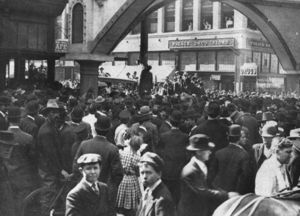
…The bloody history of Paris, Tex., about 100 miles northeast of Dallas, is well known if rarely brought up, said Thelma Dangerfield, the treasurer of the local N.A.A.C.P. chapter. Thousands of people came in 1893 to see Henry Smith, a black teenager accused of murder, carried around town on a float, then tortured and burned to death on a scaffold. Until recently, some longtime residents still remembered when the two Arthur brothers were tied to a flagpole and set on fire at the city fairgrounds in 1920. “There were two or three blacks who were actually around during that time, but you couldn’t get them to talk about it,” Ms. Dangerfield said.
Picture: Downtown Dallas in 1910, when Allen Brooks, a black man, was hanged from a telephone pole.
More here. (Note: One post throughout February will be dedicated to Black History Month.)
Are Economists Overrated? A debate
From the New York Times:

But given the profession’s poor track record in forecasting and planning, and the continued struggles of many Americans, have we given economists too much authority?
More here.
The two big holes in the strategy against IS (ISIS/ISIL)
The US-led campaign against Islamic State isn’t working. It won’t unless it addresses Shia sectarianism in Iraq and Assad’s atrocities in Syria.
Ken Roth in Open Security:
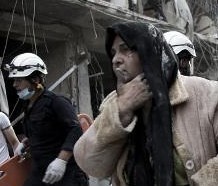
To understand what must be done about IS, it is helpful to remember the background to its rise. In Iraq, in addition to the chaos after the US invasion, the emergence of IS owes much to the abusive sectarian rule of the former prime minister, Nouri al-Maliki, and the resulting radicalisation of Sunnis. With Iranian backing, Maliki took personal control of Iraqi security forces and supported the formation of Shia militias. Many of those militias brutally persecuted the minority Sunni population. They rounded up and arbitrarily detained Sunnis under vague laws and, along with government counter-terrorism units, summarily executed many. Meanwhile, the Iraqi air force indiscriminately bombed predominately Sunni cities, beginning in Anbar in January 2014.
The severity of these abuses played perfectly into IS plans: one rationale for IS atrocities appears to be to spark precisely such reactions, which in turn bolster its standing among the Sunni population. The group’s predecessor, al-Qaeda in Iraq, was largely defeated by a combination of US military pressure and a military coalition of Sunni tribes in western Iraq, known as the Awakening Councils. But under Maliki many of the tribes which defeated the organisation became so fearful of slaughter and persecution by pro-government forces that, when conflict resumed in 2014, they felt safer fighting those forces than IS. Western governments, eager to put their own military involvement in Iraq behind them, largely shut their eyes to the worsening sectarian abuses overseen by Baghdad—and continued to ply it with arms.
More here.
George Smoot: You are a Simulation & Physics Can Prove It
Fantasies of Federalism

In several essays written in the midst of the Second World War, Hannah Arendt advocated federalism as a replacement for nationalism, which she believed had been rendered obsolete. Adolf Hitler had demonstrated the limits of ethnic homogeneity as a basis for political organization. The idea of “the nation” that had set the world on fire had definitively revealed its shortcomings: it failed to hold up when mapped onto territory shared by different peoples and so often ruled by a permanent majority. “Nowhere in Europe today,” Arendt remarked in 1945, “do we find a nationally homogeneous population.” Furthermore, political federalism of some sort had worked for Americans for a century and a half. Why not Europe? Why let nation-states remain the rule? A federation could grant rights to nationalities dispersed amidst and athwart one other.
Arendt’s federalism—recently recovered by historians Gil Rubin and William Selinger—also applied to the Middle East. It would make Jews and Palestinians equal members of some larger political entity, in which each group would have a measure of self-government in their own affairs and a role in collective decision-making. A land of two peoples within the same state, Arendt wrote in wartime, would in the long run merely reverse the Zionist result of Jewish dominance over Palestinians in the area, substituting one hierarchy for another.
more here.