
Category: Recommended Reading
Tuesday Poem
Minna Needs Rehearsal Space
.
Minna has gotten Lars to elaborate on his text.
Lars has written, But I'm not really in love with you.
Lars has always understood how to cut to the chase.
Minna can't wring any more out of him.
Lars is a wall.
Lars is a porcupine.
Minna lies in bed.
The bed is the only place she wants to lie.
Minna hates that he began the sentence with But.
Minna feels that there was a lot missing before But, but
Minna should have apparently known better.
Men are also lucky that they possess the sperm.
Men can go far with the sperm.
Men with full sacks play hard to get.
Men with full sacks turn tail, but
Minna can manage without them.
Minna is a composer.
Minna feels her larynx.
The larynx isn't willing.
Minna can hear her neighbor come home.
Minna places an ear against the wall.
The neighbor dumps his groceries on the table.
The neighbor takes a leak.
Minna puts Bach on the stereo.
Minna turns up Bach.
The neighbor is there instantly.
Bach's cello suites are playing.
Minna's fingers are deep in the wound.
Minna looks at the portrait of Lars.
The portrait is from the paper.
Lars is good at growing a beard.
Lars sits there with his beard.
Lars's mouth is a soft wet brushstroke.
Chest hair forces his T-shirt upward.
The beard wanders downward away from his chin.
An Adam's apple lies in the middle of the hair.
Minna has had it in her mouth.
Minna has tasted it.
Minna has submitted, but
Lars looks out at someone who isn't her.
Lars regards his reader.
It isn't her.
On the Life and Work of Eileen Chang

Everyone has her own Eileen Chang story. For many readers, the story crystallizes in a single horrifying detail. First you gasp. Then you thrill. When I mentioned Chang’s name to a Chinese friend, she smiled wickedly: “In one of her stories, there is a woman so thin, she can slide her jade bracelet up to the elbow.”
Before Joan Didion, there was Eileen Chang. A slender, dramatic woman with a taste for livid details and feverish colors, Chang combined Didion’s glamor and sensibility with the terrific wit of Evelyn Waugh. She could, with a single phrase, take you hostage. Chinese readers can’t forget her; most Western readers have never met her. This year, on the 20th anniversary of her death, the recent NYRB edition of Chang’s Naked Earth provides an opportunity for new readers to fall in love, and for converts to renew what you might call (borrowing a tongue-in-cheek title from her oeuvre) Half a Lifelong Romance.
Chang was born in Shanghai in the 1920s, the daughter of violent extremes. Her mother was an elegant socialite, the product of a Western education; her father was a violent opium addict, descended — ironically enough — from the anti-opium crusader Li Hongzhang. After her father took a concubine, her mother fled for Western Europe, where she skied the Alps in bound feet. Chang was five years old.
more here.
welcome to fabulous las vegas

The Welcome sign stands in the town of Paradise, four miles outside Las Vegas city limits, near the huge stone columns of the old McCarran Airport and the bright green hologram of the Bali Hai Golf Club. The sign does not face Las Vegas, but rather looks away. So, if you live in Las Vegas, and you want to see the sign, you have to leave the city. You have to get in your car and head south out of town, turn around, and come back in. If, for some reason, you find yourself at the south end of Las Vegas Boulevard, all you will see is the sign’s backside suggesting you DRIVE CAREFULLY and Come Back SOON.
It makes sense that the great icon of Las Vegas is not actually in Las Vegas. Most cities keep their icons within city walls for the benefit of its citizens. Any Los Angeleno standing on the corner of La Brea and Hollywood Boulevard can see the HOLLYWOOD sign. The Eiffel Tower can be viewed from all over Paris; the Kremlin is in the heart of Moscow. What makes the “Welcome to Fabulous Las Vegas” sign true to Las Vegas is that it exists mostly for visitors.
more here.
The Killing of Osama bin Laden

It’s been four years since a group of US Navy Seals assassinated Osama bin Laden in a night raid on a high-walled compound in Abbottabad, Pakistan. The killing was the high point of Obama’s first term, and a major factor in his re-election. The White House still maintains that the mission was an all-American affair, and that the senior generals of Pakistan’s army and Inter-Services Intelligence agency (ISI) were not told of the raid in advance. This is false, as are many other elements of the Obama administration’s account. The White House’s story might have been written by Lewis Carroll: would bin Laden, target of a massive international manhunt, really decide that a resort town forty miles from Islamabad would be the safest place to live and command al-Qaida’s operations? He was hiding in the open. So America said.
The most blatant lie was that Pakistan’s two most senior military leaders – General Ashfaq Parvez Kayani, chief of the army staff, and General Ahmed Shuja Pasha, director general of the ISI – were never informed of the US mission. This remains the White House position despite an array of reports that have raised questions, including one by Carlotta Gall in the New York Times Magazine of 19 March 2014. Gall, who spent 12 years as the Times correspondent in Afghanistan, wrote that she’d been told by a ‘Pakistani official’ that Pasha had known before the raid that bin Laden was in Abbottabad. The story was denied by US and Pakistani officials, and went no further.
more here.
When the Naxals Speak Your Language

The Wire (India) is new media venture founded by Siddharth Varadarajan and Sidharth Bhatia that seeks to “reimagine the media as a joint venture in the public sphere between journalists, readers and a concerned citizenry.” Debarshi Dasgupta:
It is early December. A chill has started to descend along with the opaque dark that cloaks Bijapur’s jungles every night. A few locals in Bedre, a small village on the banks of the Indrawati and next to the border with Maharashtra, have gathered around a crackling fire. Without televisions in most households, congregating around some warmth is how villagers here like to keep themselves entertained on long winter evenings. One of them, a government worker, flicks open his phone. He decides the occasion merits a song.
I await a mawkish Bollywood number. It is all I have heard public bus stereos belt out in Chhattisgarh. On these long, rough journeys, escapist refrains have turned out to be a favourite of the people here, scarred, not unlike their roads, by the persistent Naxal conflict.
Instead, a booming female voice plays out of his phone. An infectious rhythmic drumbeat and a rousing chorus roll in to keep her company. “Jaburjaburjangalte deke atina, laljhandalaltenima des kinaam…” the Gondi recording progresses.
She is singing of her love for her hero, not one who cavorts to woo her but a martyr who has died defending her land. “The beauty of the jungle you fought for misses you. Where are you? Where is your voice? We can’t hear it.” There’s little doubt about the song’s provenance and loyalty; it is one performed to support the Naxals. But this gathering is one of ordinary villagers, not Naxal cadres bonding around a boot-camp bonfire. Why would they play a rebel song openly, and before an outsider?
More here.
The 100 best novels: No 86 – Portnoy’s Complaint by Philip Roth (1969)
Robert McCrum in The Guardian:
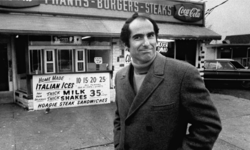
Alexander Portnoy lies on the couch. Dr Spielvogel sits behind, listening to a subject that is, says Roth, “so difficult to talk about and yet so near at hand”. In short, masturbation, and its corollary, satyromania. To facilitate his solitary lust, Portnoy commands a far richer arsenal of sex aids than most horny young men: old socks, his sister’s underwear, a baseball glove and – notoriously – a slice of liver for the Portnoy family dinner. This is a “talking cure” as Freud never envisaged it, a farcical monologue by – this is Roth again – “A lust-ridden, mother-addicted young Jewish bachelor”, a tirade that would “put the id into yid”. Alex is an archetypal Jewish-American son, coincidentally the same age as his creator, and a former “honour student” who’s now working in New York as a civil rights lawyer. His mother would have preferred him to become a doctor, marry and have children, but we are all too aware that her wishes will never be part of her son’s adult life. Alex free associates for Spielvogel with a wild frenzy that some have suggested is owed to the standup comics of Roth’s youth, and perhaps near-contemporaries such as Lenny Bruce. Roth’s response has been to identify his main influence as “a sit-down comic named Franz Kafka”.
More here.
Jennifer Doudna, a Pioneer Who Helped Simplify Genome Editing
Andrew Pollack in The New York Times:

While everyone welcomes Crispr-Cas9 as a strategy to treat disease, many scientists are worried that it could also be used to alter genes in human embryos, sperm or eggs in ways that can be passed from generation to generation. The prospect raises fears of a dystopian future in which scientists create an elite population of designer babies with enhanced intelligence, beauty or other traits. Scientists in China reported last month that they had already used the technique in an attempt to change genes in human embryos, though on defective embryos and without real success. Dr. Doudna has been organizing the scientific community to prevent this ethical line from being crossed. “The idea that you would affect evolution is a very profound thing,” she said. She is also fighting for control of what could be hugely lucrative intellectual property rights to the genome editing technique. To the surprise of many, the first sweeping patents for the technology were granted not to her, but to Feng Zhang, a scientist at the Broad Institute and M.I.T. The University of California is challenging the decision, and the nasty skirmish has cast a bit of a pall over the field.
Picture: Dr. Emmanuelle Charpentier and Dr. Doudna, center, with Dick Costolo, Twitter's chief executive, and the actress Cameron Diaz, in November. Each scientist won a $3 million Breakthrough Prize.
More here.
Monday, May 11, 2015
CATSPEAK
by Brooks Riley
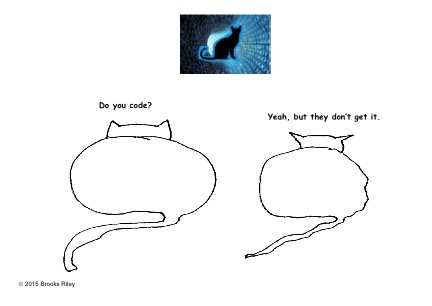
Perceptions

Sunday, May 10, 2015
Curbing the New Corporate Power

K. Sabeel Rahman presents his argument, over at the Boston Review with responses by Juliet B. Schor, Adam Thierer, Arun Sundararajan, Sofia Ranchordás, Dean Baker, Robin Chase, David Bollier, Mike Konczal, and Richard White. Rahman (image by Rodrigo Corral):
Recent commentary on threats posed by Internet companies has drawn on the language of antitrust and monopoly. In a provocative New Republic essay last year, Franklin Foer argued that Amazon represented a modern form of monopoly; like U.S. Steel and the monopolies of the late nineteenth century, Amazon had acquired the power to unfairly discriminate on the market. But unlike those monopolies, Foer argued, Amazon has kept consumer prices low, obscuring its market power. According to Paul Krugman, Amazon is a different kind of monopoly. It does not extract rents from consumers but rather operates as a monopsony, a company whose buying power allows it to discriminate against suppliers. Google too is the subject of monopoly concerns thanks to its dominance in information gathering and its growing political influence. Former Secretary of Labor Robert Reich used the same analogy to nineteenth-century monopolies in his critique of Comcast.
In contemporary antitrust regulation, however, the central question is whether concentrations of economic and market power enable extractive or unfair consumer prices. On that metric, it is hard to show how Amazon and other Internet companies use power in harmful ways. If these companies lower prices and increase access for consumers, how could they be considered dangerous? Defenders of these companies also point out that they face competitors in the marketplace: Amazon does not control the retail sector; on paper, at least, Google has rivals in search; at the national level, Comcast faces competition in Internet service provision.
The kinds of power that Amazon, Comcast, and companies such as Airbnb and Uber possess can’t be seen or tackled via conventional antitrust regulations. These companies are not, strictly speaking, monopolies; Uber and Airbnb, in particular, do not engage in the kind of price-fixing or market dominance that is the usual target of antitrust regulation today. These companies are better understood as platforms or utilities: they provide a core, infrastructural service upon which other firms, individuals, and social groups depend. For instance, the publisher Hachette depends on Amazon to access the book-buying public. This dependency operates in the other direction as well. Consumers depend on the diligence of Airbnb and Uber to ensure that services contracted through them are safe and as advertised.
A platform thus presents a uniquely troubling form of private power that manifests in its ability to set not just prices but also the wages or returns for producers, and, most importantly, the terms of access to the marketplace itself.
More here.
Why the World Does not Exist but Unicorns Do

Richard Marshall interviews Markus Gabriel in 3:AM Magazine:
3:AM: Let’s start with your arguments about ontology. You argue that the world doesn’t exist and you want to be very clear that this isn’t what Kant, Heidegger or Gadamer might claim and then smuggle in a way round the claim – cheating! So can you first outline what philosophical position you are disagreeing with with your ‘real predicate’ argument? Metaphysics of a certain stripe collapses according to your idea doesn’t it?
MG: I agree with certain versions of the famous Kantian line of thought according to which existence is not what I call a proper property. In the first step of the overall argument, by a “proper property” I mean a property reference to which puts one in a position to distinguish an object in the world from other objects in the world. Existence certainly is not a property that divides the world up into two realms: that of the existing things on the one hand and that of the non-existing things (things lacking the feature of existence) on the other hand. That would be a weird world-picture.
Against this background, Kant has argued that existence is world-containment, that is, the world’s property to contain spatiotemporal individuals. On this construal, existence is precisely not a proper property of individuals. To assert that some object x exists is to say something about the world, namely that x is to be found in the world. However, this immediately raises the question whether the world itself can exist on this model? Is the world contained by the world? What exactly is the relation of containment supposed to be? Is the world some kind of set or a mereological whole? Would it even make sense to say that the world is a spatiotemporal individual located within the world and to be met with in it? What kind of totality is the world? All of Kant’s answers hinge on his notion of the world as the “field of possible experience” (CPR, A 227/B 280f.).
This creates all sorts of problems. Yet, what is right about his view is that to exist is a property of a field or a domain and not an ordinary discriminatory property of objects we encounter within the domain. As I read him, Kant distinguished between questions concerning the existence of individuals (which he takes to be a function mapping individuals onto the field of possible experience) and questions concerning the world itself. The latter, metaphysical questions, for him, are famously unanswerable.
If this is right, the question is what we mean when in metaphysics we search for the furniture of reality or the fundamental structure of the world. If “the world” is explicitly or implicitly modeled along the lines of a huge spatio-temporal container inhabited by the totality of individuals, this creates the problem that it is entirely unclear in what sense such a container is supposed to exist.
More here.
Sexual statistics

The plus team in Plus Magazine:
Straight men have had twice as many sexual partners, on average, as straight women. Sounds plausible, seeing that men supposedly think about sex every seven seconds. Except that it's mathematically impossible: in a closed population with as many men as women (which roughly there are) the averages should match up. Someone is being dishonest, but who? And why? These questions, along with many others, are explored in Sex by numbers, a new book by David Spiegelhalter, Winton Professor for the Public Understanding of Risk at the University of Cambridge.
“Sex is a great topic,” says Spiegelhalter. “There's lots of it going on, but we don't know what goes on or how much of it, because most of the time it goes on behind closed doors. It's a really difficult topic to investigate scientifically, and a real challenge for statistics.” Spiegelhalter's aim is to get people interested in a critical approach to the numbers they hear about in the news and give them the tools to figure out if they can be believed. “It's really a book about statistics, using sex as an example.”
Statistics about sex are not all equally good. Some, like the number of births in a given year, are cast-iron facts, but others are much harder to come by. The number of sexual partners is a good example. The mismatch above comes from the third The National Survey of Sexual Attitudes and Lifestyles (Natsal), conducted between 2010 and 2012, in which men reported having had 14 sexual partners, on average, and women 7. Studies have suggested that women give lower numbers when they fear the survey isn't entirely confidential, something that doesn't seem to affect men (contrary to my expectation, it doesn't induce them to exaggerate). So that's one possible explanation for the mismatch: sadly, women still need to fear social stigma.
But there are other explanations too. One is that men (more than women) may have some of their sexual experience with sex workers. These aren't included in the surveys, so their experiences are missing from the female tally. Another is that there are different attitudes as to what counts as a sexual partner. If a woman feels she's been coerced by a man, for example, she may not want to count him.
More here.
Black America’s Lost Generation Speaks Up
Kai Wright in The Nation:

Bullock’s well-meaning parents urged him to turn himself in to the police. “We wanted Allen to do the right thing,” his mother told The Guardian. That sentiment plunged the family into a trick bag of morality that black people routinely encounter when they brush up against the criminal-justice system. For smashing that window, Bullock is being held on $500,000 bail and faces a sentence of four to eight years in prison. Bail for the six officers charged with taking Freddie Gray’s life topped out at $350,000. We couldn’t ask for a starker example of property being valued higher than black life.
Whether Bullock and his peers had already done “the right thing” by erupting in the streets of Baltimore will remain the subject of debate for some time. What’s clear, though, is that their rioting prompted a remarkable shift in the public discussion over police violence. What had been a narrow debate about cops opened up into something larger—and more honest.
More here.
Is there a war instinct in humans?
David P Barash in Aeon:

Confirmed killers: carnivorous creatures that seized living quarries by violence, battered them to death, tore apart their broken bodies, dismembered them limb from limb, slaking their ravenous thirst with the hot blood of the victims and greedily devouring living writhing flesh.
This lurid perspective has deep antecedents, notably in certain branches of Christian doctrine. According to the zealous 16th century French theologian John Calvin:
The mind of man has been so completely estranged from God’s righteousness that it conceives, desires, and undertakes, only that which is impious, perverted, foul, impure and infamous. The human heart is so steeped in the poison of sin, that it can breathe out nothing but a loathsome stench.
It’s bad enough for the religious believer to be convinced of humanity’s irrevocable sinfulness, punishable in the afterlife. But I’m even more concerned when those who speak for science and reason promote a theory of human nature that threatens to become a self-fulfilling prophecy.
More here.
Sunday Poem
My Father-in-law at Twenty
when mother-in-law is in China
father-in-law will take off his shirt
unwire the ancestral wok from the ancestral nail
mix salt and steam and cigarette ash into the fried rice
he learned to make in London.
in London when he was twenty
standing by a snowy statue in Trafalgar Square
someone taking black and white woman
in an expensive white hat.
he handsome in a dark suit
speaking dishwater English yet
the way he held his cigarette
the way he leaned towards her
dismissed the camera the cold
the woman must have understood.
I have seen those pictures
my wife knows where they are hid
and he once told me when others were in bed
how on the ship from Hong Kong to London
there was more than one fistfight with gweilo
except when the ship stopped in Egypt
a ceasefire to see the Sphinx
he has lost the photos, he says,
smiling,
coughing,
checking his heart,
blowing smoke away from me,
too long ago.
for my father-in-law at twenty
the sands of Egypt spicy under his feet
fists bloodied against condensation
stacks of unwashed dishes awaiting his arrival in London
and a mysterious white woman
smiling at him from under an expensive white hat
the riddles of the Sphinx must once have seemed
no more difficult than striking a match on ice.
.
by Timothy Kaiser
from Yuan Yang, Vol.1
the only existing Georges bataille tv interview
Balthus the Painter
Patachou (1918 – 2015)
Mom: The Designated Worrier
Judith Shulevitz in The New York Times:
As I was thinking about Mother's Day today and read the article below in the NYT, I remembered the following which validates the thesis presented: I once asked my mother that she had raised seven children, did she have a favorite? She promptly said, yes, of course. I was so shocked at this blatant admission and the first thought I had was I will kill myself if it is not me. Who, I demanded nervously. She wisely responded, 'Anyone of you who is vulnerable at the moment becomes my favorite and all my love and attention becomes focused on that child. So all of you have taken turns to be my favorite'.

I wish I could say that fathers and mothers worry in equal measure. But they don’t. Disregard what your two-career couple friends say about going 50-50. Sociological studies of heterosexual couples from all strata of society confirm that, by and large, mothers draft the to-do lists while fathers pick and choose among the items. And whether a woman loves or hates worry work, it can scatter her focus on what she does for pay and knock her partway or clean off a career path. This distracting grind of apprehension and organization may be one of the least movable obstacles to women’s equality in the workplace. IT’S surprising that household supervision resists gender reassignment to the degree that it does. In the United States today, more than half of all women work, and women are 40 percent of the sole or primary breadwinners in households with children under 18. The apportionment of the acts required to keep home and family together has also been evening out during the past 40 years (though, for housework, this is more because women have sloughed it off than because men have taken it on). Nonetheless, “one of the last things to go is women keeping track of the kind of nonroutine details of taking care of children — when they have to go to the doctor, when they need a permission slip for school, paying attention at that level,” says the social psychologist Francine Deutsch, author of “Halving It All: How Equally Shared Parenting Works.”
More here.