Category: Recommended Reading
Confessions of an Israeli traitor
Assaf Gavron in The Washington Post:
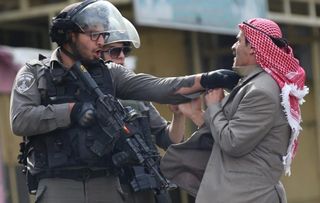
I was an Israel Defense Forces soldier in Gaza 27 years ago, during the first intifada. We patrolled the city and the villages and the refugee camps and encountered angry teenagers throwing stones at us. We responded with tear gas and rubber bullets.
Now those seem like the good old days.
Since then, the conflict between Israelis and Palestinians has seen stones replaced with guns and suicide bombs, then rockets and highly trained militias, and now, in the past month, kitchen knives, screwdrivers and other improvised weapons. Some of these low-tech efforts have been horrifically successful, with victims as young as 13. There is plenty to discuss about the nature and timing of the recent wave of Palestinian attacks — a desperate and humiliated answer to the election of a hostile Israeli government that emboldens extremist settlers to attack Palestinians. But as an Israeli, I am more concerned with the actions of my own society, which are getting scarier and uglier by the moment.
…In this latest round of fighting, the volume has been turned up still another notch. While the knife attacks are going on, my family and I are in Omaha, where I’m teaching for the semester, and what I hear and read from Israel leaves me appalled. Again led by politicians from the right (with the perplexing support of members of the supposed opposition, such as Yair Lapid), then circulated by the sensationalist mainstream media, there has been a unified demonization of Palestinians and Israeli Arabs. One recent poll by the newspaper Maariv found that only 19 percent of Israeli Jews think most Arabs oppose the attacks. This past week, the trend reached its absurd peak, with Prime Minister Benjamin Netanyahu’s ridiculous claim that Hitler decided to annihilate the Jews only after being advised to do so by Jerusalem Mufti Haj Amin al-Husseini, the leader of Palestinian Arabs at the time. (Israeli Twitter was full of jokes and memes about the speech, which one image in circulation dubbed “Hitlerious.” Even for Netanyahu’s supporters, apparently, this was too much.)
More here.
An epic fusion reactor, life trapped in crystal, and risky antibody business
Alison Crawford in Science:
The bizarre reactor that might save nuclear fusion:
Tokamak or stellarator? That’s the question fusion enthusiasts are asking as a research lab in Germany prepares to flip the switch on the largest fusion device ever built, dubbed the “stellarator.” For Star Wars lovers, this epic construction device looks like Han Solo’s Millennium Falcon and sports some of the most complex engineering models ever devised. We’ll soon find out if the stellarator is strong enough to withstand the enormous forces and temperature ranges in order to surpass tokamaks in the effort to advance nuclear fusion.
Scientists may have found the earliest evidence of life on Earth
When did life on Earth begin? A controversial new study presents potential evidence that traces of life arose more than 4 billion years ago. Clues lie hidden in microscopic flecks of graphite trapped inside a single large crystal of zircon found in the Jack Hills in Western Australia. These zircon crystals barely span the width of a human hair, but they are nearly indestructible and provide a rare glimpse into Earth’s earliest history.
Designer antibodies may rid body of AIDS virus
Anti-HIV drugs have extended life for millions of people, but they have never eliminated the virus from anyone because HIV integrates its genetic material into the chromosomes of some white blood cells, helping it escape notice of the immune system. New findings show that artificial antibodies could “redirect” the immune response to latently infected cells and help drain the HIV reservoirs into the body. The dual-action concept to reverse latency and then do the mop-up work is both promising and exciting, but it is also risky and won’t be tested in people for at least a year.
More here.
Sunday Poem
Now Sing
NOW sing: the guards howling
beat him with obscenities.
…….. But he did.
His legend is
He was singing
……………….. Venceremos
when they shot him.
Even for them, it was too much
The killed him,
they couldn't kill him enough,
Victor Jara
…………… sin guitarra,
who'd held out with bloody stumps
………………………………………….. and sung
by James Scully
from Poetry Like Bread
Curbstone Press, 1994
****
Victor Jara:
“Jara composed 'Venceremos' (We Will Triumph), the theme song of Allende's Unidad Popular (Popular Unity) movement, and he welcomed Allende's election to the Chilean presidency in 1970. Jara and his wife were key participants in a cultural renaissance that swept Chile, organizing cultural events that supported the country's new socialist government. He set poems by Chilean writer Pablo Neruda to music and performed at a ceremony honoring Neruda after the famous writer received the Nobel Prize for literature in 1972. Throughout rumblings of a right-wing coup, Jara held on to his teaching job at Chile's Technical University.
“On September 11, 1973, however, Chilean troops under the command of General Augusto Pinochet mounted a coup against the Allende government. Jara was seized and taken to the Estadio Chile, a large sports stadium. There he was held for four days, deprived of food and sleep. He was tortured, and his hands were broken by soldiers who told him to try to keep on playing the guitar with his damaged hands.
Saturday, October 24, 2015
How Long-Necked Dinosaurs Pumped Blood to Their Brains
Brian Switek in Smithsonian Magazine:
Living large isn’t easy. The sauropod dinosaurs—the biggest creatures to ever walk the Earth—required rapid growth rates, skeletons that were both light and strong and copious amounts of food, just for starters.
Now, paleontologists may have cracked one of the remaining mysteries about these giant dinosaurs: How did they pump enough blood up their long necks to feed their brains?
University of Southern California paleontologist Michael Habib was inspired to investigate sauropod necks after seeing bones from a giant titanosaur found in the New Mexico desert. The well-preserved neck bones included spines called cervical ribs that stretch almost six feet long. These rods, Habib says, turned out to be made of a very flexible sort of bone that “made pretty darn good springs.”
As the giant dinosaurs walked, the motion would have created an “inertial problem” for the sauropods. Without something to dampen this effect, Habib says, “the neck is going to start to sway back and forth like a badly mounted crane or tree in a breeze.”
This is where the cervical ribs came in. These springy bones dampened that effect, allowing the dinosaurs to keep their necks relatively steady as they plodded along, Habib told researchers gathered last week at the Society of Vertebrate Paleontology meeting in Dallas, Texas.
More here.
How the Kalashnikov rifle is made and tested
Gloria Steinem Has a Theory About Why Women Don’t Like Hillary Clinton
Michelle Goldberg in DoubleXX:
Gloria Steinem has a theory about liberal women who feel, or have felt, antipathy towards Hillary Clinton. They are insecure about their own bad marriages. That, at least, is the implication of an astonishingly condescending passage in her new book, My Life on the Road, excerpted in the Guardian. Steinem describes herself as “blindsided by the hostility” toward Clinton from some white liberal women during her first run for Senate. Eventually, Steinem developed an idea about where that animus came from. “If Hillary had a husband who regarded her as an equal—who had always said this country got ‘two presidents for the price of one’—it only dramatised their own lack of power and respect,” she writes. “After one long night and a lot of wine, one woman told me that Hillary’s marriage made her aware of just how unequal hers was.” There are a lot of theories out there about the very real resistance to Clinton among women who, on the demographic surface, should be her base. This, however, is the first time I’ve seen it suggested that they wish their husbands would be more like Bill Clinton.
And what about those women who condemned Clinton for remaining with a husband who humiliated her? “It turned out that many of them had suffered a faithless husband, too, but lacked the ability or the will to leave,” writes Steinem. “They wanted Hillary to punish a powerful man in public on their behalf.”
More here.
What the Heck is Cuneiform, Anyway?
Anne Trubek in Smithsonian:
Cuneiform made headlines recently with the discovery of 22 new lines from the Epic of Gilgamesh, found on tablet fragments in Iraq. As remarkable as is the discovery of new bits of millennia-old literature is the story of cuneiform itself, a now obscure but once exceedingly influential writing system, the world’s first examples of handwriting. Cuneiform, was invented some 6,000 years ago in what is now southern Iraq, and it was most often written on iPhone-sized clay tablets a few inches square and an inch high. Deciding to use clay for a writing surface was ingenious: vellum, parchment, papyrus and paper—other writing surfaces people have used in the past—deteriorate easily. But not clay, which has proven to be the most durable, and perhaps most sustainable, writing surface humanity has used.
Cuneiform means “wedge-shaped,” a term the Greeks used to describe the look of the signs. It was used to write at least a dozen languages, just as the alphabet that you are reading now is also (for the most part) used in Spanish, German and many other languages. It looks like a series of lines and triangles, as each sign is comprised of marks—triangular, vertical, diagonal, and horizontal—impressed onto wet clay with a stylus, a long thin instrument similar to a pen. Sometimes cuneiform was formed into prisms, larger tablets and cylinders, but mainly it was written on palm-sized pieces of clay. The script is often tiny—almost too small to see with the naked eye, as small the smallest letters on a dime. Why so tiny? That remains one of cuneiform’s biggest mysteries.
More here.
‘Awakening’, by Marilynne Robinson
Marilynne Robinson at the Financial Times:
The First and Second Great Awakenings, religious revivals that swept through the midcolonies in the late eighteenth century and the northeastern states in the first third of the nineteenth century, were followed, I have come to realise, by a third awakening in the latter half of the twentieth century, just as I was coming of age. Historians usually treat the earlier awakenings as surges of religious enthusiasm primarily or exclusively, though they are attended by a characteristic cluster of reform movements — enhancements of the status of women, broadening of access to education, mitigations of social and racial inequality. These were consistent even while the demographics of the country changed. The religious and denominational character of the earlier awakenings seems to have been as much a consequence of the old centrality of the churches as centres of civic life as it was a result of their role in stirring religious passion. I hasten to say that in these instances religious passion — and there were occasions of hysteria, fainting fits, visions — led to, and was consistent with, stable and thoughtful social change. The period in the twentieth century I would call the third great awakening was led by the black church, and sooner or later had the support of all the major denominations. But it was not, and is not, understood as an essentially religious movement, though as I have said the distinction between civic and religious is never clear, and was certainly not clear in this case.
more here.
Luc Sante’s ‘The Other Paris’
David L. Ulin at the LA Times:
“Paris,” Walter Benjamin once wrote, “is a counterpoint in the social order to what Vesuvius is in the natural order: a menacing, hazardous massif, an ever-active hotbed of revolution. But just as the slopes of Vesuvius, thanks to the layers of lava that cover them, have been transformed into paradisal orchards, so the lava of revolutions provides uniquely fertile ground for the blossoming of art, festivity, fashion.”
Such a statement reverberates through Luc Sante's “The Other Paris” like a thesis statement, an emblem of the city's soul. Paris, Sante wants us to understand, is both like and unlike other cities: an expression of class, of history, but also improvisational, serendipitous. “The city,” he insists, “— compact and curled within itself, a labyrinth — had to be played like a game.”
This is an idea — I'll admit it — that I love, not just in regard to Paris but also to the very essence of urban life. What are cities, after all, but what we make of them, the paths we carve through their maze of streets and neighborhoods, the individual existences we construct in relation to their collective ones?
more here.
The Life and Work of Frank Gehry
Nicholas Fox Weber at the New York Times:
The mystery in these pages is Goldberger’s own judgment of Frank Gehry’s architecture. We certainly see Gehry in the company of famous artists — Jasper Johns, Claes Oldenburg, Robert Rauschenberg and Robert Irwin were early friends — and we follow his meteoric rise to worldwide fame. We encounter a lot of powerful real estate developers, and learn the background stories of the Guggenheim Bilbao, the Walt Disney Concert Hall, 8 Spruce Street (to my mind Gehry’s most successful building, suggesting he is better at apartment towers than museums and concert halls) and, most recently, the Fondation Louis Vuitton museum. Yet Gehry’s entertaining and uncommonly intelligent biographer puts as much emphasis on details like the presence of Brad Pitt and Arianna Huffington at the architect’s 80th-birthday party as on the characteristics of the architecture itself. Reeling off names like Larry Gagosian, Bono, Ian Schrager, Candice Bergen and Ben Gazzara as being among the people to celebrate Gehry’s 82nd birthday, Goldberger seems to suggest that being famous matters as much, at least to Frank Gehry, as the social service and aesthetic impact of his buildings.
Bono sang at the funeral of the painter Balthus, whose biography I wrote. For me, that episode with Bono signified the infatuation with celebrity that had been one of the sillier aspects of the life of a gifted and brilliant artist.
more here.
Saturday Poem
After Aquinas
.Try making a man with no soul, you who can do all things. Not quite all. Is it you or your end that’s manifest in forms fixed before you, or in the first sums the schoolchild learns, likewise unalterable. The triangle makes its dark refusal of all you might be, great indefinite. Spared a body and this staggered mind, you cannot know the joy our weariness embraces—what made you go without the saving play of memory. Yes, to forget and invent is denied you. Though you transcend time you too cannot change what was. The sad dream seizing you most of all, still you cannot feel sadness, only—who knows. Maybe you feel less and less the rumored maker, more like one who simply sees himself reflected, unforgiving, in a foreignness… Bound by such laws. A singular. You cannot make another of what you are, be less than yourself, disappear.
by Tomas Unger
from Ecotheo Review, July 2015
Friday, October 23, 2015
Ancient civilization: Cracking the Indus script
Andrew Robinson reflects on the most tantalizing of all the undeciphered scripts — that used in the civilization of the Indus valley in the third millennium bc.
Andrew Robinson in Nature:
The Indus civilization flourished for half a millennium from about 2600 bc to 1900 bc. Then it mysteriously declined and vanished from view. It remained invisible for almost 4,000 years until its ruins were discovered by accident in the 1920s by British and Indian archaeologists. Following almost a century of excavation, it is today regarded as a civilization worthy of comparison with those of ancient Egypt and Mesopotamia, as the beginning of Indian civilization and possibly as the origin of Hinduism.
More than a thousand Indus settlements covered at least 800,000 square kilometres of what is now Pakistan and northwestern India. It was the most extensive urban culture of its period, with a population of perhaps 1 million and a vigorous maritime export trade to the Gulf and cities such as Ur in Mesopotamia, where objects inscribed with Indus signs have been discovered. Astonishingly, the culture has left no archaeological evidence of armies or warfare.
Most Indus settlements were villages; some were towns, and at least five were substantial cities (see 'Where unicorns roamed'). The two largest, Mohenjo-daro — a World Heritage Site listed by the United Nations — located near the Indus river, and Harappa, by one of the tributaries, boasted street planning and house drainage worthy of the twentieth century ad. They hosted the world's first known toilets, along with complex stone weights, elaborately drilled gemstone necklaces and exquisitely carved seal stones featuring one of the world's stubbornly undeciphered scripts.
More here.
Democracy & Islam
Draft article by Patrick O'Donnell for the Encyclopedia of Islam:
Democracy, or “rule by the people” (typically, a majority thereof) is a term that has been used to
describe a number of different kinds of government: from ancient Greek city-states (e.g., Athens) to the contemporary (liberal, corporatist, and social democratic) welfare states of Europe and North America, to the myriad post-World War II democracies (particularly since the 1970s) around the globe, North and South, East and West. Today, democratic rule is usually connected to Liberal ideas and ideals of governance and government by popularly elected officials who legislate and enforce the laws in accordance with constitutionally ensconced notions of individual liberties and civil rights, hence “the people” rule indirectly through those elected to represent their considered preferences and interests as expressed in the voting booth. Historically, Islamic juridical and political thought has legitimated various kinds of governance: from the despotic to the benign. Indeed, the bountiful intellectual fruits of Islamic traditions—philosophical, theological, jurisprudential, mystical—are capable of justifying (through the provision of what philosophers, after Bernard Williams, term 'internal' reasons) a wide array of political models and forms of political behavior and rule, including models and forms of democratic governance and government (Hashemi, 2009 and March, 2009). We cannot here address a recent claim by Wael Hallaq that is clearly germane to our discussion, namely, that “[t]he 'Islamic state,' judged by any standard definition of what the modern state represents, is both an impossibility and a contradiction in terms.”
More here.
THE LONELY AND DANGEROUS LIFE OF A NON-BELIEVER IN SAUDI ARABIA
Hamza Khaled in Narratively:
I was in fourth grade. It was the second week of school. My father picked me up with a look on his face — I thought it was because of his job as a fraud detective. Then when I got home I went to kiss my mom as usual, but she was crying. I had never seen her cry before. Not once. I asked her why she was crying. She didn’t answer. I thought someone had died, so I started crying too. Then my father pulled me back and said, “We need to talk.”
He sat me down on the ground and said, “Shut up, be a man. Men don’t cry. Are you a woman? Only women cry.” Then my mother came out and said it: “Your father divorced me.”
In Saudi Arabia men can initiate a divorce simply by saying “I divorce you” and just like that you are divorced. If he says it three times they are divorced forever; if it’s just once they are officially divorced, but have the option of reuniting.
I looked at my father shocked, and he said, “That’s right, now go pack your clothes. You’re going to live with your mother’s family.”
I was still so shocked I couldn’t move. He grabbed me by my collar and said, “Stop wasting my time.”
More here.
October 5, 1888 – Dinner party in London introducing phonograph
Behind the lines in Damascus, a war of neighbors
Thanassis Cambanis at The Boston Globe:
THE GOVERNMENT militiaman named Noor leaned out from the narrow service balcony and pointed at the trees flanking the airport highway a hundred yards away.
“We are fighting in that area to keep them from entering our street,” he said. A few months earlier, Noor said, the situation “was critical. They were too close.” Now, he said, rebels have been pushed a few miles away.
The war in Syria is a war of neighborhoods. Foreign fighters and foreign intervention have fueled the conflict, but at its heart is an intimate civil war between neighbors and relatives. Noor, a retired soldier, was running a family store when Syria’s popular uprising rapidly transformed into a bitter nationwide battle four years ago. He quickly formed a neighborhood militia, which was eventually absorbed into the paramilitary National Defense Force, that fights for the Assad government and is funded and trained by Iran.
In recent years, his neighborhood, Jaramana, remained a leafy and sprawling suburb of Damascus crowded with schoolchildren and informal sidewalk cafes by day. At night, it was a battleground, as rebels in neighboring suburbs attacked the strategically critical airport highway and lobbed shells indiscriminately, mirroring the government’s own tactics.
more here.
Truth, beauty, science and art
Martin Kemp at The Times Literary Supplement:
The notion that the world embodies “beautiful ideas” might seem to imply that some entity is required “out there” to have the ideas, rather than the more orthodox view that the world embodies mathematical orders at various levels in ways that we find beautiful as responsive observers. Wilczek’s use of the term “idea” without locating it in a specific conscious entity, whether a creative deity or ourselves, serves as an agnostic tease that allows him to identify mathematical harmonies in nature as ideas “out there” that chime with ideas within us. In doing so, he knowingly slides around the central question about who or what is responsible for the organization of the world at atomic and cosmic levels.
His incantation that the world is a work of art knowingly begs the same question. He states that “Nature loves to use such equations”, with reference to Maxwell’s laws. Nature (always with a capital N) implicitly becomes a kind of purposeful agency for the generation of the ideas. Elsewhere he asks, “Is the physical world, considered as a work of art, beautiful”? His answer is emphatically yes, but in this case he seems to allow that it is we who do the considering. For a philosopher, Wilczek’s ambiguity is likely to be irritating, but it allows him a notably productive and suggestive freedom to evangelize about the sublime beauty of the world we can observe and theorize via modern physics.
Wilczek’s evaded question recalls the kind of double truths of reason and revelation expounded in some Medieval and Renaissance theology.
more here.
rapture, religion and madness part 1: lou andreas-salomé on nietzsche
D.A. Barry at 3:AM Magazine:
In order to provoke a re-examination of a wide spectrum of assumptions with regard to Nietzsche’s philosophy and how that philosophy played out in his life, I’d like to revisit the ideas in a much maligned biography of Nietzsche, that was written by Lou Andreas-Salomé:Friedrich Nietzsche, The Man in His Works (1894).
The first time that I encountered Lou Salomé by name and image was in a cinema in Rome in 1984. I’d been invited to see the movie by a woman-friend who was an admirer of Liliana Cavani. Cavani’s film Al di lá del Bene e del Male (Beyond Good and Evil) is a fictional depiction of Salomé’s relationship with Friedrich Nietzsche and the Positivist philosopher Paul Rée. The story is loosely based on the time that the threesome spent together over eight months in 1882. It was easy for my friend and I to fall in love with the ‘idea’ of Lou Salomé: a liberated intellectual woman, a feminist of sorts — although she wouldn’t have claimed so — who lived across the cusp of previous centuries, who intrigued both of these men so much that they proposed to her. Salomé was a novelist and a poet. Nietzsche set one of her poems to music. She was a literary critic. Her first published work in 1892 was called Henrik Ibsen’s Female Characters. She was a theorist of the erotic; and finally she became a psychologist after studying with Sigmund Freud. Her biography of Nietzsche is really a psychological portrait though it reveals a deep engagement with his philosophical writings.
more here.
Alzheimer’s disease tied to brain’s navigation network
David Shultz in Science:
The way you navigate a virtual maze may predict your chances of getting Alzheimer’s. That’s the conclusion of a new study, which finds that people at risk for Alzheimer’s have lower activity in a newly-discovered network of navigational brain cells known as “grid cells.” The finding could lead to new ways to diagnose this debilitating disorder. The discovery of the grid cell network won the Nobel Prize in Medicine or Physiology last year. The neurons that make up the “grid” are arranged in a triangular lattice in the entorhinal cortex—a region of the brain used in memory and navigation. The “grid” activates in different patterns based on how individuals move, keeping track of our location in the coordinate plane.
Researchers think the cells help create mental maps and allow us to navigate through space even in the absence of visual cues. “If you close your eyes and walk ten feet forward and turn right and walk three feet forward, the grid cells are believed to [track your position],” says neuroscientist Joshua Jacobs at Columbia University. Intriguingly, people withthe so-called e4 variant of a gene known as APOE—the largest genetic risk factor for developing Alzheimer’s later in life—are at a higher risk for developing abnormalities in their entorhinal cortex. Because the grid cells are found in the same region, scientists wondered if the reason Alzheimer’s patients are more likely to get lost and have difficulty navigating could be explained by damage to the network.
More here.