The East India Company: The original corporate raiders

William Dalrymple in The Guardian:

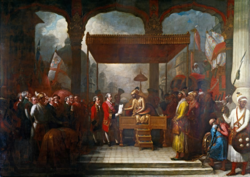
MughalThe painting shows a scene from August 1765, when the young Mughal emperor Shah Alam, exiled from Delhi and defeated by East India Company troops, was forced into what we would now call an act of involuntary privatisation. The scroll is an order to dismiss his own Mughal revenue officials in Bengal, Bihar and Orissa, and replace them with a set of English traders appointed by Robert Clive – the new governor of Bengal – and the directors of the EIC, who the document describes as “the high and mighty, the noblest of exalted nobles, the chief of illustrious warriors, our faithful servants and sincere well-wishers, worthy of our royal favours, the English Company”. The collecting of Mughal taxes was henceforth subcontracted to a powerful multinational corporation – whose revenue-collecting operations were protected by its own private army. It was at this moment that the East India Company (EIC) ceased to be a conventional corporation, trading and silks and spices, and became something much more unusual. Within a few years, 250 company clerks backed by the military force of 20,000 locally recruited Indian soldiers had become the effective rulers of Bengal. An international corporation was transforming itself into an aggressive colonial power. Using its rapidly growing security force – its army had grown to 260,000 men by 1803 – it swiftly subdued and seized an entire subcontinent. Astonishingly, this took less than half a century. The first serious territorial conquests began in Bengal in 1756; 47 years later, the company’s reach extended as far north as the Mughal capital of Delhi, and almost all of India south of that city was by then effectively ruled from a boardroom in the City of London. “What honour is left to us?” asked a Mughal official named Narayan Singh, shortly after 1765, “when we have to take orders from a handful of traders who have not yet learned to wash their bottoms?”

We still talk about the British conquering India, but that phrase disguises a more sinister reality. It was not the British government that seized India at the end of the 18th century, but a dangerously unregulated private company headquartered in one small office, five windows wide, in London, and managed in India by an unstable sociopath – Clive. In many ways the EIC was a model of corporate efficiency: 100 years into its history, it had only 35 permanent employees in its head office. Nevertheless, that skeleton staff executed a corporate coup unparalleled in history: the military conquest, subjugation and plunder of vast tracts of southern Asia.

More here.

New Ways of Being

Parul Sehgal in The New York Times:

MigThe migrant is the “defining figure of the 20th century,” Salman Rushdie wrote 20 years ago in the literary magazine Granta. In “this century of wandering,” of refugees and writers in exile carrying “cities in their bedrolls,” migrants taught us what it was to be human, he said, because they’d lost those very things that gave shape to their humanity — roots, culture, social knowledge — and were forced to devise new ways of being. And the migrant writer hatched a new language along the way. “To conquer English may be to complete the process of making ourselves free,” Rushdie wrote in his 1991 essay collection, “Imaginary Homelands.” Shoals of people still move across the world today, but the idea of a literature of migration seems to have fallen out of fashion — not with readers but with writers, some of whom chafe at being narrowly categorized, consigned to an ethnic beat, their work treated as sociology instead of art. “I don’t know what to make of the term ‘immigrant fiction,’ ” Jhumpa Lahiri said in a 2013 interview in the Book Review. “If certain books are to be termed immigrant fiction, what do we call the rest? Native fiction? Puritan fiction?” There’s a feeling that the designation edges writers to the margins — they are forever hyphenated and their work sapped of its universality. “I’m not an immigrant writer,” the poet Richard Blanco told The Los Angeles Review of Books. “I am the son of immigrants, and I’m an immigrant myself who is a writer. You always worry if you’re writing in the context of your story, it’s not ­mainstream.”

This is all very reasonable. Aren’t the themes of immigrant literature — estrangement, homelessness, fractured identities — the stuff of all modern literature, if not life? “Can it be that we’re all exiles?” Roberto Bolaño asked. “Is it possible that all of us are wandering strange lands?” Alienation is alienation, after all. Kafka spoke to everyone when he wrote in a (possibly apocryphal) diary entry: “Enclosed in my own four walls, I found myself as an immigrant imprisoned in a foreign country; . . . I saw my family as strange aliens whose foreign customs, rites and very language defied comprehension; . . . though I did not want it, they forced me to participate in their bizarre rituals.” The trouble is that the migrant is not a metaphor, or not always.

More here.

Friday, March 11, 2016

WIDE SARGASSO SEA, FIFTY YEARS ON

Suneeta Peres da Costa in the Sydney Review of Books:

Wide-sargasso-seaI first fell in love with Jean Rhys’ writing through reading Wide Sargasso Sea. It was a love affair that changed my idea of what fiction could do, what it might be for, and about the faith one must keep with one’s art even under the most adverse circumstances. Perhaps this last lesson was one I needed even though – or because – my own career had started with such promise. I was nineteen or twenty then, studying post-colonialism at university and under the spell of more florid, overtly allegorical and political writers like Marquez and Rushdie and their popular brands of magic realism.

When I chanced one day upon a copy of Wide Sargasso Sea in Sappho Books or Gleebooks Secondhand, I was instantly transfixed by Rhys’ prose, which Francis Wyndham describes in his introduction as ‘that mixture of quivering immediacy and glassy objectivity’, and the psychological acuity with which Rhys treats empire, race and hysteria, as well as the power relations between men and women. I underwent something of a conversion then, acquiring and devouring each of Rhys’ earlier works and the last, a posthumous collection of memoir sketches, Smile Please, edited by Diana Athill.

Re-reading again now in this, the fiftieth anniversary year of its first publication in 1966, I can’t help feeling that Wide Sargasso Sea remains just as groundbreaking and heartbreaking. Doubtless, Rhys’ audacity and ingeniousness – and that which enables the novel to travel so well down the decades – was to take a canonical text like Charlotte Bronte’s Jane Eyre and disrupt its imperial flow via a feminist and post-colonial re-reading.

More here.

An unexpected data signal that could change everything has particle physicists salivating

From Nature:

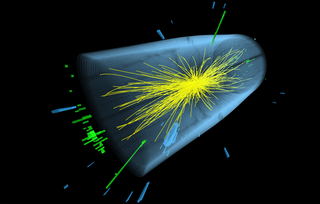
1.19036_15decPhysicists at the Large Hadron Collider (LHC), the giant particle-physics experiment near Geneva, Switzerland, have searched for many possible subatomic particles and novel phenomena. They have tried to recreate dark matter, reveal extra dimensions of and collapse matter into microscopic black holes.

But the possibility of an electrically neutral particle that is four times heavier than the top quark — the current heaviest — and that could decay into pairs of photons has apparently never crossed anybody’s mind. No theorist has ever predicted that such a particle should exist. No experiment has ever been designed to look for one.

So when, on 15 December last year, two separate teams at the LHC independently reported hints of such a particle (see Naturehttp://doi.org/bc4t; 2015), the reaction of many experts was similar to that of US physicist Isidor Isaac Rabi when the muon, a heavier relative of the electron, was discovered in 1936: “Who ordered that?”

If the particle exists, the implications would be enormous. Precisely because it is so unexpected, it could be the most important discovery in particle physics since quarks — the elementary constituents of protons and neutrons — were confirmed to exist in the 1970s. Perhaps it would be the biggest deal since the muon itself.

More here.

Five Questions for Steven Pinker

From UnDark:

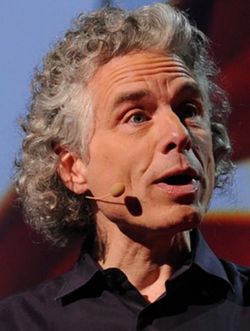
UD — On Twitter earlier this month, you wrote that “all words have [more than] one meaning” and also that “mature adults resist taking pointless offense.” We wonder about the word “all” here. How do you square that, for example, with unambiguous, sexually or racially derogative words?

ScreenHunter_1769 Mar. 11 15.09SP — Actually, it’s not easy to find words that are unambiguously derogatory; it always depends on the context. The most offensive word in contemporary English is “nigger”(from negro, Spanish for “black”), but it was far less incendiary in the antebellum South. … And today the term is famously used in a teasing or affectionate manner among African Americans, as if to say “We’re so intimate that we can call each other offensive names without taking offense.” “Queer,” “dyke,” and “bitch” have also been appropriated by their original targets, and there is a magazine for hip young Jews called Heeb.

Of course the speaker and tone are everything. In the movie “Rush Hour,” Jackie Chan plays a Hong Kong detective who innocently follows the lead of his African-American partner and greets the black patrons of a Los Angeles bar with “Wassup, my nigger!” A small riot breaks out.

More here.

Pierre Boulez’s path to total purity

MLO-1805964_small-620x400Ivan Hewett at Prospect Magazine:

The death in January of Pierre Boulez at the age of 90 robbed the musical world of a great conductor, a brilliant polemicist and an agitator for musical modernism. He was also a charismatic and intransigent human being—charming and generous to those who shared his vision, but prepared to thwart those who did not.

That much is certain about Boulez. But there is also his other role, the one he would surely like to be remembered by: as a composer. Here the situation is less certain. His music was a part of his grand project to yoke all of contemporary music to the modernist ethos. He would lead the way, through his activities as conductor of major orchestras, head of a research institute and as a composer—and he fully expected the other Young Turks of post-war modernism like Karlheinz Stockhausen and Luciano Berio to march in step with him. Certainty had dissolved, the old hierarchies had crumbled and everyone had to work out their own salvation. According to Boulez, to adopt the musical grammar and manners of the past was reprehensible escapism.

If Boulez was right, then reprehensible escapism is now the condition of both classical and pop music. The past has never been more in vogue. “Will pop eat itself?” is a question often asked, as old pop albums haunt the charts and younger bands echo their elders. The outpouring of grief over David Bowie’s death is surely bound up with this sense that pop’s great days are behind it. The question could be asked about film music too, where the gestures of the genre’s golden age come round again and again. And it could be asked about classical music, where to be obsessed with the past, and to weave references to it into one’s own music, is almost de rigueur.

more here.

why Millions of ordinary Americans support Donald Trump

Img-Jimmy-Kimmel-Behind-Epic-Prank-at-Donald-Trump-RallyThomas Frank at The Guardian:

Now, I have no special reason to doubt the suspicion that Donald Trump is a racist. Either he is one, or (as the comedian John Oliver puts it) he is pretending to be one, which amounts to the same thing.

But there is another way to interpret the Trump phenomenon. A map of his support may coordinate with racist Google searches, but it coordinates even better with deindustrialization and despair, with the zones of economic misery that 30 years of Washington’s free-market consensus have brought the rest of America.

It is worth noting that Trump is making a point of assailing that Indiana air conditioning company from the video in his speeches. What this suggests is that he’s telling a tale as much about economic outrage as it is tale of racism on the march. Many of Trump’s followers are bigots, no doubt, but many more are probably excited by the prospect of a president who seems to mean it when he denounces our trade agreements and promises to bring the hammer down on the CEO that fired you and wrecked your town, unlike Barack Obama and Hillary Clinton.

Here is the most salient supporting fact: when people talk to white, working-class Trump supporters, instead of simply imagining what they might say, they find that what most concerns these people is the economy and their place in it.

more here.

A new Eurasian paradigm

Balcer_neweurasia_468wAdam Balcer at Eurozine:

Geopolitical changes in Eurasia, aside from their political and economic context, should also be considered from a cultural and historical perspective. The issue of identity is of primary importance. The new Silk Road project is deeply rooted in the history of Central Asia and closely linked with the Great Steppe. The latter has played an important role as a highway during the great migrations from Asia to Europe, the Middle East and India. In fact, the nomads from the Great Steppe established the largest territorial powers in the history of mankind. Consider the Mongol Empire stretching from the Baltic Sea to the Pacific Ocean, from Vietnam to Lake Baikal. Their global horizons were ahead of their time. The Great Steppe also had a large impact on different forms of culture (clothing, weapons, cuisine, games, values and vocabulary) on both sides of Eurasia, from Eastern Europe to the Far East. Without it, there would have been no Ukrainian Cossacks or sarmatism, which was a unique, deeply oriental part of Polish culture. Japanese samurai culture would also not have existed, shaped as it was by contact with Korea, which was connected with the Manchurian steppe.

It is possible to anecdotally define the borders of the Great Steppe's influence by the places where people eat pierogi, a dish which comes from Central Asia. In this space, Russia is a newcomer. Its conquests are actually something quite novel. Russia conquered Belarus and most of Ukraine by the end of the 18th century, and added Moldova to this in the early 19th century. The conquest of the Caucuses ended in 1864, and that of Central Asia in the 1880s. It was in the 1850s and 1860s when China lost large chunks of territory to Russia in Central Asia, Siberia and the Far East.

more here.

Friday Poem

The Problem of Describing Color

If I said – remembering in summer,
The cardinal’s sudden smudge of red
In the bare gray winter woods –

If I said, red ribbon on the cocked straw hat
Of the girl with pooched-out lips
Dangling a wiry lapdog
In the painting by Renoir –

If I said fire, if I said blood welling from a cut –

Or flecks of poppy in the tar-grass scented summer air
On a wind-struck hillside outside Fano –

If I said, her one red earring tugging at her silky lobe,

If she tells fortunes with a deck of fallen leaves
Until it comes out right –

Rouged nipple, mouth –

(How could you not love a woman
Who cheats at the Tarot?)

Red, I said. Sudden, red.
.
by Robert Hass
from Time and Materials. Poems 1997-2005
publisher: Ecco (HarperCollins Publishers), New York, 2007
.
.

Meat-Eating Among the Earliest Humans

Briana Pobiner in American Scientist:

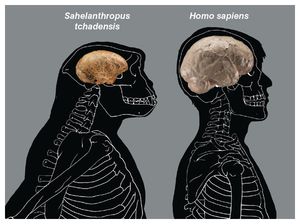
BrainAlthough the modern “paleodiet” movement often claims that our ancestors ate large amounts of meat, we still don’t know the proportion of meat in the diet of any early human species, nor how frequently meat was eaten. Modern hunter-gatherers have incredibly varied diets, some of which include fairly high amounts of meat, but many of which don’t. Still, we do know that meat-eating was one of the most pivotal changes in our ancestors’ diets and that it led to many of the physical, behavioral, and ecological changes that make us uniquely human.

…Cooking was unquestionably a revolution in our dietary history. Cooking makes food both physically and chemically easier to chew and digest, enabling the extraction of more energy from the same amount of food. It can also release more of some nutrients than the same foods eaten raw and can render poisonous plants palatable. Cooking would have inevitably decreased the amount of time necessary to forage for the same number of calories. In his 2009 book Catching Fire, primatologist Richard Wrangham postulates that cooking was what allowed our brains to get big. It turns out that using fossil skulls to measure brain size, we see the biggest increase in brain size in our evolutionary history right after we see the earliest evidence for cooking in the archaeological record, so he may be on to something.

More here.

Andrew Bacevich: Why Is No Candidate Offering an Alternative to Militarized U.S. Foreign Policy?

From Democracy Now:

In a recent article, historian and retired Colonel Andrew Bacevich raised six questions that have been ignored in the 2016 presidential race. Most notably, he says, “Nearly 15 years after this 'war' was launched by George W. Bush, why hasn’t 'the most powerful military in the world,' 'the finest fighting force in the history of the world’ won it? Why isn't victory anywhere in sight?” Bacevich joins us from Boston to talk about the race and these missing questions. His new book, “America’s War for the Greater Middle East: A Military History,” will be published next month. He is professor emeritus of international relations and history at Boston University.

More here. (Note: Thanks to dear friend Nermeen Shaikh)

Thursday, March 10, 2016

The Frank Gehry Story

Ingrid D. Rowland in the New York Review of Books:

Rowland_1-032416Artists are a biographer’s nightmare. The most important events in their lives are usually the ones that take place quietly, slowly, in the repetitive actions of work, or within the sanctum of their skulls. Even Caravaggio, an artist with a penchant for swashbuckling exploits, spent as much time putting brush to canvas as he did making trouble, and his canvases finally tell us more about the man and his art than the police blotters recording his conflicts with the law.

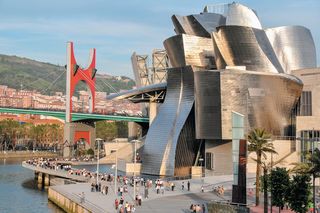
The life of the architect Frank Gehry poses similar challenges. The real question his biographer needs to answer is the impossible one: how a sixtyish architect from Los Angeles ever came to imagine, much less build, the coppery metal carapace of the Guggenheim Museum in the heart of Basque country, in the declining port city of Bilbao. Before that 1997 project, and the subsequent plan to build a new concert hall in Los Angeles, Gehry was best known for constructing cheap buildings of cheap materials in the funky geometric shapes that began to punctuate the cityscape of Los Angeles in the disco era, one of them his own house on a placid residential street in Santa Monica.

The answer to these mysteries of creation has as much to do with what Gehry saw as with how he lived (he is a Toronto-born transplant to the West Coast who has had two wives and four children), or what kind of a person he might have been.

More here.

Building James Webb: the biggest, boldest, riskiest space telescope

Daniel Clery in Science:

ScreenHunter_1766 Mar. 10 20.40GREENBELT, MARYLANDFor months, inside the towering Building 29 here at Goddard Space Flight Center, the four scientific instruments at the heart of the James Webb Space Telescope (JWST, or Webb) have been sealed in what looks like a house-sized pressure cooker. A rhythmic chirp-chirp-chirp sounds as vacuum pumps keep the interior at a spacelike ten-billionth of an atmosphere while helium cools it to –250°C. Inside, the instruments, bolted to the framework that will hold them in space, are bathed in infrared light—focused and diffuse, in laserlike needles and uniform beams—to test their response.

The pressure cooker is an apt metaphor for the whole project. Webb is the biggest, most complex, and most expensive science mission that NASA has ever attempted, and expectations among astronomers and the public are huge. Webb will have 100 times the sensitivity of the Hubble Space Telescope. It will be able to look into the universe’s infancy, when the very first galaxies were forming; study the birth of stars and their planetary systems; and analyze the atmospheres of exoplanets, perhaps even detecting signs of life. “If you put something this powerful into space, who knows what we can find? It’s going to be revolutionary because it’s so powerful,” says Matt Mountain, director of the Association of Universities for Research in Astronomy in Washington, D.C., and former JWST telescope scientist. Like that of Hubble, however, Webb’s construction has been plagued by redesigns, schedule slips, and cost overruns that have strained relationships with contractors, partners in Canada and Europe, and—most crucially—supporters in the U.S. Congress. Other missions had to be slowed or put on ice as Webb consumed available resources. A crisis in 2010 and 2011 almost saw it canceled, although lately the project has largely kept within its schedule and budget, now about $8 billion.

More here.

Antonin Scalia’s death has already changed the way the Supreme Court—and conservative litigants—do business

Dahlia Lithwick in Slate:

160308_POL_Alito-Thomas.jpg.CROP.promo-xlarge2Nobody quite knows what to make of it yet, but nobody disputes it, either: The Supreme Court of March looks nothing like the court we knew in February. The loss of a single justice, Antonin Scalia, has blown up the court and reshuffled everything. It’s the early days yet, and much of the evidence of newish, liberalish outcomes at the court lies in routine housekeeping matters: unsigned orders and withdrawn appeals. Still, it’s safe to say the high court is no longer going to be a candy store for pro-business and socially conservative litigants. What will rise in its place is still a work in progress.

As the Washington Post’s Robert Barnesput it this past weekend, with Scalia gone, “the Supreme Court, now with only eight members, seemed transformed in substance and style.” It wasn’t just the fact that Justice Clarence Thomas, after 10 years of declining to ask a single question at oral argument,suddenly did so. It wasn’t merely the fact that arguments in a blockbuster abortion case were dominated by the court’s liberal wing, while the conservative bloc struggled to land a punch.

The crazy new vibe at the court isn’t even limited to the raft of orders that have come down in the past week. Those include a critical and unanimous order affirming the right of same-sex partners to adopt children and the tossing of a death penalty conviction in Louisiana because the state withheld significant exculpatory evidence.

More here.

Viktor Shklovsky and keeping it strange

P14_Berliner_1214885hAlexandra Berlina at The Times Literary Supplement:

“What we call art exists in order to give back the sensation of life, in order to make us feel things, in order to make a stone stony. The goal of art is to create the sensation of seeing, and not merely recognizing, things; the method of art isostranenie [making strange]”, proclaims Viktor Shklovsky’s best-known essay, “Art as Device” (“Iskusstvo kak priyom”), written one hundred years ago, and published in 1917.

When I say “essay”, I mean a cross between an article and a manifesto. And when I say “published”, I mean that Shklovsky had it printed on what looked like toilet paper, along with articles by other hot-headed students who believed they had found new ways of understanding literature. Following the new fashion for abbreviations, they christened their circle “OPOYAZ”, short for “Society for the Study of Poetic Language”. When others disparagingly called them formalists, they proudly took up the label. There never was a formal beginning to formalism, but the group formed around Shklovsky in 1916. This year, then, celebrates the twinned centenary of both the OPOYAZ and ostranenie – a concept that is often misunderstood as a mere textual game, when it is actually about making life more real, both in its joys and in its horrors.

In English, ostranenie is known as “defamiliarization”, “e(n)strangement”, “making strange” or “foregrounding”, all of which have the potential to confuse. Being estranged from, say, one’s wife is the emotional opposite of the reconnection through wonder that is ostranenie. One might also think of Brecht’s Verfremdungseffekt; though he was probably inspired by the Russian theorist, the German playwright believed in restraining feelings in order to promote critical thought. Shklovsky, on the other hand, saw thought as inseparable from emotion. (As it happens, contemporary cognitive science agrees.) To avoid such confusions, I will stick to the original term.

more here.

the story of the most gored bullfighter in modern history

84442690Venetia Thompson at The New Statesman:

In his fifteen year career as a professional matador, Spaniard Antonio Barrera has survived 23 cornadas, or “hornings”, making him the most gored torero in modern history. His journey towards retirement in December 2012 is the subject of Ido Mizrahy’s new documentary Gored, which, after a hugely successful festival run last April (including winning Best Documentary at Raindance) has just been released on Netflix and iTunes in the UK.

It is not a documentary about the rights or wrongs of bullfighting, but rather, as the director Ido Mizrahy – who does not describe himself as a fan of bullfighting, but is not against it either – tells me, “about life and death, family, broken dreams”, and one man’s single-minded obsession with doing something he isn’t great at. As the Spanish bullfighting critic J A de Moral explains in Gored, he isn’t “fino, has no ‘aesthetic grace…he isn’t one of the artist matadors with an aesthetic purity from another galaxy”. He is, however, insanely brave, and is prepared to die every time he enters the ring.

Mizrahy explains that this is what drew him and Geoff Gray, his writing partner, to Barrera as a subject – the very fact he isn’t a poster boy for bullfighting insured an honest look at the ancient spectacle that would fully demonstrate its brutality. There would be no risk of the viewer getting caught up in the romance or artistry of it, not when, according to de Moral, the spectacle never stops being “a mere fight” and so cannot become “a tragic ballet of extraordinary beauty”.

more here.

Robert Moses and the Fall of New York

Lear02_3806_01Jackson Lears at The London Review of Books:

Robert Moses was a modernist pharaoh. Over the forty years from the early 1930s to the late 1960s, he became a virtual dictator of public works in all five boroughs of New York and much of its suburban surroundings. Almost singlehandedly, through chicanery, fraud and bullying, he created the modern infrastructure of the New York City area: expressways, tunnels and bridges, but also parks, beaches, swimming pools and high-rise housing projects. He envisioned an American version of Le Corbusier’s ideal city, cleansed of disorder and unpredictability, focused on cars rather than pedestrians, committed to an idea of urban public space as empty plazas dominated by glass towers. He aspired to be a master builder, and his achievements ranged from the elegant – the Art Deco bathhouses at Jones Beach on Long Island – to the catastrophic: the Cross-Bronx Expressway, which destroyed thriving neighbourhoods and displaced thousands of people.

By 1968, when Moses was finally forced from power, the catastrophes had become impossible to ignore. The bridges, tunnels and expressways had intensified traffic jams, not relieved them; the public transport system was perishing from neglect; the destroyed neighbourhoods and high-rise housing projects were all boarded-up windows, broken glass and drunks marinating in their own piss. Moses was becoming a symbol of everything that was wrong with modernist urban planning: its hostility to street life, its indifference to neighbourhood cohesion, its infatuation with cars and the comparatively well-off people who drove them.

more here.