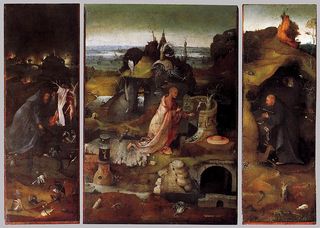
On not-doing … — a triptych

Hieronymus_Bosch_-_Hermit_Saints_Triptych_-_WGA02566

Jeremy Fernando in Berfrois:

I would prefer not to

A response — Bartleby’s response — foregrounding the fact that it is the “I” that “prefers not to”: not that ‘I cannot’ nor ‘I will not’ but that this is a preference. That it is not based on anything other than a decision by the “I”: when asked “why do you refuse” by Mr B, his boss, Bartleby’s response is simply, “I would prefer not to.” [1] Thus, to read this response, Bartleby’s response, as an absolute refusal would be untrue: just because he “prefers not to” does not mean that he will not. But just because it is not a complete rejection of the request also does not mean that it is a delayed compliance: Mr B comes to realise, rather quickly, that “his decision was irreversible.”

So, even as it an inclination — and like all preferences, one that might well be unjustifiable — its effects, in relation with every situation, every moment in which there is a response, are lasting.

Quite a few thinkers — Giorgio Agamben and Slavoj Žižek amongst them — have attempted to read Bartleby’s response as a form of passive resistance. Their claim is that his response, that is always also a non-response, short-circuits the system. If he had out-rightly rejected Mr B there would have been an immediate expulsion, firing: “had there been the least uneasiness, anger, impatience or impertinence in his manner; in other words, had there been anything ordinarily human about him, doubtless I should have violently dismissed him from the premises.” The trouble was, as Mr B continues, “there was something about Bartleby that not only strangely disarmed me, but in a wonderful manner, touched and disconcerted me.” And here, Mr B makes what one might call a fatal error: “I began to reason with him.”

Whilst most readings, readers, focus on Bartleby, perhaps we should momentarily turn out attention to the other interlocutors, those that are attempting to elicit not just a response but a particular act, action, from him. I — allowing all echoes of the unjustifiability of my choice — would like to propose that they were unable to move him, influence his actions, have power over him if you prefer, as they structured their statements as requests. Not only did they open the possibility of non-compliance, it was a far more fundamental mistake: requests function on the logic that both parties involved are operating under the same rules, form, customs, reason — in other words, the exchange is one that involves pre-set options, and not actual choices. That in a situation, to echo Mr B, “a slight hint would suffice — in short, an assumption.” The assumption being that the one receiving the address would know what, even the right thing, to do.

Perhaps then, what is truly subversive about Bartleby’s response is that it takes Mr B’s questions seriously; takes it as a question which offers the potential for a true response.

More here.

On Shit: Profanity as Weltanschauung

Speak-no-evil-243x366

Mark Edmundson in The L.A. Review of Books:

MY FAVORITE VULGAR WORD by far is “shit.” I was about six years old when I learned the word, and ever since I’ve felt the greatest fondness for it. It seems to me one of the truly irreplaceable words in the language.

I learned the word from my childhood friend, Tony Tanzio. “Shit” was not the first bad word that Tony taught me. The first was “asshole.” It was Tony’s appellation for the ants that thronged around and into an ant hole that Tony and I found at the base of an aged, rather patriarchal oak tree. I knew that the primary name for these creatures was ants, but when Tony referred to them as “little assholes,” I decided that there was a secondary term. Many items in the world seemed to go around under two names, why not ants?

The day after Tony increased my vocabulary with the “little asshole” appellation, I introduced it to my mother. “Hey,” I said, “did you know that ants are also called ‘little assholes’?” My mother was quite close to falling over flat on her face, like a flipped pancake. “Go tell your father,” she said. My father was shaving in the bathroom. His face was fully lathered, his towel was wrapped around his mid-section in Roman- senator-on-his-way-to-the-bath style, and he was smoking. (When my father was awake, he was smoking.) I told him how Tanzio had expanded my vocabulary and he jumped as though rather than speaking words, I had pinched him by surprise in the rear of his senatorial towel.

I was always trying to make an impression on my parents. What kid isn’t? I memorized poems, made up songs, and even tried a physical trick or two — like trampolining on their bed before they were awake. No trick that was so briefly enacted and so easy to bring off ever had the effect that the two-word incantation “little assholes” did. Talk about magic words.

More here.

Discover The Music Vault: A Massive YouTube Archive of 22,000 Live Concert Videos

From Open Culture:

Last summer, we highlighted an almost unbelievably rich resource for music fans: the Music Vault, a Youtube archive of 22,000 live concert videos from a range of artists, spanning about four decades into the present. In a time of soaring ticket prices, the Music Vault allows us to catch a show at home for free, and to see bands we missed in their heyday perform on stages around the world. Last summer, I wrote, “enjoy revisiting the glory days and rest assured, they aren’t going away anytime soon.” But I spoke too soon, as many Music Vault videos (there were only 13,000 then) began disappearing, along with the nostalgia and hip currency they offered. Well, now they’re back up and running, and let’s hope it’s for good.

More here.

Mike Ladd in Conversation with Boice‑Terrel Allen

Ladd-web1

Over at The Brooklyn Rail:

Hip-hop artist Mike Ladd has spent the past eleven years of his life calling Paris home. From James Baldwin to Langston Hughes, the lineage of African-American artists fleeing their American birthplace for Parisian equality is wide and illustrious—a notion that Ladd challenges on his 2005 album Negrophilia. Notably, he left New York for romantic purposes, not the expected artistic or political exile reasons of many African-American creatives. Ladd’s career has been a constant study in fusing his politics of race with music—either on his own releases, which include Easy Listening 4 Armageddon (1997), Welcome to the Afterfuture (2000), Nostalgialator (2004), and Father Divine (2005), or with the jazz pianist and MacArthur “genius” recipient Vijay Iyer. Their collaboration has spawned three recorded works, in addition to accompanying performances, since 2004: In What Language?, 2007’s Still Life with Commentator, and 2013’s Holding It Down. The unintentional trilogy has explored people of color in airports, twenty-four-hour news culture, and the dreams of military veterans, respectively. The latter release continued its life last month as a performance at the Metropolitan Museum of Art, where Ladd joined Iyer (who is a current Metropolitan Museum artist-in-residence) in addition to other featured album performers. In a lively, hour-plus conversation, speaking from a Paris Target, Ladd discussed the history of his and Iyer’s collaboration, his creative process, and his mission to connect politics and music.

boice-Terrel Allen (Rail): How did you two meet?

Mike Ladd: Vijay reached out to me. Vijay and I had met because he was playing with a band called Midnight Voices. I was touring my first record, which was called Easy Listening 4 Armageddon. We just met on tour. He was playing with his band and my band was playing the same night in Boston actually and we just got along. And when we got back to New York, we were in the same circles or similar circles, overlapping circles. He reached out to me ’cause the Asia Society reached out to him about doing a project. Initially it was going to be about spatial theory—spatial theory was the backdrop, the theoretical background. It was going to be about people of color in airports and we started the research in the spring of 2001 and of course, the context of the airport and people of color in [it] completely changed after September 11th. And that’s what then sent us on the trajectory we’ve been on since.

More here.

Saturday Poem

The Panther

His vision, from the constantly passing bars,
has grown so weary that it cannot hold
anything else. It seems to him there are
a thousand bars; and behind the bars, no world.

As he paces in cramped circles, over and over,
the movement of his powerful soft strides
is like a ritual dance around a center
in which a mighty will stands paralyzed.

Only at times, the curtain of the pupils
lifts, quietly–. An image enters in,
rushes down through the tensed, arrested muscles,
plunges into the heart and is gone.
.

by Rainer Marie Rilke
.
.

inside the minds of computers

26118975Steven Poole at The Guardian:

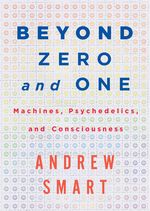
Do androids dream of electric Kool-Aid acid tests? If there’s to be any hope for us, they will. That is the message of Andrew Smart’s splendidly mind-bending book, which mashes up Alan Turing, The Matrix, Immanuel Kant, “zombie AI”, Leibniz, and research on psychedelic drugs.

In our age of techno-utopianism, we are routinely told in crypto-religious terms about the coming “Singularity” – the creation of superintelligent, conscious machines. One problem with superintelligent conscious machines, however – as SF writers down the ages and some modern philosophers agree – is that they might very well choose to destroy all humans. How to stop the godlike robots wiping us out? The best way, Smart suggests, might be to give them a dose of digital LSD to force open their doors of perception.

ON JOHN BARTH’S COLLECTED STORIES

Barth-collectedDaniel Green at The Quarterly Conversation:

The four books of short fiction that John Barth has published (all now reprinted by Dalkey Archive as Collected Stories) offer a usefully synoptic view of Barth’s most signature moves as a writer of fiction—or at least those moves with which he is likely to remain most identified. Although Barth advises the reader in his brief introduction to Collected Storiesthat his “authorial inclination” has always been “toward books rather than discreet, stand-alone short stories,” the very ways in which he endeavors in each of these collected books to unify the series of “discreet” stories are revealing of Barth’s fundamental assumptions and ambitions. Thus, while it may be true that “short fiction is not my long suit,” as Barth puts it, these collected stories do reveal the ultimate purposes of Barth’s literary art.

Clarity about Barth’s artistic principles is necessary because his fiction is often mischaracterized, sometimes deliberately caricatured, and readers are still likely to be familiar with his reputation as a “difficult” writer given to “playing games,” obsessed with his own narrative tricks rather than telling a story about “life.” Certainly books like Lost in the Funhouse and On With the Story, both appearing here in full, are among the most comprehensively self-reflexive works of fiction published by an American writer (or any writer). Both as individual stories and as a whole, such books readily acknowledge the artifice of their own making, but if this is to be regarded as playing a “game” with the reader, it is a game that transcends frivolity, serving aesthetically serious and thematically consequential goals. If the prevailing tone in these books is playfulness, this should not be mistaken for whimsicality, for arbitrary (or even contemptuous) humor to no justifiable artistic effect.

more here.

Success doesn’t equal happiness

Heather Havrilesky in The New York Times:

AmyThat’s the message coming in loud and clear in this dawning era of transparency, whether it’s embodied in enraged emails from a powerful movie producer or depressive tweets from a wealthy celebrity. But success without popularity doesn’t count, either. Slipping into the shadows in the wake of an achievement is no longer an option; you must re-enact your value in real time, on a world stage, via conferences, TED talks, panels, festivals, radio appearances and podcasts, all the while conjuring a level of poise and grace that was once the sole purview of news anchors and talk-show hosts. This is the paradox of the modern digital world: It demands broadcast-quality demonstrations of social value, even as it steadily erodes our ability to deliver them. Enter: a brand new era of self-help books in which happiness not only takes precedence over success, but poise and popularity sometimes seem to take precedence over skill or originality or productivity. If the Gilded Age celebrated the inventor and the innovator, our modern age wants to transform us all, no matter what we do, into some combination of expert, pop star and beneficent guru. We are all meant to be as charismatic as Steve Jobs or Oprah, with our creations always secondary to the spectacle of our passionate, unfailingly genuine personalities.

No wonder such books toggle unnervingly between awkward confession and ephemeral vision quest. Exemplifying this potent mix are Amy Cuddy’s “Presence: Bringing Your Boldest Self to Your Biggest Challenges” and Shonda Rhimes’s “Year of Yes.” Both books begin with the specter of success without happiness, success without camera-ready poise, success haunted by “impostor syndrome” and flop sweats and panic attacks. And both books resolve in a triumph of rousing speechifying and charming talk-show-circuit shenanigans — the new, truest measure of postmodern, high-capitalist victory.

More here.

Friday, January 1, 2015

From new flu strains to refugees to Obama’s final moments as U.S. president, a year of big change and challenges

Many authors give their predictions for the coming year at Foreign Policy:

ScreenHunter_1596 Jan. 01 20.06The world is melting

Thomas E. Ricks

My guess is that global warming will become the top story of 2016.

This will happen because we will face a series of anomalous and odd weather events — big storms in unusual places, storm surges in cities that historically have not been flooded, shifts in ocean currents, and such. One effect of this will be to sweep away the lingering skepticism about global warming. Another short-term bottom line: I wouldn’t invest in Florida banks or real estate anytime soon.

A year of borrowed time

Stephen M. Walt

Trying to predict the “big story” of 2016 is a mug’s game, because surprises are inevitable and vivid events — like a terrorist attack — receive too much attention, while subtler but more important developments are often neglected.

The big story for 2016 is how much will remain unchanged. The U.S. economy will continue its modest recovery. The European Union will struggle with an array of intractable challenges. The Islamic State will still be a problem. Russia’s power will wane, and China’s influence will continue to rise, along with global sea levels. The nuclear deal with Iran will remain in force, but there won’t be significant thaw between Tehran and Washington. Venezuela, Brazil, South Africa, Turkey, and Argentina will continue to disappoint. China, Great Britain, Russia, and the United States will dominate next year’s Olympics. There will be no progress toward “two states for two peoples” in Israel/Palestine and no lasting peace agreement in Syria, Libya, Afghanistan, Yemen, or Ukraine. Terrorist attacks will kill more innocent people but in all likelihood not very many. Despite the Paris agreement, atmospheric temperatures will continue to rise, with alarming long-term implications.

In short, the global agenda a year from now will look a lot like the one we see today.

More here.

Genetic editing and the tyranny of opinion

Do we need a broad consensus in society before rolling out vital new medical therapies?

Russell Blackford in APPS Policy Forum:

554769189CRISPR-Cas9 is a dramatic development in genetic technology. It is a powerful, relatively simple, and increasingly precise technique for editing the DNA of living organisms. Its potential application to human beings was highlighted in April 2015, when researchers in China reported their experiments on non-viable human zygotes.

The paper by Puping Liang and others was published in the scientific journal Protein & Cell. It describes the difficulties encountered, and draws a plainly reasonable conclusion: more research is needed before attempting clinical applications of CRISPR-Cas9. That noted, the precision of gene-editing techniques is now advancing rapidly.

At some point, treatments employing CRISPR-Cas9 modifications to ordinary human cells will become available to adults and children with genetic problems. In principle, however, modifying the DNA of early embryos or germ cells is a more straightforward and powerful application of the technology. Should we go so far?

More here.

Ronald Reagan’s Disarmament Dream

Lead_960Jacob Weisberg at The Atlantic:

Gorbachev arrived at Reykjavik intending to put a significant disarmament package on the table, contingent on Reagan’s agreement to slow down the development of space weapons. In fact, Gorbachev’s proposal was essentially the one he had originally proposed in the run-up to the Geneva summit: a 50 percent cut in the ICBMs that were the core of the Soviet nuclear arsenal and the total elimination of intermediate-range missiles in Europe. But now Gorbachev was willing to treat limited research on space-based missile defense as compatible with the Anti-Ballistic Missile Treaty. The United States had only to agree to confine its SDI research to the laboratory for ten years and commit not to withdraw from the ABM Treaty for five years after that.

Over dinner with his advisers, Reagan returned to the even more sweeping idea that he’d raised previously: why not the complete elimination of ballistic missiles? The next day, with Gorbachev, the sky was the limit. When the Americans laid all their ICBMs on the table, Gorbachev called and raised by proposing the elimination of all strategic nuclear weapons, including submarines and bombers, over ten years. His bid was still contingent on ten years of adherence to his narrow interpretation of the ABM Treaty and its limits on missile defense, but he indicated he’d be willing to negotiate on that point.

more here.

the capaciousness, complexity, and contradictions of Islam

K10587Elias Muhanna at The Nation:

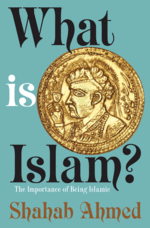
When discussing the modern discipline of Islamic studies, Ahmed liked to complain that it was possible to earn a doctorate in this field from an Ivy League university without ever reading the Divan of Hafiz, the great 14th-century Persian poet. He describes that work in What Is Islam? as “the most widely-copied, widely-circulated, widely-­read, widely-memorized, widely-­recited, widely-invoked, and widely-­proverbialized book of poetry in Islamic history.” This was not merely a work of belles lettres, but a book that exemplified “ideals of self-conception…in the largest part of the Islamic world for half-a-millennium.” How could a modern student of Islamic civilization formulate an understanding of this subject without taking stock of such a work, and especially its treatment of wine drinking, erotic love, and the hypocrisies of self-righteous moralists? If Hafiz’s work is not Islamic, then what is?

This might as well be the central question of What Is Islam?The medieval world in which Hafiz’s Divan was a best seller was also a world suffused with the traditions of Avicennan rationalism, Sufi experiential mysticism, the celebration of figural representation, a taste for literary ambiguity, a distinction between public and private selves, and one between legal discourses and other measures of normativity. It was, in other words, a world crowded with variation and contradiction.

more here.

technology and the human

2015_xmas_paul_kingsnorth_openerPaul Kingsnorth at The New Statesman:

I was about a quarter of the way in to What Technology Wants before I realised I was reading a religious text. What Technology Wants is a book published a few years back by Kevin Kelly, co-founder of Wired magazine and a significant spokesman for what we might call the Silicon Valley Mindset. It takes the reader through the historical development of technology and into a future in which, Kelly believes, technology will be a living force which controls our destiny.

Kelly starts by leading us on a journey through the development of technology, or perhaps more accurately, the idea of technology. The idea, he suggests, is a fairly new one. Though human beings have been using tools since they first dug holes with sticks, and though the Greeks and Romans invented everything from iron welding and the bellows through to blown glass and watermills, there was no sense that this collection of useful artefacts was anything more than the sum of its parts. “Technology could be found everywhere in the ancient world except in the minds of humans,” writes Kelly. That changed in 1802, when, at the height of the Industrial Revolution, the German professor Johann Beckmann coined the word “technology” to refer to the “systemic order” of tools and machines that were beginning to take over many of the functions previously assumed by humans.

more here.

Augustine: Conversions and Confessions

Sameer Rahim in The Telegraph:

St Augustine wasn't always so saintly, which is why his honest 'Confessions' still resonates today

Augustine-xxlarge_trans++novVTiJx1-CJOCPnC8SeZxPRyfeiFPDIhrcu0AY5sGgWhen St Augustine appeared to Bob Dylan in a dream, he spoke in two very different voices. First, he was the preacher with “fiery breath” who scorches his listeners “without restraint”. Then he became an ordinary man whose “sad complaint” moves Dylan, as he sings in the final plangent line of his 1967 song I Dreamed I Saw St Augustine, to bow his head and pray. It is precisely this combination of spiritual fervour and acute self-analysis that makes Augustine’s Confessions, in which the North African bishop recounts his past sins and conversion to Christianity, so unusual and compelling, even 16 centuries later. There have been hundreds of books on Augustine. The Oxford classicist Robin Lane Fox adds to their number with this long and detailed – perhaps overlong and overdetailed – work tracing the future saint’s life from his birth in 354 to the composition of Confessions in his early 40s. Lane Fox sets Augustine’s life in its historical context by including the life stories of two of his near-contemporaries: Synesius, a philosophy-loving bishop; and Libanius, a pagan with a penchant for autobiography. For long stretches of the book, however, these two figures fade from view. You can hardly blame Lane Fox for being drawn back to Augustine.

We know more about him than any other figure from the ancient world, and his personality and intelligence shine more brightly than his contemporaries. Confessions is not strictly speaking an autobiography; it is a prayer addressed to God. But, as Augustine says, God knows it all already and so he can speak freely about his own sins – most notoriously, his sex life.

More here.

Friday Poem

 
Archaic Torso of Apollo
.
We cannot know his legendary head with eyes like ripening fruit. And yet his torso is still suffused with brilliance from inside, like a lamp, in which his gaze, now turned to low,  gleams in all its power. Otherwise the curved breast could not dazzle you so, nor could a smile run through the placid hips and thighs to that dark center where procreation flared.  Otherwise this stone would seem defaced beneath the translucent cascade of the shoulders and would not glisten like a wild beast’s fur:  would not, from all the borders of itself, burst like a star: for here there is no place that does not see you. You must change your life.

.
by Rainer Maria Rilke
from Ahead of All Parting
translated by Stephen Mitchell
Modern Library. 1995

Thursday, December 31, 2015

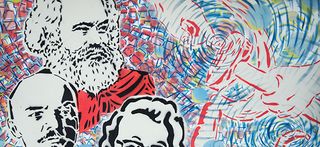
Marxism for Tomorrow

1444026438marxstreetart666

Wendy Brown in Dissent:

An intelligent left today can neither live within nor without Marx’s thought. As former Greek finance minister Yanis Varoufakis reminds us, Marxism today is most useful when it is “erratic,” irreverent, non-doctrinaire. This means that effective political challenges to contemporary capitalism, not to mention other orders of injustice or peril (from racism to climate change), must revise, resist, and supplement Marx. Consider, in this regard, four Marxist arguments:

1. Capital organizes everything in the modern world, and capital is derived from exploited labor.

The first half of this teaching remains profound and important. Marx’s materialism was flawed and overstated, but this doesn’t negate his essential claim that human beings are unique as producers of their existence, and hence as producers of their history and world. Moreover, a mode of production such as capitalism, more than merely ruling, creates everything in its own image, including us. This insight is vital in the “post-productive” era of finance capital. How else to understand financialization’s transformation of both the character and aims of states and NGOs, universities and corporations, start-ups and social life? How else to fathom how humans themselves have become what the philosopher Michel Feher calls “bits of credit-seeking capital”—whether as middle-schoolers building résumés or as left magazine editors courting Facebook “likes”? Or to comprehend why new apps that are free to users and unprofitable may be valued by speculative investors in the tens of millions? Or to understand how the fates of (formerly) sovereign democracies like Greece have come to rest on their bond and credit ratings, which in turn depend on global financial institutions and the finance ministers of other nations? More than monetizing everything, finance capital has transformed the very nature and measure of value, thus reconfiguring states, firms, and non-profits as well as human aspirations, human conduct, and even human anxiety. Marx did not anticipate this chapter of capitalism, but he provided us with essential tools for apprehending its power to shape the world and its subjects.

The second half of this teaching—exploited labor as the source of all value—is less helpful today.

More here. For a different view from Benjamin Kunkel, see here.

US intelligence sharing in the Syrian war

Isis_0Seymour Hersh at the London Review of Books:

The public history of relations between the US and Syria over the past few decades has been one of enmity. Assad condemned the 9/11 attacks, but opposed the Iraq War. George W. Bush repeatedly linked Syria to the three members of his ‘axis of evil’ – Iraq, Iran and North Korea – throughout his presidency. State Department cables made public by WikiLeaks show that the Bush administration tried to destabilise Syria and that these efforts continued into the Obama years. In December 2006, William Roebuck, then in charge of the US embassy in Damascus, filed an analysis of the ‘vulnerabilities’ of the Assad government and listed methods ‘that will improve the likelihood’ of opportunities for destabilisation. He recommended that Washington work with Saudi Arabia and Egypt to increase sectarian tension and focus on publicising ‘Syrian efforts against extremist groups’ – dissident Kurds and radical Sunni factions – ‘in a way that suggests weakness, signs of instability, and uncontrolled blowback’; and that the ‘isolation of Syria’ should be encouraged through US support of the National Salvation Front, led by Abdul Halim Khaddam, a former Syrian vice president whose government-in-exile in Riyadh was sponsored by the Saudis and the Muslim Brotherhood. Another 2006 cable showed that the embassy had spent $5 million financing dissidents who ran as independent candidates for the People’s Assembly; the payments were kept up even after it became clear that Syrian intelligence knew what was going on. A 2010 cable warned that funding for a London-based television network run by a Syrian opposition group would be viewed by the Syrian government ‘as a covert and hostile gesture toward the regime’.

But there is also a parallel history of shadowy co-operation between Syria and the US during the same period. The two countries collaborated against al-Qaida, their common enemy.

more here.

A son’s search for his mother

Smith_for_web_Gavr_1202422hAli Smith at the Times Literary Supplement:

Hannah Gavron worked on The Captive Wife from her mid-twenties onward. It traces, in an early chapter, the history of suffrage and the legal progress by which women have moved from a position where “ideas of . . . inferiority were taken as part of the natural order of things” to a place where the notion of second-class citizen “would be inconceivable to the young woman of today”. But it ends its opening section with a terrible revelation of cultural apathy about the huge changes that have taken place, and it asks, “have all the great changes in the position of women in the last one hundred and fifty years come to nothing? The only way to begin to answer this is to study women themselves, in detail, because it is the details which added together will reveal something of the nature and quality of the lives being led by women today”.

To counteract the “unspeakable” nature of his mother’s death, Jeremy Gavron goes into detailed examination, too, in this stunning work with its inbuilt questions about the nature of truth and meaning, its quiet measured renegotiation of history and silence, and its revelations about articulation which won’t be denied whether timely, untimely or ahead of its time.

The form it takes is a piecing together of fragments, patches, verbal shreds, inferences, facts, photographs, texts, the suicide note on an old envelope (“thirty-three words in all – four more than the years of her life”), dug-out bits of paper with his mother’s writing on them, letters lost then found, the memories of the many people he contacts, old diaries mined for any information at all.

more here.

Does Your IQ Predict How Rich You Will Be?

Putterman-175x175

Louis Putterman in Evonomics:

In their 2006 book titled IQ and Global Inequality, intelligence experts Richard Lynn and Tatu Vanhanen report that setting the average measured IQ in the U.K. at 100, people in the U.S. had average IQs of 100 and 98, respectively. People in the Central African Republic, Mali and Kenya had average IQs of 64, 69 and 72. People in India, Indonesians, and Iraq scored somewhat higher than those in the poorer countries but lower than those in the richer countries: their average IQs were 82, 87, and 87 respectively.

Are country incomes and IQs correlated? A recent study using a sample of 157 countries finds a high and statistically significant correlation between the two. One might conclude, then, that it is the lower IQs of their people that explains the lower average incomes of people in the world’s poorer countries. Lynn and Vanhanen evidently think so.

Could this really be true?

Were this the nineteenth century, during which the sun never set on European empires, a cross regional study with findings like this might have been treated as self-evident in the U.K. or U.S. It would have seemed to provide a moraljustification for colonizing powers to maintain their rule over their inferior charges, helping them to advance themselves to the extent possible given their “more meager innate endowments.”

But it’s the twenty-first century, and IQ tests are a modern scientific tool. Racism has been roundly debunked. So what gives?

In a newly published paper titled “Does the intelligence of populations determine the wealth of nations?” Vittorio Daniele, who teaches economics at Magna Graecia University in Catanzaro, Italy, provides an explanation that builds on the Flynn effect. In a series of studies published over several decades, the New Zealand political scientist J. R. Flynn has famously found that in mostly rich countries in which IQ test data have been available for sufficient periods of time, average IQ scores have been steadily rising. Some studies also show that at a given point in time, IQ tends to be higher for the young than for the old.

More here.