
Dean Kissick in Harper’s Magazine:
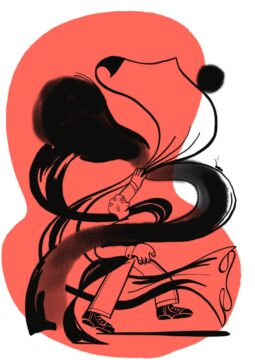 My mother lost both of her legs on the way to the Barbican Art Gallery. It was her day off, and she was going there to see an exhibition called Unravel: The Power and Politics of Textiles in Art. She had just arrived in London on a coach from Oxford and was run over by a bus outside Victoria Station. This was on a Friday morning in early May. The next day, in my apartment in Manhattan, I received an unexpected call—my mother never calls me—from a trauma ward in West London. “I’m in a lot of pain,” she said in a loud, anguished, slurring voice I hardly recognized, “but I’m in very good hands.” A few hours later, I was on a flight home.
When I visited her in the hospital, Mom asked me whether the show was worth losing her legs for. “No,” I told her, though at that point, I hadn’t seen it. When I did, two weeks later, my answer proved correct. Unravel featured tapestries, quilts, needlework, sculptures, and installations by modern artists, the majority of whom were of historically marginalized identities. The curators proposed that textiles themselves had also been marginalized, having been gendered as feminine and regarded as “craft” rather than “fine art.” As a result, the exhibition’s introductory text argued, the more politically radical aspects of textile making had been obscured. “What does it mean to imagine a needle, a loom or a garment as a tool of resistance?” the text asked.
More here.
Enjoying the content on 3QD? Help keep us going by donating now.
 D
D Building a film around a temperamental genius is never as simple as placing a star at its center. Murphy and Chalamet both do their parts: they create, they scowl, they have affairs. They are misunderstood. But their perceived genius is less about their particular actions than it is about the reactions of secondary characters. This is apparent throughout A Complete Unknown. In her review of the film, Vulture’s Alison Willmore highlights the cast around Chalamet: “Its best sequences aren’t about Dylan so much as they are about what it was like to be in his orbit when it felt like he could remake the universe.” The film succeeds because it captures how Dylan’s peers saw him—what made them want to be near him, what made them want to support his career.
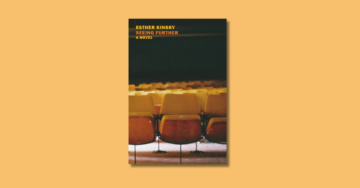 In Kinsky’s latest novel,
 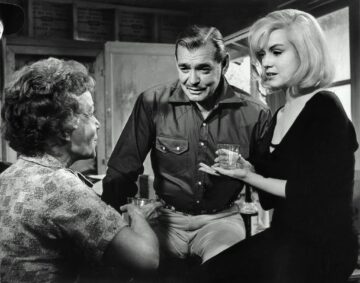 I can’t recall the first time I saw “The Misfits,” John Huston’s 1961 cinematic masterpiece about a quartet of mutually disenfranchised wanderers, but I’m certain it was after I’d become a divorcée. I know it wouldn’t have stuck with me so permanently otherwise. Set in Reno, Nev., a city once as famous for its hassle-free divorces as its casinos, the film is a timeless meditation on what it means to lose.
 Working in the field of genetics is a bizarre experience. No one seems to be interested in the most interesting applications of their research.
 The 20th century had a bunch of rising powers that all reached their peaks in terms not just of relative military might and economic strength, but of technological and cultural innovation. These included the United States, Japan, Germany, and Russia. So far, the 21st century is a little different, because only one major civilization is
  Genetically engineered woolly mice could one day help populate the Arctic with hairy, genetically modified elephants and help stop the planet warming.
 I
I A
A He began studying
  Reality can sometimes seem even stranger than fiction, and the second Trump administration has done what many people supposed to be six impossible things within the first month of its tenure. The upshot is that we are now living in a post-NATO world where black is white, up is down, friends are foes (and vice versa), and once-unthinkable impossibilities have become our new reality.
 When people ask me, “How are Canadians different from Americans?” I say, “Canadians have one characteristic: they’re polite, but wrong.” All the time, polite but wrong.
 For the last couple of months, I have had this strange experience: Person after person — from artificial intelligence labs, from government — has been coming to me saying: It’s really about to happen. We’re about to get to
  Michel de Montaigne is often upheld as a model of the examined life. In her introduction to What Do I Know? (the latest selection of Montaigne’s essays, translated by David Coward and published in 2023 by Pushkin Press), Yiyun Li writes: “For me, his writing serves as a reminder, a prompt, even, a mandate: a regular meditation on selfhood, like daily yoga, is a healthy habit.” And in M.A. Screech’s introduction to his translation of the Essays, he describes it as “one of Europe’s great bedside books.” Alain de Botton likewise included Montaigne in his book The Consolations of Philosophy as a helpful guide for thinking about the problem of self-esteem, and in his book The School of Life, he writes that the Essays “amounted to a practical compendium of advice on helping us to know our fickle minds, find purpose, connect meaningfully with others and achieve intervals of composure and acceptance.”