Slow Burn City: London in the Twenty-First Century

9781447270188Jonathan Meades at Literary Review:

London’s architecture has become laughably boorish, confidently uncouth and flashily arid. Neomodern bling and meretricious trash are the current norms. Without exception, big-name architects turn out to be horizontals who happily put their knees behind their ears at the first sight of an oligarch, a Gulf princeling, a Central Asian dictator, a modern slave-driver or a property swine, while lecturing us on sustainability, low emissions, affordability, bicycles, ethical regeneration and whatever other right-on shibboleths are in the air this week. London is a magnet for a caste of designers who seem hardly to notice that the milieu they inhabit is chasmically remote from the lives of those affected and afflicted by their creations. It is the city – sorry, ‘global city’ – where reputations built through decades of imagination and toil, strict image control and rigorous PR are frittered away in a blizzard of self-parody and voracious cupidity. The tectonic gerontocrats Rogers, Viñoly, Piano, Foster, Nouvel, Shuttleworth and so on are apparently locked in a perpetual competition to vandalise the sky with banality. There are outsiders in there too, architectural practices that, all too evidently, never had a reputation to lose – for instance, the incompetents culpable of the Strata building in Elephant and Castle, or those at Broadway Malyan, whose destruction of Vauxhall deprived London of a valuable terrain vague. A few hundred metres west, the ineffable Gehry has his head in the corpse of Battersea Power Station like a vulture in a lamb’s ribcage.

Despite all this, or rather because of all this, the standard of English writing about urbanism, architecture and its mostly unintended or unforeseen consequences has risen to dizzying heights.

more here.
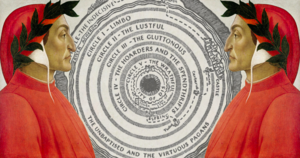
How to Read Dante in the 21st Century

Joseph Luzzi in The American Scholar:

Dante-hellgià volgeva il mio disio e ’l velle,
sì come rota ch’igualmente è mossa,
l’amor che move ’l sole e l’altre stelle.

now my will and my desire were turned,
like a wheel in perfect motion,
by the love that moves the sun and the other stars.

These breathtaking lines conclude Dante’s Divine Comedy, a 14,000-line epic written in 1321 on the state of the soul after death. T. S. Eliot called such poetry the most beautiful ever written—and yet so few of us have ever read it. Since the poem appeared, and especially in modern times, those readers intrepid enough to take on Dante have tended to focus on the first leg of his journey, through the burning fires of Inferno. As Victor Hugo wrote about The Divine Comedy’s blessed realms, “The human eye was not made to look upon so much light, and when the poem becomes happy, it becomes boring.”

In truth, some of the most sublime moments in The Divine Comedy, indeed in all of literature, occur after Dante makes his way out of the Inferno’s desolation. But Hugo’s attack suggests the particular challenge in reading Dante, whose writing can seem remote and impenetrable to modern tastes. Last year marked the 750th anniversary of Dante’s birth in 1265, and as expected for a writer so famous—Eliot claimed “Dante and Shakespeare divide the modern world between them; there is no third”—the solemn commemorations abounded, especially in Italy where many cities have streets and monuments dedicated to their Sommo Poeta, Supreme Poet. Yet Dante has the unenviable fate of having become more known than read: his name is immediately recognizable, his achievements justly acknowledged, but outside the classroom or graduate seminar, only the hardiest of literary enthusiasts pick up his Divine Comedy. Oddly enough, and at least in the United States, we seem to know more about Dante the man—his exile, his political struggles, his eternal love for Beatrice—than his poetry.

More here.

Tuesday Poem

Wayside Shrines

Doomed as I was to follow a big rig
laden with pigs and a wrecker with its intermittent strobe
I was all the more conscious of piles of rock
marking the scene of a crash,
some with handwritten notes, others a cache
of snapshots in a fogged-up globe.

Even a makeshift mobile may see off one of Calder’s
and the path among the alders
pan out like a prom-queen’s occipital lobe,
yet nothing can confirm one’s sense of being prized
like another’s being anathematized.
.

by Paul Muldoon
from Plan B
London: Enitharmon, 2009

Chocolate Can Boost Your Workout

Gretchen Reynolds in The New York Times:

Well_chocolate-tmagArticleAdding a little dark chocolate to a training diet may effortlessly improve endurance performance, according to a new study of sports nutrition. The findings provide ammunition both for athletes looking for an edge and those hoping for an excuse to indulge. For some time, dark chocolate has been touted as a relatively healthy treat, with studies showing that small amounts may have benefits for the heart and brain. Most of this research has focused on the role of a substance called epicatechin, a plant nutrient found in cocoa. Dark chocolate is generally rich in epicatechin, though levels vary, depending on how the sweet was produced. Levels of epicatechin tend to be much lower in milk chocolate, which contains little cocoa, and white chocolate contains little or none of the nutrient.

Epicatechin is known to prompt cells that line blood vessels to release extra nitric oxide, a substance that has multiple effects in the body. Nitric oxide slightly increases vasodilation, or a widening of the veins and arteries, improving blood flow and cardiac function. It also gooses muscle cells to take in more blood sugar, providing them with more energy, and it enhances the passage of oxygen into cells. Because of its many physiological effects, each of which can aid physical performance, athletes long have looked for ways to increase the amount of nitric oxide in their bloodstreams. Some down supplement pills, although the benefits of nitric oxide supplements are unproven. Others swallow beetroot juice, a beverage that contains a hefty dose of nitrates, which then break down in the body into nitric oxide and other substances. There are questions, however, about the safety of nitrates and also, as anyone who has tried beetroot juice will tell you, the palatability of a beverage that tastes distinctly like liquid dirt.

More here.

Monday, March 28, 2016

3 Quarks Daily is looking for new Monday Columnists

Dear Reader,

6a00d8341c562c53ef010536413bef970b-400wiHere's your chance to say what you want to the large number of highly educated readers that make up 3QD's international audience. Several of our regular columnists have had to cut back or even completely quit their columns for 3QD because of other personal and professional commitments and so we are looking for new voices. We do not pay, but it is a good chance to draw attention to subjects you are interested in, and to get feedback from us and from our readers.

You would have a column published at 3QD every fourth Monday. It should generally be between 1000 and 2500 words and can be about any subject at all. To qualify for a Monday slot, please submit a one or two paragraph bio and a sample column to me by email (s.abbas.raza.1 at gmail.com) as an MS Word-compatible document, or a URL if what you want us to look at is available online, which I will then circulate to the other editors and we will let you know our decision by about April 11. If you are given a slot on the 3QD schedule, your sample can also serve as your first column if it has never been published anywhere in print or online before. Feel free to use pictures, graphs, or other illustrations in your column. Naturally, you retain full copyright over your writing.

Please DO NOT submit more than one piece of writing, and also do not send the URL for a whole blog or website. I do not have the time to look through multiple postings. Select one piece of writing that you think is representative of the kinds of things you'd like to do at 3QD and just send that please.

Several of the people who started writing at 3QD have gone on to get regular paid gigs at well-known magazines, others have written well-received books. Even those who have not, have written to us saying that it has been a uniquely rewarding experience.

The deadline for submissions is 11:59 PM New York City time, Saturday, April 2, 2016.

Yours,

Abbas

NEW POSTS BELOW

Sunday, March 27, 2016

Albert Camus in New York City

Robert Zaretsky in the Los Angeles Review of Books:

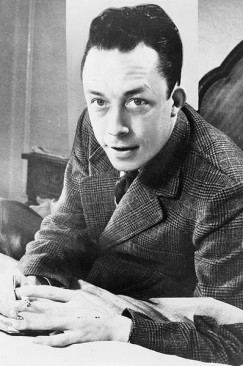
Camus1-243x366On March 25, 1946, the French anthropologist Claude Lévi-Strauss, having left the rainforests of Brazil for the concrete canyons of New York City, confronted a social structure as complex and harsh as those he had found in the rainforests of Brazil. Moonlighting as the French Embassy’s cultural attaché, Lévi-Strauss received an unexpected visit from a group of French passengers who had just arrived on an American freighter, theOregon. Immigration officials had detained one of them because he refused to give the names of friends who belonged to the Communist Party. Lévi-Strauss dispatched a colleague to the docks, and the French visitor, frazzled and frustrated, was finally released.

With this faintly absurd event began Albert Camus’s only visit made to America.

Camus was no ordinary tourist. France’s Ministry of Foreign Affairs had sent him as an official representative of the recently liberated country. Who better to speak to American audiences about France’s experience of occupation and liberation? By 1944 and the liberation of Paris, the young French-Algerian writer was not just the author of The Stranger and The Myth of Sisyphus, both published to critical acclaim in occupied Paris. He was also the editor of Combat, the most influential underground paper of the French Resistance. With a suddenness that both touched and troubled him, Camus had become the one marketable export left to a bloodied and brutalized country: the French intellectual for whom ideas were a matter of life and death.

His friend, Jean-Paul Sartre, had preceded him to New York in 1945. Playing the role of existentialism’s John the Baptist, Sartre spoke at great length about Camus to a reporter from, of all places, the American edition of Vogue. Praising the new literature that had taken root in the liberated soil of France, Sartre declared, “its best representative is Albert Camus, who is thirty years old.”

More here.

Embattled Forensic Experts Respond to Scandals and Flawed Convictions

Liliana Segura and Jordan Smith in The Intercept:

ScreenHunter_1815 Mar. 27 18.54Despite the image peddled by popular TV shows like CSI: Crime Scene Investigation, which portray forensic experts as crime-fighting scientists with unparalleled gifts of observation, the field has become increasingly embattled in recent years. Crime labs have come under fire for mishandling evidence, and high-profile exonerations have exposed how “junk science” has sent innocent people to prison. The bad press has led to heightened skepticism of forensics, forcing practitioners to defend their reputation.

2015 was no exception. Soon after the AAFS convened last February under the banner “Celebrating the Forensic Science Family,” a series of controversies cast further scrutiny on the field. There was the abrupt halting of DNA testing in Washington, D.C.’s first independent crime lab — a three-year-old $220 million project whose director was forced to resign amid damning audits. There was the ongoing fallout in Massachusetts over a crime lab chemist who falsified thousands of drug tests over her nine-year career. And there were the usual headlines exposing miscarriages of justice based on junk science: a Texas man freed after 25 years in prison due to bad “bite mark” evidence, and three men exonerated in New York after more than 30 years based on a faulty arson investigation (one died of a heart attack in prison). Among the record number of cleared cases in 2015, according to the National Registry of Exonerations, 45 involved “false or misleading forensic science.”

But perhaps most devastating, in April 2015, the Justice Department issued a bombshell announcement, formally admitting to a disastrous mishandling of evidence that lawyers, prisoners, and even its own forensic experts had pointed out for years. For more than two decades, as the Washington Post reported, FBI analysts doing hair fiber examination “gave flawed testimony in almost all trials in which they offered evidence against criminal defendants.”

More here.

Here comes pseudolaw, a weird little cousin of pseudoscience

Colin McRoberts in Aeon:

ScreenHunter_1814 Mar. 27 18.47Would you like to stop paying taxes? Just renounce your 14th Amendment United States citizenship and claim ownership of the secret cestui que (beneficiary) trust that the US government created in your name on the day that you were born. Credit card debt? No problem, the trust is flush with millions or billions of dollars that you can use, just as soon as you establish ownership of your verified birth certificate and the corporate entity that has your name – but in all-capital letters.

These are some of the claims advanced by the self-styled experts who insist that everything you know about the legal system is wrong. These days, we are distressingly familiar with alternative, conspiracy-theory versions of science and medicine. Less well-known is the legal version of this phenomenon, not as visible as creationism or anti-vaccine activism but in many ways as destructive. Just ask the residents of Harney County, Oregon, who recently saw militants occupying the Malheur Wildlife Refuge emboldened by ‘judges’ and ‘citizen grand juries’ who had less to do with actual law than fantasy football does with the US National Football League.

Pseudolaw resembles pseudoscience in both its methods and applications. Believers are typically intelligent and motivated, and capable of constructing complex edifices that sound superficially credible.

More here.

The Inherent Bias of Facial Recognition

Rose Eveleth in Motherboard:

ScreenHunter_1813 Mar. 27 18.32Facial recognition systems are all over the place: Facebook, airports, shopping malls. And they’re poised to become nearly ubiquitous as everything from a security measure to a way to recognize frequent shoppers. For some people that will make certain interactions even more seamless. But because many facial recognition systems struggle with non-white faces, for others, facial recognition is a simple reminder: once again, this tech is not made for you.

There are plenty of anecdotes to start with here: We could talk about the time Google’s image tagging algorithm labeled a pair of black friends “gorillas,” or when Flickr’s system made the same mistake and tagged a black man with “animal” and “ape.” Or when Nikon’s cameras designed to detect whether someone blinked continually told at least one Asian user that her eyes were closed. Or when HP’s webcams easily tracked a white face, but couldn’t see a black one.

There are always technical explanations for these things. Computers are programmed to measure certain variables, and to trigger when enough of them are met. Algorithms are trained using a set of faces. If the computer has never seen anybody with thin eyes or darker skin, it doesn’t know to see them. It hasn’t been told how. More specifically: the people designing it haven’t told it how.

The fact that algorithms can contain latent biases is becoming clearer and clearer. And some people saw this coming.

More here.

Cast No Evil

Alia Ali in Lensculture.com:

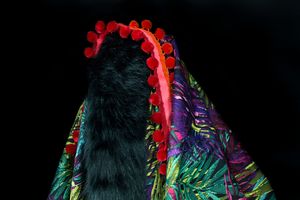
WomanThroughout life we are presented with endless examples in which individuals and groups have been excluded from communities based on appearances, beliefs and actions. When this happens, there must always be two, those who impose standards, the decision makers, the 'included,' and those they exclude. Communication can be used to both connect and divide, evolve and regress, educate and destroy. Inclusion is, therefore, engaging someone in a dialogue, but not necessarily a verbal one.

Girl4…The characters in the portraits, called —cludes, are wrapped in layers of fabric that shield them from interrelating with anything beyond the material. What are these fabricated barriers in society that inhibit the incorporation of others? Or are the obstacles just that: ideas, intuitions, fear, discriminations and ‘understandings’? Does inclusion mean acceptance? If so, does this definition lend itself to exclusion meaning rejection? Or do they both mean different points on the spectrum of tolerance? What side of the fabric are we on and can we be on both sides at once? When we exclude, does it come from the fear of being excluded ourselves? Isn’t exclusion a form of security, as well? If so, what is it that we fear from discovering that lies beneath the cloth and behind the curtain? By remaining indifferent, and incommunicative, do we become like one of them, dehumanized? Dummies? Or are we the ones enclosed and what we see is an illusive barrier that we have bestowed on them?

Who are the ‘includes’ and who are the ‘excludes’? How do we become secludes.

Does the material set a power dynamic? It certainly creates a boundary, but who holds the power; them, for their anonymity, or us, for their confinement?

More here.

American, Muslim, and under constant watch

Rose Hackman in The Guardian:

AhsanAhsan Samad sits on the sofa in the living room of his small family home in Brooklyn, New York. The 30-year-old plumber leans forward and carefully pours the coffee his mother has just brought in from the kitchen. His young niece and nephew are playing in a nearby room. “I know I have done nothing wrong. I am constantly thinking about it. Their visits made me terrified.” Samad looks up, bewildered and confused. He is trying to lay out the complexity of the mental hell the past four and a half years have been for him. Samad is an American citizen with no criminal record – no arrests, no felonies. But in the shifting eyes of the American law, he is something worthy of seeming extra attention. Samad is not just American – he is also Muslim.

Over the course of more than four years between September 2011 and 2015, he received at least five visits to his home by NYPD and then FBI officers. He says the visiting officers came with no warrant and used threatening and provocative language. During a visit in September 2011, they even forced themselves inside his home. Law enforcement agents presenting themselves to his residence were repeatedly and systematically told by him and his petrified family members to arrange for interviews in the presence of lawyers (who later followed up with agencies) – something law enforcement officials repeatedly declined to do. Followups by Samad’s lawyers – members of a free legal clinic named Clear, which is operated by the law school at City University of New York – have not revealed the existence of any kind of formal investigation tied to Samad and his family.

More here.

Sunday Poem

A Prism: Wet With Wars

this is the chapter of
devastation
this is our oasis
an angle where wars intersect
tyrants accumulate around our eyes
and in the shackle’s verandah
there is enough space for
applause
let us applaud

another evening climbs
the city’s candles
technological hoofs crush the night
a people is being slaughtered across short waves:
but local radio vomits raw statements
and urges us to
applaud

with a skeleton of a burning umbrella
we receive this rain
a god sleeps on our flag
but the horizon is prophetless
maybe they will come if we
applaud
let us applaud

we will baptize our infants with smoke
plough their tongues
with flagrant war songs
teach them the bray of slogans
and leave them beside burning nipples
in an imminent wreckage
and applaud

before we weave an autumn for tyrants
we must cross this galaxy of barbed wires
and keep on repeating
HAPPY NEW WAR!

Baghdad, March 1991
by Sinan Antoon
from Iraq Poetry Today
Zephyr Press, 2003
Translated from the Arabic by the poet

Saturday, March 26, 2016

How the surprising union between a fungus and an alga raises questions about the nature of identity

Elizabeth Lopatto in Bay Nature:

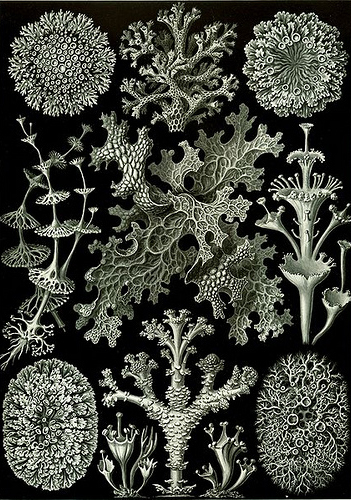
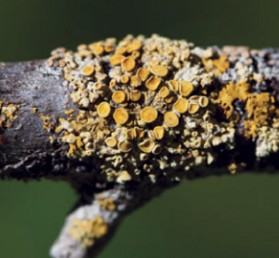
ScreenHunter_1812 Mar. 26 19.07In July, Governor Jerry Brown signed into law a bill declaring the lace lichen—found along the Pacific coast and throughout the coast ranges—the state lichen. As of January 1, 2016, California will be the first state ever to designate a lichen as a state symbol.

Lace lichen, Ramalina menziesii, is easily recognized. It is pale green and dangles in strips from trees. It’s sometimes confused with Old Man’s Beard (Usnea sp.), which is also pale green and dangly. Lace lichen’s range stretches from Alaska to Baja California. It’s an important food for deer; it also serves as material for birds’ nests. I see it once, in researching this story, when naturalist Morgan Evans, a former student naturalist aide at Tilden Nature Area in the East Bay hills, removes it from her backpack and spreads it out. Evans is a pleasant and patient woman, whose true love is fungi. Her interest in lichens is an extension of that, she says. Anyway, she found some lace lichen growing in Morgan Territory Regional Park. She figured I’d want to see it and there isn’t much growing in Tilden that she knows of. She hands me the lichen, which feels strangely plasticine. It’s pale green—she wetted it so it wouldn’t crumble when she transported it—and dangles impressively, at least six inches long. Lace lichen can grow as long as a meter, and it has a netted structure that looks, to me at least, more like fishnet stockings than lace. Perhaps fishnet-stocking lichen would be a little too racy a nickname.

Before I tell you more, though, a disclaimer: It turns out lichen identity is fraught with existential issues, not least of which is that lichens are a union between two separate organisms.

More here.

Haptics and Emotion: How Touch Communicates Feelings

Ajay Karpur at Somatic Labs:

ScreenHunter_1811 Mar. 26 18.53When we think about the content of a conversation, it’s easy to focus on just the verbal information exchanged through spoken words; however, there are many other factors that color our interpretation of conversations and, in turn, the information they communicate. One such consideration is the context provided by prosody—the intonation, stress, tempo, rhythm, and pauses in a person’s speech, all of which lend their voice a unique texture. The brain also employs detailed mappings that link different kinds of facial expressions and gestures with the emotions and nuances that they convey. In fact, up to 65% of the raw information in a conversation is exchanged nonverbally [1]. As we continue to investigate human communication, we uncover a highly complex, multi-modal system that comprises many of our senses—including our sense of touch.

Though modern messaging systems are efficient in transmitting visual information, they provide a limited channel for expressing emotions and fail to capture the nuances of face-to-face conversations. To express emotion, people often resort to using emoticons, emoji, or shorthand abbreviations (such as the ubiquitous ‘lol’). While grinning face, smiling face with open mouth, and face with tears of joy all convey different “happy” emotions, none of these pictographs can convey what it feels like to see a subtle smile creep across someone’s face and cascade into a joyous laugh.

More here.

Artist Shahzia Sikander on her multicultural past and our future

Shahzia Sikander in the Los Angeles Times:

ScreenHunter_1810 Mar. 26 18.47Human identity is mercurial. Like a human being, it is alive and liable to shift, evolve, challenge and surprise.

I was born in Lahore, Pakistan, to a family of storytellers. My father was an enthusiastic narrator, with oratory prowess. My first memory is of him reading to me Korney Chukovsky's book “Unusual Tales” translated into Urdu. His creative freedom in customizing the tales as he read out loud was infectious and entertaining. It signaled to me as a young child to be inventive. A couple of years later, encounters with Edgar Allan Poe, Lewis Carroll, Walter de la Mare alongside the stories of Miraj — the visionary night journey of Prophet Muhammad — felt like the Everest expedition in pursuit of wit, candor and irony. In high school the pendulum swung between Shakespeare and Salman Rushdie and a multitude of sources in between, allowing my imagination to inspect reality from different cultural consequences.

But growing up in Pakistan in the 1980s under a military regime that incessantly institutionalized religion was a deeply conflicting experience. The Hudood ordinances, which limited women's rights, loomed large. Art school was considered immoral. Co-education dissipated. Religious tolerance diminished.

More here.