Category: Recommended Reading
Thriving at Age 70 and Beyond
Jane Brody in The New York Times:
A recently published book, “70Candles! Women Thriving in Their 8th Decade,” inspired me to take a closer look at how I’m doing as I approach 75 and how I might make the most of the years to come. It would be a good idea for women in my age cohort to do likewise. With a quarter of American women age 65 expected to celebrate their 100th birthday, there could be quite a few years to think about. It’s not the first time I’ve considered the implications of longevity. When one of my grandsons at age 8 asked, “Grandma, will you still be alive when I get married?” I replied, “I certainly hope so. I want to dance at your wedding.” But I followed up with a suggestion that he marry young!
Still, his innocent query reminded me to continue to pursue a healthy lifestyle of wholesome food, daily exercise and supportive social connections. While there are no guarantees, like many other women now in their 70s, I’ve already outlived both my parents, my mother having died at 49 and my father at 71. If I have one fear as the years climb, it’s that I won’t be able to fit in all I want to see and do before my time is up, so I always plan activities while I can still do them. I book cycling and hiking trips to parts of the world I want to visit and schedule visits to distant friends and family to be sure I make them happen. In a most pragmatic moment, I crocheted a gender-neutral blanket for my first great-grandchild, but attached a loving note in case I’m no longer around to give it in person. Of course, advancing age has taken — and will continue to take — its incremental toll. I often wake up wobbly, my back hates rainy days, and I no longer walk, cycle or swim as fast as I used to. I wear sensible shoes and hold the handrail going up and down stairs. I know too that, in contrast to the Energizer Bunny life I once led, I now have to husband my resources more carefully. While I’m happy to prepare a dish or two for someone else’s gathering, my energy for and interest in hosting dinner parties have greatly diminished. And though I love to go to the theater, concerts, movies and parties, I also relish spending quiet nights at home with my Havanese, Max, for company.
More here.
The left-wing firebrands who turned to the right
John Gray at The New Statesman:
Writing about Whittaker Chambers, who, from being a member of the Communist Party and later an operative for Soviet intelligence, defected to become a leading figure of the American right, Daniel Oppenheimer comments: “The party, for Chambers, was less a political organisation than a crucible for the forging of his own Bolshevik soul.” It is an astute judgement, one that applies to some degree to all of the six apostates from the left whose lives and beliefs Oppenheimer examines in this arresting and at times revelatory study. Chambers, James Burnham, Ronald Reagan, Norman Podhoretz, David Horowitz and Christopher Hitchens were different from one another in many ways, some of them quite fundamental. And yet, for each man, his volte-face was much more than a response to world events: it was an exercise in self-creation, in which what was being fashioned was the meaning of a life.
Chambers turned to communism while fleeing a fractured family and a hidden life of homosexual cruising, which he renounced when he rejected communism and became a Christian. A scion of Princeton and Balliol, Burnham used his mastery of Marxist theory to show off his formidable intellect and, once he had demolished Marxism, to issue dramatic forecasts of the near future that were nearly always confounded, but somehow enabled him to enjoy an afterlife as a consultant to the CIA. Reagan moved on from liberalism to the American presidency by way of a failed marriage and a flagging Hollywood career.
more here.
Open the Cages!
Peter Singer at The New York Review of Books:
The most fundamental question to ask about Pacelle’s thesis is whether the humane economy can take us beyond piecemeal reforms to a world without speciesism. As long as we continue to eat animals, that seems doubtful, for it is difficult to respect the interests of beings we eat, especially when we are under no necessity to eat them. This daily practice taints all our attitudes toward animals. Can the humane economy change that?
Pacelle introduces us to several entrepreneurs who are trying to change it. Plant-based products with the taste and “mouth feel” of meat are already in supermarkets and restaurant chains, offering a product that is not only cruelty-free, but healthier and more environmentally friendly than meat. Further down the track, if costs can be reduced we may be eating meat that comes from a factory without ever being part of an animal. In 2013 Mark Post, of Maastricht University in the Netherlands, served a group of journalists the world’s first lab-grown hamburger. In a Brooklyn laboratory, Andras Forgacs’s company Modern Meadow uses a different process to achieve the same end. Forgacs visited Pacelle in Washington, D.C., bringing a “steak chip,” a kind of lab-grown beef jerky. Pacelle, a vegan for thirty years, had to think hard before deciding to take a bite. He does not enthuse about the taste, but adds that real beef jerky wouldn’t do much for him either.
There is broad support beyond the animal movement for reducing meat consumption. The United Nations Food and Agriculture Organization report Livestock’s Long Shadowacknowledged that livestock, as a result of their digestive process, are responsible for more greenhouse gas emissions than the entire transport sector.7 One study has even suggested that farmed animals are the most significant drivers of climate change.
more here.
‘hystopia’, by david means
Anthony Domestico with David Means at Commonweal:
David Means, a recognized master of the short story, is the author of four collections of fiction, most recently The Spot (2010). Means’s stories display the compressed intensity of poetry, throwing off little lyrical flares every few sentences, as in his description of a car “roar[ing] off in a rooster tail of dust.” Like Alice Munro, he manipulates time in surprising ways—dilating and contracting, telescoping an entire life, with all its dramas and regrets, into a single paragraph. This effect is especially acute when he writes, as he often does, about events of dramatic import and limited temporal scope: a bank heist, a murder, a police standoff. He reminds us of how flexible the apparently rigid form of the short story can be.
Means was born in 1961 in working-class Kalamazoo, Michigan. As he told the New Yorker, “Our neighbor was a paper-mill worker, and a drunk, and I remember feeling that Bruce Springsteen was making songs about the people in my world.” Most of his stories are grounded in a world of closed factories and desperate crimes, and they are peopled by outsiders: tramps and criminals, prostitutes and war veterans, “these stupid sinning willful men who were dying by their own clock.” Means describes himself as a “problematic Christian,” and he finds in such outcast figures—and, more specifically, in the violence they inflict on one another—a space for thinking about grace and redemption.
more here.
Monday, April 25, 2016
A Puzzle about Metaphilosophy
by Scott F. Aikin and Robert B. Talisse
Enduring movements in the history of philosophy often owe their influence not to their core doctrines, but rather to the distinctive vision of philosophy they embody. Indeed, one might say of such movements – think of the traditions associated with the Stoics, Descartes, Hegel, the existentialists, and beyond – that they are primarily conceptions of what philosophy is. A conception of what philosophy is – a metaphilosophy – coordinates ideas about philosophical method, the nature of philosophical problems, and the limits of philosophy. In other words, a metaphilosophy tells us not only how to do philosophy, but also what philosophy can do, what we can expect from philosophy. A metaphilosophy hence often distinguishes genuine philosophical problems from pseudo-problems and nonsense; it also typically demarcates genuine philosophical problems from those genuine problems that reside within the purview of some other kind of inquiry, such a natural science, psychology, and history. It is tempting to conclude that although we tend to think of the history of philosophy as a series of debates concerning truth, goodness, knowledge, being, meaning, and beauty, it is actually an ongoing clash among metaphilosophies.
Though tempting, this conclusion should be resisted. This is because it is as yet unclear how metaphilosophical clashes are to be resolved, or even addressed. Which area of inquiry is suited to adjudicate conflicts over what philosophy is? Must there be a meta-metaphilosophy? But then wouldn't we also require a fourth tier to address conflicts at the meta-meta level? Then a fifth, sixth, and seventh? This proliferation of “meta” discourses about philosophy looks well worth avoiding. A further cause for resistance lies in the fact that the very idea of a clash among metaphilosophies is opaque. Why regard, say, the phenomenologist and the ordinary language philosopher as embroiled in a metaphilosophical clash at all? Why not say instead that they are engaged in entirely different enterprises and be done with it? Why posit something over which (philosophy and its proper methods) they are in dispute? The fact that it is not clear how there could be an adjudication of metaphilosophical clashes may be marshalled as a consideration in favor of the idea that opposing schools normally identified as philosophical do not promote different conceptions of philosophy, but instead embrace distinctive concepts that each calls “philosophy,” and so ultimately do not even clash at all, but only speak past each other. It certainly seems to capture what it is like to witness such clashes.
On Muslims, Terrorism, and Bigotry
by Ahmed Humayun
Terrorist attacks of the sort we have seen in Lahore, Brussels, Ankara, Paris, and in so many other cities around the world, are serious atrocities against innocents. These attacks are also a cunning attempt by strange cult-like groups to provoke large scale conflict – between Muslims and Westerners, and between different types of Muslims. These groups are utterly opposed to those of us who hold multiple identities at the intersection of different cultures, and do so comfortably or even proudly.
People become members of terrorist organizations for different reasons. Some are fanatics and true believers; some are looking for adventure; some are commonplace thugs and criminals; some are sadists; some are deceived and some know exactly what they are doing. Whatever the case may be, the leadership of these groups is investing an enormous amount of time and energy in finding young Muslims who have real or imagined grievances, and channeling this sentiment into a destructive path. A vast infrastructure of extremism and propaganda is designed to incite and recruit people to the ranks of these groups.
It's true that terrorist recruitment mostly fails: the number of terrorists are a tiny portion of the global Muslim community. Yes, that matters. Most people are not attracted to spectacular terror as a way of life.
But this is small comfort. Terrorist groups may comprise a tiny minority of Muslims but they have an outsized impact – on the politics of Muslim majority societies, and on the state of Muslim communities in the West.
Consider what has happened to the Muslim world so far. There are now tens of thousands of members of these types of militias, maybe more, depending on how you count. Many of these people are from the middle class – people who have lots of options in life. Thousands have migrated from Western societies to join the wars in places like Syria and Iraq. (Though, we are overly naïve when we ask, how do people with choices fall for this murderous nonsense? The people with choices – the rich Bin Laden's, the middle class Zawahiri's – are at the vanguard of these types of groups. The use of terror to advance utopian ideas has deep precedent in modern history).
Tally the lives lost and maimed, the treasure expended to confront these groups. And when you factor in the devastation of Islam's intellectual and cultural heritage, the serious setbacks to democratization, scientific progress, and moral advancement, the costs start becoming incalculable.
Perceptions
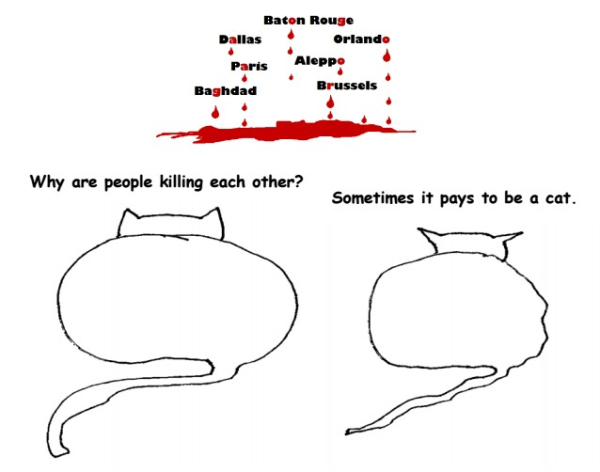
CATSPEAK
by Brooks Riley
Sorting Burnt Pancakes: or, how Bill Gates Became a Billionaire
by Jonathan Kujawa
In 1894 Benjamin Finkel, a teacher at the Kidder Institute in Missouri, founded the American Mathematical Monthly. Its purpose was and is to provide inspiration and stimulation for teachers of mathematics. As Finkel later described the founding of the Monthly,
Knowing that the status of the mathematical teaching in our high schools and academies was very deplorable and even worse in the rural schools, I had the ambition to publish a journal devoted solely to mathematics and suitable to the needs of teachers of mathematics in these schools. — B. Finkel
Apparently decrying the state of mathematics education was as popular then as now. But rather than fume and write an op-ed for the New York Times, Finkel created the Monthly. It still appears every month and contains a variety of mathematics for teachers and students at the high school and college level. The favorite pages for most, though, is the Problem section. In it you can find puzzles of all kinds, most of which don't require anything more than high school math.
A good example of a Monthly problem is this one proposed by Harry Dweighter [1] in 1975:
The chef in our place is sloppy, and when he prepares a stack of pancakes they come out all different sizes. Therefore, when I deliver them to a customer, on the way to the table I rearrange them (so that the smallest winds up on top, and so on, to the largest on the bottom) by grabbing several from the top and flipping them over, repeating this (varying the number as I flip) as many times as necessary. If there are n pancakes, what is the maximum number of flips (as a function of n) that I will ever have to use to rearrange them?
That is, imagine you have a spatula and a stack of pancakes of all different sizes which you'd like to put into order from biggest to smallest. In the worst case how many times would you have to stick the spatula between two pancakes and flip over the part of the stack sitting on your spatula? For example, if there are two pancakes, either they are in order or they are out of order. If out of order, then slipping your spatula under the stack and doing a single flip is all that's needed. If there are three pancakes, then the worst case is when the stack of pancakes from top to bottom is smallest, largest, medium. This requires three flips. In general, let's write f(n) for the number flips required in the worst case stack of n pancakes (so f(1)=0, f(2)=1, f(3)=3, etc.). Harry Dweighter is asking us to determine a formula, rule, or algorithm which computes f(n).
This is a classic Monthly problem. No fancy math, just a nifty puzzle which came to mind over breakfast. There is no expectation that this will lead to deep new math or cure cancer, just a little recreational math with your morning coffee. Amazingly enough, despite its simplicity, forty years later we still don't know how to answer Dweighter's question! Some progress has been made, though.
Sunday, April 24, 2016
The Road not Taken
Arjun Jayadev over at INET:
Can we theorize the economy as an entity that is growing, evolving, never in equilibrium? An economy passes through periods of intense instability and groping towards an uncertain future as a matter of course? How might one begin?
The pretense that we know the future probabilistically as a given set of probability distributions of every damn thing is, I think, a pretty dangerous delusion, but it’s also a comforting one to some people.
The year was 1967. Young Axel Leijonhufvud sat in front of a pile of papers, full of unfinished notes, half-worked through arguments and intellectual dead-ends that he had been at for nearly four years. Two years into a tenure track position in the economics department at the University of California Los Angeles, he seemed unable to fashion a coherent dissertation from the morass of ideas in the sprawl. This year was his last chance to do so if he wanted to remain in academic employment.
The Swedish émigré had rather immodestly and perhaps unwisely decided that his doctoral work should be on some of the deepest problems of macroeconomics: why was it that the capitalist economy sometimes fails calamitously, and why was it that the Great Depression (still very much in the public memory in the 1960s) had been so very different from ordinary recessions? In trying to understand that defining period of the 1930s he had undertaken a wide range of reading of earlier economists, including a closer reading of the ur-text of the discipline –the General Theory of Employment, Interest and Money by John Maynard Keynes.
One day, following yet another dead-end, and feeling like he was ready to give up and leave academic life, he began to look in desperation at his footnotes. For the first time, he began to see something in his scribblings — an electrifying theme emerged that laid the ground for what was to be a set of ideas that aimed directly at the heart of academic macroeconomics.
More here.
A Forum on Anne-Marie Slaughter’s Unfinished Business: Women, Men, Work, Family
Over at Signs's Short Takes, a forum on Slaughter's new book with Heather Boushey, Kimberly Freeman Brown, Stephanie Coontz, Nancy Folbre, Kathleen Geier, Tressie McMillan Cottom, Premilla Nadasen, Ai-jen Poo, and Joan C. Williams, with a response by Anne-Marie Slaughter. Nancy Folbre:
When the suit sitting next to me on an airplane saw me reading Anne-Marie Slaughter’sUnfinished Business (the subtitle, Women, Men, Work, Family, is not so easy to see), he cheerfully asked me what line of business I was in. When I said, “I’m in the feminist business,” he did a double take. “Yes,” I added, “and it’s expanding like mad.”
Fortunately he did not ask me about its profit margins.
Pondering the book’s title in the aftermath of this brief exchange, I registered the hidden pun. This is largely a book about busyness—tyrannical over-busyness. In this it succeeds as a thoughtful and therapeutic treatment.
Slaughter challenges the “women can do it all” norm that gives women so little permission to disappoint anyone’s expectations. She also sharply deplores the antifamily pressures of the modern workplace and the inadequacies of our public care infrastructure.
In some ways, she reverses Sheryl Sandberg’s Lean In (subtitled Women, Work, and the Will to Lead) by arguing that women need to lead men, as well as themselves, away from psychological subordination to paid employment. Lean in to your family, your friends, and your community, Slaughter urges. Lean in to make political change.
Unlike Sandberg, Slaughter almost manages to transform her privileged standpoint (as an academic and political superstar rather than an entrepreneur) into a political asset rather than a liability. After all, if a woman who can afford a full-time housekeeper still needs to take time out from the job of her dreams, the rest of us should not succumb to feelings of inadequacy when we do the same.
Unfortunately, her book, despite its attentiveness to economic differences among women, doesn’t quite preempt the “privilege” critique. In its cheerful exhortation to everyone to fight for changes that would, in principle, benefit everyone, it glosses over larger issues of income inequality.
More here.
Life lessons from ancient Greece: the growing popularity of stoicism
Rowland Manthorpe in More Intelligent Life:
After Helen Rudd sustained traumatic injuries in a traffic accident, she lay in a coma for three weeks. “I had to learn everything again. I had to learn to read and write,” says Rudd. Her life had changed completely and she needed a different outlook. When she heard about an event in which people attempted to live like ancient stoics for a week, the idea struck a chord. In 2014, Rudd was one of almost 2,000 people to take part in Stoic Week. “Stoicism has helped me concentrate on the good things,” she says. Over two millennia after it first came to prominence, stoicism is having a moment. It’s on the internet, of course: the stoicism subreddit, the largest meeting place for stoics online, has over 28,000 subscribers, many times the number of erstwhile rival Epicureanism (around 4,000). But it is also infiltrating real life, even in its toughest forms. The Navy Seals teach stoic insights to new recruits; throughout the NFL, players and coaches are devouring Ryan Holiday’s guide to stoicism, “The Obstacle Is the Way”. Tim Ferriss, a start-up guru, extols the benefits of Stoicism at firms such as Google. “For entrepreneurs,” says Ferriss, “it’s a godsend.”
Even in antiquity, stoicism was noted for its practicality. Ancient Greek and Roman stoics wrote about theology, logic and metaphysics, but their focus was on the “hic et nunc”, the here and now. “Stoicism tells you what in life is worth having and gives you a way to get there,” says William Irvine, the author of the stoic handbook, “A Guide to the Good Life”. The key is learning to be satisfied with what you’ve got. “Some things are up to us and others are not,” taught Epictetus. “Up to us are opinion, impulse, desire…Not up to us are body, property, reputation, office, in a word, whatever is not our own action.” This indifference to everyday comforts has left stoicism with a reputation for coldness. In reality, its defenders argue, it is simply a rational approach to managing expectations. The central insight of stoicism is that life is tough and changeable, so prepare for difficulty.
More here.
MEET THE ARTISTS: PLAYWRIGHT AYAD AKHTAR
Linda Lombardi in the Arena Stage Blog:
The most-produced play of the 2015/2016 theater season, Ayad Akhtar’s Pulitzer Prize winner, Disgraced, is inspiring a national dialogue about everything from cultural appropriation to identity politics to what it means to be an American. I met with Ayad recently to discuss his body of work, the themes in Disgraced, and his love of theater. Below is an excerpt of our conversation.
How did you come to theater? How did you start playwriting?
My parents came over from Pakistan in 1968 and 1969. They were the first to leave Pakistan and come to America. My dad was the only son on his side of the family and my mom was the eldest. I was the first-born son. They were both doctors so, of course, I was going to be a doctor, right? My mom trained me — when the teacher asks what you want to do when you grow up, to say I want to be a neurologist. My kindergarten teachers were very impressed. I didn’t quite know what a neurologist was.
When I was fifteen I had a literature teacher who changed my life. She made me want to become a writer. It was certainly a great — perhaps the great —encounter in my life. Everything I do is an homage to her. I had her for class two hours a day, both semesters, junior and senior year. She introduced me to the theater via text. I was reading everything under the sun. She was really obsessed with European continental modernism, so I was reading a lot of very obscure modernist writers. I went to college to become a writer and my second year there a friend was directing David Mamet’s Sexual Perversity in Chicago and he thought I’d be good in it. I don’t know why he thought I’d be good in that play. But I loved acting, and I started to do more and more theater. When I graduated from Brown, I worked with Jerzy Grotowski for a year in Italy, and ended up as his assistant. I spent a lot of time with him towards the end of his life. Then I came to New York and worked with Andre Gregory and taught acting with him for many years. I had this weird, avant-garde training that was all about process. And now I write these overtly audience oriented, well-made, traditional plays. It’s really weird how life is.
More here.
A genetic technology that can kill off mosquito species could eradicate malaria, but is it too risky to ever use?
Antonio Regalado in the MIT Technology Review:
Malaria kills half a million people each year, mostly children in tropical Africa. The price tag for eradicating the disease is estimated at more than $100 billion over 15 years. To do it, you’d need bed nets for everyone, tens of thousands of crates of antimalaria drugs, and millions of gallons of insecticides. But it would take more than stuff. You’d need things the poorest countries in the world don’t have, like strong governments, purchasing power, and functioning public health systems. So malaria keeps killing.
But what if, instead, you needed only a bucket full of mosquitoes?
I saw such an invention at Imperial College London. A student led me through a steel door, under a powerful gust of air, and into a humid room heated to 83 °F. Behind glass, mosquitoes clung to the sides of small cages covered in white netting. A warning sign read, “THIS CUBICLE HOUSES GENE DRIVE GM MOSQUITOES.” It went on to caution that the insects’ DNA contains a genetic element that has “a capacity to spread” at a “disproportionately high” rate.
A gene drive is an artificial “selfish” gene capable of forcing itself into 99 percent of an organism’s offspring instead of the usual half. And because this particular gene causes female mosquitoes to become sterile, within about 11 generations—or in about one year—its spread would doom any population of mosquitoes. If released into the field, the technology could bring about the extinction of malaria mosquitoes and, possibly, cease transmission of the disease.
More here.
How the chili pepper got to China
Andrew Leonard in Nautilus:
In 1932, the Soviet Union sent one of its best agents to China, a former schoolteacher and counter-espionage expert from Germany named Otto Braun. His mission was to serve as a military adviser to the Chinese Communists, who were engaged in a desperate battle for survival against Chiang Kai-shek’s Nationalists.
The full story of Braun’s misadventures in China’s Communist revolution is packed with enough twists and turns for a Hollywood thriller. But in the domain of culinary history, one anecdote from Braun’s autobiography stands out. Braun recalls his first impressions of Mao Zedong, the man who would go on to become China’s paramount leader.
The shrewd peasant organizer had a mean, even “spiteful” streak. “For example, for a long time I could not accustom myself to the strongly spiced food, such as hot fried peppers, which is traditional to southern China, especially in Hunan, Mao’s birthplace.” The Soviet agent’s tender taste buds invited Mao’s mockery. “The food of the true revolutionary is the red pepper,” declared Mao. “And he who cannot endure red peppers is also unable to fight.’ ”
Maoist revolution is probably not the first thing that comes to mind when your tongue is burning from a mouthful of Kung Pao chicken or Mapo Tofu at your favorite Chinese restaurant. But the unlikely connection underscores the remarkable history of the chili pepper.
More here.
Why liberal economists dish out despair
Gerald Friedman in Evonomics:
When I conducted an assessment of Senator Bernie Sanders’ economic proposals and found that they could produce robust growth, the negative reaction among powerful liberal economists was swift and vehement. How much, I wondered, did this reflect personal disappointment being rationalized into a political economy of despair? Professional economists tend to embrace an economic theory that government can do little more than fuss around the edges. From that stance, what do they have to offer ordinary people for whom the economy is not working? Not a whole lot.
It has certainly been a rough seven years for the liberal economists in the Obama Administration. Economic recovery has been slow, the slowest in the post-World War II era. Ambitious programs for reform of social insurance programs (such as unemployment insurance) and for public investment have been scaled back, and back. Yes, there is much that these economists who served Obama can be proud of: more people have health insurance, and the economy did not collapse. But the constant slog must have taken a toll. Having experienced so many compromises and disappointments, perhaps it is easier to say to those who expect more that it just can’t happen. There is comfort in the Thatcherite phrase: There Is No Alternative (TINA).
More here.