by Brooks Riley
Category: Recommended Reading
Sunday, May 29, 2016
FABLE
Charles Yu in The New Yorker:
Once upon a time, there was a man whose therapist thought it would be a good idea for the man to work through some stuff by telling a story about that stuff.
The man lived in a one-bedroom efficiency cottage all by himself, in a sort of dicey part of town. One day, the man woke up and realized that this was pretty much it for him. It wasn’t terrible. But it wasn’t great, either. And not likely to improve. The man was smart enough to realize this, yet not quite smart enough to do anything about it. He lived out the rest of his days and eventually died. The end. Happy now?
The man could see that his therapist was not amused.
A rather unsatisfactory ending, the therapist opined, and suggested that the man could do better. The man thought, Is she really serious about this? But he didn’t say anything out loud. The man was not convinced that he needed to be talking to the therapist at all, but he had tried so many other things (potions, spells, witches), and spent so much of his copper and silver, with absolutely nothing to show for it, that he figured why the hell not.
So how do I do this? he asked.
Why don’t you start again? the therapist replied. And, instead of rushing to the end, try to focus on the details.
O.K., the man said.
More here.
A Shocking Find In a Neanderthal Cave In France
Ed Yong in The Atlantic:
In February 1990, thanks to a 15-year-old boy named Bruno Kowalsczewski, footsteps echoed through the chambers of Bruniquel Cave for the first time in tens of thousands of years.
The cave sits in France’s scenic Aveyron Valley, but its entrance had long been sealed by an ancient rockslide. Kowalsczewski’s father had detected faint wisps of air emerging from the scree, and the boy spent three years clearing away the rubble. He eventually dug out a tight, thirty-meter-long passage that the thinnest members of the local caving club could squeeze through. They found themselves in a large, roomy corridor. There were animal bones and signs of bear activity, but nothing recent. The floor was pockmarked with pools of water. The walls were punctuated by stalactites (the ones that hang down) and stalagmites (the ones that stick up).
Some 336 meters into the cave, the caver stumbled across something extraordinary—a vast chamber where several stalagmites had beendeliberately broken. Most of the 400 pieces had been arranged into two rings—a large one between 4 and 7 metres across, and a smaller one just 2 metres wide. Others had been propped up against these donuts. Yet others had been stacked into four piles. Traces of fire were everywhere, and there was a mass of burnt bones.
More here.
Robert Reich: It’s time for Clinton and Sanders supporters to swallow some tough medicine
With the Democratic primaries grinding to a bitter end, I have suggestions for both Clinton and Sanders supporters that neither will like.
Robert Reich in Raw Story:
First, my advice to Clinton supporters: Don’t try to drum Bernie Sanders out of the race before Hillary Clinton officially gets the nomination (if she in fact does get it).
Some of you say Bernie should bow out because he has no chance of getting the nomination, and his continuing candidacy is harming Hillary Clinton’s chances.
It’s true that Bernie’s chances are slim, but it’s inaccurate to say he has no chance. If you consider only pledged delegates, who have been selected in caucuses and primaries, he’s not all that far behind Hillary Clinton. And the upcoming primary in California – the nation’s most populous state—could possibly alter Sanders’s and Clinton’s relative tallies.
My calculation doesn’t include so-called “superdelegates”—Democratic office holders and other insiders who haven’t been selected through primaries and caucuses. But in this year of anti-establishment fury, it would be unwise for Hillary Clinton to rely on superdelegates to get her over the finish line.
More here.
WRITERS SPEAK OUT AGAINST DONALD TRUMP
Andrew Altschul and Mark Slouka in Literary Hub:
AN OPEN LETTER TO THE AMERICAN PEOPLE
Because, as writers, we are particularly aware of the many ways that language can be abused in the name of power;
Because we believe that any democracy worthy of the name rests on pluralism, welcomes principled disagreement, and achieves consensus through reasoned debate;
Because American history, despite periods of nativism and bigotry, has from the first been a grand experiment in bringing people of different backgrounds together, not pitting them against one another;
Because the history of dictatorship is the history of manipulation and division, demagoguery and lies;
Because the search for justice is predicated on a respect for the truth;
More here.
What do clothes say?
Shahidha Bari in Aeon:
Where language falls short though, clothes might speak. Ideas, we languidly suppose, are to be found in books and poems, visualised in buildings and paintings, exposited in philosophical propositions and mathematical deductions. They are taught in classrooms; expressed in language, number and diagram. Much trickier to accept is that clothes might also be understood as forms of thought, reflections and meditations as articulate as any poem or equation. What if the world could open up to us with the tug of a thread, its mysteries disentangling like a frayed hemline? What if clothes were not simply reflective of personality, indicative of our banal preferences for grey over green, but more deeply imprinted with the ways that human beings have lived: a material record of our experiences and an expression of our ambition? What if we could understand the world in the perfect geometry of a notched lapel, the orderly measures of a pleated skirt, the stilled, skin-warmed perfection of a circlet of pearls?
Some people love clothes: they collect them, care for and clamour over them, taking pains to present themselves correctly and considering their purchases with great seriousness. For some, the making and wearing of clothes is an art form, indicative of their taste and discernment: clothes signal their distinction. For others, clothes fulfill a function, or provide a uniform, barely warranting a thought beyond the requisite specifications of decency, the regulation of temperature and the unremarkable meeting of social mores. But clothes are freighted with memory and meaning: the ties, if you like, that bind. In clothes, we are connected to other people and other places in complicated, powerful and unyielding ways, expressed in an idiom that is found everywhere, if only we care to read it.
More here.
nick menza (1964 – 2016)
bert kwouk (1930 – 2016)
Neil Postman: “Amusing Ourselves to Death”
Why You Will Marry the Wrong Person
Alain de Botton in The New York Times:
IT’S one of the things we are most afraid might happen to us. We go to great lengths to avoid it. And yet we do it all the same: We marry the wrong person. Partly, it’s because we have a bewildering array of problems that emerge when we try to get close to others. We seem normal only to those who don’t know us very well. In a wiser, more self-aware society than our own, a standard question on any early dinner date would be: “And how are you crazy?”
Perhaps we have a latent tendency to get furious when someone disagrees with us or can relax only when we are working; perhaps we’re tricky about intimacy after sex or clam up in response to humiliation. Nobody’s perfect. The problem is that before marriage, we rarely delve into our complexities. Whenever casual relationships threaten to reveal our flaws, we blame our partners and call it a day. As for our friends, they don’t care enough to do the hard work of enlightening us. One of the privileges of being on our own is therefore the sincere impression that we are really quite easy to live with. Our partners are no more self-aware. Naturally, we make a stab at trying to understand them. We visit their families. We look at their photos, we meet their college friends. All this contributes to a sense that we’ve done our homework. We haven’t. Marriage ends up as a hopeful, generous, infinitely kind gamble taken by two people who don’t know yet who they are or who the other might be, binding themselves to a future they cannot conceive of and have carefully avoided investigating.
More here. (Note: Also watch the video of Mr. Alain de Botton's talk posted below on Saturday)
Sunday Poem
At the Center
Today doves flew from my head
and my hair grew
the longing is gone from my body
and I'm filled with peace, perfect peace
No longer shall I speak of electrocuted poets
or the ones who inhaled gas until
they danced in the dizziness of death
But of brown women
who turn the soil with their hands
making vegetable gardens and tending fruit trees
Today I went into my storehouse
selected the choicest oil and annoint my body
wrapped myself in the rarest cloth
of a deep wine red
stood at my front gate
and words poured from my mouth in flaming chants
Today the craftsman has come
to make a design for me
of a woman sitting in deep repose
with doves flying from her head
He has made all the pieces and they fit
well together
I shall hang it at my window for all the world to see
by Afua Cooper
from Understatement: An Anthology of 12 Toronto Poets
Toronto: Seraphim Edition, 1996.
.
Saturday, May 28, 2016
Taking the Kamasutra seriously
Nicola Barker in The Spectator:
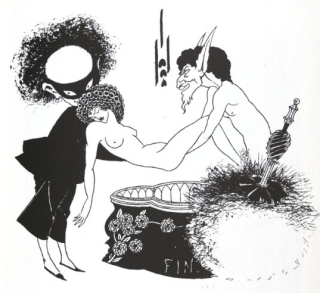
The rough English translation of Kamasutra is pleasure (kama) treatise (sutra). In the West, since it was first (rather surreptitiously) translated and published back in 1883, the book has generally been associated with a series of beautiful, ancient illustrations of a couple determinedly coupling in a variety of fascinating — and often utterly improbable — positions; as essentially ‘the erotic counterpart to the ascetic asanas of yoga’. But there is so much more to it than that, as Wendy Doniger doggedly contends in this, her fine collection of frank, brief, clear-eyed essays. Doniger believes the Kamasutra to be not only a precious and under-appreciated part of the Sanskrit canon, but also a great Indian literary landmark which has been — for way too long now — criminally undervalued in its place of origin. Hence its need for ‘redemption’ (a paradoxically Christian notion, perhaps).
She traces the history of the Kamasutra, detailing how the three aims of human life (the Triple Set in Indian parlance) are dharma(religion), artha (power) and kama (pleasure). In a satisfying parallel, these three aims are underpinned by a trinity of ancient texts; theDharmashastra (written by the sober, strict and rather sexist Manu), the Arthashastra (by Kautilya, the Indian Machiavelli-plus) and theKamasutra (by the slightly slippery but often refreshingly open-minded Vatsyayana).
More here.
Major Cell Phone Radiation Study Reignites Cancer Questions
Dina Fine in Scientific American:
Federal scientists released partial findings Friday from a $25-million animal study that tested the possibility of links between cancer and chronic exposure to the type of radiation emitted from cell phones and wireless devices. The findings, which chronicle an unprecedented number of rodents subjected to a lifetime of electromagnetic radiation starting in utero, present some of the strongest evidence to date that such exposure is associated with the formation of rare cancers in at least two cell types in the brains and hearts of rats. The results, which were posted on a prepublication Web site run by Cold Spring Harbor Laboratory, are poised to reignite controversy about how such everyday exposure might affect human health.
Researchers at the National Toxicology Program (NTP), a federal interagency group under the National Institutes of Health, led the study. They chronically exposed rodents to carefully calibrated radio-frequency (RF) radiation levels designed to roughly emulate what humans with heavy cell phone use or exposure could theoretically experience in their daily lives. The animals were placed in specially built chambers that dosed their whole bodies with varying amounts and types of this radiation for approximately nine hours per day throughout their two-year life spans.
More here.
Can Liberal Education Save the Sciences?
Lorraine Daston in The Point:
Some of you may be mentally re-parsing my title to something more like “Can Liberal Education Be Saved from the Sciences?” For today’s embattled humanities, the sciences have come to stand for the antithesis of what is now understood to constitute the content and values of a liberal education, namely: the cultivation of the intellectual and artistic traditions of diverse cultures past and present, the assertion of the generalist’s prerogatives over those of the specialist, and the defense of non-utilitarian values as preparation for civic engagement in the cause of the commonweal. In contrast, what are currently known as the STEM disciplines—science, technology, engineering and mathematics—stand for knowledge that is presumed universal and uniform, for narrow specialization and, above all, for applications that are useful and often lucrative. A comparative glance at the budgets for the sciences and for the disciplines that constitute the core of the Core seems to tell it all: it’s not the sciences that need saving, most certainly not by the likes of liberal education, a minnow—a starving minnow, at that—sent out to rescue a fat and sassy whale.
Nonetheless, I’m sticking to my original title. In the scant time allotted, I’m going to gallop through the history of the place of the sciences and mathematics in the liberal education curriculum, from the medieval university through the present. This is a history that packs some surprises. I’ll then draw some lessons for the place of the sciences in a liberal education for the here and now.
More here.
Alain de Botton – The Future Of The Way We Live, Love And Work
In ‘Secondhand Time,’ Voices From a Lost Russia
Dwight Garner at The New York Times:
In “Danko’s Burning Heart,” a short story by Maxim Gorky (1868-1936), a group of people are lost in a forest at night. Danko wants to lead them to safety. His heart burns with such desire that it catches fire. He rips it from his chest and uses it to light the way.
There’s a bit of Danko, an element of self-sacrifice, in the lives and work of Russia’s best journalists. I’m thinking of Anna Politkovskaya, who was assassinated on Vladimir V. Putin’s birthday in 2006. I’m thinking too of Svetlana Alexievich, born in Ukraine, winner of the 2015 Nobel Prize in Literature.
Ms. Alexievich is an investigative journalist who compiles, in Studs Terkel-like fashion, dense volumes of oral history about postwar Russia. Her books bring her trouble. “Zinky Boys” (1992), for example, about Soviet soldiers in Afghanistan, led her to be put on trial for defaming the Soviet Army. (She was acquitted.)
When she won the Nobel, Ms. Alexievich was little known in the West. Her major books are slowly making their way into English. Here now is her newest, “Secondhand Time: The Last of the Soviets,” a sprawling examination of life in Russia after the collapse of the Soviet Union and the rise of a feral brand of capitalism.
more here.
JULIAN BARNES AND THE SHOSTAKOVICH WARS
Nikil Saval at The New Yorker:
Julian Barnes’s new novel, “The Noise of Time,” is about Shostakovich, and it begins with the composer enduring the humiliation and misery of his exclusion from musical life, in 1936. “All that he knew was that this was the worst time,” the first part opens. Barnes has Shostakovich repeat it twice more, at the beginnings of the novel’s two other sections, in response to fresh sources of persecution in 1948 and 1960, bringing to mind Edgar from “King Lear”: “The worst is not / So long as we can say, ‘This is the worst.’ “ The novel’s title comes from the nineteenth-century poet Alexander Blok, who used the phrase to describe history. The Soviet poet Osip Mandelstam chose it for the title of his memoir, published in 1923—Mandelstam, who would indeed suffer Stalin’s worst. For Barnes’s Shostakovich, “the noise of time” is counterposed to “that music which is inside ourselves—the music of our being—which is transformed by some into real music.” Real artists, Barnes has Shostakovich say, protect that private part of themselves against history, but if the music “is strong and true and pure enough to drown out the noise of time” it is “transformed into the whisper of history.” So we watch as Shostakovich struggles to live a life devoted to music, with history constantly intervening.
What Shostakovich’s music had to do with history has been one of the most fraught questions in the history of music. He lived through the most terrifying decades of the Soviet Union to become its most celebrated composer. Despite his transgression with “Lady Macbeth,” many of his compositions—such as the Seventh Symphony (“Leningrad”), performed in 1942 in the midst of the devastating siege and broadcast over loudspeakers into no man’s land—served the purposes of official propaganda (though the music itself was more multilayered than its use would suggest).
more here.
a review of ‘the violet hour’ by katie roiphe
Thom Cuell at 3:AM Magazine:
“Either the wallpaper goes or I do.” “A certain butterfly is already on the wing”. “I haven’t had champagne for a long time.” We love to package celebrity deaths up with a final quote, a summing up of the subject’s life and character – a way to process the messiness of mortality into something clean and understandable. In 2016, this year of notable deaths, we are updating the symbolic language surrounding death for the social media age: there is the temporary Facebook profile filter – the digital equivalent of the Victorian widow’s weeds – the hashtag, the contrarian newspaper columnist’s cynical response, the street party. In her new book The Violet Hour, Katie Roiphe looks at the reality behind these tropes, exploring the process of death through biographical essays on six writers who were notable for their engagement with mortality: Susan Sontag, Sigmund Freud, John Updike, Dylan Thomas, Maurice Sendak and James Salter.
Each of these writers worked in the shades of the prison-house; as Roiphe describes it, her chosen subjects are “especially sensitive or attuned to death… [writers and artists] who have worked through the problem of death in their art, in their letters, in their love affairs, in their dreams”. Through close examination of their final days, Roiphe aims to find some insight into the way the artist’s mind responds to impending mortality. Underlying her work are the questions of whether creativity can have a palliative function, and whether an artistic engagement with the subject can prepare us for the reality of death. Although fans of Roland Barthes (himself the victim of a bizarre, disputed death, run over by either a laundry van or a milk float, depending on who you believe) might query the close identification between the writer and the work, Roiphe hopes that “it is in the specifics, the odd, surprising details, the jokes, the offhand comments, that some other greater story is told and communicated”.
more here.
The political passion of Eva Longoria: Hispanics could decide the outcome of America’s next presidential election
David Rennie in 1843Magazine:
It started with this book. I read this book, and I wrote to the author, and he said ‘come and meet me’,” says Eva Longoria, recalling her political awakening. The book is “Occupied America” by Rodolfo Acuña, a firebrand professor of Chicano studies, (as some call Mexican-American studies, notably since 1960s and among the West Coast left). His book is a densely argued blast written to awaken his students to centuries of colonial oppression and white racism. Longoria met Acuña, and he suggested that she should take his introductory course. “I was so unfamiliar with the word ‘Chicano’. Growing up in Texas where ‘Tejano’ was the term. And also ‘Chicano’ was a very politicised term.” She took Chicano 101 and only became more curious. “So then the next semester he said, you should take a Chicano feminism class, so I took Chicano feminism, and Chicano art.” At the time, Longoria was filming “Desperate Housewives”, then the biggest TV show in the world. “From the set of ‘Desperate Housewives’ I would drive an hour to the school, take a class from seven to ten at night, then be on set at six in the morning. I would be doing my homework behind the sets.”
Even in today’s Hollywood, where liberal politics is de rigueur and activism fashionable, Eva Longoria is unusual. She has campaigned for Democratic presidential contenders since 2004. In 2012 she was a co-chair of President Barack Obama’s re-election campaign, speaking at the Democratic National Convention, and, at the height of the campaign in Florida, she addressed seven cities in one day. Political types, Longoria says wryly, call every election the most important of their lifetimes. But in 2016 she is sure that the stakes are unusually high. This time one of the Republican front-runners, Donald Trump, says he would build a wall on the Mexican border and make Mexico pay for it and claims – fantastically – that his government would deport the estimated 11m immigrants in America without legal papers. His chief Republican rival, Senator Ted Cruz of Texas, whose own father arrived as a penniless student from Cuba, has promised to rescind the executive orders with which Obama has shielded millions of migrants from deportation, notably those brought to America as children and educated in the country. But the election will also be a test of confident predictions that Hispanics will soon be a demographic block capable of deciding who occupies the White House. The Pew Research Centre, a non-partisan think-tank, predicts that a record 27.3m Hispanics will be eligible to vote in the elections of 2016 – with enough of them concentrated in a series of battleground states to swing the election results in places such as Nevada, Colorado and Florida. Yet Hispanics have, so far, failed to realise their potential power. Turnout among Latinos is woeful.
Longoria hopes to change that.
More here.
EAST WEST STREET: On the Origins of “Genocide” and “Crimes Against Humanity”
Bernard-Henri Levy in The New York Times:
“A man’s home is his castle,” Joseph Goebbels told the League of Nations in 1933, so “we will deal as we see fit” with our various “opponents” and, in particular, “our Jews.” At the time, Goebbels’s view was almost universally shared. However shocking, detestable and morally indefensible it might seem today, no one dreamed of contesting it then. Sovereignty — a term that muddled people’s right to decide for themselves and the right of despots to decide for their people — was the first and last word in international relations. If the same cannot be said today, if dictators are no longer seen to hold the power of life or death over their subjects, if the archcriminals of Cambodia, Sudan and Rwanda are indicted and sometimes even punished, in short, if the idea of international justice has gradually gained a semblance of meaning, we owe it to two ideas, or more precisely two concepts — as well as to the two men who brought them to life: Hersch Lauterpacht for the concept of the crime against humanity and Raphael Lemkin for that of genocide. Philippe Sands, a professor of law at University College London, recounts the life and work of both men in “East West Street: On the Origins of ‘Genocide’ and ‘Crimes Against Humanity.’ ”
Sands begins by drawing distinctions between the two concepts. He is careful to show how, despite their complementarities, the two rest on different, even opposing, notions of rights. One is rooted in individual rights, the other in the rights of groups. One places at the top of the scale of offenses those perpetrated on individual men and women, the other the intention to annihilate the population or community from which those individuals spring.
More here.