
Sarah Kuta in Smithsonian Magazine:
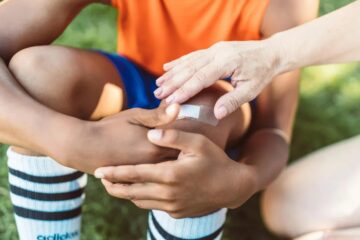 The follicles at the root of each hair contain stem cells, which, in addition to producing hair, can grow new skin when necessary. Since humans have much less hair than other mammals do, it makes sense that our wounds would also take longer to heal.
“When the epidermis is wounded, as in most kinds of scratches and scrapes, it’s really the hair-follicle stem cells that do the repair,” says Elaine Fuchs, a biologist at Rockefeller University who was not involved with the research, to the New York Times’ Elizabeth Preston.
At some point in the evolutionary journey, humans lost most of their body hair. Since chimps’ wounds heal faster than ours, this shift likely occurred after humans diverged from our shared ancestor with the primates, reports New Scientist’s Chris Simms.
It’s not entirely clear why early humans lost their hair. But it seems our species swapped the once-abundant hair follicles for sweat glands, which are not as efficient at healing wounds but help keep us cool in hot environments.
More here.
Enjoying the content on 3QD? Help keep us going by donating now.
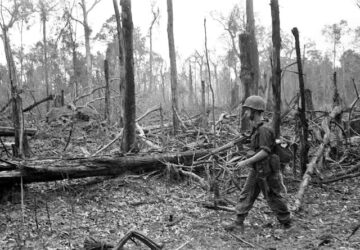 When the Vietnam War finally ended on April 30, 1975, it left behind a landscape
  Bringing nonhumans into our democracies may be less radical than it first appears. Nussbaum is quick to clarify that attending to the political voices of animals does not mean giving them a vote in our elections, which “would quickly become absurd.” Her vision is not of beleaguered pets marching down our grand boulevards demanding the vote for every Sparky, Buddy, and Princess. Rather more modestly, she proposes that “duly qualified animal ‘collaborators’ should be charged with making policy on the animals’ behalf, and bringing challenges to unjust arrangements in the courts.” The goal is not to force animals with “little interest in political participation in the human-dominated world” to suddenly take part in “elections, assemblies, and offices.” Nussbaum’s ambition, rather, is for expert guardians to give the “creatures who live in a place […] a say in how they live.”
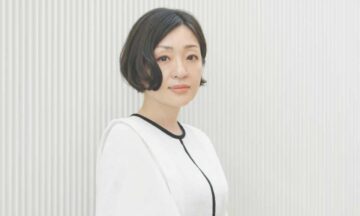 From a very young age, Murata never thought of her body as her own. “The grownups would always talk about whether Sayaka had childbearing hips,” she recalls. “It was almost like they were keeping an eye on my uterus, which was something that existed not for me, but for them, for the relatives.” No matter how much she tried to resolve the conflict of motherhood in her fiction, she has never escaped “this idea of being expected to reproduce for the good of the village”.
 “Restaurants will break your heart” is something that I often hear myself saying. It has become a mantra. When did I start saying it, I wonder. Maybe it was when I first discovered the criss-crossed lines of affection; falling in a crash-out kind of love with a fellow line cook because he helped me with my mise en place. Maybe it was when my sous-chef first called me mediocre; we all watched slices of chocolate cake I cut pile up in the garbage because of my disappointing quenelles. Maybe it was the first time that I had to fire a kitchen assistant over the phone, hearing him quietly murmur in response, “Okay.” Maybe (definitely) it was the time I got fired—the bad news sandwiched between my manager saying I was “amazing” and also “so great.” Maybe it was the first time I watched a plate of food I made go out and I understood, profoundly, that I would never know who might eat it.
 1. ESA’s Euclid Telescope Unveils Millions of New Galaxies
 Bates’s score rings out — a wobbly, synthetic chime of sorts — you’d swear someone had pressed a power button in the orchestra pit. On Friday evening at the Kennedy Center, the Washington National Opera opened its production of Bates’s opera with a libretto by Mark Campbell — its tenth since the opera’s premiere at Santa Fe Opera in 2017. Guest conductor Lidiya Yankovskaya led the Washington National Opera Orchestra and Chorus in this revival of Tomer Zvulun’s production, here directed by Rebecca Herman.
 T
T
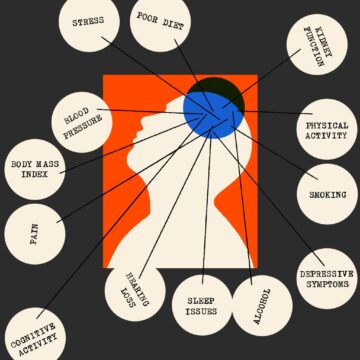 New research has identified