ASTRONYMY

Justin E. H. Smith in Cabinet:

ScreenHunter_2102 Jul. 18 06.14There is a main-belt asteroid of stony composition, roughly four kilometers in diameter, and with an albedo, or solar reflection coefficient, of around 17 percent. It bears the same name as the author of the present article, though with the middle initials eliminated, the first and last names concatenated, and a string of numbers added to the beginning: 13585 Justinsmith. To be more precise, it does not just have the same name as the author, but was in fact named after the author. Its relationship to the author is like that of Colombia to Columbus, or of the Vince Lombardi Travel Plaza to Vince Lombardi: a relationship of eponymy.

“I hope that some people see some connection between the two topics in the title,” is how, in 1970, Saul Kripke began the first of his lectures on “Naming and Necessity.”1 Plainly, though, it was not necessary that Justinsmith should come to bear my name. The asteroid was first observed in 1993, when I was twentyone years old and had yet to accomplish anything that would merit so much as an eponymous clod of dirt. According to the rules established by the International Astronomical Union’s Minor Planet Center, discoverers enjoy the exclusive right of naming for the first ten years, though they may still choose a name after that deadline, pending approval by the iau’s fifteenmember Committee for Small-Body Nomenclature, if no one else has gone through the complicated steps necessary to do so.2 In this case, the discoverer, Belgian astronomer Eric W. Elst, would not choose the name until the middle of 2015: it was, after all, only one of at least 3,600 asteroids he had discovered in his long and distinguished career.

More here.

Islamist extremism in Bangladesh may be countered, but not easily

K. Anis Ahmed in Time:

ScreenHunter_2101 Jul. 18 05.33As Bangladesh continues to reel from the terrorist attack on the Holey Artisan Bakery on July 1, like so many people I know, it has crossed my mind that I could have been there.

I am friends with the owners, and every other day I would meet friends and family for coffee on the cafe’s manicured lawns. My wife and I always spoke with pride of our apartment being “right around the corner” from Holey, which was an oasis, a sanctuary, in a city that has now changed forever. Things may never be the same again here, most grievously for the families who lost their loved ones, but for the country too. Indeed, it may mark a turning point so severe that years from now people will think of Bangladesh in terms of pre- and post-Holey.

After such a disfiguring calamity, the biggest question is always, Why? Yet looking for a reason based on the stated claims of terrorists is a mistake. There is no need for a reason when it comes to convincing young men to join groups promising violence in the name of a cause. Islam is not needed, religion is not needed; all that is needed is a sense of righteous injustice and unique victimhood.

The puppet masters, whoever they are, have a clear goal: to grab state power using an ideology that will turn recruits into terrorists while gaining credence with parts of the population. Already, I see comments on social media about Western hegemony, economic inequality and other factors that might have motivated the killers, as if those are legitimate grounds for such an outrage. Let us be clear — there are no legitimate grounds.

More here.

Whatever their limits, Murray Bookchin’s ideas should be studied by today’s left

Damian White in Jacobin:

ScreenHunter_2100 Jul. 18 05.28Murray Bookchin spent fifty years articulating a new emancipatory project, one that would place ecology and the creative human subject at the center of a new vision of socialism.

Here is a thinker, who in the early sixties, declared climate change as one of the defining problems of the age. Bookchin saw the environmental crisis as capitalism’s gravedigger.

But he also insisted we must be continually alert to the postcapitalist potentialities that may surface within capitalism. “Liberatory technologies” from renewables to developments in “minituration” and automation combined with broader forms of social and political reorganization, could open up unprecedented possibilities for self-management and sustainable abundance.

In the seventies and eighties, Bookchin suggested an environmentalism obsessed with scarcity, austerity, and the defense of “pure nature” would get nowhere. The future lay with an urban social ecology that addressed people’s concerns for a better life and could articulate this in the form of a new republican vision of politics and a new ecological vision of the city.

More here.

How A Danish Town Helped Young Muslims Turn Away From ISIS

Hanna Rosin at NPR:

ScreenHunter_2099 Jul. 18 05.20One day in 2012, a group of policemen in a Danish town were sitting around in the office when an unusual call came in. This town, called Aarhus, is a clean, orderly place with very little crime. So what the callers were saying really held the cops' attention. They were parents, and they were “just hysterical,” recalled Thorleif Link, one of the officers. Their son was missing. They woke up one day and he was gone.

The officers put together whatever clues they had about the missing person: He was a teenager who went to a local high school, and he lived in a largely Muslim immigrant neighborhood just outside town. But before they got any further with their investigation, they got another call, from another set of parents. Their son was missing too.

“Why is this going on?” asked Allan Aarslev, a police superintendent.

After talking to the parents and snooping around the neighborhood, the police figured it out: These young men and women had gone to Syria. They were among the exodus of thousands of European citizens who were drawn to the call put out by ISIS, the Islamist terrorist group, for Muslims worldwide to help build the new Islamic state.

Link and Aarslev are crime prevention officers. They usually deal with locals who are drawn to right-wing extremism, or gangs. The landscape of global terrorism was completely new to them. But they decided to take it on. And once they did, they wound up creating an unusual — and unusually successful — approach to combating radicalization.

More here.

Pokémon Go is barely a week old and Hillary Clinton is already using it to register voters

Dylan Matthews in Vox:

The game, which came out on July 6, encourages users to walk around and visit PokéStops where they can acquire items for the game like Poké Balls, and “gyms” where they can fight against other players. PokéStops and gyms are real locations in the real world. For instance, there’s a gym on a small traffic island by the Vox DC offices, and the Embassy of Iraq is a PokéStop and a reliable source of Poké Balls.

So campaign organizers for Clinton, like her Ohio organizing director Jennifer Friedmann, started showing up at PokéStops and gyms to register Pokémon Go players to vote…

The Cincinnati Enquirer's Mallorie Sullivan reports that Clinton's Ohio staff spent the past weekend going “from Cuyahoga to Athens to seek out players in their communities to register them to vote.”

There’s even an official Hillary event scheduled in Lakewood, Ohio, pegged to the game. “Join us as we go to the Pokestop in Madison Park and put up a lure module, get free pokemon, & battle each other while you register voters and learn more about Sec. Hillary Clinton!!!” the event description says. “Kids welcome!”

Lure modules, for context, are items in the game that attract a large number of Pokémon to a given area. You can acquire them for free, but to use them for any length of time usually requires shelling out for additional lures, meaning the Clinton campaign could be spending funds on attracting Pokémon (and players) to its events.

The ease with which Clinton’s campaign flocked to Pokémon Go is partially an indication of how perfect the app is as a campaign tool. Campaigns have invested considerable time and money into mastering social media platforms like Snapchat, Twitter, and Facebook, but the payoff is uncertain. If you send a funny tweet, that might win your campaign a good press cycle — but does it actually sway public opinion? Does it actually increase your odds of victory? The path to impact is so windy and indirect that evaluating whether your strategy is actually working is extraordinarily difficult.

That’s largely because those apps are not well-positioned to spur action outside their confines.

More here.

Sharia Does Not Mean What Newt Gingrich Thinks It Means

Jeffrey Goldberg in The Atlantic:

Lead_960In response to the latest terrorist atrocity, Newt Gingrich, the former speaker of the House, and quite possibly the next secretary of state, suggested that the U.S. should investigate American Muslims to ascertain their level of commitment to sharia, or Islamic law. (Details about the attacker, and his motives, were still emerging as of Friday morning; police sources have said the attacker was a young French Tunisian, though at press time there was no official confirmation.) “Western civilization is in a war. We should frankly test every person here who is of a Muslim background, and if they believe in sharia, they should be deported,” Gingrich told Fox’s Sean Hannity. “Sharia is incompatible with Western civilization. Modern Muslims who have given up sharia, glad to have them as citizens. Perfectly happy to have them next door.”

…There is much to critique in Gingrich’s approach, but I was struck in particular by his statement that “Sharia is incompatible with Western civilization.” One of the Middle East countries that officially endorses sharia as a legal system is one of Gingrich’s most favored countries, Israel, which is, by his lights—and mine—a crucial component of Western civilization. Israel’s sharia courts, which are supervised by the Ministry of Justice, allow the more than 15 percent of Israel’s population that is Muslim to seek religious recourse for their personal dilemmas. These courts have been in operation since Israel’s founding, and yet the country does not seem to have been fatally undermined by their existence. Israel’s sharia courts raise complicated mosque-state questions (and the power of the Israeli rabbinate raises complicated synagogue-state questions) but, so far, Western civilization, in its Israeli democratic manifestation, seems to be holding on. So, apart from the obviously unconstitutional quality of Gingrich’s demand—and its deeply counterproductive national security component—another question is worth raising: Does the Israeli government’s support for the existence of sharia courts—the government actually pays the salaries of sharia judges—cast doubt on the Jewish state’s commitment to Western values? Should Benjamin Netanyahu, the Israeli prime minister, be questioned by American authorities for advancing the cause of sharia? And what about Israel’s president, Reuven Rivlin, who, in a recent ceremony welcoming the appointment of seven new Muslim court judges, quoted the following passage from the Quran: “Indeed, did We send Our apostles with all evidence of truth, and through them We bestowed revelation from on high, and gave you a balance so that men might behave with equity.”

More here.

Saturday, July 16, 2016

ISIS: The Durability of Chaos

Scott Atran in the New York Review of Books:

ScreenHunter_2098 Jul. 16 20.37

Mass murder has again been visited upon France and shaken the world. Again ISIS has claimed credit, though this time the link to the group seems confusingly ambiguous, feeding new fears in the West about random violence by alienated or radicalized Muslims anywhere. It raises the urgent questions: What does the attack tell us about the changing face of jihadist violence today? And how might our own response, in turn, be contributing to it?

The local driver of the truck that mowed down at least eighty-four people, including ten children, and wounded more than two hundred, on the Nice waterfront Thursday was a Tunisian citizen residing in France. He had a police record for road rage and wife beating, but was not on a terrorism watch list and had no known jihadi affiliations. Yet supporters of the Islamic State immediately celebrated his actions on social media, and French President François Hollande directly linked the attack to France’s war against ISIS in Syria and Iraq.

And on Saturday, the ISIS media outlet Amaq formally claimed the Nice truck driver as “one of its soldiers” who answered the call to kill anyone from a country in the coalition against it. Such formal claims have, until now, never been merely opportunistic but refer to those who have either sworn allegiance to ISIS (like the Orlando shooter) or have actually been involved in an ISIS plot (like the Paris and Brussels attackers).

All of this suggests that trying to pin down a direct ISIS connection—while ramping up operations against ISIS in Syria and Iraq—may be missing the point.

More here.

Productivity Is Slowing and Inequality Is Growing. Here’s What’s Causing it.

Jason Furman in Evonomics:

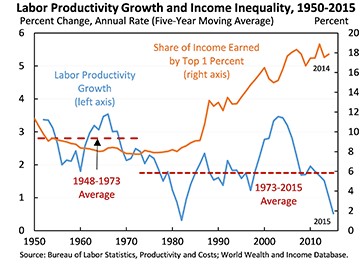
ScreenHunter_2096 Jul. 16 20.29Productivity growth—a necessary (though not sufficient) condition for rising incomes in the long run—has slowed since 1973, growing at a 1.8 percent annual rate, as compared to a 2.8 percent annual rate in the 25 years prior to 1973. At the same time, inequality in the United States is higher and, in recent decades, has risen faster than in other major advanced economies. In 2014, the top 1 percent captured 18 percent of income, up from 8 percent in 1973. These two major trends have been the major causes of the slowdown in income growth for the median household.

These dual trends—that is, the slowdown in productivity growth and the increase in inequality in recent decades—have many distinct sources, but insofar as they have some causes in common, there is the potential to address these causes in ways that simultaneously improve efficiency and equity. To this end, the evidence that a rise in rents is contributing to both phenomena is important.

More here.

‘The Violet Hour: Great Writers at the End’

P32dylanthomasPaul Lakeland at Commonweal:

Katie Roiphe’s new book takes up the question of how six writers especially well versed in death and dying dealt with their own impending deaths. As such, The Violet Hour is a study of intellectual and moral consistency under stress. To what degree did Susan Sontag stay faithful, in her struggle with cancer, to her commitment to illness as a metaphor? How did Freud’s speculations about the “death wish” play out in his own final passage? Was John Updike able to hold together the matter-of-factness about death displayed in his writing in the face of his own impending death—and maintain the burning zeal to keep writing to the very end? Where did Dylan Thomas’s neurotic obsession with imagined illness, and decades of destructive alcoholism, leave him in confronting his demise? What about the children’s author Maurice Sendak, in whose classic stories death was never far away and who on his deathbed remarked that, while he did not believe in any kind of beyond, “if nothing is where my brother and sister are, then that is where I want to be”? And Roiphe helps us get to know the great American novelist James Salter, the only one of her subjects she was able to interview. He emerges as a man aware of death but not fixated on it.

more here.

Evelyn Waugh: A Life Revisited

Methode-times-prod-web-bin-895c0f04-3931-11e6-aa72-a53adb7df446Ian Sansom at Literary Review:

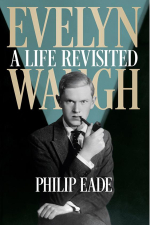
Unexpectedly, yet perhaps inevitably, Evelyn Waugh is becoming more likeable as the years go by. Fifty years dead now, the vile, rude, snobbish, cigar-chomping, ear trumpet-brandishing, banana-gobbling bigot is slowly becoming, in distant memory and from a comfortable distance, a bit of an old sweetheart. The more one reads about him, the more one likes him. Even the banana incident – shortly after the Second World War he ate three precious, strictly rationed bananas intended for his children in front of them, an act that his son Auberon famously found difficult to forgive and even more difficult to stop talking about – seems in retrospect as much a prank as an act of pure unpleasantness, more jolly jape than great evil. Weren’t all 20th-century bourgeois bohemian families equally brutish and strange? That’s certainly what all the books and biographies seem to suggest, isn’t it? And where’s the harm in a bit of a teasing – the children all get over it in the end, don’t they? Auberon’s son Alexander unearthed some years ago a letter from Auberon to Evelyn, never sent, which certainly suggests that even Auberon didn’t really begrudge his old man his eccentricities. The letter begins, ‘Dear Papa, Just a line to tell you what for some reason I was never able to show you in my lifetime, that I admire, revere and love you more than any other man in the world.’ Funny thing, that: as we get older it’s easier to forgive others, since we’re so much in need of forgiveness ourselves.

more here.

Sympathy should be our only response to the Nice terror attack

Simon Jenkins in The Guardian:

NiceEighty-four people died late on Thursday night as a lorry drove for more than a mile through the Bastille Day crowds in the southern French city of Nice. The driver eventually died in a hail of police bullets. The incident, on a day when the French celebrate equality, liberty and fraternity, could hardly be more horrific. The victims are beyond help, but the French people should have whatever sympathy the world can usefully offer. The danger is that ritualised global responses to these incidents become their megaphone. They raise the multiplier impact of the terror – and also raise public expectation that “something can be done”. The French president, François Hollande, has extended for three months the state of emergency resulting from the Charlie Hebdo killings and the events in Paris last November. He has announced, yet again, that France is “at war” with the threat of Islamist terrorism. A further 10,000 army reservists are to be deployed. “Activities will be strengthened” in Iraq and Syria. In London and Washington counter-terrorism agencies are on alert, and President Obama is “being updated by his national security team”.

…Hollande might more usefully have called up 10,000 psychologists or 10,000 Islamic historians. As for strengthening France’s role in the Islamist civil wars in Iraq and Syria, it is hard to imagine anything more likely to incite other young men to suicide attacks. A Nice truck driver does not remotely threaten the security of the French state, any more than such acts do the security of America or Britain. The identification of the nation state with random killings of innocent people has become a political aberration. The implication that leaders can somehow prevent such attacks by armed response is a total distraction from the intelligence and police work that might at least diminish their prevalence. It nationalises and institutionalises public alarm. It leads governments into madcap adventurism abroad and “securitises” the private lives of citizens at home. What has happened in France is tragic and calls for human sympathy. Beyond that, there is nothing we can usefully do – other than make matters worse.

More here.

Can Love Redeem the Sins of Jonah Lehrer?

David Brooks in The New York Times:

BrooksWe’ve all experienced the delicious madness when love first blooms — whether it happens in a bar, on a snowy street or when one person slips a hand into yours by a campfire. Your faces glow with that radiating aura. You marvel at the miraculous ways you are both the same! You’re up all night, sleepless, not eating. There are bursts of overflowing communication, and having crazy, silly fun in public. Every second apart produces an ache, and every minute together goes too fast. Your solar system has a new sun. For Jonah Lehrer, true love is not usually like this. In “A Book About Love” he argues that this wild first ecstasy feels true but is almost nothing. It’s just an infatuation, a chemical fiction that will fade with time. For Lehrer, love is more flannel pajamas than sexy lingerie; it is a steady attachment, not a divine fire. For Lehrer, attachment theory is the model that explains all kinds of love. Attachment theory was developed by researchers like John Bowlby and Mary Ainsworth in the decades after World War II. The basic idea is that all of life is a series of daring explorations from a secure base. That secure base is established during the first years of life by having an attuned relationship with a parent. Most children are securely attached. Their parents mirrored their emotions and attended to their needs. They carry through life a mental model of how to establish reciprocal bonds. They can be brave and independent because they know how to be dependent on someone else.

But other children do not develop that attuned relationship early on. They carry avoidant, fearful or disorganized attachment models in their brains and are likely to have trouble bonding with others. The effects of early attachment styles reverberate. In one study, babies who had bad attachment patterns were nearly three times more likely to have chronic illness at age 32 than were securely attached babies. In the famous Grant study, done at Harvard, men who came from the most loving homes earned 50 percent more over the course of their careers than those from the unhappiest homes. They were much less likely to suffer from dementia in old age. As Lehrer writes, “Early attachment is more predictive of achievement than any other variable measured in the Grant study, including I.Q. scores.” Lehrer sees faith in God through the prism of attachment. Having an insecure attachment pattern in childhood nearly doubles the chance of having a sudden religious conversion as an adult. God is the ultimate secure base.

More here.

Friday, July 15, 2016

The Erotic Bard of Ancient Rome

The life of Roman poet Catullus was stranger than fiction, but a new biography speculates far more than any history should.

James Romm in The New Republic:

B0c8b4a1be6c13381632fae3abb9bfbeedc7c9aa“This bedspread, / Embroidered with the shapes of men / Who lived long ago, unveils the virtue of heroes / Through the miracle of art.” These lines, from a mini-epic by the Roman poet Catullus, speak of a coverlet given to Thetis, mother of Achilles, on her wedding day; Catullus is about to set its embroidered scene into motion using the “miracle” of poetry. With a racy title—Catullus’ Bedspread: The Life of Rome’s Most Erotic Poet—and the use of this quote as epigram, classicist Daisy Dunn lays claim to a parallel miracle: The reanimation, for modern readers, of the poet himself. It’s a noble goal, but one that can be pulled off only by resorting to the dark arts of historical biography—guesswork, speculation, and the reconstruction of characters’ thoughts and feelings. Dunn’s book raises questions about how far these forms of necromancy can be taken before nonfiction passes over into fiction, and scholarship is eclipsed by romance.

The lure of these dark arts is strong for any scholar who approaches Catullus; the voice and emotional candor of this twenty-something writer—he died at age 30—are as alive as anything from ancient Rome. I vividly recall my first encounter, more than three decades ago, with the two dozen odes in which he charted a passionate and ultimately agonized love affair with the woman he called Lesbia, a name that evoked in his day the lyric genius of the Lesbos-born poetess, Sappho. “I hate and I love,” he wrote of his inability to get free of his obsessive passion for this woman. “Why do I do it, perhaps you will ask. / I don’t know why. But it’s happening, and it’s torment.” Catullus may have refined that elegiac couplet, today the most famous in all Latin literature, over days or weeks, but like so many of the poems about his feelings for Lesbia it reads like it poured straight out of him.

More here.