Bernie Sanders: Where the Democrats Go From Here

Bernie Sanders in the New York Times:

ScreenHunter_2362 Nov. 14 11.09Millions of Americans registered a protest vote on Tuesday, expressing their fierce opposition to an economic and political system that puts wealthy and corporate interests over their own. I strongly supported Hillary Clinton, campaigned hard on her behalf, and believed she was the right choice on Election Day. But Donald J. Trump won the White House because his campaign rhetoric successfully tapped into a very real and justified anger, an anger that many traditional Democrats feel.

I am saddened, but not surprised, by the outcome. It is no shock to me that millions of people who voted for Mr. Trump did so because they are sick and tired of the economic, political and media status quo.

Working families watch as politicians get campaign financial support from billionaires and corporate interests — and then ignore the needs of ordinary Americans. Over the last 30 years, too many Americans were sold out by their corporate bosses. They work longer hours for lower wages as they see decent paying jobs go to China, Mexico or some other low-wage country. They are tired of having chief executives make 300 times what they do, while 52 percent of all new income goes to the top 1 percent. Many of their once beautiful rural towns have depopulated, their downtown stores are shuttered, and their kids are leaving home because there are no jobs — all while corporations suck the wealth out of their communities and stuff them into offshore accounts.

Working Americans can’t afford decent, quality child care for their children. They can’t send their kids to college, and they have nothing in the bank as they head into retirement. In many parts of the country they can’t find affordable housing, and they find the cost of health insurance much too high. Too many families exist in despair as drugs, alcohol and suicide cut life short for a growing number of people.

President-elect Trump is right: The American people want change. But what kind of change will he be offering them?

More here.
What So Many People Don’t Get About the U.S. Working Class

Nov16-10-55948705-1200x675

Joan Williams in Harvard Business Review:

One little-known element of that gap is that the white working class (WWC) resents professionals but admires the rich. Class migrants (white-collar professionals born to blue-collar families) report that “professional people were generally suspect” and that managers are college kids “who don’t know shit about how to do anything but are full of ideas about how I have to do my job,” said Alfred Lubrano in Limbo. Barbara Ehrenreich recalled in 1990 that her blue-collar dad “could not say the word doctor without the virtual prefix quack. Lawyers were shysters…and professors were without exception phonies.” Annette Lareau found tremendous resentment against teachers, who were perceived as condescending and unhelpful.

Michèle Lamont, in The Dignity of Working Men, also found resentment of professionals — but not of the rich. “[I] can’t knock anyone for succeeding,” a laborer told her. “There’s a lot of people out there who are wealthy and I’m sure they worked darned hard for every cent they have,” chimed in a receiving clerk. Why the difference? For one thing, most blue-collar workers have little direct contact with the rich outside of Lifestyles of the Rich and Famous. But professionals order them around every day. The dream is not to become upper-middle-class, with its different food, family, and friendship patterns; the dream is to live in your own class milieu, where you feel comfortable — just with more money. “The main thing is to be independent and give your own orders and not have to take them from anybody else,” a machine operator told Lamont. Owning one’s own business — that’s the goal. That’s another part of Trump’s appeal.

Hillary Clinton, by contrast, epitomizes the dorky arrogance and smugness of the professional elite. The dorkiness: the pantsuits. The arrogance: the email server. The smugness: the basket of deplorables. Worse, her mere presence rubs it in that even women from her class can treat working-class men with disrespect. Look at how she condescends to Trump as unfit to hold the office of the presidency and dismisses his supporters as racist, sexist, homophobic, or xenophobic.

Trump’s blunt talk taps into another blue-collar value: straight talk. “Directness is a working-class norm,” notes Lubrano. As one blue-collar guy told him, “If you have a problem with me, come talk to me. If you have a way you want something done, come talk to me. I don’t like people who play these two-faced games.” Straight talk is seen as requiring manly courage, not being “a total wuss and a wimp,” an electronics technician told Lamont. Of course Trump appeals.

More here.

Sunday Poem

Lost my Voice? Of Course

—for Beanie*

Lost my voice?
Of course.

You said “Poems of
love and flowers are
a luxury the Revolution
cannot afford.”

Here are the warm and juicy
vocal cords,
slithery,
from my throat.

Allow me to press them upon
your fingers,
as you have pressed
that bloody voice of yours
in places it could not know
to speak,
nor how to trust.

Alice Walker
from Her Blue Body Everything We Know
Harvest Books, 1991

*A childhood bully

.

Death of the hatchet job

JD Taylor in New Statesman:

Hatchett_job_illoTwenty years ago, I published a novel called English Settlement. It attracted what is known in the trade as “mixed reviews”, which is to say that a handful of people remarked that clearly a new star had risen in the cultural firmament, while a rather larger number declared themselves surprised that a fine old firm like Chatto & Windus should waste its money on such talentless dreck. Absolute nadir among the detractors was plumbed by the gallant ornament of the Sunday Times’s books section – a chap named Stephen Amidon who concluded, after much incidental savagery, that the book was “about as much use as a one-legged man in a butt-kicking competition”. If this sounds bad – and it was no fun at all to sit at the kitchen table reading the ­review while one’s three-year-old romped around wondering why Daddy was looking so glum – then I should point out that this was an era in which wounding disparagement was, if not absolutely routine, then a frequent feature of newspaper books pages. Comparable highlights from the period include Philip Hensher’s dismissal of James Thackara’s The Book of Kings in the Observer (“could not write ‘Bum’ on a wall”) and, a little later, Tibor Fischer noting of a below-par Martin Amis that being seen reading it would be like your uncle getting caught masturbating in the school playground. Even I once submitted, to this very magazine, a review of a collection of journalism by Jon Savage called Time Travel, which the then literary editor ran under the headline “All the young pseuds”.

There are several questions worth asking about these outpourings of bygone critical spleen, in which the pretence of objective criticism very often disappears beneath a tide of ad hominem bitchiness. One of them is: would anyone be prepared to print this kind of thing on a magazine or newspaper in Britain in 2016? Another is: would anyone – writer, publisher, reader – or literary culture, in general, benefit in any way if they were? The answer to the first question, as the merest glance at a modern-day newspaper arts section suffices to demonstrate, is no. Here, by way of illustration and picked at random from the recycling pile by the back door, are an edition of the Saturday Guardian’s Review and a six-page review section taken from the Spectator.

More here.

Saturday, November 12, 2016

Rising morbidity and mortality in midlife among white non-Hispanic Americans in the 21st century

F1.medium (1)

Anne Case and Angus Deaton in PNAS, from a little while ago:

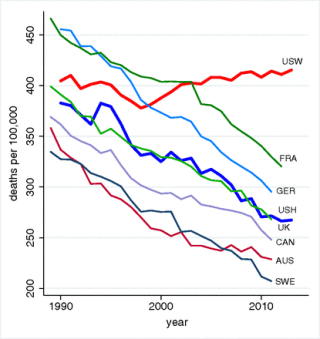
There has been a remarkable long-term decline in mortality rates in the United States, a decline in which middle-aged and older adults have fully participated (13). Between 1970 and 2013, a combination of behavioral change, prevention, and treatment (4, 5) brought down mortality rates for those aged 45–54 by 44%. Parallel improvements were seen in other rich countries (2). Improvements in health also brought declines in morbidity, even among the increasingly long-lived elderly (69).

These reductions in mortality and morbidity have made lives longer and better, and there is a general and well-based presumption that these improvements will continue. This paper raises questions about that presumption for white Americans in midlife, even as mortality and morbidity continue to fall among the elderly.

This paper documents a marked deterioration in the morbidity and mortality of middle-aged white non-Hispanics in the United States after 1998. General deterioration in midlife morbidity among whites has received limited comment (10, 11), but the increase in all-cause midlife mortality that we describe has not been previously highlighted. For example, it does not appear in the regular mortality and health reports issued by the CDC (12), perhaps because its documentation requires disaggregation by age and race. Beyond that, the extent to which the episode is unusual requires historical context, as well as comparison with other rich countries over the same period.

Increasing mortality in middle-aged whites was matched by increasing morbidity. When seen side by side with the mortality increase, declines in self-reported health and mental health, increased reports of pain, and greater difficulties with daily living show increasing distress among whites in midlife after the late 1990s. We comment on potential economic causes and consequences of this deterioration.

More here.

A libertarian utopia

Header_porcupine

Livia Gershon in Aeon:

The Free State Project began life in 2001 with a call-to-arms by Jason Sorens, then a political science PhD student at Yale. Sorens suggested that a few thousand activists could radically change the political balance in the small state. ‘Once we’ve taken over the state government, we can slash state and local budgets, which make up a sizeable proportion of the tax and regulatory burden we face every day,’ he wrote. ‘Furthermore, we can eliminate substantial federal interference by refusing to take highway funds and the strings attached to them.’

Sorens’ views — which focus on problems with taxes and regulations and don’t dispute the government’s role in protecting commerce and conducting foreign policy – suggest a more-Republican-than-the-Republicans sort of outlook. But some people who’ve responded to his call subscribe to an entirely different ideology: an anarchism that sees government as a tool of wealthy capitalists. The rest fall somewhere in between. Free Staters say that what brings them together is a common belief that government is the opposite of freedom.

The crowd that gathered in February for Liberty Forum 2014 at the Crowne Plaza Hotel in Nashua was a pretty good reflection of the US libertarian movement: mainly male, and overwhelmingly white. A few people openly carried guns, which is thoroughly legal in New Hampshire.

One of the first speakers, Aaron Day, a Republican activist and member of the Free State Project board, railed against government plans to expand Medicaid. His PowerPoint flashed images comparing President Barack Obama’s health insurance reforms to the Soviet famine of the 1930s, when Stalin shipped away Ukraine’s wheat, leaving its people to starve. Day announced he’d be running for state Republican Party chair and called for everyone in the audience to seek local office. If I was looking for the embodiment of right-wing libertarianism, here he was, a true believer in cutting the government down to size from within – starting with programmes that benefit the poor.

More here.

Nihil Unbound

9780230522053

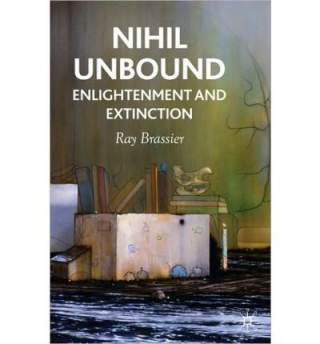
Richard Marshall interviews Ray Brassier in 3:AM Magazine:

3:AM: To understand the significance of Wilfrid Sellars’ notion of the ‘Manifest image’ and the myth of Jones for your defence of the Enlightenment can you say something about these things. What do you think the manifest image is, and what’s the myth of Jones?

RB: The Manifest Image is Sellars’s term for the system of concepts we use to understand ourselves and our world in our everyday life. Philosophers have contributed to its development. It contains notions like that of “person”, “mind”, “thing”, “property”, “belief”, “desire”, “action”, “intention”, and a host of other related notions. It is an extremely sophisticated system of concepts that has developed out of our practical interactions and activities over millennia of human cultural evolution. It is structured around certain fundamental distinctions, such as the difference between minded and mindless things, or between living and lifeless things. (Such differences are fundamental and irreducible within the Manifest Image, but perhaps not beyond it.) The term “manifest” is not supposed to connote “superficial” or “illusory”, at least not for Sellars. In a telling formulation, Sellars suggests the Manifest Image is the medium in which humans first encountered themselves as humans, by which I think he means it is the manifestation of a kind of human self-consciousness: the medium in which we conceive of ourselves as humans engaged in pursuing various practical and cognitive goals.

In Sellars’s account, the “myth of Jones” is perhaps the most momentous step in the construction of the Manifest Image and hence in the development of our collective self-conception as humans. It is the step through which we begin to understand ourselves both as minded beings motivated by beliefs and as sentient beings affected by sensations. In Sellars’s myth, Jones is the genius who first suggests that what humans say and do can be explained as the outward manifestation of inner mental states of believing, desiring, and sensing. In other words, the myth of Jones proposes that we did not always understand ourselves as minded beings motivated by thoughts and sensations; we had to learn how to do this and acquiring the resources to do so was a momentous step in our cognitive evolution.

More here.

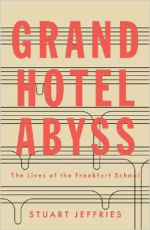
Grand Hotel Abyss: The Lives of the Frankfurt School, by Stuart Jeffries

51eP+iTtr8L._SY344_BO1,204,203,200_John Banville at the Dublin Review of Books:

The “Frankfurt School”, the popular name for the determinedly Marxist Institute for Social Research, flourished, ironically, on a capitalist fortune. Hermann Weil was the world’s largest trader in grain, but after his death in 1928 his son Felix, in a classic instance of oedipal rebellion, used his inheritance to provide an annual grant of 120,000 marks to ensure the continued solvency of the institute, which had been founded in 1923 by Carl Grünberg, a professor of law at the University of Vienna. Grünberg’s successor, the sociologist Max Horkheimer, took over the directorship in 1930, and brought in many of the school’s leading figures, including Theodor Adorno, Herbert Marcuse, Erich Fromm and the much younger Jürgen Habermas, who is today one of Europe’s most formidable philosophical voices.

From the outset the Frankfurt School had its passionate detractors. It was the Hungarian Marxist critic György Lukács who contemptuously dubbed it the “Grand Hotel Abyss”, equipped, as he wrote, “with every comfort, on the edge of an abyss, of nothingness, of absurdity”. As Stuart Jeffries writes, Horkheimer, Adorno and Co were regarded as “virtuosic at critiquing the viciousness of fascism and capitalism’s socially eviscerating, spiritually crushing impact on western societies, but not so good at changing what they critiqued”.

Yet leading figures of the school such as Horkheimer, Adorno and Fromm cannot be accused of hypocrisy or Sartrean bad faith.

more here.

Robert Silverberg: The Philip Roth of the science fiction world

Final front coverMichael Dirda at The Washington Post:

In the early 1950s a teenage Robert Silverberg began to submit stories to science fiction magazines. About this same time the Paris Review was inaugurating its celebrated “Writers at Work” interviews. In a properly run world, Silverberg would by now have been among the authors honored by that literary quarterly, since his has been one of the most prodigious careers in all American letters. Still, one can hardly imagine the result being better, or more sheerly enjoyable, than the seven long conversations conducted by Alvaro Zinos-Amaro in “Traveler of Worlds.”

That word “prodigious” captures two aspects of Silverberg’s professional life. First, he was a prodigy, publishing his first novel — the popular juvenile book “Revolt on Alpha C” — in 1955, when he was just 21. In 1956 he won a special Hugo award as the most promising young talent in science fiction. (The runner-up was Harlan Ellison.) Determined to earn his living with his typewriter, Silverberg then began to produce fiction and nonfiction at an astonishing rate, using both his own name and an unknown number of pseudonyms. One year he wrote 40 novels (though many of these were just quick-cash pornography). He worked much harder on popular introductions to archaeology and accounts of history’s byways, such as the still valuable “Lost Cities and Vanished Civilizations.” By 1961 Silverberg had grown wealthy enough — largely through investments — to purchase a mansion that had once belonged to New York City Mayor Fiorello La Guardia. Money, as he says here, “makes for a quieter life, and I’m not interested in turbulence.”

more here.

‘Labyrinths,’ Emma and Carl Jung’s Complex Marriage

07BOOKCLAY2-SUB-master180-v3Jennifer Senior at The New York Times:

Carl Jung called his separate selves “Personality No. 1” and “Personality No. 2.” No. 1 was a magnificent extrovert, performing his brilliance, steamrolling his colleagues, blowing away admirers with gusts of charm. No. 2, on the other hand, was a kettle of insecurities: introverted, anxious, tortured by voices and dark waking fantasies. At least once in his adult life, he seemed to suffer an episode of psychosis; as a young boy, images both psychedelic and profane would rudely obtrude on his thoughts, including a vision of God seated on a throne high above a cathedral and shattering its roof with a well-aimed bullet of ordure.

In his 1963 review of Jung’s autobiography, “Memories, Dreams, Reflections,” the psychoanalyst Donald Winnicott said it outright: “Jung, in describing himself, gives us a picture of childhood schizophrenia.” Yet through Jung’s own laborious exertions, he somehow healed himself. “At cost he recovered,” Winnicott wrote, “and part of the cost to him is what he paid out to us, if we can listen and hear, in terms of his exceptional insight.”

One could say that Jung made a psychoanalytic philosophy out of his doubleness. He theorized that many of us, not just the mentally ill, are split personalities, awaiting integration.

Subsequent generations of tortured souls may have benefited from Jung’s bewitching complexity. But one woman also married it. At just 19 years old, Emma Rauschenbach, the daughter of a wealthy industrialist, tied her fate to this penniless, clever man, correctly intuiting that he would offer her something beyond the monochromatic tedium of an haut-bourgeois life. What she couldn’t have known was the parlous nature of his mental stability. Or that he’d been sexually molested as a boy.

more here.

Saturday Poem

Discovery

I believe in the great discovery.
I believe in the man who will make the discovery.
I believe in the fear of the man who will make the discovery.

I believe in his face going white,
His queasiness, his upper lip drenched in cold sweat.

I believe in the burning of his notes,
burning them into ashes,
burning them to the last scrap.

I believe in the scattering of numbers,
scattering them without regret.

I believe in the man’s haste,
in the precision of his movements,
in his free will.

I believe in the shattering of tablets,
the pouring out of liquids,
the extinguishing of rays.

I am convinced this will end well,
that it will not be too late,
that it will take place without witnesses.

I’m sure no one will find out what happened,
not the wife, not the wall,
not even the bird that might squeal in its song.

I believe in the refusal to take part.
I believe in the ruined career.
I believe in the wasted years of work.
I believe in the secret taken to the grave.

These words soar for me beyond all rules
without seeking support from actual examples.
My faith is strong, blind, and without foundation.

By Wislawa Szymborska
from View With a Grain of Sand
Harcourt Brace

.

Fashion, Faith and Fantasy in the New Physics of the Universe

Graham Farmelo in The Guardian:

PenSomething is rotten in the state of physics. In spite of all the smug talk about the amazingly accurate predictions made by modern models of the most fundamental forces, things go terribly awry if these theories are used to estimate the energy of empty space. A perfectly reasonable back-of-an-envelope calculation that theoreticians have been making for decades overestimates the observed energy by no less than a trillion trillion trillion trillion trillion trillion trillion trillion trillion trillion. This may be the most inaccurate estimate made by conventional theories in the entire history of science.

The eminent mathematician and physicist Roger Penrose identifies several possible sources of the rot. Fashion, Faith and Fantasy in the New Physics of the Universe is based on a series of lectures with the same title that he gave 13 years ago in Princeton. With his usual modesty, he tells us that he was “apprehensive” about presenting his nonconformist ideas there, as that New Jersey town is home to several of the world’s leading theoreticians, many of whom are unsympathetic to his perspective. Some of these leading physicists are among the pioneers of string theory, the only candidate for a unified and fundamental description of nature at the deepest level. This fashionable and mathematically beautiful theory has attracted a global following over the past three decades, but has yet to make a prediction that has been verified by experiment. String theory is the focus of Penrose’s first chapter. He begins by reminding us of kindergarten science, before putting his foot firmly on the accelerator. A little over a hundred pages later, we are contemplating “branes”, the exotic entities that may exist in the deeply subnuclear world, and pondering whether the mathematical forms of nature’s laws have something called “supersymmetry”, which has not shown its face in the most recent experiments at Cern’s Large Hadron Collider, to the great disappointment of many physicists.

More here.

They’ll Blame Us: Growing Up Muslim After 9/11

Rafia Zakaria in The New York Times:

Zakaria-blog427-v2For the anniversary of 9/11 this year, CNN convened a special panel it titled “9/11 Kids to Terrorists: ‘You Lose.’ ” It featured 10 young men and women, all of whom had lost fathers on that fateful September day. Seated in a studio, they spoke poignantly of growing up with loss, of milestones punctuated by the absence of fathers. I remember watching the tribute and thinking of those who were not included, and its very literal assessment of casualties and those affected by it. Sept. 11, 2001, was also the day amid whose macabre details lay America’s introduction to Islam. The generation of Muslim American children who have grown up in its shadow are, in a different but just as pertinent sense, also 9/11 kids. Amani Al-Khatahtbeh’s memoir “Muslim Girl: A Coming of Age” is a chronicle of how these “other” children of 9/11 have been affected by America’s inveterate gluing together of “Muslim” and “terrorist.” It is an account that should both enlighten and shame Americans who read it.

Al-Khatahtbeh, who is also the founder of the media site “Muslim Girl,” was in fourth grade at the Bowne-Munro Elementary School in East Brunswick, N.J., that sunny September day. It was yearbook photo day, and she had dressed for it in “a stiff pair of jeans and a blue shirt.” The photographs never happened; instead there was early dismissal and the struggle to understand what her mother meant when she said the twin towers were “not there anymore” and that “two planes crashed into them.” At home, in front of the television, her father’s ominous words would make more sense: “This is a horrible thing that happened. . . . And they’re going to blame us. And it’s going to get much worse.”

He was right.

More here.

Friday, November 11, 2016

Beyond anger

Header_ESSAY-MANDELA-portrait--79375861

Martha C Nussbaum in Aeon:

There’s no emotion we ought to think harder and more clearly about than anger. Anger greets most of us every day – in our personal relationships, in the workplace, on the highway, on airline trips – and, often, in our political lives as well. Anger is both poisonous and popular. Even when people acknowledge its destructive tendencies, they still so often cling to it, seeing it as a strong emotion, connected to self-respect and manliness (or, for women, to the vindication of equality). If you react to insults and wrongs without anger you’ll be seen as spineless and downtrodden. When people wrong you, says conventional wisdom, you should use justified rage to put them in their place, exact a penalty. We could call this football politics, but we’d have to acknowledge right away that athletes, whatever their rhetoric, have to be disciplined people who know how to transcend anger in pursuit of a team goal.

If we think closely about anger, we can begin to see why it is a stupid way to run one’s life. A good place to begin is Aristotle’s definition: not perfect, but useful, and a starting point for a long Western tradition of reflection. Aristotle says that anger is a response to a significant damage to something or someone one cares about, and a damage that the angry person believes to have been wrongfully inflicted. He adds that although anger is painful, it also contains within itself a hope for payback. So: significant damage, pertaining to one’s own values or circle of cares, and wrongfulness. All this seems both true and uncontroversial. More controversial, perhaps, is his idea (in which, however, all Western philosophers who write about anger concur) that the angry person wants some type of payback, and that this is a conceptual part of what anger is. In other words, if you don’t want some type of payback, your emotion is something else (grief, perhaps), but not really anger.

Is this really right? I think so. We should understand that the wish for payback can be a very subtle wish: the angry person doesn’t need to wish to take revenge herself. She may simply want the law to do so; or even some type of divine justice. Or, she may more subtly simply want the wrongdoer’s life to go badly in future, hoping, for example, that the second marriage of her betraying spouse turns out really badly. I think if we understand the wish in this broad way, Aristotle is right: anger does contain a sort of strike-back tendency. Contemporary psychologists who study anger empirically agree with Aristotle in seeing this double movement in it, from pain to hope.

The central puzzle is this: the payback idea does not make sense. Whatever the wrongful act was – a murder, a rape, a betrayal – inflicting pain on the wrongdoer does not help restore the thing that was lost. We think about payback all the time, and it is a deeply human tendency to think that proportionality between punishment and offence somehow makes good the offence. Only it doesn’t.

More here.

Paul Krugman: Thoughts for the Horrified

Paul Krugman in the New York Times:

ScreenHunter_2362 Nov. 11 20.04So what do we do now? By “we” I mean all those left, center and even right who saw Donald Trump as the worst man ever to run for president and assumed that a strong majority of our fellow citizens would agree.

I’m not talking about rethinking political strategy. There will be a time for that — God knows it’s clear that almost everyone on the center-left, myself included, was clueless about what actually works in persuading voters. For now, however, I’m talking about personal attitude and behavior in the face of this terrible shock.

First of all, remember that elections determine who gets the power, not who offers the truth. The Trump campaign was unprecedented in its dishonesty; the fact that the lies didn’t exact a political price, that they even resonated with a large bloc of voters, doesn’t make them any less false. No, our inner cities aren’t war zones with record crime. No, we aren’t the highest-taxed nation in the world. No, climate change isn’t a hoax promoted by the Chinese.

So if you’re tempted to concede that the alt-right’s vision of the world might have some truth to it, don’t. Lies are lies, no matter how much power backs them up.

And once we’re talking about intellectual honesty, everyone needs to face up to the unpleasant reality that a Trump administration will do immense damage to America and the world. Of course I could be wrong; maybe the man in office will be completely different from the man we’ve seen so far. But it’s unlikely.

Unfortunately, we’re not just talking about four bad years. Tuesday’s fallout will last for decades, maybe generations.

More here.