
Category: Recommended Reading
john berger (1926 – 2017)
Saturday, January 7, 2017
Remembering Derek Parfit
Amia Srinivasan in the London Review of Books:
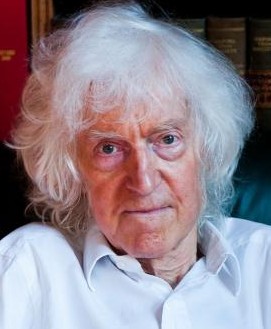
Without a trace of annoyance, Parfit signed our books and offered to show us round the college. In the 15th-century chapel he pointed out the hammer-beam roof and gilded angels, the Gothic reredos and its 19th-century statues. We talked about moral philosophy. He said he couldn’t understand how Shelly Kagan, a philosopher at Yale whom he deeply admired, believed in moral retribution. ‘I just can’t believe that anyone deserves to suffer,’ he said, shaking his head. After the tour he gave us detailed instructions on how to get back to the railway station, anxious that we didn’t get lost, and wished us well.
More here.
Dark Matter: Did we just hear the most exciting phrase in science?
A new analysis shows a surprisingly simple relationship between the way galaxies move, and the distribution of ordinary matter within them. Unexpectedly this seems to hold however much mysterious dark matter they contain. That’s funny.
John Butterworth in The Guardian:

Galaxies are made up of three components. Stars, which we can see. Gas, which we can also see, although much of what we ‘see’ is infrared light with a wavelength too long for our eyes but which we can nevertheless measure. And most elusive of all, ‘Dark Matter’, which we can’t see at all. We deduce its presence from its gravitational influences – on the way galaxies move and the way light bends as it passes by them. We don’t know what Dark Matter is made of, a situation which especially annoys and intrigues particle physicists like me, who want to know what everything is made of.
Key to the analysis is the measurement of rotation curves of galaxies. This is the way the average speed of the stars orbiting in galaxies changes as they get further from the centre. To measure this you need a good spatial resolution (to distinguish the distance from the centre) and a measurement of the wavelength of the light, because the wavelength tells us the speed – from the ‘Doppler Shift’, similar to the way the pitch of a horn is higher for an approaching train and lower as it recedes. McGaugh, Lelli and Schmobery have analysed 2693 measurements in 153 galaxies studied by Spitzer.
More here.
It’s finally happening: Finland has just launched a world-first universal basic income experiment
Dom Galeon in Science Alert:

These Finns are the lucky recipients of a guaranteed income beginning this year, as the country’s government finally rolls out its universal basic income (UBI) trial run.
UBI is a potential source of income that could one day be available to all adult citizens, regardless of income, wealth, or employment status.
This pioneering UBI program was launched by the federal social security institution, Kela. It will give out €560 (US$587) a month, tax free, to 2,000 Finns that were randomly selected.
The only requirement was that they had to be already receiving unemployment benefits or an income subsidy.
The program allows unemployed Finns to not lose their benefits, even when they try out odd jobs.
"Incidental earnings do not reduce the basic income, so working and … self-employment are worthwhile no matter what," says Marjukka Turunen, legal unit head at Kela.
If successful, the program could be extended to include all adult Finns.
More here.
The history of Daesh (ISIS) in 6 minutes
Video length: 6:33
The American democracy and dream are the building of castles in air
Lewis Lapham in Lapham's Quarterly:

…Things haven’t worked out as well for the democratically endowed dreamers of the American dream floating on the rising tide of prosperity in the boom years subsequent to the Second World War. By the late 1970s, the boom was losing momentum, and so was the affordable credit. Which is to say, as did Henrik Ibsen in 1879, “Home life ceases to be free and beautiful as soon as it is founded on borrowing and debt.” Ceases to be free and beautiful for the occupant of the lived-in human space, not for the absentee owners of the price of the thing (corporation, insurance company, bank) who retain title to the property free and clear of its human flotsam and jetsam.
More here.
Can a Bombay Strongman Explain Trump?
Suketu Mehta in The New York Times:

He was a master of the art of the outrage, of politics as performance. He would castigate his opponents as “vampires,” “a sack of flour” and various untranslatable epithets like calling South Indians “yandu-gundus.” Periodically, he would express admiration for Hitler, immediately attracting thousands of news pages of free publicity. He regularly called for books and films that he felt were antithetical to Hindu values to be banned. Egged on by his invective, his legions would go out and beat up artists and journalists. Though Mr. Thackeray neither inherited nor ran businesses as Mr. Trump did, the two men’s support base was remarkably similar in its political contours. The people Mr. Thackeray represented were the native Maharashtrians, the “sons of the soil.” The list of his enemies varied with the seasons, from Communists to South Indian migrants to Gujaratis to Muslims and, eventually, North Indians. Working-class Maharashtrians felt excluded from booming Bombay, capital of Maharashtra State, as it made the transition from manufacturing to a postindustrial financial and services economy. They resented both the moneyed cosmopolitan elites as well as the North Indian migrants who competed with them for low-skill jobs.
More here.
John Berger remembered

I heard John Berger speaking at the end of 2015 in London at the British Library. Someone in the audience talked about A Seventh Man, his 1975 book about mass migrancy in which he says: “To try to understand the experience of another it is necessary to dismantle the world as seen from one’s own place within it and to reassemble it as seen from his.”
The questioner asked what Berger thought about the huge movement of people across the world. He put his head in his hands and sat and thought; he didn’t say anything at all for what felt like a long time, a thinking space that cancelled any notion of soundbite. When he answered, what he spoke about ostensibly seemed off on a tangent. He said: “I have been thinking about the storyteller’s responsibility to be hospitable.”
As he went on, it became clear how revolutionary, hopeful and astute his thinking was. The act of hospitality, he suggested, is ancient and contemporary and at the core of every story we’ve ever told or listened to about ourselves – deny it, and you deny all human worth. He talked about the art act’s deep relationship with this, and with inclusion. Then he gave us a definition of fascism: one set of human beings believing it has the right to cordon off and decide about another set of human beings.
more here.
FROM ‘THE MAGICIAN OF VIENNA’ BY SERGIO PITOL

Our century seems to take pleasure in repeating cyclically that strange comedy of errors that stirs between certain authors and an unreceptive public. The cases of Robert Musil, Hermann Broch, Malcolm Lowry, Joseph Roth are examples of writers who have needed an upheaval in literary taste, which happened twenty-five or thirty years after their death, in order for the magnitude of works like The Man Without Qualities, The S, Under the Volcano, The Radetzky March, At Swim-Two-Birds, and The Third Policeman to be added to the list of those fundamental novels of our time that have been rediscovered belatedly.
The bizarre name of this novel, At Swim-Two-Birds, comes from the name of a village that lies on the banks of the River Shannon, which is the Anglicized form of a long-ago place mentioned in medieval Irish lyric, which in Gaelic sounds like Snám-da-en.
At Swim-Two-Birds entails a dizzying transit between every register of Irish literature, and is a book that contains at least three other books: one, about the relationship between the novelist and his characters, an erratic convivence between the demiurge and his creatures, who end up rebelling against he who gave them life; another, about the old medieval legend of King Sweeney whom God cursed with madness and —as if that were not enough! —with immortality, for having attempted to kill a pious cleric, and who in those old Gaelic songs appears transformed into a pathetic old bird that leaps from tree to tree; and a third, which registers at a level that could be called realist, composed of the familial vicissitudes of a young man who attempts to write a novel, his initiation into alcohol, his day-to-day conflicts.
more here.
Poet Philip Levine sketched the life of working-class Americans

In the spring of 1952, poet Philip Levine worked at the Chevrolet Gear and Axle plant in Detroit, Mich. He was 24 and had been writing poems for nearly 10 years.
Some get their calling early, but being a young poet is not easy. He had clocked hours in an ice factory, a bottling corporation, on the railroad — but none as boring and hazardous as in the gear and axle plant, where he pulled automotive parts from the forge and hung them on conveyors that whisked them elsewhere in the factory.
Years later, well committed to a life of “poverty and poetry,” he could still feel “almost without hatred that old sense of utter weariness that descended each night from my neck to my shoulders, and then down my arms to my wrists and hands.”
Over his lifetime, Levine, who died at 87 in 2015, never lost that muscle memory, his ars poetica. He carried it with him whenever he “lifted a pencil to write,” the memory of that hellish world — with its clanging steel, poisoned rats and freezing winds rushing through broken windows — of so many exploited lives.
more here.
Friday, January 6, 2017
A Deeper Boom: A privileged generation reckons with race, climate, and getting things done
Gary Ferguson in Orion Magazine:
The environmental movement that arose in response to these disasters was hardly populated by Luddites. The very emblem of the movement was a photograph called Earthrise, taken by Apollo 8 astronaut William Anders—the product of one of the most complicated technological accomplishments in human history. Indeed the boomers deliberately linked science and technology to the goals of clean air and water and sustainable agriculture. They succeeded because they were good at speaking scientific truth to power rather than pining for an Arcadian past. In 1967, about 20 percent of Americans listed the environment as a top priority. Just fifteen months later—in large part thanks to rallies and protests and organizing by young environmentalists—that number had swelled to 80 percent.
More here.
An Orphaned Sewing Machine
Laurel Thatcher Ulrich in Harvard Magazine:

…According to one scholar, the Singer sewing machine emerged from a collaboration “between a mechanical genius, Isaac Merrit Singer (Image 4), and a lawyer, Edward Clark.” Singer may or may not have been a mechanical genius, but he was a genius at keeping his own name in view: it appears at least five times on our sewing machine (Image 5). It is an appealing name: a sewing machine may not sing, but it certainly hums. Lawyer Edward Clark (Image 6) played another role. As historian Nira Wickramasinghe explains, “The early history of the company…can be read as a maze of patent grabbing by a number of inventors….and subsequent litigation. No owner of a single patent could make a sewing maching without infringing on patents of others. Clark was instrumental in the creation of the Albany patent pool, where the holders of these key patents agreed to forgo litigation and to license their technology to one another.” Some sense of the importance of patents is seen on our sewing machine, which lists those from the 1880s to 1892.
More here.
Steven Weinberg: The Trouble with Quantum Mechanics
Steven Weinberg in the New York Review of Books:

The first shock came as a challenge to the clear categories to which physicists by 1900 had become accustomed. There were particles—atoms, and then electrons and atomic nuclei—and there were fields—conditions of space that pervade regions in which electric, magnetic, and gravitational forces are exerted. Light waves were clearly recognized as self-sustaining oscillations of electric and magnetic fields. But in order to understand the light emitted by heated bodies, Albert Einstein in 1905 found it necessary to describe light waves as streams of massless particles, later called photons.
Then in the 1920s, according to theories of Louis de Broglie and Erwin Schrödinger, it appeared that electrons, which had always been recognized as particles, under some circumstances behaved as waves. In order to account for the energies of the stable states of atoms, physicists had to give up the notion that electrons in atoms are little Newtonian planets in orbit around the atomic nucleus. Electrons in atoms are better described as waves, fitting around the nucleus like sound waves fitting into an organ pipe.1 The world’s categories had become all muddled.
More here.
Safety Pins and Swastikas
Shuja Haider in Jacobin:

Spencer, who popularized the now common euphemism “alt-right,” is fond of describing his platform as “identity politics for white people.” He takes pains to correct those who refer to him as a white supremacist, insisting that he is merely a “nationalist,” or a “traditionalist,” or, better yet, an “identitarian.” He wants to bring about what he calls a “white ethno-state,” a place where the population is determined by heritability. In a knowing inversion of social justice vocabulary, he describes it as “a safe space for Europeans.”
Spencer has an advanced degree in humanities, spent time in the famously left-wing graduate program at Duke University, and wrote an antisemitic interpretation of Theodor Adorno’s music criticism for his master’s thesis. His political mentor, Paul Gottfried, was a student of Herbert Marcuse. Spencer is clearly intimately acquainted with both academic left philosophy and campus social justice activism.
It was only a matter of time before the right identified liberal and leftist strategies that they themselves could adopt, as a conservative Christian Duke freshman portended in 2015. Amid widespread debate over trigger warnings, he refused to read Alison Bechdel’s graphic novel Fun Home, a memoir that included depictions of lesbian sex.
More here.
A Brilliant Madness: John Nash Descends into Madness
Video length: 54:39
Two New Ballets

Dance is the least predictable of art forms. Even when done by a choreographer you love, with superb music and excellent dancers, a new piece may disappoint—and, conversely, something about which you had low expectations may delight and move you. Last spring I saw, in quick succession, two relatively new evening-length ballets on either side of the Atlantic. Christopher Wheeldon’s The Winter’s Tale had been around since 2014, in performances by both the Royal Ballet and the National Ballet of Canada, but I only caught up with it in May at Covent Garden. Alexei Ratmansky’s version of The Golden Cockerel (a work which has an old Russian history, going back to Fokine and earlier) opened in Copenhagen in 2012 but did not have its American premiere until this past June in New York. In each case, the performances I saw surprised me.
Wheeldon is not one of my favorite choreographers, and I’ve especially disliked the way he’s sometimes used women in his work, which did not bode well for Hermione, Paulina, and Perdita. Worse yet, thisWinter’s Tale had a newly commissioned score by an unknown-to-me Englishman, Joby Talbot—a worrisome fact, given my long history of attending British Shakespeare productions burdened by trashily new music. Moreover, the lead dancer in the May performance, Edward Watson, had recently been criticized by a major Anglo-American dance critic for, among other things, having red hair and pale skin: flaws that I forgive, since I have them both myself, but still… So I was nervous about the Covent Garden evening. I warned my non-ballet-fan companions (dragged along at great expense) that the only thing in the dance’s favor was that a San Francisco friend had raved about the Toronto performance she had seen, saying it was one of her favorite new ballets ever.
more here.
the startling story of lobotomies in the 20th century

On November 19, 1948, the two most enthusiastic and prolific lobotomists in the Western world faced off against each other in the operating theatre at the Institute of Living in Hartford, Connecticut. They performed before an audience of more than two dozen neurosurgeons, neurologists and psychiatrists. Each had developed a different technique for mutilating the brains of the patients they operated on, and each man had his turn on the stage.
William Beecher Scoville, Professor of Neurosurgery at Yale, went first. His patient was conscious. The administration of a local anaesthetic allowed the surgeon to slice through the scalp and peel down the skin from the patient’s forehead, exposing her skull. Quick work with a drill opened two holes, one over each eye. Now Scoville could see her frontal lobes. He levered each side up with a flat blade so that he could perform what he called “orbital undercutting”. What followed was not quite cutting: instead Scoville inserted a suction catheter – a small electrical vacuum cleaner – and sucked out a portion of the patient’s frontal lobes.
The patient was wheeled out and a replacement was secured to the operating table. Walter Freeman was next, a Professor of Neurology from George Washington University. He had no surgical training and no Connecticut medical licence, so he was operating illegally – not that this seemed to bother anyone present. Freeman sought an assembly-line approach so that lobotomy could be performed quickly and easily. His technique allowed him on occasion to perform twenty and more operations in a single day. He proceeded to use shocks from an Electro-Convulsive Therapy machine to render his female patient unconscious, and then inserted an ice pick beneath the eyelid until the point rested on the thin bony structure in the orbit.
more here.
Friday Poem
Orb Spider
I saw her, pegging out her web
thin as a pressed flower in the bleaching light.
From the bushes a few small insects
clicked like opening seed-pods. I knew some
would be trussed up by her and gone next morning.
She was so beautiful spinning her web
above the marigolds the sun had made
more apricot, more amber; any bee
lost from its solar flight could be gathered
back to the anther, and threaded onto the flower
like a jewel.
She hung in the shadows
as the sun burnt low on the horizon
mirrored by the round garden bed. Small petals
moved as one flame, as one perfectly-lit hoop.
I watched her work, produce her known world,
a pattern, her way to traverse
a little portion of the sky;
a simple cosmography, a web drawn
by the smallest nib. And out of my own world
mapped from smallness, the source
of sorrow pricked, I could see
immovable stars.
Each night
I saw the same dance in the sky,
the pattern like a match-box puzzle,
tiny balls stuck in a grid until shaken
so much, all the orbits were in place.
Above the bright marigolds
of that quick year, the hour-long day,
she taught me to love the smallest transit,
that the coldest star has planetesimal beauty.
I watched her above the low flowers
tracing her world, making it one perfect drawing.
by Judith Beveridge
from The Domesticity of Giraffes
Black Lightning Press, 1987
.
Thursday, January 5, 2017
THE ERASURE OF ISLAM FROM THE POETRY OF RUMI
Rozina Ali in The New Yorker:
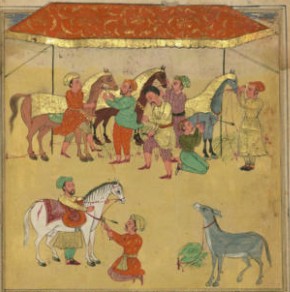
Rumi has helped the spiritual journeys of other celebrities—Madonna, Tilda Swinton—some of whom similarly incorporated his work into theirs. Aphorisms attributed to Rumi circulate daily on social media, offering motivation. “If you are irritated by every rub, how will you ever get polished,” one of them goes. Or, “Every moment I shape my destiny with a chisel. I am a carpenter of my own soul.” Barks’s translations, in particular, are shared widely on the Internet; they are also the ones that line American bookstore shelves and are recited at weddings. Rumi is often described as the best-selling poet in the United States. He is typically referred to as a mystic, a saint, a Sufi, an enlightened man. Curiously, however, although he was a lifelong scholar of the Koran and Islam, he is less frequently described as a Muslim.
More here.