
Category: Recommended Reading
ikutaro kakehashi (1930 – 2017)
william m. hoffman (1939 – 2017)
Sean Spicer Returns – SNL
Happy mother’s day

“Mothers of teenagers know why animals eat their young.” ~ Author Unknown
“It would seem that something which means poverty, disorder and violence every single day should be avoided entirely, but the desire to beget children is a natural urge.” ~ Phyllis Diller
“My mother had a great deal of trouble with me, but I think she enjoyed it.” ~ Mark Twain
I’ve been married 14 years and I have three kids. Obviously I breed well in captivity. – Roseanne Barr
My mom's favorite Stevie Wonder song is, “I Just Called to Say Someone You Don't Know Has Cancer”
– Damien Fahey @DamienFahey
There are three ways to get something done: hire someone to do it, do it yourself, or forbid your kids to do it !
“You don't really understand human nature unless you know why a child on a merry-go-round will wave at his parents every time around – and why his parents will always wave back.” ~William D. Tammeus.
“My mother's menu consisted of two choices: Take it or leave it.” ~ Buddy Hackett
Motherhood is like Albania—you can’t trust the descriptions in the books, you have to go there.
– Marni Jackson
Over the years I have learned that motherhood is much like an austere religious order, the joining of which obligates one to relinquish all claims to personal possessions.
– Nancy Stahl
The reason I don’t call my mother more often is that I get tired of her complaining that I never call. – Melanie White
An ounce of mother is worth a ton of clergy. – Spanish Proverb
Sunday Poem
Chaos Theory
I heard a scientist
say the flutter of
a butterfly's wing
could cause a tornado,
that the theory of
cause and effect
has been shaken to the roots,
that we cannot reduce
hurricanes, floods, the knife edge
of a lightning flash, anger
or an accidental death
to a neat equation.
The Greeks got it right
after all it seems,
we are born from Chaos
spat out on a sea of pot luck,
Chaos who spawned mother earth,
the sky, oceans
from her clay haunches,
the ocher dust of her giant thighs.
Move one decimal point
the scientists said and our lives
run on a different course,
instead of hope there is despair
or the carrot fly blighting
a near perfect crop. In the
silent pond a thousand tadpoles spawn
beneath the shadow of a stickleback.
Like schoolboys knocking
marbles in the asphalt yard
we ricochet off
what life throws up
fall like yarrow sticks
of a Chinese soothsayer
straw blown in the gusting wind,
hinged on a fluke of chance.
.
by Sue Hubbard
from Everything Begins With The Skin
Enitharmon Press, 1994
.
Saturday, May 13, 2017
Review of Sharon Duggal’s debut novel, “The Handsworth Times”
Zaheer Kazmi in 3:AM Magazine:
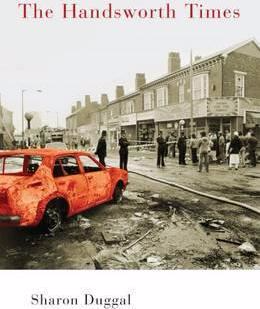
In her semi-autobiographical debut novel, The Handsworth Times, Sharon Duggal takes the reader back to the scene of the original riots of 1981 at a time when she too was a resident of Handsworth, of which Lozells is a sub-district. The ‘Handsworth Riots’ of 1981 were a seminal part of the first wave of so-called ‘race riots’ that rocked England’s inner-cities, from Liverpool to London, that Summer. They were to erupt again with even fuller force at the height of Thatcherism in 1985 culminating in the murder of police officer Keith Blakelock on the Broadwater Farm Estate in Tottenham and the deaths of the post office brothers in Birmingham.
More here.
The world’s most valuable resource is no longer oil, but data
In the Economist:
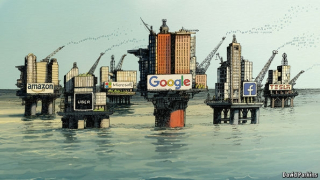
A NEW commodity spawns a lucrative, fast-growing industry, prompting antitrust regulators to step in to restrain those who control its flow. A century ago, the resource in question was oil. Now similar concerns are being raised by the giants that deal in data, the oil of the digital era. These titans—Alphabet (Google’s parent company), Amazon, Apple, Facebook and Microsoft—look unstoppable. They are the five most valuable listed firms in the world. Their profits are surging: they collectively racked up over $25bn in net profit in the first quarter of 2017. Amazon captures half of all dollars spent online in America. Google and Facebook accounted for almost all the revenue growth in digital advertising in America last year.
Such dominance has prompted calls for the tech giants to be broken up, as Standard Oil was in the early 20th century. This newspaper has argued against such drastic action in the past. Size alone is not a crime. The giants’ success has benefited consumers. Few want to live without Google’s search engine, Amazon’s one-day delivery or Facebook’s newsfeed. Nor do these firms raise the alarm when standard antitrust tests are applied. Far from gouging consumers, many of their services are free (users pay, in effect, by handing over yet more data). Take account of offline rivals, and their market shares look less worrying. And the emergence of upstarts like Snapchat suggests that new entrants can still make waves.
But there is cause for concern. Internet companies’ control of data gives them enormous power. Old ways of thinking about competition, devised in the era of oil, look outdated in what has come to be called the “data economy” (see Briefing). A new approach is needed.
More here.
Inequality Is About Access to Public Goods, Not Income

Claude S. Fischer in Boston Review:
Many explanations for growing inequality are on the table. Technical and structural changes, such as computerization and globalization, have strengthened the market position of educated specialists while undermining that of uneducated workers. Business rearrangements, including the growing role of finance in the economy and of “shareholder value” in corporate affairs, enrich managers and asset-holders more than workers. Social trends, such as the increasing delay of marriage, more children raised by single parents, women’s entry into the professions, and growing marital “homogamy”—high earners marrying high earners—have also widened the economic gap between top and bottom.
Almost all the possible causes of growing inequality are, however, conditioned by policy. Inequality trends vary substantially among Western nations. Inequality has surged in the United States and a few other English-speaking countries since 1970, while other countries, such as Australia and France, have experienced only mild or even negligible increases in inequality. Even within the United States, states vary in the pace of increasing inequality, variation that seems connected to state policy. Economist Thomas Piketty, whose work has been interpreted as suggesting that rising inequality is inevitable, demurs: “The history of the distribution of wealth has always been deeply political. . . . It is shaped by the way economic, social, and political actors view what is just and what is not, as well as by the relative power of those actors and the collective choices that result.”
As British economist Tony Atkinson wrote in his last book, Inequality (2015), even the most seemingly technical or market forces are guided by government actions. For Atkinson the rise in inequality has been the joint result of market forces driving inequality (such as global trade) and weakening state action against such forces. Policy can affect earnings through, for example, rules for wages, corporate governance, and labor bargaining. The weakening of organized labor has been the key force, Atkinson argues, for worsening income inequality in the United States and the UK. And policy of course affects any post-market adjustments through taxes, subsidies, health provision, and so on. Policy even shapes social trends such as delayed marriage through provisions for housing and child care, equal rights laws, and the like.
More here.
Justice Not Revenge – Examining the Concept of Revolutionary Justice
Saturday Poem
Bad News Good News
I was at a camp in the country,
you were home in the city,
and bad news had come to you.
You texted me as I sat
with others around a campfire.
It had been a test you and I
hadn’t taken seriously,
hadn’t worried about.
You texted the bad news word
cancer. I read it in that circle
around the fire. There was
singing and laughter to my right and left
and there was that word on the screen.
I tried to text back but,
as often happened in that county,
my reply would not send, so I went to higher ground.
I stood on a hill above the river and sent you
the most beautiful words I could manage,
put them together, each following each. Under
Ursa Major, Polaris, Cassiopeia, a space station flashing,
I said what had been said
many times, important times, foolish times:
those words soft-bodied humans say when the news is bad.
The I love you we wrap around our
need and hurl at the cosmos: Take this, you heartless
nothing and everything, take this.
I chose words to fling into the dark toward you
while the gray-robed coyote came out of hiding
and the badger wandered the unlit hill
and the lark rested herself in tall grasses;
I sent the most necessary syllables
we have, after all this time the ones we want to hear:
I said Home, I said Love, I said Tomorrow.
.
by Marjorie Saiser
from I Have Nothing to Say About Fire
The Backwaters Press, 2016
.
‘A GREATER MUSIC’ AND ‘RECITATION’ BY BAE SUAH
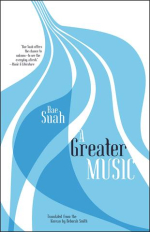
Somehow, South Korean author Bae Suah weaves the strangest and most human narratives from the events of our lives. In her two recent titles, A Greater Music and Recitation, she finds the mysterious border where life and dreams, travel and place, the past and future merge.
Readers that rely on plot will find themselves on unpredictable ground. Bae Suah is a circular writer, and a circle, as we know, has no end. Recitation, especially, whose protagonist is a wandering actress, whose stories and memories become the stories and dreams of other characters, seems akin to gazing at a beautiful painting without a point of focus. Perhaps this is the point; where does one draw a map of life? Or art? Where do these things start and end? Are they supposed to start and end? García Márquez insisted that intuition was fundamental to writing fiction; Bae Suah seems to support this belief, demonstrating how this conviction shapes their work. As the characters in both these books wander through their lives, their pasts, and their memories, so too does the reader.
The main character of Recitation, Kyung-hee, is stateless, traveling across Europe and Asia, between Vienna and Seoul and several other cities, staying at stranger’s homes or hostels. As she tells her stories to different hosts and old friends, her listeners interject, often with their own stories, and soon the contrast between plot and story is evident; plot is altogether absent, but Recitation is replete with stories, awash with characters eager to disclose their theories on life and travel, destiny and family.
more here.
rediscovering Goncharov

Again and again, the 19th-century European novel returns to its favorite theme: lost illusions. Balzac’s fiction regularly tracks the corruption of visionaries and idealists; “War and Peace” ends with its surviving characters abandoning the romantic dreams of youth to embrace a complacent, bourgeois middle age; those famously restless wives — Emma Bovary, Effi Briest and Anna Karenina, among many others — learn that adultery can be at least as disappointing as marriage.
In some ways, disillusionment might be viewed as simply another name for maturity. That’s certainly among the underlying meanings of “The Same Old Story ,” Stephen Pearl’s English title for his new translation of Ivan Goncharov’s tragicomic first novel. But there are other, more jaded implications, too, mainly concerning love.
Because 19th-century Russia abounds in stupendous literary figures, Ivan Goncharov (1812-1891) can be easily overlooked, though his masterpiece, “Oblomov ,” should sound vaguely familiar, if only because it is sometimes described as the story of a guy who doesn’t want to get out of bed.
more here.
Patrick Buchanan Reveals Himself to Be the First Trumpist
Patrick J. Buchanan is a merry troglodyte, a naughty provocateur. He still calls homosexuality “sodomy,” just to get the goat of a community he will only reluctantly call “gay.” He writes that he wanted to be named ambassador to South Africa by President Ford so he could support the apartheid government. He thinks public television is “an upholstered playpen” for liberals. He considers “The New York Times” an epithet. His stump appearances in his outlaw 1992 and 1996 presidential campaigns were a guilty pleasure for the reporters who followed him, a hilariously clever, and prescient, exhibition of right-wing populism. “Buchanan,” Richard Nixon once told him, “you’re the only extremist I know with a sense of humor.”
And it is Buchanan, not Nixon, who emerges as the central — and most intriguing — character in “Nixon’s White House Wars,” an entertaining memoir of that benighted presidency. Buchanan’s Nixon is a familiar figure: distant, awkward, smart, defensive and damaged, caring a bit too much what the Establishment — a word Buchanan uses frequently — thinks of him. The not-so-tricky president is a policy moderate; he has surrounded himself with brilliant, if mainstream, experts like Henry Kissinger and Daniel Patrick Moynihan. There is also a retinue of traditional moderate Republican aides like Ray Price and Leonard Garment, and technocrats like H. R. Haldeman and John Ehrlichman. Buchanan, the house wing nut, finds all this moderation frustrating; he began as a peripheral figure in the Nixon White House, a political gunslinger perhaps a bit too hot for the high-rent nuances of governance.
more here.
Who’s the best presidential impersonator?
Note: For Abbasi
civil rights leader and “Mama Africa” Miriam Makeba
Friday, May 12, 2017
Friday Poem
Harmony
Sisyphus punches in, each morning,
At a mountain he must face all day,
In hell, for eternity, and at night,
Having not reached the summit
Again, he walks down slow, where
The rock rushed by, careful to see,
With new eyes, where it all went
Wrong, again, and then later,
At the bar in town, sits cooling his
Bleeding hands against a whiskey,
On the rocks, and maps new paths,
On a napkin, inside the wet ring
His tumbler made, again and again,
The routes running on to absurd
Lengths, hands shaking, and if it
Wasn’t a map, you might think
It was the history of history
Or parts of a nude in repose,
Patient with death and belonging.
by Aaron Fagan.
published by the Academy of American Poets
why the polls tell you nothing you actually need to know
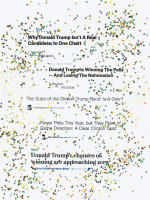
If one pollster had failed to accurately predict one result, you could conduct a fairly simple investigation: Had they chosen their samples incorrectly? Had they asked their questions misleadingly? When every poll gets it wrong, with increasing and alarming frequency, the problem is no longer methodological but metaphysical. There are, of course, some perfectly reasonable explanations. For starters, there are anything-but-surveyable patterns of voter suppression and voter lethargy, together with steady influxes of new, never-before-surveyed voters in the electorate. There’s also the huge methodological difficulty that most polling is traditionally carried out via phone, and large sectors of the electorate are no longer happy to answer the phone when unknown numbers appear on the screen.
But these second-order obstacles aren’t enough to explain the current collapse of poll-driven political certainty. They’re just excuses, even if they’re not untrue. Something about the whole general scheme of polling—the idea that you can predict what millions of undecided voters will do by selecting a small group and then just simply asking them—is out of whack. We need to think seriously about what the strange game of election-watching actually is, in terms of our relation to the future, our power to choose our own outcomes, the large-scale structure of the universe, and the mysteries of fate. And these questions are urgent. Because predictions of the future don’t simply exist in the future, but change the way we act in the present. Because in our future something monstrous is rampaging: it paces hungrily toward us, and we need to know if we’ll be able to spot it in time.
more here.
Homer of Lod: The Indispensability of Erez Bitton

In Israel of the 1970s everyone was supposed to speak Hebrew and forget the past. There would be no Yiddish, there would certainly be no Arabic, and being from the Maghreb—a fluid Arabic term encompassing Morocco, Algeria, and Tunisia—was nothing to be proud of. Shouting “I’m from the Maghreb” in the confident heart of the new Israel—and in Arabic—in those days was daring. The same poem goes on to imagine the poet sitting among Ashkenazi intellectuals at the nearby Café Roval wearing a colorful Moroccan robe.
All of this might seem innocuous now. But Bitton’s poems had an electrifying effect on many readers—particularly young Mizrahim who had been given the impression in school, as one put it, that their parents arrived “from a smooth and empty place, like the surface of the moon.” That writer, Sami Shalom Chetrit, remembered a school classroom of “forty Mizrahim and one good-hearted Ashkenazi teacher” where he received no inkling of the cultural riches of his Moroccan family, or of any of the Jews who poured into Israel from the Islamic world after 1948. (Today roughly half of Israel’s Jewish population has roots in Islamic countries.)
Few of the stories the new state told about itself—“from annihilation to rebirth,” the kibbutz, Herzl—had much to do with people from Casablanca or Tehran. Their culture wasn’t welcome in public, beyond fragments quarantined as folklore. Some of the greatest Iraqi musicians had been Jews, like the famous brothers el-Kuwaiti, and there was Zohra el-Fassiya, of course, and many others—but the music wasn’t on the radio, kept alive only in living rooms, at private parties, and in small clubs in the area of south Tel Aviv known as the Yemenite Vineyard.
more here.
Louis Kahn’s work is accessible, minimal, simple, solid, systematic, and self-evident

HERE ARE TWO THINGS TO KNOW about architects. First, they are fastidious and inventive with their names. Frank Lincoln Wright was never, unlike Sinatra, a Francis. He swapped in the Lloyd when he was 18—ostensibly in tribute to his mother’s surname on the occasion of her divorce, but also to avoid carrying around the name of a still more famous man, and for that nice three-beat meter, in full anticipation of seeing his full name in print. In 1917, Charles-Edouard Jeanneret-Gris—who is to modern architecture what Freud is to psychoanalysis—was given the byline Le Corbusier (after corbeau, crow) by his editor at a small journal, so that he could anonymously review his own buildings. The success of the sock puppet critic meant that after the critiques were collected into a book-length manifesto, the nom-de-plumeeventually took over Jeanneret-Gris’ architect persona, as well. Ludwig Mies—the inventor of the glass-walled skyscraper—inherited an unfortunate surname that doubled as a German epithet for anything lousy or similarly defiled. He restyled himself Miës van der Rohe—vowel-bending heavy-metal umlaut and all—with the Dutch geographical tussenvoegsel “van” from his mother’s maiden name to add a simulation of the German nobiliary particle, von. Ephraim Owen Goldberg became Frank Gehry.
Second, all architects are older than you think. Or than they want you to think. Unlike the closely adjacent fields of music and mathematics, architecture has no prodigies. Design and construction take time. At 40, an architect is just starting out. Dying at 72 in architecture is like dying at 27 in rock and roll. The body of knowledge required is broad and intricate, philosophical and practical, and the training is long.
more here.