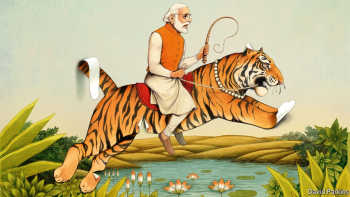
India’s prime minister is not as much of a reformer as he seems, but he is more of a nationalist firebrand

From The Economist:

20170624_LDD001_0When Narendra Modi became prime minister of India in 2014, opinion was divided as to whether he was a Hindu zealot disguised as an economic reformer, or the other way round. The past three years appear to have settled the matter. Yes, Mr Modi has pandered to religious sentiment at times, most notably by appointing a rabble-rousing Hindu prelate as chief minister of India’s most-populous state, Uttar Pradesh. But he has also presided over an acceleration in economic growth, from 6.4% in 2013 to a high of 7.9% in 2015—which made India the fastest-growing big economy in the world. He has pushed through reforms that had stalled for years, including an overhaul of bankruptcy law and the adoption of a nationwide sales tax (GST) to replace a confusing array of local and national levies. Foreign investment has soared, albeit from a low base. India, cabinet ministers insist, is at last becoming the tiger Mr Modi promised.

Alas, these appearances are deceiving (see article). The GST, although welcome, is unnecessarily complicated and bureaucratic, greatly reducing its efficiency. The new bankruptcy law is a step in the right direction, but it will take much more to revive the financial system, which is dominated by state-owned banks weighed down by dud loans. The central government’s response to a host of pressing economic problems, from the difficulty of buying land to the reform of rigid labour laws, has been to pass them to the states. And at least one of the big reforms it has undertaken—the overnight cancellation of most of India’s banknotes in an effort to curb the black economy—was counterproductive, hamstringing legitimate businesses without doing much harm to illicit ones. No wonder the economy is starting to drag. In the first three months of the year it grew at an annualised rate of 6.1%, more slowly than when Mr Modi came to power.

More here.
Why Your Brain Hates Other People

Robert Sapolsky in Nautilus:

ScreenHunter_2728 Jun. 25 19.52As a kid, I saw the 1968 version of Planet of the Apes. As a future primatologist, I was mesmerized. Years later I discovered an anecdote about its filming: At lunchtime, the people playing chimps and those playing gorillas ate in separate groups.

It’s been said, “There are two kinds of people in the world: those who divide the world into two kinds of people and those who don’t.” In reality, there’s lots more of the former. And it can be vastly consequential when people are divided into Us and Them, ingroup and outgroup, “the people” (i.e., our kind) and the Others.

Humans universally make Us/Them dichotomies along lines of race, ethnicity, gender, language group, religion, age, socioeconomic status, and so on. And it’s not a pretty picture. We do so with remarkable speed and neurobiological efficiency; have complex taxonomies and classifications of ways in which we denigrate Thems; do so with a versatility that ranges from the minutest of microaggression to bloodbaths of savagery; and regularly decide what is inferior about Them based on pure emotion, followed by primitive rationalizations that we mistake for rationality. Pretty depressing.

But crucially, there is room for optimism. Much of that is grounded in something definedly human, which is that we all carry multiple Us/Them divisions in our heads. A Them in one case can be an Us in another, and it can only take an instant for that identity to flip. Thus, there is hope that, with science’s help, clannishness and xenophobia can lessen, perhaps even so much so that Hollywood-extra chimps and gorillas can break bread together.

More here.

The bloodstained leveller

Header_essay-50803503_master

Walter Scheidel in Aeon:

Blame inequality on climate change. Until the end of the last Ice Age, some 12,000 years ago, our ancestors lived in small foraging groups. They moved around a lot, owned very little, and passed on even less to the next generation, sharing any windfalls on the spot. The Holocene changed all that. Rising temperatures allowed humans to settle down to farm the land and domesticate livestock; collective management of resources gave way to private property rights, and new norms made assets hereditary. Over time, the cumulative rewards of brain, brawn and luck came to separate the haves from the have-nots.

This process of stratification was reinforced by the creation of states, as political power and military muscle aided the acquisition and preservation of fortunes and privilege: more than 3,000 years ago, the ancient Babylonians were well aware that ‘the king is the one at whose side wealth walks’. With the emergence of mighty empires, and as slow but steady increases in the stock of knowledge expanded economic output, the concentration of income and wealth reached previously unimaginable heights.

The principal sources of inequality have changed over time. Whereas feudal lords exploited downtrodden peasants by force and fiat, the entrepreneurs of early modern Europe relied on capital investment and market exchange to reap profits from commerce and finance. Yet overall outcomes remained the same: from Pharaonic Egypt to the Industrial Revolution, both state power and economic development generally served to widen the gap between rich and poor: both archaic forms of predation and coercion and modern market economies yielded unequal gains.

Does this mean that history has always moved in the same direction, that inequality has been going up continuously since the dawn of civilisation? A cursory look around us makes it clear that this cannot possibly be true, otherwise there would be no broad middle class or thriving consumer culture, and everything worth having might now be owned by a handful of trillionaires.

More here.

Power Causes Brain Damage

Lead_960

Karl Deutsch somewhere notes that power is the ability not to learn, that is, to be ignorant and suffer no consequences from being so. Jerry Useem in the Atlantic:

If power were a prescription drug, it would come with a long list of known side effects. It can intoxicate. It can corrupt. It can even make Henry Kissinger believe that he’s sexually magnetic. But can it cause brain damage?

When various lawmakers lit into John Stumpf at a congressional hearing last fall, each seemed to find a fresh way to flay the now-former CEO of Wells Fargo for failing to stop some 5,000 employees from setting up phony accounts for customers. But it was Stumpf’s performance that stood out. Here was a man who had risen to the top of the world’s most valuable bank, yet he seemed utterly unable to read a room. Although he apologized, he didn’t appear chastened or remorseful. Nor did he seem defiant or smug or even insincere. He looked disoriented, like a jet-lagged space traveler just arrived from Planet Stumpf, where deference to him is a natural law and 5,000 a commendably small number. Even the most direct barbs—“You have got to be kidding me” (Sean Duffy of Wisconsin); “I can’t believe some of what I’m hearing here” (Gregory Meeks of New York)—failed to shake him awake.

What was going through Stumpf’s head? New research suggests that the better question may be: What wasn’t going through it?

The historian Henry Adams was being metaphorical, not medical, when he described power as “a sort of tumor that ends by killing the victim’s sympathies.” But that’s not far from where Dacher Keltner, a psychology professor at UC Berkeley, ended up after years of lab and field experiments. Subjects under the influence of power, he found in studies spanning two decades, acted as if they had suffered a traumatic brain injury—becoming more impulsive, less risk-aware, and, crucially, less adept at seeing things from other people’s point of view.

More here.

It’s Complicated: Unraveling the mystery of why people act as they do

Michael Shermer in The American Scholar:

BOOKS-Shermer1Have you ever thought about killing someone? I have, and I confess that it brought me peculiar feelings of pleasure to fantasize about putting the hurt on someone who had wronged me. I am not alone. According to the evolutionary psychologist David Buss, who asked thousands of people this same question and reported the data in his 2005 book, The Murderer Next Door, 91 percent of men and 84 percent of women reported having had at least one vivid homicidal fantasy in their life. It turns out that nearly all murders (90 percent by some estimates) are moralistic in nature—not cold-blooded killing for money or assets, but hot-blooded homicide in which perpetrators believe that their victims deserve to die. The murderer is judge, jury, and executioner in a trial that can take only seconds to carry out.

What happens in brains and bodies at the moment humans engage in violence with other humans? That is the subject of Stanford University neurobiologist and primatologist Robert M. Sapolsky’s Behave: The Biology of Humans at Our Best and Worst. The book is Sapolsky’s magnum opus, not just in length, scope (nearly every aspect of the human condition is considered), and depth (thousands of references document decades of research by Sapolsky and many others) but also in importance as the acclaimed scientist integrates numerous disciplines to explain both our inner demons and our better angels. It is a magnificent culmination of integrative thinking, on par with similar authoritative works, such as Jared Diamond’s Guns, Germs, and Steel and Steven Pinker’s The Better Angels of Our Nature. Its length and detail are daunting, but Sapolsky’s engaging style—honed through decades of writing editorials, review essays, and columns for The Wall Street Journal, as well as popular science books (Why Zebras Don’t Get Ulcers, A Primate’s Memoir)—carries the reader effortlessly from one subject to the next. The work is a monumental contribution to the scientific understanding of human behavior that belongs on every bookshelf and many a course syllabus.

More here.

Democrats in the Dead Zone

Jeffrey St. Clair in Counterpunch:

Screen-Shot-2017-06-22-at-9_34_31-PMThis year the Dead Zone in the Gulf of Mexico is expected to grow larger than ever. Oceanologists predict the lifeless expanse of water below the Mississippi River Delta will swell to an area bigger than the state of Vermont, an aquatic ecosystem despoiled by industrial fertilizers, pesticides, herbicides, oil leaks and the lethal effects of a warming climate. But the desolate waters of the Gulf pale next to the electoral dead zone now confronting the Democratic Party, which seems to occupy about two-thirds of the geographical area of the Republic—a political landscape deadened by the Party’s remorseless commitment to neoliberal economics, imperial wars and open hostility toward the working class base which once served as its backbone.

The latest political zombie offered up as a vessel to freight the electoral asperations of the Democrats was a pious former congressional staffer called Jon Ossoff, whose name sounds like one of those creepy Svengali-like characters from a Tod Browning horror film of the 1930s. But the candidate wasn’t as scary as all that. In fact, Ossoff scared no one, which was both his campaign theme and his problem. One of his problems, anyway. Ossoff presented himself as an anodyne candidate, a nowhere man, a quiescent emissary for a return to civility in politics. He was the white Rodney King, who plaintively asked why we couldn’t all just get along. Of course, who really wants civility in politics, when you’re working two jobs, can’t pay the power bill, have a kid with asthma and just had your Ford Focus repossessed. Ossoff proved much more popular outside the sixth congressional district of Georgia, than within it, which is only fitting for a candidate who didn’t even bother to reside in the district he was running to represent. Ossoff was an interloper, a carpetbagger, who refused to promote even the trickle-down benefits of a second Reconstruction for a South that has been ravaged by a 30-year-long exodus of good-paying jobs. In an age crying out for a new kind of politics, Ossoff campaigned directly from the Clinton playbook (Hillary version), apparently hoodwinked into believing that absent Russian interventionism this stale platform was a winning strategy. His main opponent was Trump, not even Trumpism, which might offend some of the Republican voters he was targeting. In what became a kind of daily ritual on the campaign trail, Ossoff repeatedly scrubbed himself clean of any taint of populism or progressive inclinations. Ossoff denounced single-payer health care, kept himself at arm’s length from Bernie Sanders and never uttered even a minor critique of American imperialism. Think of him as a prettified Tim Kaine.

More here.

Sunday Poem

Ode to the Cat

The animals
were imperfect,
long-tailed, dismal
in the head.
Little by little
they composed themselves,
becoming a landscape,
gaining spots, grace, flight.
The cat,
only the cat,
appeared complete
and proud:
born completely
finished,
it walks alone and knows what it wants.

Man wants to be a fish and a bird,
the snake would rather have wings,
the dog is a lost lion,
the engineer wants to be a poet,
the fly studies the swallow,
the poet tries to imitate the fly,
but the cat
wants only to be cat,
and every cat is cat
from whiskers to tail,
from hunches to live rat,
from night to its yellow eyes.

There’s no entity
like it,
neither moon nor flower
has its construction:
it’s a solitary thing
like the sun or a topaz,
and the supple line
of its contour,
firm and delicate, is like
the prow line of a ship.
Its yellow eyes
leave a single
slot
through which the coins of night drop.

Read more »

Saturday, June 24, 2017

Strongmen and Fragile Democracies

David Kaye in the Los Angeles Review of Books:

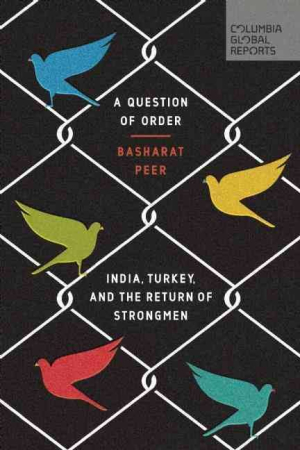
AquestionoforderIn his introduction to Nations and Nationalism Since 1780 (1990), Eric Hobsbawm argued that nations are “dual phenomena, constructed essentially from above, but which cannot be understood unless also analysed from below.” We need to pay attention to this view “from below,” he wrote, to the “assumptions, hopes, needs, longings and interests of ordinary people.”

Hobsbawm would have approved of this new book by Basharat Peer. In A Question of Order: India, Turkey, and the Return of Strongmen, Peer gives us two parallel renderings of the abuse of nationalist symbols by the powerful, sharpened and humanized by the impact this abuse has on real people living their lives in the nations their leaders imagine. Yet Peer does more than merely describe the people of India and Turkey as victims: he shows them to be active agents, sometimes supporting nationalist strongmen but all too often caught up in a maelstrom of repression, stigmatization, and violence. Peer describes how Narendra Modi and Recep Tayyip Erdoğan rose from humble origins to become leaders of their respective countries, and the “terrible human toll” their leadership has had on fragile democracies and their citizens. But he also shows that their messages have found adherents among the people, often the poor but also, sometimes surprisingly, the elite and moneyed classes.

The title promises to address why the “return of strongmen” is “a question of order,” but the book, essentially two conjoined works of reportage, does not really focus on how Modi and Erdoğan were driven by principles of order in the conventional sense (e.g., public order, law and order, economic order). These are not leaders who emerged from an environment of domestic chaos or failed-state strife, despite the economic inequalities and obvious repression and violence they exploited. Instead, according to the evidence Peer presents, Modi and Erdoğan are driven by an immediate hunger for power and an ambition to alter history, to reimagine their nations’ values and place in the world.

More here.

Why Are Bird Eggs Egg-Shaped? An Eggsplainer

Ed Yong in The Atlantic:

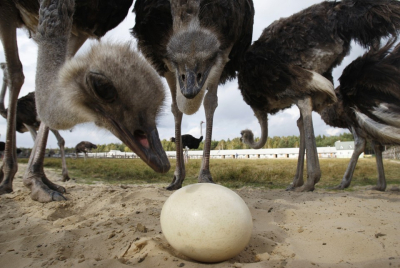
Lead_960 (5)When Mary Caswell Stoddard started measuring bird eggs from hundreds of species, she wasn’t expecting to learn that most eggs are not egg-shaped.

Think about an egg and you’ll probably conjure up an ellipse that’s slightly fatter at one end—the classic chicken egg. But chickens are outliers. Hummingbirds lay eggs that look like Tic Tacs, owls lay nigh-perfect spheres, and sandpipers lay almost conical eggs that end in a rounded point. After analyzing hundreds of species, Stoddard showed that the most common shape—exemplified by an unremarkable songbird called the graceful prinia—is more pointed than a chicken’s.

“We mapped egg shapes like astronomers map stars,” Stoddard says. “And our concept of an egg is on the periphery of egg shapes.”

Beyond displacing chickens as the Platonic ideal of egg-dom, Stoddard’s data also helped her to solve a mystery that scientists have debated for centuries: Why exactly are eggs shaped the way they are?

More here.

A Theory of Reality as More Than the Sum of Its Parts

Natalie Wolchover in Quanta Magazine:

ScreenHunter_2727 Jun. 24 22.50In his 1890 opus, The Principles of Psychology, William James invoked Romeo and Juliet to illustrate what makes conscious beings so different from the particles that make them up.

“Romeo wants Juliet as the filings want the magnet; and if no obstacles intervene he moves towards her by as straight a line as they,” James wrote. “But Romeo and Juliet, if a wall be built between them, do not remain idiotically pressing their faces against its opposite sides like the magnet and the filings. … Romeo soon finds a circuitous way, by scaling the wall or otherwise, of touching Juliet’s lips directly.”

Erik Hoel, a 29-year-old theoretical neuroscientist and writer, quoted the passage in a recent essay in which he laid out his new mathematical explanation of how consciousness and agency arise. The existence of agents — beings with intentions and goal-oriented behavior — has long seemed profoundly at odds with the reductionist assumption that all behavior arises from mechanistic interactions between particles. Agency doesn’t exist among the atoms, and so reductionism suggests agents don’t exist at all: that Romeo’s desires and psychological states are not the real causes of his actions, but merely approximate the unknowably complicated causes and effects between the atoms in his brain and surroundings.

Hoel’s theory, called “causal emergence,” roundly rejects this reductionist assumption.

“Causal emergence is a way of claiming that your agent description is really real,” said Hoel, a postdoctoral researcher at Columbia University who first proposed the idea with Larissa Albantakis and Giulio Tononi of the University of Wisconsin, Madison. “If you just say something like, ‘Oh, my atoms made me do it’ — well, that might not be true. And it might be provably not true.”

More here. Scott Aaronson rejects the argument, and Hoel responds.

COMPASS BY MATHIAS ÉNARD

Compass-enardHal Hlavinka at the Quarterly Conversation:

Compass’s scope and erudition are astonishing—particularly when Énard drops any pretext of plot and shifts into a more essayistic voice—and the novel is simply riddled with barn burners. To wit: “[There] was graffiti here and there, I said anti-Semitism? He replied no, love”; “The terrifying nationalism of corpses”; “Music is time domesticated, reproducible time, time shaped”; “Tuberculars and syphilitics, there’s the history of art in Europe.” Said makes his own appearance as “the Great Name,” akin to “invoking the Devil in a Carmelite convent.” Like Mann, Énard balances his speaker’s arguments on an equilibrium between civilization (art, music, poetry, life) and chaos (war, greed, famine, death). We get an early glimpse of Ritter’s own theory of Orientalism through his musings on musicology. Figures like Beethoven and Liszt owe their innovations to the Romantic period’s fascination with the Orient’s alterity, smuggled into their art as a means of undermining “the dictatorship of church chant and harmony.” But the Orient’s influence on Western art isn’t direct; rather, artists are always caught in a tangle of influence upon influence, mistaken origins, smoke and mirrors, in a word, misrepresentations:

Berlioz never travelled to the Orient, but was, at the height of his twenty-five years, fascinated with Hugo’s Les Orientales. So there might be a secondOrient, that of Goethe or Hugo, of people who know neither Oriental languages, nor the countries where they are spoken, but who rely on the works of Orientalists and travellers like Hammer-Purgstall, and even a third Orient, a Third-Orient, that of Berlioz or Wagner, which feeds on these works that are themselves indirect.

It’s only fitting, then, that when Flaubert enters Cairo, he also enters the music of Beethoven—a Third-Orient of its own.

more here.

Essayism by Brian Dillon

Cwggetbze5bl5edsthosLauren Elkin at The Guardian:

Dillon suggests that we cannot define the essay, but that we might more productively gesture at some quality of essayism: a certain texture, a style, a voice, an “experiment in attention”. The essay will – and by its nature must – always resist attempts to pin it down. It refuses to be contained by any neat summary; it is “diverse and several – it teems”.

Dillon himself is a superbly varied essayist; the author of a range of books about photography, hypochondriacs, the great explosion at a munitions factory in Faversham, Kent, in 1916, and another written in 24 hours called I Am Sitting in a Room, his lines of inquiry are the body and its afflictions, contemporary art and literature, the history of place and ruins. He has a natural affinity for the essay “as a kind of conglomerate: an aggregate either of diverse materials or disparate ways of saying the same or similar things”. Lists are a wonderful tactic of essayism – consider Georges Perec’s astonishing lists in Species of Spaces, from the food and drink he consumed in 1974 to the objects on his desk. Dillon helps us see, via Joan Didion in The White Album, the list as incomplete, the very act of making a list a gesture at what cannot be listed or will always be left out: “the list, if it’s doing its job, always leaves something to be invented or recalled, something forgotten in the moment of its making”.

more here.

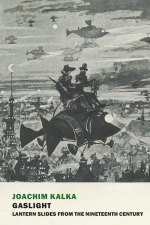
“Gaslight: Lantern Slides from the Nineteenth Century,” by Joachim Kalka

GaslightMichael Dirda at the Washington Post:

The biographical note accompanying “Gaslight: Lantern Slides From the Nineteenth Century” describes Joachim Kalka as “an essayist, literary critic, and translator of authors such as Martin Amis, Angela Carter, G.K. Chesterton, Christopher Isherwood, and Gilbert Sorrentino.” Impressive as it is, that list only hints at the extent of Kalka’s literary sophistication. His freewheeling essays — adroitly translated by Isabel Fargo Cole — reveal not only an easy familiarity with the obvious masterpieces of German, French and English-language literature, but also a devotee’s appreciation of ghost stories, mysteries, classic films and comics. His subjects range from Wagner’s conception of the Valkyries in “The Ring of the Nibelungs” to the artistic legacy of Jack the Ripper to a ­mini-history of anarchist bomb-throwing.

In fact, Kalka belongs to that admirable line of European intellectuals, such as Roland Barthes, E.M. Cioran, Umberto Eco and Simon Leys, who can write interestingly about almost anything. What he doesn’t do, however, is write conclusively. Whereas an American essayist frequently resembles a courtroom lawyer, trying to make an argument or prove a case, Kalka — who is from Stuttgart, Germany — is content to circle around a subject, illuminating it from various angles. Then, instead of closing with a knockout summary of the evidence, he simply stops. This can take getting used to. Still, how can you resist a writer who draws insights from “Mickey Mouse and His Sky Adventure” and Gershon Legman’s “Rationale of the Dirty Joke”?

more here.

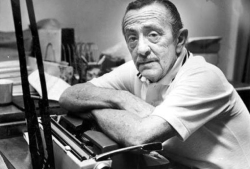
Realization and Recognition: The Art and Life of John Fante

Neil Gordon in Boston Review:

John-FanteThe universe of John Fante’s fiction is so immediately moving, so poetically vivid, that it is hard to decide which is the greater quandary: that it went so long unrecognized, or that in the factitious worlds of publishing and Hollywood it is receiving such enormous recognition today. Fante was a writer from the 1930s, only occasionally recognized during his lifetime and swallowed, for long periods, by inactivity and obscurity. And yet today his complete works are in print with sales that any writer would envy: 100,000 copies of his books in America since 1980 and an astounding half-million copies in France. Most of his working life was spent in the subliterary world of Hollywood screenplays, and many of his novels never found a publisher. Yet he has now been accorded the highest commercial accolade: one book filmed and nearly every other one under option or in development, with Francis Ford Coppola and Robert Towne heading the impressive list of Hollywood figures who have invested serious money in his work.

Fante’s highly autobiographical fiction draws us deeply into his life, and that life reveals a struggle familiar to any reader of literary biography: between a profound urge to realize an artistic talent and an equally profound anxiety about recognition in the literary market. All writers struggle with the marketplace and many write about it, from Balzac to Hemingway. But the surprising turns of Fante’s commercial fortunes are rendered especially compelling by the sheer depth of his talent. His disturbing, singular writing stands absolutely alone among American Depression and mid-century writers. He was always the equal, and often the better, of his recognized contemporaries: Fitzgerald, Steinbeck, West, Schulberg. With no place in the genres of his day, it is only now that his finest work is being recognized as utterly original, and the precursor to voices of writers like Kerouac and Bukowski and through them, to a vast spectrum of contemporary writers.

More here.

Weekend Music Break No.110 — Abdullah Ibrahim’s ‘tawhid’

Samuel Argyle in Africaisacountry:

Ibrahim-piano-1024x682A shadow underlies many artistic expressions, including human spirituality and religion. In 1962, with Nelson Mandela imprisoned, the Cape Town-born Ibrahim left South Africa for Europe – where he met his mentor, Duke Ellington – and then on to New York to attend Juilliard. After struggling with alcohol and marijuana misuse and “searching for spiritual harmony in an increasingly fractured life,” Ibrahim returned to Cape Town. “Years of smoking and drinking had battered his body,” writes John Edwin Mason, a professor of African History at University of Virginia. “In New York, doctors and a Native American medicine woman both told him to ‘straighten up.’ And he did, entering a period of ‘cleaning’ and embarking on a spiritual quest that began in New York City and culminated with his conversion to Islam, in Cape Town.” Speaking about this turning point in his life with the UK Guardian in 2001, Ibrahim said, “I went back to church; I didn’t find it there. I went into all religions – the [Bhagavad] Gita, I-Ching. Then I realized most of the friends I grew up with were Muslim. Cape Town has a rare harmony, intermarriage.” The musician converted to Islam in 1968. During this period in the 1960s, harmony was sought after in America as well. Many American jazz musicians viewed Islam as part of a decolonization movement, as an escape from their country’s segregation laws. Before his conversion, Ibrahim was exposed to many musicians involved in the Muslim movement in America. Figures like Sheikh Daoud Faisal, a fellow alumnus of Juilliard, inspired up-and-coming jazz musicians like Ibrahim. Faisal lead a mosque in Brooklyn Heights and was a representative of Morocco at the United Nations. Archie Shepp, Ornette Coleman, John Coltrane, and Pharoah Sanders, to name a few, were also influenced by Islam, specifically Sufism and the Gnawa music of Morocco.

…While tawhid refers to the unity of God, it also maintains that the rest of the world is many. This paradox of oneness and multiplicity is central to Islam. It is also a major theme in Ibrahim’s music. Musicians perform in aggregate, forming an apparent whole. This dialectical relationship forming a captivating breathe of sound is only possible with someone as talented and devoted as Ibrahim guiding the movement. “The most beautiful, potent aspect of Islam is the unity of things,” Ibrahim told the Guardian. “You can’t throw anything out of the universe. This realization has been a driving force for me.”

More here.

Saturday Poem

How Things Work
Today it's going to cost us $20
To live. Five for softball. Four for a book,
A handful of ones for coffee and two sweet rolls,
Bus fare, Rosin for your mother's violin.
We’re completing our task. The tip I left
For the waitress filters down
Like rain, wetting the new roots of a child
Perhaps, a belligerent cat that won't let go
Of a balled sock until there is chicken to eat.
As far as I can tell, daughter, it works like this:
You buy bread from a grocery, a bag of apples
From a fruit stand, and what coins
Are passed on helps others by pencils, glue,
Tickets to a movie in which laughter
is thrown into their faces.
If we buy a goldfish, someone tries on a hat.
If we buy crayons, someone walks home with a broom.
A tip, a small purchase here and there,
And things just keep going. I guess. (Thanks Nils Peterson)