The minimum wage wars are heating up

News-lead-570

Martin Sandbu in the FT's Alphaville:

The effects of raising minimum wages is one of the most contested battlefields in economic policy analysis. All sides can claim to care about the poor: those against higher minimum wages warn that they hurt the poor by putting them out of work while those for them assert that the employment effects are negligible. And so anyone who can marshal facts for their side can almost automatically accuse the other side of callousness.

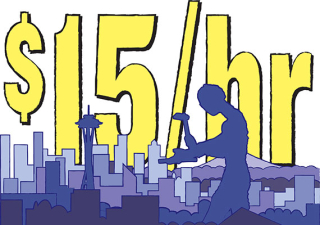
This week, minimum wage sceptics have embraced new evidence from Seattle, which is pushing through one of the most aggressive increases anywhere. The city’s wage floor increased from the state minimum of $9.47 an hour to $11/hour in 2015, to $13/hour in 2016, and headed towards $15/hour by the end of the process. There are impartial summaries of the research from FiveThirtyEight and the Wall Street Journal, which report the study’s conclusion that, on average, the lost jobs and hours due to the minimum wage increase meant low-wage workers earned $125 a month less than they would have without the minimum wage increase.

Megan McArdle expresses well the vindication felt by reasonable sceptics of wage floors. “If the minimum wage increases by a penny an hour, probably even most rock-ribbed conservatives would not predict mass firings. On the other hand, if the wage was arbitrarily set to $100 an hour, even ardent labor activists would presumably expect widespread unemployment to follow . . . The size of the increase, and the level of the resulting wage, obviously matter at some margin. Seattle may have discovered that margin.”

The problem is that the study’s methodology does not support this conclusion.

More here.

Reading Varoufakis: Frustrated Strategist of Greek Financial Deterrence

Adam Tooze in his own website:

Screen-Shot-2017-06-30-at-5.55.02-PMAdults in the Room is a book that anyone interested in modern European politics should read. To say it is the best memoir of the Eurozone crisis is an understatement. It is a devastating indictment of current state of Europe and a fascinating inside account of the logic of reformist politics and its limits and why it keeps going anyway.

It’s a truly complex document for a variety of reasons:

It’s a highly personal even confessional memoir of recent history.

Varoufakis is an intensely self-conscious historical subject.

He has a pronounced aesthetic and writerly self-consciousness. One may argue as to taste.

He has an outsized ego and this was seized on by the world’s media, who made his persona into the target for vast amounts of public comment and criticism. He has reason to feel victimized.

He is also an academic and an intellectual with wide-ranging interests: political theory, social theory and economics.

And he is a political activist with a cause, DiEM25, to promote.

All of these interests and concerns inflect the text. All of them would be worth expanding on at some length. But I’ll focus on three of the more “substantive” aspects of his memoir.

More here.

Some people simply cannot handle the fact that Donald Trump was elected president

Kevin D. Williamson in the National Review:

ScreenHunter_2741 Jul. 02 16.47One of those people is Donald Trump.

Trump has shown himself intellectually and emotionally incapable of making the transition from minor entertainment figure to major political figure. He is in the strange position of being a B-list celebrity who is also the most famous man in the world. His recent Twitter attack on Mika Brzezinski of MSNBC’s Morning Joe exemplifies that as much as it does the president’s other by-now-familiar pathologies, notably his strange psychological need to verbally abuse women in physical terms.

Trump may have his problems with women, but it is his unrequited love of the media that is undoing him.

“I always tell the president, ‘You don’t need them,’” says Sean Hannity, the self-abasing monkey-butler of the Trump regime. The president, Hannity says, can reach more Americans via Twitter than he could through the conventional media. That isn’t true, of course: Only about one in five Americans uses Twitter. Hannity might be forgiven for not knowing this, a consequence of his much more general habit of not knowing things. But he actually does know the president. How could he possibly believe that this man — this man — does not need them?

He needs them the way a junkie needs his junk.

Donald Trump cares more about how he is perceived in the media than he cares about anything else in the world, including money.

More here.

Forget the Blood of Teens. This Pill Promises to Extend Life for a Nickel a Pop

Sam Apple in Wired:

Metformin_YW_0320-F-NEWCOLORNir Barzilai has a plan. It’s a really big plan that might one day change medicine and health care as we know it. Its promise: extending our years of healthy, disease-free living by decades. And Barzilai knows about the science of aging. He is, after all, the director of the Institute for Aging Research at the Albert Einstein College of Medicine in the Bronx. And, as such, he usually talks about his plan with the caution of a seasoned researcher. Usually. Truth is, Barzilai is known among his colleagues for his excitability—one author says he could pass as the older brother of Austin Powers—and sometimes he can’t help himself. Like the time he referred to his plan—which, among other things, would demonstrate that human aging can be slowed with a cheap pill—as “history-making.” In 2015, he stood outside of the offices of the Federal Drug Administration, flanked by a number of distinguished researchers on aging, and likened the plan to a journey to “the promised land.”

…That progress has been spurred by huge investments from Silicon Valley titans, including Google’s Sergey Brin and Larry Page, Amazon’s Jeff Bezos, PayPal cofounder Peter Thiel, and Oracle cofounder Larry Ellison. Armed with such riches, biotech researchers are now dreaming up a growing list of cribbed-from-science-fiction therapies to beat back death: growing new organs from your own DNA, infusing older bodies with blood and stem cells from young bodies, uploading brains to computers. Almost nothing seems too far-fetched in the so-called life-extension community. And yet, while it’s certainly possible that this work will lead to a breakthrough that will benefit all of humanity, it’s hard to escape the sense that Silicon Valley’s newfound urge to postpone aging indefinitely is, first and foremost, an attempt by the super wealthy to extend their own lives. As one scientist recently put it to The New Yorker, the antiaging science being done at Google-backed Calico Labs is “as self-serving as the Medici building a Renaissance chapel in Italy, but with a little extra Silicon Valley narcissism thrown in.” Barzilai’s big plan isn’t necessarily less quixotic than those being dreamed up at Silicon Valley biotechs. It’s just quixotic in a completely different way. Rather than trying to develop a wildly expensive, highly speculative therapy that will likely only benefit the billionaire-demigod set, Barzilai wants to convince the FDA to put its seal of approval on an antiaging drug for the rest of us: A cheap, generic, demonstrably safe pharmaceutical that has already shown, in a host of preliminary studies, that it may be able to help stave off many of the worst parts of growing old.

More here.

Revolution at The Washington Post

Kyle Pope in Columbia Journalism Review:

IS IT AN UNDERHANDED COMPLIMENT to be called the most innovative company in the newspaper business?

WashThe Washington Post will happily take it. In the three years since Amazon’s Jeff Bezos bought the Post for $250 million—now seen as a steal for one of the great brands in publishing—the Post has reinvented itself with digital speed. Its Web traffic has doubled since Bezos arrived, and it far outstrips The New York Times (and even BuzzFeed) in the number of online posts its reporters file every day. So successful has the Post become in the digital game that it now licenses its content management system to other news outlets, a business that could generate $100 million a year. It is a moment to savor for a once-iconic family business that has spent much of the last decade in retreat. When Bezos bought the Post in 2013, its news franchise had been decimated by Politico (which will soon celebrate its 10th anniversary); it had lost its editor; and its digital business had four years earlier joined the mothership from an office in Arlington.*

Today, the office has the feel of a tech startup well-blessed by the VC gods. Video screens scrolling Web analytics hang above the newsroom. Reporters roam the place carrying laptops. The Post’s turnaround, in a terrible period for newspapers, has made Martin Baron, its editor, a journalism rock star (Pulitzer Prize, dominating coverage of the 2016 election, portrayal by Liev Schreiber in an Oscar-winning movie). But it has also raised the profile of the paper’s tech team, who have become stars in their own right on the digital-media conference circuit. If a paper like the Post can right itself digitally, perhaps there’s hope for everyone else. There most certainly could be, if everyone else were owned by a billionaire who sees today’s media game as analogous to the internet circa 1999, essentially a land grab open to whomever can spend the most money and move the fastest to grab the biggest market share. That is the story of the rise of Amazon.com, and Bezos is applying many of those same lessons to the Post. (Along with an obsession with Web traffic and engagement metrics, which are much more important internally than whether the paper makes any money.)

More here.

Sunday Poem

The Poet with His Face in His Hands

You want to cry aloud for your
mistakes. But to tell the truth the world
doesn’t need anymore of that sound.

So if you’re going to do it and can’t
stop yourself, if your pretty mouth can’t
hold it in, at least go by yourself across

the forty fields and the forty dark inclines
of rocks and water to the place where
the falls are flinging out their white sheets

like crazy, and there is a cave behind all that
jubilation and water fun and you can
stand there, under it, and roar all you

want and nothing will be disturbed; you can
drip with despair all afternoon and still,
on a green branch, its wings just lightly touched

by the passing foil of the water, the thrush,
puffing out its spotted breast, will sing
of the perfect, stone-hard beauty of everything.

by Mary Oliver
from The New Yorker

Saturday, July 1, 2017

The Book Smugglers of Timbuktu

5107William Dalrymple at The Guardian:

For African historians, the realisation during the late 1990s of the full scale of Timbuktu’s intellectual heritage was the equivalent of the discovery of the Dead Sea Scrolls for scholars of Judaism in the 1950s. When the African American academic Henry Louis Gates Jr visited Timbuktu in 1997 he actually burst into tears at the discovery of the extraordinary literary riches. He had always taught his Harvard students that “there was no written history in Africa, that it was all oral. Now that he had seen these manuscripts, everything had changed.”

Yet with the coming of al-Qaida, there was now a widespread fear that this huge treasure trove, the study of which had only just begun, could go the way of the Baghdad, Kabul or Palmyra museums, or the Bamiyan Buddhas. Before long, efforts began to smuggle the most important of the manuscripts out of Timbuktu and to somehow get them to safety in Bamako, the capital of Mali. The story of how this was done forms the narrative backbone of The Book Smugglers of Timbuktu, which consequently reads like a sort of Schindler’s list for medieval African manuscripts, “a modern day folk tale that proved irresistible, with such resonant, universal themes of good versus evil, books versus guns, fanatics versus moderates”.

more here.

David Lagercrantz dreams of writing the perfect literary novel

Andy Martin in The Independent:

ScreenHunter_2740 Jul. 01 20.26It’s top secret and hush hush and is strictly embargoed until 7 September when it’s published. But I was privileged to see some of the fifth volume of the Millennium trilogy even as it was being written. I promise not to give too much away, but consider this a sneak preview, or trailer for The Girl Who Takes An Eye For An Eye.

If you want to know what happens to ace Swedish ass-kicker and hacker extraordinaire Lisbeth Salander and heroic journalist Mikael Blomkvist, you’re in the right place. It’s written by David Lagercrantz, who took over the reins from Stieg Larsson for the last one, The Girl In the Spider’s Web.

You may recall that Larsson, having written all three of the trilogy, The Girl With the Dragon Tattoo, The Girl Who Played With Fire, and The Girl Who Kicked the Hornet’s Nest, and had them accepted for publication, promptly dropped dead. Late for a meeting, he ran up a few flights of stairs when the lift broke down, and collapsed with a heart attack, aged 50. The poignant back-story helped the books sell millions worldwide, but the death of the author meant it was inevitable that someone would have to pick up the baton and carry on. The job went to Lagercrantz, a Swedish writer then best known for ghosting the quasi-autobiography of the Swedish footballer Zlatan Ibrahimovic, I Am Zlatan.

More here.

Dark Matter Theory Triumphs In Sweeping New Study

Ethan Siegel in Forbes:

1-skwt3fHW8eyz75KwcjYSLgWhen you look out at the Universe, all you see is matter and light. The stars, galaxies, plasmas, and unusual astrophysical objects all emit radiation from across the electromagnetic spectrum; the dust, gas, and neutral atoms absorb it. Yet what we infer from viewing them, particularly on the largest scales, tells us that there's much more than what we presently perceive. In addition to matter and light, there's got to be dark energy, a form of energy inherent to the fabric of space itself that causes the expanding Universe to accelerate, and a significant amount of dark matter: massive, clustering particles that are invisible to light. Dark matter can do many things, but one prediction it's always struggled with is exactly reproducing how galaxies are observed to rotate. It's been a problem for decades, from the 1970s until 2017. But as of June 23rd, a new paper claims to have finally solved the problem of galactic rotation at long last.

Since 1970, it's been known that galaxies don't just rotate, but they rotate with speeds too quick, particularly at the outskirts, for what normal matter alone can account for. Nearly half a century of studies have shown that if dark matter exists, it should form diffuse, massive halos that extend much farther than the visible disks and elliptical swarms do, with the gravity of both dark and normal matter affecting the galaxies' motion.

More here.

Can Jonathan Haidt Calm the Culture Wars?

Evan R. Goldstein in the Chronicle of Higher Education:

Photo_82439_cover_320x426On a February morning in Washington, a hotel ballroom is packed with people eager to hear Jonathan Haidt explain what’s wrong with higher education. His talk is part of the International Students for Liberty Conference, which has attracted 1,700 attendees, mostly young libertarians, to a weekend of sessions with titles like "Stereotyped 101," "Advancing Liberty Around the World," and "Beer Is Freedom." Before he’s introduced, Haidt, a social psychologist at New York University’s Stern School of Business, stands at the front of the room, tall and thin, dressed in a dark suit and white shirt. As people gather around, a brown-haired woman in a gray skirt chats him up before rushing off. "Oh, my God," she says to a friend, "I just shook Jonathan Haidt’s hand!"

Haidt’s renown is driven by bold declarations like those in a 2015 cover story in The Atlantic titled "The Coddling of the American Mind." Written with Greg Lukianoff, president and chief executive of the Foundation for Individual Rights in Education (FIRE), the article took the rise of microaggressions, trigger warnings, and safe spaces as evidence that colleges are nurturing a hypersensitive mind-set among students that "will damage their careers and friendships, along with their mental health." The article, which has been viewed by nearly six million people, catapulted Haidt, already a prominent scholar and best-selling author, into a new role: gadfly of the campus culture wars.

More here.

the twin peaks phenomenon

P19_Andrew-605x454Andrew Irwin at the TLS:

Reviving a series twenty-six years after its last episode aired is always going to be a dangerous game. Twin Peaks, much loved and firmly entrenched in popular culture, with a healthy body of academic literature surrounding it, seems particularly risky: mainly because much of it wasn’t very good. Although David Lynch and Mark Frost’s surrealist melodrama created a number of extraordinary images, and greatly influenced the television that came after, it notoriously suffered from problems of pacing in its second series, with its central mystery resolved too soon (at the network’s behest and against Lynch’s wishes). The plot lines that replaced it were ad hoc and irritating; with plummeting ratings, Twin Peaks was cancelled after its second season, and was then followed by a number of books and a prequel film, Fire Walk with Me, to flesh out the story. The chances seemed high that this revival, set twenty-five years later and featuring many from the original cast, would simply repeat the mistakes of the second series, lose the atmosphere that was integral to the success of the first, and tarnish a legacy.

Set in a scenic rural town in Washington State, the original series begins as the body of a popular blonde high school student named Laura Palmer (Sheryl Lee) washes up on the shore, wrapped in plastic; the discovery of her body triggers great spasms of anguish in the small logging community. Special Agent Dale Cooper (Kyle MacLachlan), wearing the anonymous black suit of the FBI and expert in his investigations, but filled with boyish wonder, is called into town to investigate the case and is at once smitten with the wholesome values, the air, the trees and the coffee-and-cherry-pie version of 1950s Americana, transplanted inexplicably into the 90s.

more here.

Where a doctor saw a treatable cancer, a patient saw an evil spirit

Bob Tedeschi in StatNews:

CancerThe woman, who was in her 50s, had thyroid cancer, and scans suggested it had spread to her lungs. But her doctor, Michael Fratkin, knew there were options. “It’s like, well, what a bummer you have metastatic cancer, but we have a sort of magic missile for that kind of cancer, and it can be controlled,” he thought to himself. “All you have to do is swallow three iodine capsules.” The woman, a Hmong immigrant, spoke little, if any, English. Through an experienced interpreter, Fratkin explained the protocol and told her she would need a lung biopsy to confirm the diagnosis. After the procedure, he told her he felt confident the protocol he had described would cure her. The woman, though, was incensed. “Something about how we explained what we were doing didn’t match her way of thinking about things,” Fratkin recalled. “She thought we gave her cancer in the chest.” Thousands of Hmong emigrated from Southeast Asia after the Vietnam War, when the CIA recruited them to fight or spy on the United States’s behalf, only to face harsh repercussions after U.S. forces withdrew.

Many Hmong understand physical illness in mystical terms1: an evil spirit, or “dab,” can enter the body if a person is badly startled, for instance, or if a baby’s placenta is not properly buried. A dab might depart only if a person takes specific actions, like drinking an herbal remedy while also leaving a cup of the remedy for the dab to drink. The Hmong’s beliefs about medicine and illness, combined with hard-earned suspicions about American institutions, can mix poorly. Even from the start, she was cool toward him, and inscrutable. “Never ever did I get a glimpse of something I recognized,” said Fratkin, who has practiced in Northern California for two decades. Still, he persuaded her to accept the cancer treatments. Then, at the last minute, she refused — for reasons Fratkin could not understand, even with his interpreter’s help. He contacted a social worker with experience with the Hmong community, and helped pay for the social worker’s visit.

His patient agreed to try. Again, she backed away at the last minute.

More here.

By 2100, Refugees Would Be the Most Populous Country on Earth

Vijay Prashad in AlterNet:

BoatThe UN Refugee Agency has announced the new figures for the world’s displaced: 65.9 million. That means that 65.9 million human beings live as refugees, asylum seekers or as internally displaced people. If the refugees formed a country, it would be the 21st largest state in the world, just after Thailand (68.2 million) and just ahead of the United Kingdom (65.5 million). But unlike these other states, refugees have few political rights and no real representation in the institutions of the world. The head of the UN Refugee Agency, Filippo Grandi, recently said that most of the displacement comes as a result of war. "The world seems to have become unable to make peace," Grandi said. "So you see old conflicts that continue to linger, and new conflicts erupting, and both produce displacement. Forced displacement is a symbol of wars that never end." Few continents are immune from the harsh reality of war. But the epicenter of war and displacement is along the axis of the Western-driven global war on terror and resource wars. The line of displacement runs from Afghanistan to South Sudan with Syria in between. Eyes are on Syria, where the war remains hot and the tensions over escalation intensify daily. But there is as deadly a civil war in South Sudan, driven in large part by a ferocious desire to control the country’s oil. Last year, 340,000 people fled South Sudan for refugee camps in neighboring Uganda. This is a larger displacement than from Syria.

Poverty is a major driver of displacement. It is what moves hundreds of thousands of people to try and cross the Sahara Desert and then the Mediterranean Sea for European pastures. But most who try this journey meet a deadly fate. Both the Sahara and the Mediterranean are dangerous. This week, the UN’s International Organisation for Migration (IOM) in Niger rescued 600 migrants from the Sahara, although 52 did not survive. A 22-year-old woman from Nigeria was among those rescued. She was on a pick-up truck with 50 people. They left Agadez for Libya. ‘We were in the desert for ten days,’ she says. "After five days, the driver abandoned us. He left us with all of our belongings, saying he was going to pick us up in a couple of hours. But he never did." Forty-four of the migrants died. The six who remained struggled to safety. ‘We had to drink our own pee to survive,’ she said.

More here.

‘FEVER DREAM’ BY SAMANTA SCHWEBLIN

Fever-dream-schweblinSarah Coolidge at The Quarterly Conversation:

Through short stories, Schweblin established herself as a writer of the strange and eerie. While Granta featured her in its list of “The Best of Young Spanish-Language Novelists” alongside Carlos Labbé, Alejandro Zambra, Andrés Neuman, and Carlos Yoshimito, her style is more closely attuned to that of Edgar Allan Poe, or perhaps more close to home, Julio Cortázar. Like them she is fascinated by the oftentimes disturbing and inexplicable forces at work in the world. In the titular story of Pájaros en la boca, parents discover, and proceed to agonize over, their daughter’s inexplicable urge to eat her pet birds—which she thrusts whole into her mouth and chews bloodily.

At the core of many of Schweblin’s stories is a morbid, hysterical portrayal of motherhood. In one, a couple struggling with fertility spends the night “hunting” some unnamed entity, and Schweblin’s refusal to give the thing a name, paired with the couple’s desperation, produces an unsettling aura. In another story a pregnant woman dreading her nearing delivery date goes to see a doctor who prescribes her pills that, month by month, reverse her pregnancy as her family looks on horrified.

Schweblin’s stories demonstrate her ability to make the reader feel viscerally manipulated, if not morally violated. And yet, while their brevity may at times intensify their effect, there is something fleeting about them. They disturb and manipulate the reader but they don’t haunt or linger in the mind like a nightmare.

more here.

Saturday Poem

Sonnet 94: They that have power to hurt and will do none
They that have power to hurt and will do none,
That do not do the thing they most do show,
Who, moving others, are themselves as stone,
Unmoved, cold, and to temptation slow:
They rightly do inherit heaven's graces
And husband nature's riches from expense;
They are the lords and owners of their faces,
Others but stewards of their excellence.
The summer's flower is to the summer sweet
Though to itself it only live and die,
But if that flower with base infection meet,
The basest weed outbraves his dignity:
….. For sweetest things turn sourest by their deeds;
….. Lilies that fester smell far worse than weeds.

William Shakespeare

Friday, June 30, 2017

The Choice Was Real

General-Election-2017

David Runciman in the LRB:

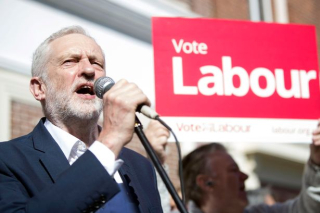
One of the better arguments for Britain’s leaving the EU was that it might reinvigorate and liberate national politics, stifled for too long by the absence of real choice at election time. The EU is a legalistic and treaty-based political institution designed to take some of the heat out of domestic politics. That left people complaining that the EU was generating all the heat. Brexit offered the prospect of a return to two-party politics across Britain, squeezing out the minor parties motivated by single-issue grievances. To a remarkable extent, this is what seems to have happened. The electoral map of Britain in 2017 looks very much as it did in 1970, before we joined the EEC. The two main parties now command well over 80 per cent of the popular vote between them, a figure not reached since the election of 1970. Scotland is no longer another country in electoral terms and both Labour and the Tories can claim to speak for all parts of the Union. This was achieved without either of the main parties cleaving to the centre. The choice on offer at this election was real and the voters embraced it.

It may be one of the better arguments, but that still doesn’t make it convincing. No election that results in the prospect of a minority government formed between the Tories and the DUP can be a great advertisement for two-party politics. There are many words that could be used to describe such an arrangement, but reinvigorated and liberated are not among them. British politics feels pinched and insecure after this vote. The prospect of real change hovers in the background but it is still hard to see how we get there from here. This is not 1970. The SNP retains a large bloc of support in Scotland that makes it much more difficult for either of the main parties to forge decisively ahead. Seventy seats in the new Parliament are held by MPs who are not Labour or Tory. In 1970 that figure was 12. Back then, Northern Irish electoral politics were still an extension of what happened on the mainland: the Ulster Unionists, effectively the Northern Irish branch of the Conservative Party, won eight of the 12 seats contested in the province. Now, Westminster politics looks more like an extension of what happens in Northern Ireland. If a return to the early 1970s means British politics being overshadowed by entrenched divisions in Northern Ireland, then here we go again. But that isn’t what Brexit was designed to achieve.

More here.