
Video length: 7:43
Category: Recommended Reading
Art in a digital age

We live in an age permeated by the digital. Just how much so we are made aware when we walk into this exhibition. In our Western consumer society the digital revolution has infiltrated and shaped our relationships on social media, as well as the way we buy and consume, find sexual partners, or learn about politics. Many individuals even develop identities that are entirely technology driven. What this exhibition does then, whether we like it or not, is capture the mood and cultural practices of the early twenty-first century by emphasising how the digital is embedded, in ways to which we’re often oblivious, in the objects, images, and structures that we encounter on a daily basis. In his 2013 book PRESENT SHOCK: When Everything Happens Now,Douglas Rushkoff argues that we no longer have a sense of a future, of goals, or a direction because we seem to be living in a constant now. Life is but one click away. This is underlined by Nina Canell’s sculptures and installations where the cut wires of internet circuitry are displayed like archaeological fragments on traditional white plinths, reminding us that today’s technology becomes tomorrow’s obsolescence. These surprisingly beautiful aborted bits of technology seem to suggest a departure from the word, from logos, from the forms of communication that have hitherto been associated with human interaction.
Elsewhere the artist Julia Varela litters the gallery floor with broken, bent, and distorted plasma screens, which she describes as “an act or resistance”, a “hijacking”. Lying contorted and twisted they seem to evoke the end of something, as Joseph Beuys’s iconic work once signalled the End of the 20thCentury. This detritus, only very recently used to do something–transmit information, news, and entertainment–is now presented as redundant, a collection of mediaeval relics as technology moves on its inexorable course.
more here.
ezra pound in prison

Ezra Pound was not the first poet to spend years confined to a mental hospital nor will he probably be the last, but he was surely the only one to have turned his legally enforced confinement into a long-running literary soirée, his very own “Ezuversity”. As Daniel Swift puts it in The Bughouse, his lively and searching account of Pound’s years at St Elizabeths Hospital in Washington, DC, from 1946 to 1958, it was “the world’s least orthodox literary salon: convened by a fascist, held in a lunatic asylum”. Though there has been much hand-wringing over the years by Pound’s acolytes about the incarceration, it proved to be in many ways a perfect environment for the garrulous poet. His visitors ranged from illustrious old friends, such as T. S. Eliot, Marianne Moore and William Carlos Williams, to eager younger poets, such as Robert Lowell and Allen Ginsberg, to less savoury members of the real lunatic fringe, among them the violent white supremacist John Kasper, whose neo-Nazi views “Uncle Ez” warmly supported and encouraged. To the end Pound remained an anti-Semite, but now he added black Americans and civil rights protesters to his roster of well-nurtured hatreds. Best of all for Pound, however, was the opportunity to lecture and harangue his seemingly endless procession of admirers, whether on his crack-brained economic and political theories or on matters literary and aesthetic. Nor did his apparent derangement mitigate his vanity. Elizabeth Bishop noted that when Pound asked her to bring him a journal in Bengali, a language he did not know, it was principally to check as to whether his name was mentioned there (since he couldn’t read Bengali it is not clear how he managed this).
more here.
The Strange History of ‘O Canada’

Born in 1842 in southern Quebec, Calixa Lavallée was Canada’s original hitmaker. He landed his first gig at age nine: he played the organ barefooted in a St-Hyacinthe church. At fifteen, he followed minstrels from Montreal to New Orleans. Lavallée enlisted in the Union army at the outset of the American Civil War and served as a cornetist; he was wounded and discharged with a monthly pension of $8.
Lavallée then worked as a composer, travelling through Quebec, Boston, and France. His big break came in 1880, when the Société Saint-Jean-Baptiste, a group created for the growing French population of the new world, commissioned a party song. Lavallée composed the music to “O Canada,” and Adolphe-Basile Routhier, a Quebec judge and poet, wrote the French lyrics. At a skating pavilion in Quebec City on June 24, 1880, during a celebration of the province’s Saint-Jean-Baptiste Day, more than 500 guests first sang what would become Canada’s national anthem.
Lavallée died penniless in Boston in 1891. His song, though, stayed on the provincial hit parade for about eighty years. The Encyclopédie du patrimoine culturel de l’Amérique française notes that “O Canada” rang out during the 300th birthday of Quebec City in 1908 and “occupied a place of honour in Quebec Catholic schools for many years.” Andrée Dufour, a researcher at Laval University who is an expert in the history of education in Quebec, says, “I knew the era when we proudly sang ‘O Canada’ in class.”
more here.
the women of Utamaro
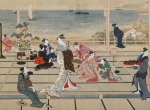
The legend of Utamaro as a demon of art, as well as an erotic connoisseur, began early on, but was later burnished in a movie by the great director Mizoguchi Kenji, entitled Utamaro and His Five Women (1946), which was based on a novel of the same title. The portrayal of the artist probably owes more to the way Mizoguchi saw himself than to historical accuracy.
The exotic image of traditional Japan as a kind of paradise of sexual refinement, which was already the product of a fantasy world promoted by artists like Utamaro, appealed to sophisticated collectors, writers, and artists in late-nineteenth-century Paris. The pleasure world of the Edo Period was seen as an elegant and sensuous antidote to the ugliness of the industrial age. And the same was true in Japan.
At first, in the last decades of the nineteenth century, when the Japanese were eager to modernize along Western lines, the hedonism of Floating World prints, and the wilder shores of Kabuki, were considered rather shameful. Soon, however, the popular theatrical genres and sensual entertainments of the past calcified in the culture of geisha and in classical Japanese theater, shorn of its wild inventiveness. But the art of Utamaro still retains the old spirit, which now evokes feelings of nostalgia.
more here.
Journeys of Lactic Abstraction

Milk is versatile. One of its qualities is the capacity to separate or be separated. Milk is separated from cream, curds from whey. Its relation to separation extends in other directions. A form of physical separation is at work in the distancing or abstraction of milk from the female mammal’s body. Separation abounds in the milk industry whereby the calf is separated from the cow, and milk is extracted from animals for human consumption. Separation more broadly occurs between milk for use and milk as a commodity for exchange. Separation is also part of the process of individuation—the separation of subject and object. Humans separate from caregivers, having passed through the nexus that milk provides.
Milk extracted or abstracted is a liquid representation of an annihilation of nature over time. In order to produce cows’ milk for humans, the seasonal cycle related to gestation has been extended into the endless time of ever-increasing milk yields. This is the temporality of the market, of production and circulation. Production time is decoupled from the idea of limits and insists that what is profitable be available at all times. Milk flows across the political body, its stream an emblem of progress and the perfectibility of modern times. Situating milk as infinitely available, white, aseptic, and central to the adult Western diet was a quest of modernity. The mass industrialization of milk indicates a mode of industrial metaphysics: an abstraction from its associations with female human and non-human animal lactation and its transformation into a de-gendered industrial staple. Luce Irigaray proposed that all Western culture rests on the murder of the mother.1
more here.
A London Fellowship for Urban Design
Olivia Munk in Harvard Magazine:

The GSD hopes to use the house in London and the international nature of the fellowship to enable Harvard to contribute to and affect the lives of people far beyond the boundaries of Cambridge. Besides housing fellows (two every three months, including one couple from Mexico City this summer), Mostafavi hopes the building will become a center for debate and discussion for both Harvard alumni and a wider audience. One of the first talks in the house, to be set up “salon” style, will pertain to food and the city—issues such as waste, distribution, and how food is prepared. Larger-scale events supported by the fellowship will take place in venues around the city. Events at Wimbledon House and in London, Mostafavi said, will “deal with topics that have importance and relevance” to the broader London community.
Much like the fellowship, Wimbledon House, built between 1969 and 1970, is one of a kind. Rogers described the design as a “transparent tube with solid boundary walls.” The property consists of two structures, separated by a courtyard.
More here.
Meditation, yoga, and tai chi can reverse damaging effects of stress
From KurzweilAI:

David Gorski, MD, PhD, has published a critique of this study here. (Lead author Ivana Burić has replied in the comments below.) In addition to stress effects, increased sitting is known to be associated with an increased risk of cardiovascular disease, diabetes, and death from all causes. But regular two-minute brisk walks every 30 minutes (in addition to daily 30-minute walks) significantly reduce levels of triglyceride (lipid, or fatty acid) levels that lead to clogged arteries, researchers from New Zealand’s University of Otago report in a paper published June 19, 2017 in the Journal of Clinical Lipidology.
More here.
Friday Poem
Answering the Phone
Used to be
you'd say
Hello
and think nothing of it
or else someone else might do it
for you
He's out may I take a message
and you'd return the call
When Bobby died
and the man across the street
and Bill
and Mr. G.
all that changed
and you think
now before you answer the phone
and take a deep breath
and think something of it
and you know
no one else can ever answer
for you again
so now you pick up the receiver
and say not hello but
now what
now what
by John Stone
from In All This Rain
Louisiana State University Press, 1980
.
Thursday, July 6, 2017
KAFKA: THE IMPOSSIBLE BIOGRAPHY

The prospect of a new Kafka biography is like an invitation to a party that is bound to be entertaining but may end badly. Situating Kafka’s writing within the cultural and political landscape of European modernism and the late Austro-Hungarian Empire is a worthy, if daunting, endeavor. Less certain is whether such efforts to contextualize his corpus actually garner insights into it. Kafka’s readers are intrigued by virtually any anecdote about him, but few would allow that the abiding mysteries of his texts will be resolved by learning that he lived in Prague, was the son of a fancy goods merchant, and enjoyed going to the beach. Nor does history provide a reliable key to unlock his works, which have dates but do not date. If they are decidedly not a product of our time, there appears to be little chance of them ever going out of style.
Although Kafka’s importance is incontestable, scholars and casual fans alike fiercely debate every feature of his corpus. Each plot twist or curious turn of phrase calls for clarification, yet customary interpretive practices are seldom up to the task. To read Kafka is to lurch back and forth between the uncannily familiar and the abjectly foreign. To reread a favorite story is to risk seeing any exegetical progress made the first, second, or third time through evaporate. Given these challenges, learning more about Kafka’s life may be a good opportunity to win new perspectives on his writing, but it may also be the furthest thing from it.
more here.
RECONSIDERING VENICE, CRUMBLING CITY
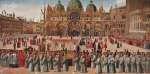
When did this love for “crumbling Venice” begin, and why has it taken hold with such tenacity? By the time Victorian historian and art critic John Ruskin encountered the city in the 1840s, he thought Venice was so neglected that she might melt into the lagoon “like a lump of sugar in hot tea.” It’s true that Ruskin feared any further deterioration, but what appalled him to an even greater extent was any attempt to modernize the city. He wanted a Venice that was set in aspic, a time-capsule for posterity. And thus the movement to save La Serenissima was born—and what a successful movement this has been—for Venice is probably the finest preserved medieval and Renaissance city in Europe. Yet all this tender loving care has not been without consequence. It could be argued that she’s been stifled, moth-balled—even de-commissioned as a real city. For, while there is a great deal of industry and development about the rim of the Venetian lagoon, it is almost impossible to find a modern building in Venice herself. For the most part, she is the same city that Ruskin visited, kept safe in her watery refuge and forbidden from growing up.
But it’s not just crumbling Venice that we have come to love through art, film and literature. We’re equally, if not more attached to “decadent Venice”—shameless, lustful, dissipated Venice. We might blame Casanova and Lord Bryon and their epic sexual exploits for bestowing this reputation upon the place, but Venice’s status as a city of pleasure goes back much further in history. By the early 17th century, there were estimated to be as many as 20,000 prostitutes in a city that only numbered around 140,000 people. Even for those not seeking to pay for sex, there was plenty of the stuff on offer—adulterous affairs, secret assignations, riotous carnivals and masked balls. Even the city’s nuns sometimes took lovers. One needs only to look at the paintings of Titian, particularly the eroticism of his 1538 painting “Venus of Urbino” to appreciate that this was a society with a relaxed and permissive attitude to sex.
more here.
The infinity of blue

Maggie Nelson’s Bluets, originally published in the US in 2009 and only now appearing in the UK, thanks to Jonathan Cape, joins a small collection of books I seem to have acquired, without really trying, on the subject of the colour blue. Nelson’s book might best be described as an essay in the form of prose-poetic fragments; its tone is set from the first line, which runs: “Suppose I was to begin by saying that I had fallen in love with a color”. What follows are ruminations on Nelson’s relationship with the colour blue; more critical explorations of why this colour might have a power over us that red, for instance, or green don’t have; and brief back-slips into memoir that exhibit the same jagged candour as The Argonauts (2015).
The other books in my micro-collection are William Gass’s On Being Blue, Derek Jarman’s Blue, and Blue Mythologies by Carol Mavor. It may be chance that these particular books have come into my possession (I have no particular interest in the colour, myself) but it is surely not chance that all these books were written about blue, rather than any other colour. Nelson is well aware of the anomaly. “It does not really bother me that half the adults in the Western world also love blue”, she writes, “or that every dozen years or so someone feels compelled to write a book about it.”
more here.
(RE)READING DON DELILLO IN DARK TIMES
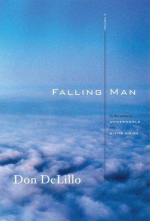
What do we expect from literature? Fiction offers writers the chance to formulate uncomfortable ideas, to place words in the mouths of characters that are distinct from the author’s point of view. Written six years after September 11, however, Falling Manstill did not address much of the madness that occurred in the aftermath of this epochal event: the self-censorship that characterized the time; the mindless patriotism; the trauma that was fixated exclusively on victimhood, as opposed to the devastating effects of United States policy abroad; the conspiracy theories—the latter being a particularly noteworthy omission, given that in his research for Libra, DeLillo immersed himself in the sea of speculation surrounding the JFK assassination, the last era-defining catastrophe before 9/11. Was it a cop-out to give the strongest critical voice to a foreigner, the vaguely dubious Martin with the socialist past? Oddly, his nationality is not precisely specified, as though Europe were some indistinguishable entity patently hostile to American values and virtues, and therefore decadent, discredited. DeLillo seems to be asking how much we actually want to know about ourselves, and it seems significant in this respect that Falling Man was one of his least loved books. A similar fate befell Susan Sontag, who famously issued an apology for the short essay she read out loud at the American Academy in Berlin on September 13, 2001 and published two days later in the Frankfurter Allgemeine Zeitung. Finally appearing in The New Yorker on September 24, nearly two weeks after the event, the piece made the comparatively mild and fairly accurate observation that America was attacked for its arrogance and its disastrous international interventions and heaped scorn on “the unanimity of the sanctimonious, reality-concealing rhetoric spouted by American officials and media commentators.” Sontag stood alone in her audacity to state what should have been obvious to everyone, and she was vilified for it. When does it become the writer’s responsibility to put skin in the game, to come out of hiding and state an unequivocal point of view? Are DeLillo’s deflected statements the only way he saw to voice deeply uncomfortable and unpopular ideas, and is this a legitimate literary strategy?
more here.
Massimo Pigliucci: The philosophy of Stoicism
Video length: 5:29
Noam Chomsky: On Trump and the State of the Union
George Yancy and Noam Chomsky in the New York Times:

George Yancy: Given our “post-truth” political moment and the growing authoritarianism we are witnessing under President Trump, what public role do you think professional philosophy might play in critically addressing this situation?
Noam Chomsky: We have to be a little cautious about not trying to kill a gnat with an atom bomb. The performances are so utterly absurd regarding the “post-truth” moment that the proper response might best be ridicule. For example, Stephen Colbert’s recent comment is apropos: When the Republican legislature of North Carolina responded to a scientific study predicting a threatening rise in sea level by barring state and local agencies from developing regulations or planning documents to address the problem, Colbert responded: “This is a brilliant solution. If your science gives you a result that you don’t like, pass a law saying the result is illegal. Problem solved.”
More here.
The Divided States of Hysteria’s shocking cover should never have been printed
Kieran Shiach in The Guardian:

Image is far from the only publisher to let questionable images go to print. Marvel Comics has run several, including J Scott Campbell’s Invincible Iron Man cover, which depicted teenage Riri Williams in a textbook example of how black women are stereotyped as hypersexualised.
More here.
How Aging Research Is Changing Our Lives
Katharine Walter in Nautilus:

Can those incredible increases in lifespan continue? Is there an upper limit?
There currently is an upper limit, and the upper limit is probably around 115, 120. You have a very large number—100 billion people to choose the number of people that have ever lived—and you have only one who has made it through to 122, Jeanne Calment. The second oldest was 119. It does seem there is an upper limit. Some people have shown that in the last hundred years, even though we have progressively increased the average lifespan, the number of people who live above 115 has not increased. That has to tell you that we might be reaching sort of a limit. That’s already a pretty good limit. If we could all live to 110 healthy and a disease in the last five years of life, I think most people would sign for this.
More here.
Wednesday, July 5, 2017
Soul of a Molecular Machine: A Conversation With Venki Ramakrishnan
From Edge:

There are so many large-scale problems dependent on large datasets that we're getting more divorced from the data. There's this intermediary doing the analysis for us. To me, that is a change in our way of understanding it. When someone asks how we know, we say that the system analyzed it and came up with these relationships—maybe it means this or maybe it means that. That is philosophically slightly different from the way we've been doing it. The other reason to worry is a cultural reason. The Internet and the World Wide Web have been a tremendous boon to scientists. It's made communication far easier among scientists. It's in many ways leveled the playing field.
More here.
How to build a human cell atlas
Anna Nowogrodzki in Nature:

The results are already widening the spectrum of known cell types — identifying, for example, two new forms of retinal neuron2 — and Regev is eager to find more. In late 2016, she helped to launch the International Human Cell Atlas, an ambitious effort to classify and map all of the estimated 37 trillion cells in the human body (see 'To build an atlas'). It is part of a growing interest in characterizing individual cells in many different ways, says Mathias Uhlén, a microbiologist at the Royal Institute of Technology in Stockholm: “I actually think it's one of the most important life-science projects in history, probably more important than the human genome.”
More here.