Is philosophy simply harder than science?

David Papineau in the Times Literary Supplement:

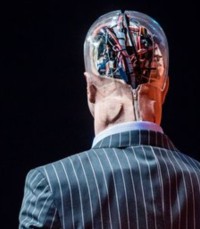
PlatoWhat’s the purpose of philosophy? Alfred North Whitehead characterized it as a series of footnotes to Plato. You can see his point. On the surface, we don’t seem to have progressed much in the two and a half millennia since Plato wrote his dialogues. Today’s philosophers still struggle with many of the same issues that exercised the Greeks. What is the basis of morality? How can we define knowledge? Is there a deeper reality behind the world of appearances?

Philosophy compares badly with science on this score. Since science took its modern form in the seventeenth century, it has been one long success story. It has uncovered the workings of nature and brought untold benefits to humanity. Mechanics and electromagnetism underpin the technological advances of the modern world, while chemistry and microbiology have done much to free us from the tyranny of disease.

Not all philosophers are troubled by this contrast. For some, the worth of philosophy lies in the process, not the product. In line with Socrates’ dictum – “The unexamined life is not worth living” – they hold that reflection on the human predicament is valuable in itself, even if no definite answers are forthcoming. Others take their lead from Marx – “The philosophers have only interpreted the world. The point, however is to change it” – and view philosophy as an engine of political change, whose purpose is not to reflect reality, but disrupt it.

Even so, the majority of contemporary philosophers, myself included, probably still think of philosophy as a route to the truth. After all, the methods we use wouldn’t make much sense otherwise.

More here.

The new, nearly invisible class markers that separate the American elite from everyone else

Aspirational

Dan Knopf in Quartz:

Being wealthy has become so passé that rich people are increasingly choosing not to display that wealth—that’s the theory behind a new book exploring the changing consumption habits of rich people in the West.

In 1899, the American economist and sociologist Thorstein Veblen published the classic polemic The Theory of the Leisure Class. Veblen’s book was among the first to examine how the wealthy used purchasing decisions to demonstrate their class. To describe this behavior, Veblen coined the term “conspicuous consumption”—defined as spending on publicly observable goods like clothing and accessories. Veblen argued, as an example, that the main point (pdf) of wearing high-heel shoes or a top hat for the rich was to demonstrate that you could not possibly do any manual labor. The book became well-known as an early criticism of the excesses of capitalism.

Almost 120 years later, sociologist Elizabeth Currid-Halkett has taken the baton from Veblen—but with a modified target. In her new book, The Sum of Small Things: A Theory of the Aspirational Class, Currid-Halkett takes aim at “Aspirationals”—the group that she sees as the new elite. They’re best characterized on the book’s webpage as:

Highly educated and defined by cultural capital rather than income bracket, these individuals earnestly buy organic, carry NPR tote bags, and breast-feed their babies. They care about discreet, inconspicuous consumption—like eating free-range chicken and heirloom tomatoes, wearing organic cotton shirts and TOMS shoes, and listening to the Serial podcast. They use their purchasing power to hire nannies and housekeepers, to cultivate their children’s growth, and to practice yoga and Pilates.

Currid-Halkett’s biting, often humorous commentary is not just a send up of the so-called “coastal elites.” It’s a trenchant analysis that combines economic and sociological evidence to describe major trends.

More here.

Why whales are back in New York City

Kendra Pierre-Louis in Popular Science:

ScreenHunter_2719 Jun. 13 22.02For the first time in a century, humpback whales have returned to the waters of New York harbor. And not just occasionally, either. They're coming in enough numbers that a company can reliably trot tourists out to the ocean—within sight distance of Manhattan’s skyscrapers—to see them.

“Because of the improvement of the water quality, algae and zooplankton have multiplied, giving good food for the menhaden [a small oily forager fish beloved by whales], which have returned in numbers that the fishermen say they have not seen in their lifetimes,” Paul L. Sieswerda told PopSci. Once a curator at the New York Aquarium, Sieswerda has since founded Gotham Whales, an organization that conducts tours and monitors the presence of whales, seals, and dolphins in NYC. “Our surveys show an exponential increase in the number of whales since 2011 when we first began our studies," he said. "Prior to that, whales were only seen intermittently."

While Sieswerda dates the presence of whales back to 2011, 2014 was the year that whales caught the attention of many New Yorkers: one especially charismatic whale was captured on camera. A humpback seamlessly parted the water's surface, maneuvering its forty-foot, forty-ton form so that it was floating perfectly erect. Although its tail stayed below the surface, its rostrum (or beak-like snout) and head stood proudly exposed. The incredible power and buoyancy of its pectoral fins kept it aloft in a slow and controlled motion that bore a striking visual similarity to a person treading water. Whales use this motion, called spyhopping, to get a better view of what's on the surface—like prey, or humans gawking at them from whale watching boats. This is a marvel to behold anywhere in the world; to see it in New York City, with the Empire State building glimmering in the background, borders on the fantastical.

More here.

A PAKISTANI IN PALESTINE

Mohammed Hanif in Dawn:

593c9f12c8e35I met the only Jewish-Pakistani in Israel by accident. It turned out he had also ended up there through a historic misunderstanding.

I wasn’t looking for him. He wasn’t expecting me.

In the last days of the last millennium, just before the millennium bug was predicted to wipe out all our computer memory, there were reliable rumours of peace between Israel and Palestine.

The proof of this impending peace was in my passport. I was given a reporting visa by the Israeli embassy in London on a Pakistani passport.

They were understanding enough not to stamp the visa on the passport. I had grown up with a green passport which said in bold letters, ‘Valid for travel to all countries of the world except Cuba and Israel.’

I was convinced that peace was about to break out when I reported to the Directorate of Censors in Jerusalem and discovered all its staff was on strike.

Having lived under various forms of censorship in Pakistan (from midnight knocks to what your uncle will think of what you are writing), I found it exhilarating: when your directorate of censorship goes on strike, who is there to fear?

Hours later, trying to score a meal, I was terrified. Like a naive tourist who believes that the best way to get to know a city is to get lost in the city, I tried to walk into random shops and cafes and bars.

When I tried this in the upmarket district of West Jerusalem I was pounced upon at the doors.

Your name? Your ID? And as I presented my passport with the hope of hearing, ‘Oh where is Pakistan? What brings you to our country?’ I was told, ‘We don’t allow.’

I almost wanted to say ‘But I am not Palestinian’ but I realised it all probably sounded the same.

I retreated to the safety of the Jerusalem Hotel, where a tour operator with three mobile phones gave weary directions to lost souls like me.

More here.

A LOOK INSIDE JAMES BALDWIN’S 1,884 PAGE FBI FILE

James-BaldwinWilliam J. Maxwell at Literary Hub:

When did the Bureau lose sleep over the popularity of Baldwin’s “recent books . . . ringing up best-selling figures,” the “100,000 copies in hardcover” sold of The Fire Next Time and “the two million mark in soft covers” in sight for Another Country? It did so when a column in the Washington Post conveyed the news that Baldwin planned to publish another “book about the F.B.I. in the South.”

Hoover’s sensitivity to literary competition and challenge, always acute, had been exquisite since 1950, when Max Lowenthal’s study The Federal Bureau of Investigation, the first rigorously unauthorized history of the organization, somehow made its way to the printers without the Bureau’s knowledge. “Mr. Hoover, if I had known this book was going to be published,” swore Louis Nichols, then head of the Crime Records Division, “I’d have thrown my body between the presses and stopped it.” Nichols’s successors at Crime Records made certain that Baldwin’s FBI book—shortly given the working title of The Blood Counters—would not take them unawares.

The June memo to Cartha DeLoach identifies the book’s expected publisher, the Dial Press, and indicates in an addendum that “should the book be published, naturally it will be reviewed.” A July memo to the head of the New York field office requests a less passive form of vigilance: “Supervisor [name redacted] requested that if possible, through established sources at Dial Press, a copy of the proposed book concerning the FBI be discreetly obtained prior to publication.”

more here.

Speaking Out about almond milk

Cabinet_062_oreilly_sally_001Sally O'Reilly at Cabinet Magazine:

Dear WhiteWave Foods,

I am writing to complain about one of your products: namely, Silk Cashewmilk (with a touch of almond). I imagine that you receive many complaints about your use of the word “milk,” and frequent challenges to specify where exactly on the cashew nut the teats are located. This, however, is not a problem for me, since I simply mop up what I take to be a sloppy euphemism with a pair of quotation marks. No, what I wish to complain about is the recent redesign of your half-gallon “milk” cartons.

My bipartite beef with this redesign is 1) the reduction in realism of the illustration and 2) the stance of the nuts represented therein. To start with the latter point: I have come, in recent years, to identify with the two nuts who, like game siblings, plunge pell-mell into their fate. I hope that it is not an anthropomorphism too far to suggest that one splashes down as if propelled from a water chute, and the other arcs forward, as if diving headlong, emboldened by the first’s joyful splash. This is an image of excitement and of freedom (from what, I presume, is for the “milk” drinker to decide). In the new arrangement, however, the two nuts face one another, turning their backs on the world to assume a conservative relation based in partnering and stability. My concern is that here you are affirming and perpetuating recent troubling shifts in political attitudes the world over. Your open and energetic cashews have become inward-looking; even their spatial alignment is now in almost complete agreement with one another, as if no differently oriented nut would be welcome.

more here.

Dostoevsky’s ‘White Nights’ as architecture

Dostoevsky_elevationsmall_sizeMatteo Pericoli at The Paris Review:

We’re used to seeing skyscrapers towering over cities. We’re used to imagining the fabric of a city as the footprint of solids over voids.

The protagonist of Fyodor Dostoyevsky’s White Nights is, as he himself tells us, a dreamer. A lonely man, with no friends or acquaintances, who only knows the look and soul of the physical places around his city, Saint Petersburg. Hiding from the sunlight, he wanders the city at nighttime, animating each street corner with character—filling its voids.

The novel is an adventure that lasts four nights. On the first night, the dreamer meets a woman in tears, bravely approaches her as he’s never approached anyone before, and consoles her.

Although her heart beats for someone else, she lets him in and the two spend four nights getting to know each other. The closer he gets to her, the farther he distances himself from his lonely life. He has finally found the one chance he’ll ever have to rise above the city from which he feels estranged.

The improbable union between the two protagonists approaches in an unbearable crescendo until the final moment, when the story ends as abruptly as it had begun, and the dreamer suddenly sees even the physical city as a lifeless and meaningless place.

more here.

‘Our brains are being rewired to exist online’

Marta Bausells in The Guardian:

BrainIn one of Jillian Tamaki’s comic-book stories, entitled 1. Jenny, a “mirror Facebook” appears on the internet. At first, it looks like it is merely a duplicate of the familiar social network – until small changes begin to appear on everyone’s profiles. Like most internet phenomena, it is “all anyone could talk about for two weeks”, considered “playful at best, mischievous at worst”. But as Jenny watches the mysterious mirror-Jenny’s life diverge from her own in tiny ways – growing her hair long, watching Top Gun – she grows increasingly obsessed with the life that could be hers; wishing, all the same, that “she had followed through with her threats to quit Facebook. (Threatening to whom?)” As in many of Tamaki’s stories in her delicate new collection Boundless, 1. Jenny is unpredictable and wry, focusing on women struggling with societal expectations, both online and in reality. Technology and social media are front and centre in most of the stories, but the Canadian writer and artist isn’t moralising. “I try to be more observational about it, and think about its sensory aspects or people’s different connections to it,” she says from Toronto.

Despite some of the stories being written years before Black Mirror and The Handmaid’s Tale landed on TV, they feel very current. “Part of your brain thinks, ‘I should make something that stands the test of time and is very universal’,” Tamaki says with a smile. “I can see how there is a temptation to do that, but I think it’s really interesting to do something super-topical. I am living in 2017 and that’s where my brain is – and a lot is happening and our brains are being rewired to exist online.”

More here.

The Liver: A ‘Blob’ That Runs the Body

Natalie Angier in The New York Times:

LiverTo the Mesopotamians, the liver was the body’s premier organ, the seat of the human soul and emotions. The ancient Greeks linked the liver to pleasure: The words hepatic and hedonic are thought to share the same root. The Elizabethans referred to their monarch not as the head of state but as its liver, and woe to any people saddled with a lily-livered leader, whose bloodless cowardice would surely prove their undoing. Yet even the most ardent liverati of history may have underestimated the scope and complexity of the organ. Its powers are so profound that the old toss-away line, “What am I, chopped liver?” can be seen as a kind of humblebrag.

After all, a healthy liver is the one organ in the adult body that, if chopped down to a fraction of its initial size, will rapidly regenerate and perform as if brand-new. Which is a lucky thing, for the liver’s to-do list is second only to that of the brain and numbers well over 300 items, including systematically reworking the food we eat into usable building blocks for our cells; neutralizing the many potentially harmful substances that we incidentally or deliberately ingest; generating a vast pharmacopoeia of hormones, enzymes, clotting factors and immune molecules; controlling blood chemistry; and really, we’re just getting started. “We have mechanical ventilators to breathe for you if your lungs fail, dialysis machines if your kidneys fail, and the heart is mostly just a pump, so we have an artificial heart,” said Dr. Anna Lok, president of the American Association for the Study of Liver Diseases and director of clinical hepatology at the University of Michigan. “But if your liver fails, there’s no machine to replace all its different functions, and the best you can hope for is a transplant.”

And while scientists admit it hardly seems possible, the closer they look, the longer the liver’s inventory of talents and tasks becomes. In one recent study, researchers were astonished to discover that the liver grows and shrinks by up to 40 percent every 24 hours, while the organs around it barely budge.

More here.

Tuesday Poem

House of Cards

I miss you winter evenings
With your dim lights.
The shut lips of my mother
And our held-breaths
As we sat at a dining room table.

Her long, thin fingers
Stacking the cards,
Then waiting for them to fall.
The sound of boots in the street
Making us still for a moment.

There’s no more to tell.
The door is locked,
And in one red-tinted window,
A single tree in the yard,
Leafless and misshapen.

.
by Charles Simic
from The Best American Poetry2006
Scribner Poetry
.

Monday, June 12, 2017

Sunday, June 11, 2017

The Hacker

Untitled-15

Richard Marshall interviews McKenzie Wark in 3:AM Magazine:

3:AM: You have an interesting take on globalization – it’s not as clean or stable as it is sometimes presented and it’s something that seems to frame a deal of your thinking. It’s also an idea that is recently beginning to look less obviously definitive of what the future and the near present may look like – I was reading about how some economists are beginning to talk about nationalist economics again – so first can you give us a sketch of where your thinking is about what globalization and its media space is today and how it may have changed since you started writing about it in the 90’s. Has the nature of its chaos changed?

MW: What makes ‘globalization’ even possible in the first place? One answer would be that it requires the regularization of some kind of media and communication infrastructure. When you have that, you might get globalized economic trade within some political or imperial framework, but it is likely you’ll get transnational cultural flows as well.

This was clear when I was in China in the late eighties. Deng Xiaoping had mandated, at one and the same time, the ‘open door policy’ on trade and a campaign against ‘spiritual pollution’ on culture. It turned out that when you open the door to one you’re likely to get the other whether you want it or not.

So it might be best to think about both kinds of border-crossing vector – economic and cultural – at the same time, and as dependent on the same media and communication form. Then you find that they can interact in all sorts of interesting ways. Globalizing trade can lead to a cosmopolitan culture, but also to all sorts of nationalistic or racist or patriarchal reactions to those as breaches of imaginary communities. And the relation can be reversed. A reaction against the free flow of culture can contribute to a nationalistic turn in political-economy.

More here.

An unexpected rain of spiders led to a lovely Twitter geek-out between astronomers and arachnologists

Ed Yong in The Atlantic:

Lead_960 (3)Last Wednesday, a spider fell onto Jamie Lomax’s laptop. Two days later, it happened again. Soon enough, several spiders were crawling across the ceiling of her office. “It was a little unnerving,” says Lomax, who’s an astronomer at the University of Washington. “I’m not scared of spiders but if someone else wants to take care of the spider in a room, I’ll gladly let them do it over me. And I don’t really want them raining down on my head.”

Lomax identified the abseiling arachnids as zebra jumping spiders, and tweeted about her experiences with the hashtag #ItIsRainingSpidersNotMen. And after considering options including “nukes and fire,” she settled for notifying her university. They sent over an exterminator, who failed to find any lingering spiders within the ceiling. He figured that a nest had probably hatched, and the newborn spiders had scattered. “But a couple of hours later, there were still spiders everywhere,” she tells me. “As of yesterday, there still were.”

Meanwhile, fellow astronomer Alex Parker had read Lomax’s tweets. “Have you tried lasers?” he replied. “Seriously though, some jumping spiders will chase laser pointers like cats do.”

There are, indeed, many Youtube videos of them doing exactly that. But Emily Levesque—Lomax’s colleague, with an office two doors down—wanted to see it for herself. “She has a laser pointer and she happens to be the only other person with spiders in her office,” says Lomax. “She ran down to me and said: You have to see this.”

More here.

Mohammed Hanif: Not All Attacks Are Created Equal

Mohammed Hanif in the New York Times:

10hanif1-inyt-master768There is a sickeningly familiar routine to terrorist attacks in Pakistan. If one happens in your city, you get a text message or a phone call asking if you are O.K. What happened? you ask. From that, the caller concludes that you are O.K.. Then you turn on the TV and watch the screen zoom in on a Google map or an animated blast before cameras reach the scene and start beaming images of bloodied slippers.

Last Saturday, I went through the same routine during a stay in London. It was a friend in Pakistan who alerted me by text message about the attacks here. As I looked for the TV remote, I got another message from him. “Did you ever think you’d hear about London from Pakistan?”

I found the observation slightly upsetting. I wanted to write back: “You are sitting peacefully in your home in Islamabad. This is not the time to be ironic. There is no irony in carnage.” I didn’t reply, and instead got busy trying to track down my son, who happened to be in the area near where the attack happened. Last year, I sent him off to university in London, calculating this was a safer place than home in Karachi.

After I found out that my son was all right, I had time for ironic reflection.

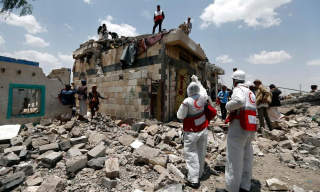
In the weeks during which a concert in Manchester and a lively neighborhood of London were struck by terrorists, a dozen people were killed at two sites in Tehran, an ice cream parlor was blown up in Baghdad, a single bombing killed some 90 people in Kabul, then more Afghans died during protests about that attack and then still more Afghans died in another attack at a funeral for people killed during the protests.

More here.