
Category: Recommended Reading
Chinese blacklist an early glimpse of sweeping new social-credit control

Nathan Vanderklippe in The Globe and Mail:
In late 2013, he was arrested and accused of "fabricating and spreading rumours." Late in 2016, a court found him guilty of defamation and ordered him to apologize on his social-media account, which at the time had 740,000 followers. If he was unwilling to do that, the court said, he could pay $115 to publish the verdict on an authorized website. Mr. Liu paid the money.
Then, he said, the judge raised the fee to $2,900.
But in the midst of Mr. Liu's attempt to seek legal redress early in 2017, he discovered that his life had abruptly changed: Without any notice, he had been caught up in the early reaches of a social-credit system that China is developing as a pervasive new tool for social control – one expected to one day tighten the state's grip on its citizens. Critics have called it an Orwellian creation – a new kind of "thought police."
What it meant for Mr. Liu is that when he tried to buy a plane ticket, the booking system refused his purchase, saying he was "not qualified." Other restrictions soon became apparent: He has been barred from buying property, taking out a loan or travelling on the country's top-tier trains.
"There was no file, no police warrant, no official advance notification. They just cut me off from the things I was once entitled to," he said. "What's really scary is there's nothing you can do about it. You can report to no one. You are stuck in the middle of nowhere."
More here.
Anselm Kiefer’s Eroticism at Gagosian

Within the high walls of a cloistered garden, a young man falls in love with a rose, but seeking every possible avenue through which to attain his affection, it becomes increasingly clear he can never have it without destroying that aspect of it which he loves. With the general plot line of the original “Romance of the Rose” (1230 CE) in our minds, and its universal ramifications for all human relationships, we can follow the path that Anselm Kiefer weaves in his newest exhibition, “Transition from Cool to Warm,” rich with themes of sexuality, eroticism, femininity and longing. Though bookended with several massive paintings, the heart of the exhibition comprises watercolors and books. The exhibition has also been, to extend the metaphor, bookmarked by two events: an interview with Paul Holdengräber at The New York Public Library and an intimate demonstration of the plaster-soaked-cardboard books taken out of their vitrines at the gallery. These extra-curricular activities allowed the viewer into Kiefer’s thorny garden, and explicated a profound transition of the artist/author from his pulpit of philosopher and historian to a much more earthy place, looking up at the stars with the rest of us.
The exhibition has been laid out along the plan of a basilica, with a pair of rooms as aisles on either side of a main nave. The inner sanctum of the gallery contains a presentation of Kiefer’s newest one-off art books—hybrid objects that ensnare a dizzying number of references: to Wagner and Nordic mythology, Abrahamic traditions, Rodin, Picasso and the modern conception of data storage and presentation.
more here.
Kevin Hart’s ‘Poetry and Revelation: For a Phenomenology of Religious Poetry’
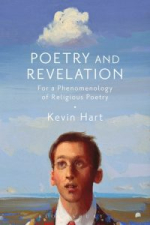
Kevin Hart is not one to boast. Nothing in this volume, which discusses religious poetry, would let one know that Hart is a major contemporary poet (as Harold Bloom amongst others has claimed), nor that some of his poems are religious. We do not find out that Hart is the one who has written the lines: “I want to live/Like a water spider over my own life/And touch again the month we fell in love/And feel its flesh,” nor that he has written “The Room,” which is said to have sustained a captured Chilean soldier who had memorized the poem through a period of intense mental and physical torture.
Perhaps Hart wanted the volume, one of a number of important theoretical works he penned, to stand on its own, and it certainly does; however, it is worth mentioning that this theoretical account of religious poetry is written by someone who is a practicing religious poet. The book is essentially an apologia for religious poetry accomplished through a novel mode of argumentation: phenomenology. As far as I am aware, this is the first major treatment of religious poetry in the field of phenomenology, and the result is a stirring defense of religious poetry against two major detractors of the very idea.
more here.
Thursday Poem
The Carpet Merchant
Wary as an animal she sniffs the air
enters the color of wounds, shadows
of crushed aubergine, the cedar dark
where fretted shutters jigsaw the blazing light.
Outside the cries of saffron vendors
fade, the clatter of the bazaar
where fair-haired English teachers
flirt with traders for Turkish delight.
Elegant he sits her on soft cushions
nods to the olive boy to bring her cayi
and limpid apple tea, clicks his fingers
to conduct the symphony of rugs.
which unroll like prayers, The knots
are looped and dropped, he explains,
for perfection belongs to Allah.
He offers her weaves of indigo,
faded of cochineal, where trellises
of butterflies symbolize the transience
of love, and corrugated arcs a nomad's
thirst for waves. he tells her this was
his father's house. How as children
they jumped naked to the sea from the carved
balcony, as he pushes to the shutter,
brushing a cool hand against her white shoulder.
.
by Sue Hubbard
from Everything Begins with the Skin
Enitharmon Press, 1994
On the unsettling experience of being a patient
Anesthesia has been around for over 170 years, and in spite of its inherent drama it’s impressively nonlethal. Current estimates place the death toll at about one in two hundred thousand or even one in three hundred thousand, which means—according to the earnest nonprofit the National Safety Council—that you or I are more likely to die from insect stings, “excessive natural heat,” or “contact with sharp objects” than either of us is from being put under. Properly supervised anesthesia is not only exceedingly safe but also ubiquitous, and necessary for a slew of lifesaving and life-improving procedures. Yet in these heady days of organic, “toxin”-free lifestyle goals, wariness of medical convention abounds. People rush to point out that we (“we” meaning doctors, which “we” usually aren’t) don’t really know how anesthesia works, thereby implying that it’s fundamentally suspect. There are movements in opposition to advances like vaccines and hormonal birth control, so it makes sense that anesthesia, too, with its murky chemical magic, would be a source of unease.
Because anesthesia is unlikely to cause death outright, the case against it goes more or less as follows: It’s mysterious and it’s scary. The former is posited as the reason for the latter, but even if there were a flawless explanation for how anesthesia works, we’d still be disconcerted—it strips us of our awareness, movement, speech, and senses.
more here.
A powerful new weapon against drug-resistant bacteria was inspired by the human body
Kelly Servick in Science:

Nibbering and a team of Dutch collaborators are trying to combat these biofilm-associated infections by improving on a human peptide called LL-37, which helps regulate the body’s immune response. LL-37 already has some natural bacteria-killing abilities, and the researchers previously shortened the peptide to make a more powerful variant, consisting of 24 of the 37 original amino acids. In the new work, they optimized this peptide by making a series of random replacements to its building blocks without disrupting its overall structure. One variation, dubbed SAAP-148, proved a powerful little weapon, the team reports online today in Science Translational Medicine. Whereas most traditional antibiotics target specific groups of bacteria and kill by disrupting key mechanisms of those microbes, SAAP-148 is more of a generalist. It kills by damaging most any bacterium’s plasma membrane, causing it to spill its contents and deflate.
More here.
Wednesday, January 10, 2018
The Anti-Bamboozler: H. L. Mencken’s campaign against bluff and bunk
Danny Heitman in the Weekly Standard:
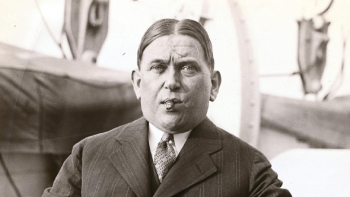
Mencken (1880-1956) led many literary lives, often several at once. He began newspapering in his native Baltimore in 1899, quickly rising from a reporter to an editor and columnist. His bombastic commentaries for the Baltimore Sun gained attention far beyond his hometown, and his work for the Smart Set and the American Mercury affirmed his national profile as the dominant social critic of the 1920s. Mencken wrote about politics, music, drama, and literature, collecting his best essays in Prejudices, a series of six volumes that rests at the heart of his oeuvre. But there was so much more: memoirs, books on theology, ethics, the state of the American woman, and a mammoth philological study called The American Language. The thousands of letters he wrote to everyone from Theodore Dreiser to Ezra Pound to F. Scott Fitzgerald are their own monument to industry.
Mencken once estimated that he had published some 10 to 15 million words in various venues—a stream of production cut short by a 1948 stroke that deprived him of the ability to write. He lingered another eight years, though he casually suggested to British journalist Alistair Cooke that he traced the real time of his death to the year his typewriter fell silent.
But Mencken was much too prodigious a talent to let a small inconvenience like mortality get in the way of his literary legacy. In the more than six decades since his passing, a steady stream of Mencken material has continued to appear for the first time in book form, most of it drawn from his journalism.
More here.
ERECTILE-DYSFUNCTION GEL CONTAINING EXPLOSIVE NITROGLYCERIN WORKS 12 TIMES FASTER THAN VIAGRA
Kastalia Medrano in Newsweek:

Researchers at the University College Hospital in London and various other United Kingdom medical centers tested the product on a total of 220 male participants, according to the International Business Times. They found that after applying a small amount of the gel (a blob roughly the size of a pea) nearly half of the male participants studied reported getting an erection within five minutes, and 70 percent within 10 minutes—making the gel 12 times faster than industry standard Viagra, according to the Deccan Chronicle.
Erectile dysfunction affects about 40 percent of American men over the age of 40, according to the Cleveland Clinic. Viagra and its impotence-relieving peers, such as Cialis and Levitra, are consumed in pill form and generally take around 30 minutes to an hour to produce any results. Even then, they remain ineffective for approximately 30 percent of men who try them, according to Channel News Asia.
When rubbed onto the skin, the gel releases nitric gases that relaxes muscles, expanding blood vessels and helping increase blood flow.
More here.
Moustafa Bayoumi On Being Muslim and American in the Age of Trump
Moustafa Bayoumi in The Nation:

Trump’s defenders insisted that this was all just “campaign-trail rhetoric,” as if exploiting bigotry were any different from bigotry itself. But by the end of 2015, hate crimes against Muslims in the United States had rocketed to what was then their highest point since 2001. Brian Levin, director of the Center for the Study of Hate and Extremism at the University of California, San Bernardino, told The New York Times that the anti-Muslim violence in this period seemed to escalate immediately following Trump’s flamethrowing comments.
And the situation did not ease after 2015; instead, it got substantially worse.
More here. [Thanks to Corey Robin and Najla Said.]
A philosopher (Stephen Asma) and a psychologist (Rami Gabriel) discuss the nature and history of emotions
The Impossibility of Knowing Mark Twain
Gary Scharnhorst in The Paris Review:
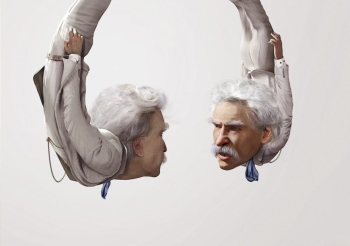
the truest of all books; for while it inevitably consists mainly in extinctions of the truth, shirkings of the truth, partial revealments of the truth, with hardly an instance of plain straight truth, the remorseless truth is there, between the lines, where the author-cat is raking dust upon it which hides from the disinterested spectator neither it nor its smell … the result being that the reader knows the author in spite of his wily diligences.
Howells replied skeptically, “Even you won’t tell the black heart’s-truth. The man who could do it would be famed to the last day.”
Howells was correct. In the end, Sam failed to tell the whole truth and nothing but the truth about his life in his memoirs. From the beginning, he was reticent to discuss sex, for example. “There were the Rousseau confessions,” he acknowledged, “but I am going to leave that kind alone.” He eventually conceded to Howells that “as to veracity,” the entire autobiography “was a failure; he had begun to lie, and that if no man ever yet told the truth about himself it was because no man ever could.” Sam elsewhere declared that “no man dares tell the truth until after he is dead.” His autobiography is so rife with inaccuracies, embellishments, exaggerations, and utter untruths that a cottage industry of naysayers has developed to debunk it. Many parts contain not so much a remembrance of things past but a remembrance of things that did not happen. As Louis J. Budd remarks, scholars who try “to separate truth from yarn-spinning in his autobiographical dictation” have discovered it is “a mountain of funny putty.” Sam Clemens’s biographers must consult the autobiography with caution in reconstructing the events of his life. He never allowed the facts to interfere with a good story, such as the discovery of a blind lead in Roughing It (1872) or his complicity in the death of a stranger in “The Private History of a Campaign that Failed” (1885). Even the apologetic Paine admitted that Sam’s autobiographical dictations bear “only an atmospheric relation to history.” Bernard DeVoto agreed that though he was one “of the most autobiographical of writers,” he was “least autobiographical” when he tried to chronicle his life. Howard Baetzhold describes Sam’s memory as “faulty” and “convenient,” and Hamlin Hill calls it “immensely selective.” James M. Cox refers tactfully to “the magnifying lens of his imagination.”
More here.
You’re Descended from Royalty and So Is Everybody Else
Adam Rutherford in Nautilus:

This I find relatively easy to digest. The simple logic is that there are more living people on Earth now than at any single moment in the past, which means that many fewer people act as multiple ancestors of people alive today. But how can we say with utter confidence that any individual European is, like Christopher Lee, directly descended from the great European conciliator?
The answer came before high-powered DNA sequencing and ancient genetic analysis. Instead it comes from mathematics. Joseph Chang is a statistician from Yale University and wished to analyze our ancestry not with genetics or family trees, but just with numbers. By asking how recently the people of Europe would have a common ancestor, he constructed a mathematical model that incorporated the number of ancestors an individual is presumed to have had (each with two parents), and given the current population size, the point at which all those possible lines of ascent up the family trees would cross. The answer was merely 600 years ago. Sometime at the end of the 13th century lived a man or woman from whom all Europeans could trace ancestry, if records permitted (which they don’t). If this sounds unlikely or weird, remember that this individual is one of thousands of lines of descent that you and everyone else has at this moment in time, and whoever this unknown individual was, they represent a tiny proportion of your total familial webbed pedigree. But if we could document the total family tree of everyone alive back through 600 years, among the impenetrable mess, everyone European alive would be able to select a line that would cross everyone else’s around the time of Richard II.
More here.
Wednesday Poem
Everything
pushes all matter
towards emptiness:
child-nodes,
tree-droppings
with a root element of null.
None is always included
in every cluster
of children.
Infinite nesting
pushes all matter
towards emptiness:
child-nodes,
tree-droppings
with a root element of null.
None is always included
in every cluster
of children.
Nothing in nothing
prepares us.
Yet a fresh light was shed
on immortality
for me climbing the stairs
firm foot first.
Everything was in the banister:
crows on branches, crickets,
architects, handsaws and democrats.
Red moon at 3 AM.
by Fanny Howe
from Poetry, Vol. 199, No. 3
December, 2011
The dark history of the word “pariah”

The earliest known inscription of the Tamil word “paraya” is found in a Sangam-era text, Purananuru, composed between the second and third centuries. In his essay “Waiting to lose their patience,” Ravikumar noted that when the first modern edition of Purananuru was published in 1894, many historians claimed that the presence of the word “parayan” in Song 335 implied that a caste system existed 1,800 years ago. “Nondalit commentators understand this to mean that the discrimination and oppression of the parayars/dalits is not of recent origin,” he wrote, “and they derive solace in believing that untouchability is as old as the Sangam period.” The pioneering Dalit intellectual Iyothee Thass questioned the very authenticity of the text in his 1908 article “Is there a book called Purananuru?” According to Ravikumar, there is no way to verify whether the song exists in its original form, or whether it was added in later centuries. The second-oldest inscription of the word is from the thirteenth century, during the Chola period. In this case, Ravikumar writes, there are references to both paraya cheri, or paraya settlement, and theenda cheri, or untouchables’ settlement, indicating that the two were not the same. The conflation of untouchability with “paraya” had not yet occurred.
more here.
all that’s solid melts into airports

What are these airports, what promises do they hold? What secrets do they hide? The piece gets more interesting as we read on. With a widening array of amenities and entertainment options—not to mention employment opportunities— “People will choose to go to the airport.” This is a recurring fantasy fruit that gets juiced from time to time: the idea that airports may become so desirous as to become destinations themselves. There is a threshold here, somewhere, at which point people decide that their present space takes priority over far-flung locales. If the ultimate airport is a rich, luscious place brimming with entrainment and energy, a true magnet for local citizens—and if every airport can become such a site—of what use are the airplanes, of what use the term “destination” as we know it? John Kasarda and Greg Lindsay have called these future nodes aerotropoli, but we might as well ground all the pesky planes and call such a place utopia, instead.
In the next paragraph of the Bloomberg piece, things get even more interesting. We learn about “infrastructure investments and technologies that will, in theory, allow airports to largely eradicate the dreaded waiting.” In theory. Of course, we all know that the practice of air travel is far messier and more uncomfortable than the airline loyalty pamphlets make it appear.
more here.
The Impossibility of Knowing Mark Twain

Over a century and a half ago, a columnist for the San Francisco Daily Dramatic Chronicle predicted that Samuel Langhorne Clemens, aka Mark Twain, was “bound to have a biographer one of these days—may it be a hundred years hence!” Albert Bigelow Paine’s official biography of the author was published less than fifty years later. It is an indispensable source for the legend of Saint Mark. Paine portrayed his subject as “the zealous champion of justice and liberty” who was “never less than fearless and sincere. Invariably he was for the oppressed. He had a natural instinct for the right, but, right or wrong, he was for the underdog.” As recently as 2002, Robert E. Weir echoed the dubious claim: Sam “was an indefatigable foe of anything that stood in the way of human progress and individual potential,” as if to suggest that the world would be a better place if only everyone emulated him. Sam Clemens’s most honest comments about his life, or so he asserted, appear in his autobiography, most of which appeared posthumously. “A book that is not to be published for a century gives the writer a freedom which he could secure in no other way,” he explained in 1899. “In these conditions you can draw a man without prejudice exactly as you knew him and yet have no fear of hurting his feelings or those of his sons or grandsons.” “I speak from the grave rather than with my living tongue, for a good reason,” he declared. “I can speak thence freely.”
more here.
Tuesday, January 9, 2018
A Strategy for Ruination: An interview with China Miéville
From the Boston Review:
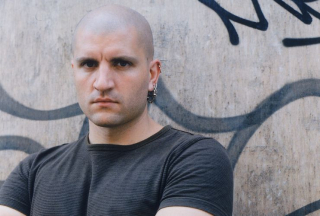
Boston Review: You are often quoted as saying that you want to write a book in every genre. Nonetheless, many of your books have centered around themes of utopia and dystopia. Do you feel as though dystopia has finally, well-and-truly slipped the bounds of genre?
China Miéville: Dystopia and utopia are themes, optics, viruses that can infect any field or genre. Hence you find utopian, dystopian, and heterotopian aspects in stories across the board: westerns, romances, crime—let alone, more obviously, in science fiction, speculative fiction, and fantasy.
To the extent that, before anything else, texts are -topias (particularly utopias) narrowly conceived—warnings, suggestions, cookbooks, or proposals—they are mostly uninteresting to me. Still, the often-repeated slur that utopias are “dull” has never been politically innocent: it bespeaks reaction. When Emil Cioran attacks utopias for lacking the “rupture” of real life—“the totality of sleeping monsters”—he ignores the ruptures and monsters that lurk in -topias too. As texts, -topias get interesting to the extent that they deviate, underperform, or do too much. Rather the excess of the Big Rock Candy Mountain, with its cigarette trees and lemonade springs, than the plod of Edward Bellamy’s Looking Backward (1888). In their conflicts, aporias, and surpluses, they can captivate. Alexander Bogdanov’s 1908 science fiction novel Red Star, for example, is fairly stodgy gruel until the protagonist, Leonid, veers unexpectedly and seemingly off-script through madness and the pedagogy gets opaque.
None of which is to argue against -topias of any prefix, still less of utopian yearning tout court. They are indispensable. But the -topian drive is more contradictory and succulent than some of its vulgar advocates, no less than its critics, make out.
More here.
Novelty in science – real necessity or distracting obsession?
Jalees Rehman in The Conversation:

Reproducibility of findings is a core foundation of science. If scientific results only hold true in some labs but not in others, then how can researchers feel confident about their discoveries? How can society put evidence-based policies into place if the evidence is unreliable?
Recognition of this “crisis” has prompted calls for reform. Researchers are feeling their way, experimenting with different practices meant to help distinguish solid science from irreproducible results. Some people are even starting to reevaluate how choices are made about what research actually gets tackled. Breaking innovative new ground is flashier than revisiting already published research. Does prioritizing novelty naturally lead to this point?
More here.