
Category: Recommended Reading
The Ghost of Zora Neale Hurston
Chantel Tattoli in The Paris Review:
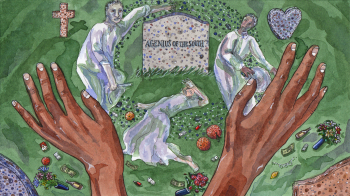
And so: nearly a decade before Walker published The Color Purple, a sister masterpiece to Their Eyes Were Watching God, the contributing editor at Ms. magazine stood in weeds up to her waist in Florida while sand and bugs poured into her shoes, looking for Hurston. Walker had flown from Jackson, Mississippi, to Orlando and driven to nearby Eatonville, the prideful all-black town where Hurston was raised, but not, as Walker learned from an octogenarian former classmate—Mathilda Moseley, teller of “woman-is-smarter-than-man” tales in Hurston’s Mules and Men—where she was put under.
Walker’s quest took her to Fort Pierce, on the Atlantic Coast, to the dead end of Seventeenth Street, to the Garden of Heavenly Rest. "In fact, I’m going to call you just one or two more times,” Walker swore. Hurston was somewhere in the crummy segregated burial ground; trouble was, her grave was unmarked. “Zo-ra!” Walker roared. And, as if Hurston had shoved her, Walker stumbled into a sunken rectangle in the heart of the yard: presumably Zora.
More here.
The art of gentling
Haley Cohen in The Economist:

Patience and tenderness are new traits for Tierce, who is 50 years old and serving the final months of a seven-year sentence at Arizona’s state prison complex in Florence for assaulting his ex-girlfriend while high on methamphetamine. “I’ve been in the system my whole life, you know. I was probably given up for incorrigible when I was about five.” At that age Tierce would sneak out of the window of his home in Phoenix to roam the streets with older friends, returning late at night. His father had walked out when he was young; his mom had polio and two other kids. “She was scared to death. She had to do something – she couldn’t control me,” he says flatly. He was placed in a group home for troubled youngsters, where he suffered physical and sexual abuse throughout his childhood. At 18, finally independent, he found meth, and spent 21 of the next 32 years in a jail cell, mostly on drug-related charges.
Tierce’s current sentence – his fifth – has been the most agreeable. In many states, including Arizona, all prisoners who are physically able to must work by law. While other inmates at the Florence complex toil in the prison slop hall, harvest tilapia on the prison fish farm or tinker with broken prison vehicles, Tierce is one of about 20 who spend their weekdays outside, training mustangs as part of the prison’s Wild Horse Inmate Programme (WHIP).
More here.
Saturday, January 27, 2018
Facebook Begins Its Downward Spiral
Nick Bilton in Vanity Fair:
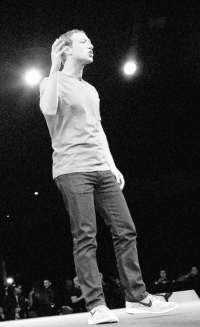
Taking a walk, it should be noted, was Zuckerberg’s thing. He regularly took potential recruits and acquisition targets on long walks in the nearby woods to try to convince them to join his company. After the walk with my friend, Zuckerberg appeared to take the relationship to the next level. He initiated a series of conference calls with his underlings in Facebook’s product group. My friend’s small start-up shared their product road map with Facebook’s business-development team. It all seemed very collegial, and really exciting. And then, after some weeks passed, the C.E.O. of the little start-up saw the news break that Facebook had just launched a new product that competed with his own.
Stories about Facebook’s ruthlessness are legend in Silicon Valley, New York, and Hollywood. The company has behaved as bullies often do when they are vying for global dominance—slurping the lifeblood out of its competitors (as it did most recently with Snap, after C.E.O. Evan Spiegel also rebuffed Zuckerberg’s acquisition attempt), blatantly copying key features (as it did with Snapchat’s Stories), taking ideas (remember those Winklevoss twins?), and poaching senior executives (Facebook is crawling with former Twitter, Google, and Apple personnel). Zuckerberg may look aloof, but there are stories of him giving rousing Braveheart-esque speeches to employees, sometimes in Latin.
More here. [Thanks to Ali Minai.]
Directorate S: The US v al-Qaida and the Taliban
Rafia Zakaria in The Guardian:
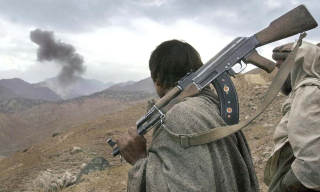
Directorate S, from which the book gets its title, lies buried deep in the bureaucracy of the ISI (Inter-Services Intelligence), Pakistan’s spy agency. Ensconced thus, the directorate works to “enlarge Pakistan’s sphere of influence in Afghanistan”. It goes about this task, Coll explains, by supplying, arming, training and generally seeking to legitimise the Taliban, the AK-47 toting terrorists who took over Afghanistan in 1992, stringing up decapitated corpses in town squares and shoving women into the confines of their homes. Nobody paid much attention then, and perhaps never would have, had the Taliban not become host to Osama bin Laden.
Bin Laden, the architect and financier of the 9/11 attacks, was the US’s most obvious target, and in order to get him, sights had to be set on Afghanistan. The scene Coll paints is riveting.
More here.
20 Years Later, The Vagina Monologues Are as Important as Ever
Lorraine Berry in Signature:
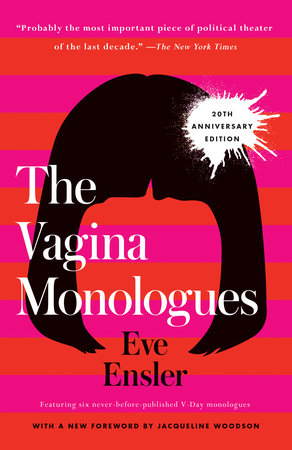
Each year at around Valentine’s Day, hundreds of college campuses across the United States and the world present The Vagina Monologues as fundraisers for various local women’s agencies in each production’s area. In addition, other moneys can be donated to “VDay,” the foundation bringing attention to women all over the world that have been affected by violence. These college productions feature students, staff members, and faculty in the speaking roles and as part of the production staff. Some of the monologues require a chorus of voices, while others require the single voice of individual women – many of whom have no prior acting experience – but who are animated in their desires to articulate each story, written by Ensler after she had interviewed over 200 women and got them to talk about their vaginas.
The stories have moments of side-splitting humor, and other moments that make audience members weep. But a common reaction to being in the audience is the desire to get organized to resist the forces that keep women vulnerable to violence. And the play has new elements each year, as Ensler writes a new monologue for that year’s performances in response to current issues. The 20th anniversary edition of The Vagina Monologuescontains a number of these new monologues, in addition to a history of the play’s production and reception.
More here.
John Rizvi: When Launching Your Dreams Full Throttle is the Only Option
‘THE TONGUE OF ADAM’ BY ABDELFATTAH KILITO
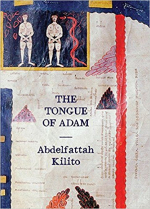
No longer than the lead piece in the latest literary quarterly, yet unearthing a teleology for some of humanity’s oldest stories, The Tongue of Adam sets a reader thinking of noble forebears. W.G. Sebald comes to mind, though there’s no meandering involved, and Anne Carson, though there’s no anachronism or toying with form. Jorge Luis Borges, especially, casts his shadow, given the erudite cool with which this text handles Adam and Eve, Eden and Babel, effortlessly switching between Quranic (as spelled by Kilito) sources and Judeo-Christian. Similar material, in the hands of the great Argentine, resulted in amazing aesthetic objects, and to say the latest from Abdelfattah Kilito doesn’t shrivel in comparison—well, that’s high praise. Even more noteworthy, however, may be what the book accomplishes, at this hour of the world, for Arab civilization in general.
The Tongue of Adam began as a series of lectures at a French university, as one of the author’s colleagues explains in the introduction (sensitive, if at times gushing). Then following seven short chapters—essays, meditations—Kilito himself provides the afterward, revealing that he taught in French, and often French literature, for forty years. Nonetheless this epilog, like his text, makes an argument for his culture of origin.
more here.
‘Ultraluminous’ by Katherine Faw
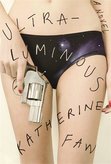
A woman with a set of fake names—Kata, Katya, Kasia, Katushka—has returned to New York after eighteen years in Dubai. Glass towers now crowd the Williamsburg waterfront and women yell at her to get out of the bike lane. Bodega cigarettes cost fourteen dollars and smoking in bars is against the law. It’s unclear why she’s come back, and even more unclear why, at eighteen, she left in the first place. “New York wants to trick me, make me think it’s gone soft,” she thinks. But bricks of heroin still come stamped: VERSACE and HERMÈS, then DRONE, RIHANNA, ISIS. She still works as a prostitute. “I have given myself a year to quit: heroin, whoring,” she announces, but life slides by all the same. “Again and again on a different day I wake up in New York.”
Ultraluminous, Katherine Faw’s second novel, envisions a life lived at the intersection of valuable and expendable. The book tracks the slight shifts and changes that its many-named protagonist—"K" for short—makes in her life as she half-heartedly wrestles with the forces that both ensure her survival and hasten her demise. In Faw’s cruel world there’s little to hope for, but plenty to fear. K wants a different life, but her days creep along with enough success to warrant surrender. In a universe trending only toward chaos, the novel seems to ask, how can you risk change?
more here.
murder in the church
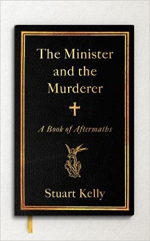
Should a murderer be allowed to serve as a minister of the church? Is such a person suitable to conduct marriages, open coffee mornings and suffer little children to come to them? Such were the questions facing the Church of Scotland in 1984, when a licence was sought by James Nelson, who after his release from prison on parole, having served a 10-year sentence, had studied divinity at St Andrews and taken up preaching. With the tabloids closely following the story (Nelson, not averse to publicity, had given an interview to the Glasgow Herald the year before), the Kirk’s General Assembly knew it would be criticised, whatever its decision. But after a three-hour debate, by 622 votes to 425, with a courage it’s hard to imagine today, they gave their approval to Nelson, thus making him, it seems, the first convicted killer to be ordained into the Christian church.
The Nelson case is the core of Stuart Kelly’s fascinating book. But it ranges widely, digressively, Shandyesequely even, to encompass so much more: theology, philosophy, literary criticism, the nature of evil and Kelly’s own intellectual development and struggle with faith: “Nelson for me is the keyhole through which I can see issues and ideas that have troubled and intrigued me for decades.”
Saturday Poem
Daybreak
Hands and lips of wind
heart of water
…………………..eucalyptus
campground of the clouds
the life that is born every day
the death that is born every life
I rub my eyes
the sky walks the land
.
Nightfall
What sustains it,
half-open, the clarity of nightfall,
the light let loose in the gardens?
All the branches,
conquered by the weight of birds,
lean toward the darkness.
Pure, self-absorbed moments
still gleam
on the fences.
Receiving night,
the groves become
hushed fountains.
A bird falls,
the grass grows dark,
edges blur, lime is black,
the world is less credible.
.
by Octavio Paz
from The Collected Poems 1957-1987
Carcanet Books
Translation: Eliot Weinberger
.
Swiped away: In the era of commercial dating apps, is the easy availability of sex dehumanising the experience?
Joana Ramiro in New Humanist:

“Tinder is a symptom of a very specific type of capitalist cyberspace,” says the technology writer Roisin Kibern. “Where instead of us having the room to prove ourselves as human, we are all just cogs within machines and we are given rankings.” Kibern has used Tinder but now prefers to stay away from it, because dating apps give her “that horrible feeling that you get towards the end of the night in a club and feel like you’re suddenly part of a meat market. Half of you wants to just go headlong into it and be like, ‘Yeah I could go home with anyone tonight’, but the other half of you is, ‘Jesus, this is horrible, I am so alone, I never felt like such an alien wearing a human suit in my life.’” We both laugh at this comment, perhaps because we both know it all too well. Kibern calls the apps a system of “pure convenience”, and it’s not hard to see why people would set aside uneasiness about outsourcing their love lives to technology. In a world of permanent competition, being a mere cog in the machine can come across as a very simple and thus appealing option.
The need for physical and emotional contact is universal. But when our interactions are mediated online by services that are also trying to make profit from us, dating can become alienating, or even enslaving. Kibern sees this sense of alienation as the epitome of “capitalist realism”: a concept proposed by the late theorist Mark Fisher, which describes the cultural and emotional effects of living within a system to which it seems there is no possible alternative. Marcus Gilroy-Ware also drew on the concept in his recent book Filling the Void: Emotion, Capitalism & Social Media (Repeater). As Gilroy-Ware says an online interview with New Humanist, “One of the things that really inspired me to write the book was Fisher’s idea of ‘depressive hedonia’.
More here.
Swing Low, White Women
Brigitte Fielder in Avidly:
As I stood with my sign last year, a middle-aged white woman stopped marching, turned around, and approached me. She called out, smiling, “You know, what Sojourner Truth ACTUALLY said was ‘Ain’t I a Woman?’” She was referring to an alternate version of the speech I had quoted, published by Frances Gage in the New York paper The Independent and the National Anti-Slavery Standard over a decade later, in 1863. I’ve taught this version, as well. While there were many things I might have said to this stranger, I instead smiled and directed her to the correct citation. This white woman clearly thought that she knew more about Sojourner Truth than a black woman holding a sign quoting her did, and this fact was not lost on me. Whatever I might have to say, she was more interested in explaining than listening.
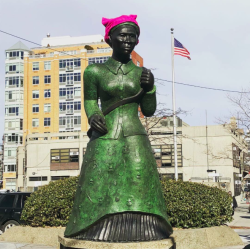
After this year’s march a picture has been shared repeatedly on Facebook and Twitter showing a statue of Harriet Tubman wearing a bright pink pussy hat. The statue is Alison Saar’s Harriet Tubman Memorial in Harlem, “Swing Low,” located at the intersection of Frederick Douglass Boulevard, West 122nd Street, and St. Nicholas Avenue, called the “Harriet Tubman Triangle.” As various people shared the image, the response from Black Twitter was a predictably hilarious clapback. While the most resounding message here was simply “No” (repeated in meme form) some people offered nuanced explanations of their complaints. Put simply, this merger of Tubman’s image with the (highly–critiqued) marker of a problematically exclusive movement reeks of appropriation rather than actual engagement. Not unlike the moment when I was whitesplained about Sojourner Truth.
More here.
Friday, January 26, 2018
The Lost Giant of American Literature
Kathryn Schulz in The New Yorker:
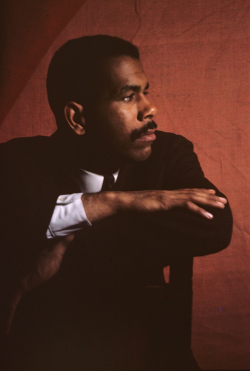
A fiction writer and occasional essayist, Kelley was, himself, notably woke. A half century before the poet Claudia Rankine used her MacArthur “genius” grant to establish an institute partly dedicated to the study of whiteness, Kelley turned his considerable intellect and imagination to the question of what it is like to be white in this country, and what it is like, for all Americans, to live under the conditions of white supremacy—not just the dramatic cross-burning, neo-Nazi manifestations of it common to his time and our own but also the everyday forms endemic to our national culture.
Kelley first addressed these issues at length in his début novel, “A Different Drummer.” Published three weeks after that Times Op-Ed, when he was twenty-four, it promptly earned him comparisons to an impressive range of literary greats, from William Faulkner to Isaac Bashevis Singer to James Baldwin. It also got him talked about, together with the likes of Alvin Ailey and James Earl Jones, as among the most talented African-American artists of his generation.
More here.
Why You Should Fear ‘Slaughterbots’ —A Response
Stuart Russell, Anthony Aguirre, Ariel Conn and Max Tegmark in IEEE Spectrum:

We have been working on the autonomous weapons issue for several years. We have presented at the United Nations in Geneva and at the World Economic Forum; we have written an open letter signed by over 3,700 AI and robotics researchers and over 20,000 others and covered in over 2,000 media articles; one of us (Russell) drafted a letter from 40 of the world’s leading AI researchers to President Obama and led a delegation to the White House in 2016 to discuss the issue with officials from the Departments of State and Defense and members of the National Security Council; we have presented to multiple branches of the armed forces in the United States and to the intelligence community; and we have debated the issue in numerous panels and academic fora all over the world.
Our primary message has been consistent: Because they do not require individual human supervision, autonomous weapons are potentially scalable weapons of mass destruction (WMDs); essentially unlimited numbers can be launched by a small number of people. This is an inescapable logical consequence of autonomy. As a result, we expect that autonomous weapons will reduce human security at the individual, local, national, and international levels.
More here.
Why Do People Say “AX” Instead of “ASK”?
Higher Education Is Drowning in BS
Christian Smith in the Chronicle of Higher Education:
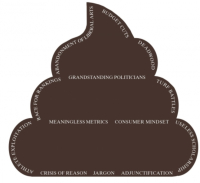
BS is the farce of what are actually "fragmentversities" claiming to be universities, of hyperspecialization and academic disciplines unable to talk with each other about obvious shared concerns.
BS is the expectation that a good education can be provided by institutions modeled organizationally on factories, state bureaucracies, and shopping malls — that is, by enormous universities processing hordes of students as if they were livestock, numbers waiting in line, and shopping consumers.
BS is universities hijacked by the relentless pursuit of money and prestige, including chasing rankings that they know are deeply flawed, at the expense of genuine educational excellence (to be distinguished from the vacuous "excellence" peddled by recruitment and "advancement" offices in every run-of-the-mill university).
BS is the ideologically infused jargon deployed by various fields to stake out in-group self-importance and insulate them from accountability to those not fluent in such solipsistic language games.
More here.
Friday Poem
Mystic Bounce
Even if you love the racket of ascension,
you must know how the power leaves you.
And at this pitch who has time for meditation?
the sea walled in by buildings. I do miss
the quiet, don't you? When I said, "Fuck the deer
antlered and hithered in fur," it was because
I had seen the faces of presidents balled into a fist.
If I were in charge, I would know how to fix
the world: free health care or free physicals,
at least, and an abiding love for the abstract.
When I said, "All of history is saved for us,"
it was because I scorned the emancipated sky.
Does the anthem choke you up? When I asked
God if anyone born to slaves would die
a slave, He said: "Sure as a rock descending
a hillside." That's why I'm not a Christian.
by Terrence Hayes
from Poetry, March 2008
revolution and lightning
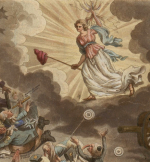
It is often observed that the French Revolution was a revolution of scientists. Nourished by airy abstractions and heartfelt cries to Jean-Jacques Rousseau, its leaders sought a society grounded, not in God or tradition, but in what Edmund Burke decried as “the conquering empire of light and reason”. To be sure, if we tallied the professional affiliations of the members of the first National Assembly, we would find it overwhelmingly populated by lawyers. But the revolution’s symbols and motifs were not derived from legal practices and traditions, and it was not as men of law that Maximilien Robespierre and Jean-Paul Marat called for the death of their king and the creation of a democratic republic. Rather, they did so as scientists—middle class intellectuals who saw in government a field ripe for experimentation, innovation, and improvement.
Nowhere was this as clear as their approach to “the will of the people”. Of the many puzzles to which revolutionaries applied themselves as scientists, few seemed so pressing and so intractable. It is obvious what a king’s will looks like, or so we like to think. Kings are individuals, they have bodies, and they can tell us what to do. However they choose to communicate their will — through voice, a gesture, a written pronouncement — it is relatively clear when such acts belong to them.
more here.
Art, Science, and the Question of Convergence

While proponents of sci-art are given to citing the commonalities between the two fields (the primacy of curiosity and imagination, the thirst for disclosing the invisible) and their ostensive original unity, the impassable fact is that the two represent fundamentally dissimilar epistemological approaches: one that aspires to objective knowledge, and the other whose meaning derives from the production and transmission of tacit, or implicit, knowledge. While accuracy, precision, and discursive reason are indispensible to the one, the other tends to become sclerotic in their presence, relying instead on ambiguity, multivalence, and internal contradiction for its power. With such vastly different approaches to meaning, how can what’s essential to each remain intact in a synthesis?
The nagging question at the center of sci-art, then, is twofold. First, with the claim of “convergence,” is it really a synthesis of the two fields that’s being proposed, or something more like a complementary relationship? And if it’s the latter, what does each truly stand to gain from the partnership? On this there are some facile answers, but none withstands much critical scrutiny. On the side of art, the ostensive gains are clear: with its wealth of imagery, new technologies, and ever-more fantastical discoveries, science presents as an endless source of timely and relevant subject matter.
more here.