Rope, Birdman, and the Economy of the Single-Shot Film

Shechtman-Fig-11-600x325Anna Shechtman at nonsite:

As a number of scholars have argued, the final film product—a semblance of Brandon and Phillip’s crime in real-time—offers the viewer a sensation of “presence” conventionally impeded by montage in cinema.17 That such a sense of presence could emerge from within cinema at all would have shocked Georg Lukács, who, comparing the then-nascent cinematic medium to theater in 1913, wrote that “the stage is absolute presence, [but] the absence of ‘presence’ is the essential characteristic of the ‘cinema.’”18 He continued, “In a word: the basic law of connection for stage and drama is inexorable necessity; for the ‘cinema,’ its possibility is restricted by nothing … ‘Everything is possible’: that is the worldview of the ‘cinema.’”19 In Rope, however, Hitchcock imposes artificial limits on the cinema’s “endless possibilities.” He imposes the limits of theater. Rope’s camera never probes the perspective of the film’s protagonists (one never gets into Brandon or Phillip’s eyes); rather, Rope’s single, mobile camera assumes one unidentified point-of-view. It becomes an anonymous witness to Phillip and Brandon’s crime and the perverted dinner party that follows. In this sense, the film functions as a subjective long-take, but seemingly without a subject. Like theater-viewers, one sees only what this limited camera-witness sees, peering into the kitchen and overhearing a conversation in the next room. There is no reverse-shot that would attribute this 80-minute visual “quote” to a character because, as in theater, the viewer is it.20

This mode of filmmaking—and the phenomenology of presence that it ostensibly compels for actors and viewers alike—anticipates Bazin’s remarks about the ontology of live television, which he wrote in 1954. For Bazin, the live-ness of live television (then the dominant mode of broadcast) offered the medium “a particular way of dealing with action: more freely than theater, but less varied than cinema.

more here.

Rohingya and the Myth of Buddhist Tolerance

M. Reza Pirbhai in Counterpunch:

Screen-Shot-2017-09-12-at-7_57_04-PMWhen old and young are systematically rounded up and shot. When women are gang raped and their babies thrown into waterways to drown. When their homes and businesses are burned. When all the atrocities of ethnic cleansing are plain to see, international law leaps into action. Global bodies and their constituent states work to simultaneously put an end to the atrocities, provide refuge for survivors and bring perpetrators to book, no matter the identity of the offender or the victim. Or so we are told. For as the on-going slaughter and displacement of Myanmar’s Rohingya Muslims reveals, international law is not so blind.

Since their citizenship rights have been progressively revoked between the 1940s and ‘80s, thousands of Rohingya men, women and children have been subjected to murder and rape, their villages have been raised to the ground and more than a million have fled to neighboring countries without much protest from the world beyond. Even the UN’s late attempts to investigate the most recent barbarities have fallen short of constituting a full Commission of Inquiry and independent investigators have been blocked from entering Myanmar by the Buddhist-led government of Nobel Peace Prize winner Aung Sang Suu Kyi. “Just imagine, for a minute,” Columbia University’s Hamid Dabashi urges in a recent article, “if it were Jews or Christians, or else the ‘peaceful Buddhists,’ who were the subjects of Muslim persecutions.” Given the attention Muslim violence ceaselessly garners, the reason behind the apparent lack of outrage to protect the Rohingya is clear to him: “Something in the liberal fabric of Euro-American imagination is cancerously callous. It does not see Muslims as complete human beings.”

More here.

How We Cope with the End of Nature

Stephen Marche in Nautilus:

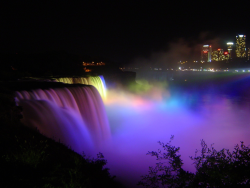
FallsSolastalgia is the definitive disease of the 21st century but only a few even know its name. The symptoms include an underlying sense of loss, a vague sensation of being torn from the earth, a general out-of-placeness, homelessness without leaving home. You have probably felt it without knowing what it was. Solastalgia is the unease we inflict on ourselves as we create a world we don’t want to inhabit, a world stripped of nature. Nature is retreating, and not gradually. According to the World Wildlife Fund, over half of the world’s wild vertebrate species has disappeared over the past forty years. More than 290 million acres of North American grasslands have been converted to agriculture. At current growth rates, US development will reduce its forested regions by about 30 million acres by 2050. The amount of urban land in biodiversity hotspots is expected to increase by three times between 2000 and 2030. Deeper catastrophes, we know, are lurking. The North Pole has hovered near the freezing point this past winter. The partial breakdown of the Paris Accords, and the sudden spike in the consequences of climate change—icebergs the size of Delaware cracking off Antarctica, the bleaching of the Great Barrier Reef—are forcing us to face a hard truth. The future we are building is one with much less exposure to nature and vastly diminished biodiversity.

And this creates a new problem for us as a species: The experience of nature is integral to our wellbeing and, by destroying the earth, we are making ourselves sick. In 2003, Glenn Albrecht, then an environmental philosopher at the School of Environmental and Life Sciences at the University of Newcastle in Australia, coined the term solastalgia. Much like nostalgia, solastalgia is difficult to define with precision, but is nonetheless instantly recognizable: “Solastalgia,” Albrecht wrote, “is the pain or sickness caused by the loss of, or inability to derive solace from, the present state of one’s home environment. Solastalgia exists when there is recognition that the beloved place in which one resides is under assault.” The type of assault may vary. The force of the assault may vary. The loss and unease that follows in the wake of the assault do not.

Glenn Albrecht chose “solasta” as a new root word for two reasons. “Solasta” contains the sense both of “solace” and “desolation.” Where nostalgia describes a longing for another place and another time, solastalgia is a longing for the now as it should be, for nature when there’s no nature there.

More here.

Tuesday Poem

Housing Shortage

I tried to live small.
I took a narrow bed.
I held my elbows to my sides.
I tried to step carefully
And to think softly
And to breathe shallowly
In my portion of air
And to disturb no one.

But see how I spread out and I cannot help it.
I take to myself more and more, and I take nothing
That I do not need, but my needs grow like weeds,
All over and invading; I clutter this place
With all the apparatus of living.
You stumble over it daily.

And then my lungs take their fill.
And then you gasp for air.

Excuse me for living,
But, since I am living,
Given inches, I take yards,
Taking yards, dream of miles
And a landscape, unbounded
And vast in abandon.
And you dreaming the same.
.

Naomi Replansky
from No More Masks
Anchor Books

>

Tuesday, September 12, 2017

Jeff Koons: Or, Who’s Liberating Whom?

Morgan Meis in The Easel:

Koonsimage1-1024x768

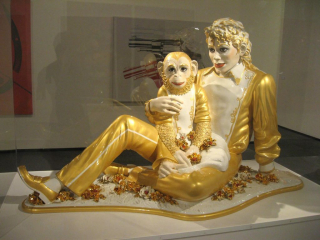
Koons has his defenders, but with works like Pink Panther and Michael Jackson and Bubbles, he has driven many in the art-critical establishment into what can only be called paroxysms of outrage. Jeff Koons’ recent retrospective at the Whitney Museum (2014) was another chance for the critics and academics to take their whacks. Jed Perl, in a piece for the New York Review of Books, summed up the feelings of many. Perl titled his piece, “The Cult of Jeff Koons.” Here’s the opening paragraph:

“Imagine the Jeff Koons retrospective at the Whitney Museum of American Art as the perfect storm. And at the center of the perfect storm there is a perfect vacuum. The storm is everything going on around Jeff Koons: the multimillion-dollar auction prices, the blue chip dealers, the hyperbolic claims of the critics, the adulation and the controversy and the public that quite naturally wants to know what all the fuss is about. The vacuum is the work itself, displayed on five of the six floors of the Whitney, a succession of pop culture trophies so emotionally dead that museumgoers appear a little dazed as they dutifully take out their iPhones and produce their selfies.”

If Perl is right (and he may well be) the only thing that is really interesting about Jeff Koons is the magnitude of the boondoggle. The question is how we square Perl’s contempt with, for instance, the following claim to be found at the Whitney Museum of American Art’s website: “Jeff Koons is widely regarded as one of the most important, influential, popular, and controversial artists of the postwar era.” There are, moreover, a number of important critics who have held this view, the best and most intelligent being philosopher and art critic Arthur Danto.

More here.

Gottlob Frege: The machine in the ghost

Ray Monk in Prospect:

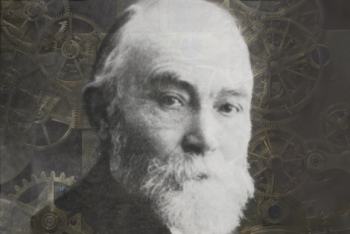
Frege_2-e1505130435166By common consent, the three founders of the modern analytic tradition of philosophy are, in chronological order, Gottlob Frege, Bertrand Russell and Ludwig Wittgenstein. The biggest project in my professional life has been to write biographies of the second and third of these men. But of the three, it is Frege who is—100 years on from his retirement—held in the greatest esteem by the philosophers of today.

His essay “On Sense and Reference” (1892) offered a philosophical account of linguistic meaning that broke new ground in sophistication and rigour, and it is still required reading for anyone who wants to understand contemporary philosophy of language. It is scarcely an exaggeration to say that he invented modern logic: he developed the basic ideas (if not the symbols now in use) of predicate logic, considered by most analytic philosophers to be an essential tool of their trade and a required part of almost every philosophy undergraduate degree programme. His book The Foundations of Arithmetic (1884) is still hailed as a paradigm of the kind of crisp, rigorous prose to which every analytic philosopher should aspire.

Frege’s insights have been influential outside philosophy, in areas including cognitive science, linguistics and computer science. Among the public, however, he is almost completely unknown, especially when put beside Wittgenstein and Russell. Most people have some idea who Russell was. Many have seen clips of his frequent appearances on television, can picture his bird-like features crowned with his mane of white hair, and recognise his unique voice, high-pitched, precise and aristocratic in an impossibly old-fashioned way (one imagines that no-one has spoken like that since the Regency). Even better known is Wittgenstein, the subject of a Derek Jarman movie and several poems, whose name is dropped by journalists, novelists and playwrights, confident that their audiences will have some idea who he is. But Frege? How many people know anything about him?

More here.

Global Ocean Circulation Appears To Be Collapsing Due To A Warming Planet

Trevor Nace in Forbes:

Ocean-circulationScientists have long known about the anomalous "warming hole" in the North Atlantic Ocean, an area immune to warming of Earth's oceans. This cool zone in the North Atlantic Ocean appears to be associated with a slowdown in the Atlantic Meridional Overturning Circulation (AMOC), one of the key drivers in global ocean circulation.

A recent study published in Nature outlines research by a team of Yale University and University of Southhampton scientists. The team found evidence that Arctic ice loss is potentially negatively impacting the planet's largest ocean circulation system. While scientists do have some analogs as to how this may impact the world, we will be largely in uncharted territory.

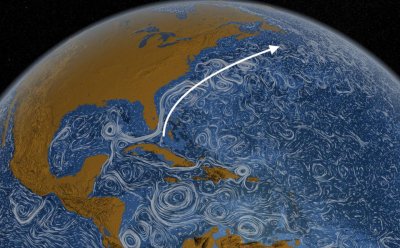
AMOC is one of the largest current systems in the Atlantic Ocean and the world. Generally speaking, it transports warm and salty water northward from the tropics to South and East of Greenland. This warm water cools to ambient water temperature then sinks as it is saltier and thus denser than the relatively more fresh surrounding water. The dense mass of water sinks to the base of the North Atlantic Ocean and is pushed south along the abyss of the Atlantic Ocean.

This process whereby water is transported into the Northern Atlantic Ocean acts to distribute ocean water globally. What's more important, and the basis for concern of many scientists is this mechanism is one of the most efficient ways Earth transports heat from the tropics to the northern latitudes. The warm water transported from the tropics to the North Atlantic releases heat to the atmosphere, playing a key role in warming of western Europe. You likely have heard of one of the more popular components of the AMOC, the Gulf Stream which brings warm tropical water to the western coasts of Europe.

More here.

empathy and other ‘neuroscience’ flapdoodle

Download (3)Seamus O'Mahony at the Dublin Review of Books:

Empathy is the latest target of this neo-phrenology. As well as the obligatory fMRI-based neuroanatomy, all contemporary meditations on empathy contain earnest accounts of mirror neurons, described as “the most hyped concept in neuroscience”. These cells were first described in the 1990s by the Italian neuroscientist Giacomo Rizzolatti, who studied macaque monkeys. He found that some motor cells (involved in the control of movement) are activated by the sight of the same movement in others (humans and monkeys). Since then, outlandish claims have been made for these neurons, particularly by the Indian-American neuroscientist VS Ramachandran, who believes these mirror neurons are responsible for empathy, language, even civilisation. A sobering review of mirror neurones written by British neuroscientists JM. Kilner and RN Lemon, published in Current Biology in 2013, concluded that we can’t extrapolate findings from monkey studies to humans, and furthermore, we’re not absolutely sure that these cells exist in humans, and even if they do, we’re not sure what their function is. These doubts haven’t remotely impeded the establishment of the new popular science orthodoxy that mirror neurons are what make us human and empathetic. Neurobollocks has escaped from the laboratory and is now the rickety foundation for popular, and populist, books by writers such as Jonah Lehrer, Malcolm Gladwell and many others. Writing in the New Statesman in 2012, Stephen Poole described this phenomenon as “an intellectual pestilence”, and observed how putting the prefix “neuro” to whatever you are talking about gives a pseudo-scientific respectability to all sorts of meretricious rubbish.

more here.

against space

PARKING_COMP_copyJames Hyde at the Brooklyn Rail:

In our culture we find “space” everywhere. It is prevalent as a type of background noise in our speech and writing. Space is taught in geometry, physics, architecture, and even in psychology, with terms like “personal space” and “psychological space.” The (often subliminal) purpose of adding space to terms that stand-alone is to make those terms more passive, and to give the term’s user distance from the subject. With the addition of “space” to “psychological,” consider that “psychology” suffices as a term on its own with no inherent need for the addition of space. Combining the terms adds the toughening effect of physics to the softer science of psychology. At the same time, adding space to the monolithic sounding "psychological" makes it warmer and fuzzier. Often the term space is used as an easygoing generality. For example, “narrow gap,” “narrow corridor,” or “narrow room” are all more specific than “narrow space.” With respect to storage, the term “storage space” does little more to describe the location than simply add a syllable. Other than “outer space” or “rental space,” the term is employed more often than necessary—more for effect (or affect) than for precision.

I have long held that artists can whip up a complaint for any occasion—it is perhaps the favorite sport of painters, and we gain mysterious comfort from it. Over the last decade I have become increasingly conscious of the vacuity of the term space.

more here.

the art of rachel whiteread

IMG_1122-600x450Sue Hubbard at Artlyst:

I first came across Rachel Whiteread’s work in the early 1990s. It was intelligent, quiet and thoughtful, at odds with the razzmatazz of many of her contemporaries, the other Young British Artists shocking their way into visibility. In contrast, she was casting the inside of wardrobes, dressing tables, and hot water bottles, that looked like the headless torsos of dead babies. Dreamy, ruminative and poetic her work explored how physical objects acted as Proustian catalysts to retrieve what is so often only half remembered, what lurks just below the plimsol line of consciousness. And then there was House, created in 1993 in a small park in the East End of London, which existed for a mere 80 days. A caste of the last surviving end-of-terrace that was about to be demolished, home of Sydney Gale a former docker, which was a direct connection to an older, disappearing way of life. Using the building as a mould, Whiteread imprinted fireplaces, cornices, and cupboards to create a stark mausoleum that ensnared the ghosts of its past inhabitants like flies trapped in amber. That year she was also the first woman to win the Turner Prize and a few years later made Embankment constructed of 14,000 polyethylene cases of cardboard boxes stacked, one on top of the other, that filled the Turbine Hall of Tate Modern and spoke, obliquely, of global warming. And then there was her controversial sculpture commissioned for the Holocaust Memorial 2000, in Vienna.

more here.

Tuesday Poem

Bay Window Lauds

Cul-de-sac Pastoral

The sill plays a cruel joke – thrones me. Frames me
lording over lawn mower stripes – myself

in a shallow trench. In grass blades. Myself
persisting, despite a dickhead sun – me

in chlorophyll. Early, I find myself
swaying – me! in the black chokeberry, me!

in the rabbit’s throat. Me, the rabbit. Me
dancing out pellets. Out-dancing myself –

my father’s pellet gun, the hawk. The joke
is a bright belly full of dark hopping

along my father’s garden & the joke
small, between wrapped talons, is the hawking

too, is the axe sun, swift, rising, this joy.
This joy, it swallows itself far too soon!
.

Marcus Wicker
from Poetry, Vol. 199, No. 2, November, 2011
.

A Sinner in Mecca

Charles Kaiser in The Guardian:

MeccaParvez Sharma is a proud gay Muslim whose first film, A Jihad For Love, was the first ever made about Islam and homosexuality. It made him the subject of death threats throughout the Arab world. Nevertheless, the power of his faith and his curiosity as a journalist propelled him to take the Hajj pilgrimage of to Saudi Arabia – a journey that also became a film – even though he knew if he was identified at the border his punishment would almost certainly be a beheading. “Immense faith had brought me here,” he writes. “I was obeying my highest calling as a Muslim.” Somehow, the name on his Indian passport did not set off any alarm bells. The result is the first book about the Hajj from a gay perspective, written by a man with a deep knowledge of Islamic history. This pilgrimage is the centerpiece of his book, and he recounts it with courage and fierce emotion. Part of Sharma’s compulsion to find his spiritual salvation at Mecca was a need to prove to himself that despite his sexual orientation, he was still holy enough to be worthy of this journey. It was far from a casual decision. As a child, a medical issue prevented him from having the required circumcision. To reduce one major risk during his pilgrimage, when he would be forced to wear an ihram, two seamless pieces of white cloth with no underwear, he had to have the operation as an adult.

He writes: “In my nightmares, my ihram would fall off in Mecca, subjecting unsuspecting pilgrims to my un-Muslim penis.” His grandfather had told him how after the partition of India and Pakistan, his two best friends were stripped and identified as Muslim by their genitals. They were then hacked to death. Sharma’s struggle to reconcile his faith with his sexual orientation leads him on a search for the essential humanity of the prophet Muhammad. “Scholars learn to question faith,” he writes, “while believers just accept it. My adult self seemed to possess both abilities.” He argues convincingly that the version of Islam promoted by Isis comes directly from Saudi Arabia’s Wahhabi doctrine and that both represent a terrible corruption of the original intent of his religion. He also believes that without Wahhabi indoctrination, there could not have been a 9/11 – because it had been taught to 15 of the hijackers.

More here.

What Does It Cost to Create a Cancer Drug? Less Than You’d Think

Gina Kolata in The New York Times:

CancerWhat does it really cost to bring a drug to market? The question is central to the debate over rising health care costs and appropriate drug pricing. President Trump campaigned on promises to lower the costs of drugs. But numbers have been hard to come by. For years, the standard figure has been supplied by researchers at the Tufts Center for the Study of Drug Development: $2.7 billion each, in 2017 dollars. Yet a new study looking at 10 cancer medications, among the most expensive of new drugs, has arrived at a much lower figure: a median cost of $757 million per drug. (Half cost less, and half more.) Following approval, the 10 drugs together brought in $67 billion, the researchers also concluded — a more than sevenfold return on investment. Nine out of 10 companies made money, but revenues varied enormously. One drug had not yet earned back its development costs. The study, published Monday in JAMA Internal Medicine, relied on company filings with the Securities and Exchange Commission to determine research and development costs.

…One striking example was ibrutinib, made by Pharmacyclics. It was approved in 2013 for patients with certain blood cancers who did not respond to conventional therapy. Ibrutinib was the only drug out of four the company was developing to receive F.D.A. approval. The company’s research and development costs for their four drugs were $388 million, the company’s S.E.C. filings indicated. After it was approved, Janssen Biotech acquired the drug for $21 billion. “That is a 50-fold difference between revenue post-approval and cost to develop,” Dr. Prasad said.

More here.

Monday, September 11, 2017

Perceptions

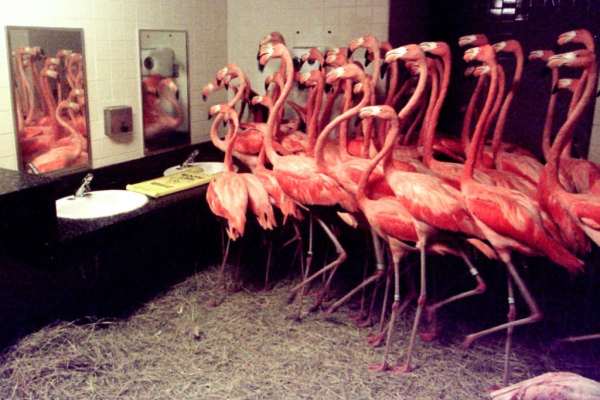
Flamingos during Irma Florida 2017

“More than 50 Caribbean flamingos take shelter in a men's restroom at the Miami Metrozoo (now Zoo Miami) on Sept. 25, 1998. Zookeepers rounded up the birds to protect them from the effects of Hurricane Georges. This was not the first time the zoo had to corral flamingos in a restroom. They were also in there during Hurricane Andrew, six years earlier. Max Trujillo/Getty Images.”

More here and here.

Sunday, September 10, 2017

This is how your world could end

Peter Brannen in The Guardian:

ScreenHunter_2818 Sep. 10 20.00Many of us share some dim apprehension that the world is flying out of control, that the centre cannot hold. Raging wildfires, once-in-1,000-years storms and lethal heatwaves have become fixtures of the evening news – and all this after the planet has warmed by less than 1C above preindustrial temperatures. But here’s where it gets really scary.

If humanity burns through all its fossil fuel reserves, there is the potential to warm the planet by as much as 18C and raise sea levels by hundreds of feet. This is a warming spike of an even greater magnitude than that so far measured for the end-Permian mass extinction. If the worst-case scenarios come to pass, today’s modestly menacing ocean-climate system will seem quaint. Even warming to one-fourth of that amount would create a planet that would have nothing to do with the one on which humans evolved or on which civilisation has been built. The last time it was 4C warmer there was no ice at either pole and sea level was 80 metres higher than it is today.

I met University of New Hampshire paleoclimatologist Matthew Huber at a diner near his campus in Durham, New Hampshire. Huber has spent a sizable portion of his research career studying the hothouse of the early mammals and he thinks that in the coming centuries we might be heading back to the Eocene climate of 50 million years ago, when there were Alaskan palm trees and alligators splashed in the Arctic Circle.

“The modern world will be much more of a killing field,” he said. “Habitat fragmentation today will make it much more difficult to migrate. But if we limit it below 10C of warming, at least you don’t have widespread heat death.”

In 2010, Huber and his co-author, Steven Sherwood, published one of the most ominous science papers in recent memory, An Adaptability Limit to Climate Change Due to Heat Stress.

“Lizards will be fine, birds will be fine,” Huber said, noting that life has thrived in hotter climates than even the most catastrophic projections for anthropogenic global warming. This is one reason to suspect that the collapse of civilisation might come long before we reach a proper biological mass extinction.

More here.

In the Eye of Hurricane Irma Lie the Fingerprints of Global Warming – and Inequality

Nagraj Adve in The Wire:

Screen-Shot-2017-09-09-at-9.33.35-PMExperts have voiced their surprise that Hurricane Irma has surfaced so soon after Hurricane Harvey. In fact, Irma is being accompanied by Hurricanes Jose to its east and Katia to its west. Jose, itself close to Category 5, will be the second to hit the Caribbean islands in just a couple of days. It’s made some raise what is increasingly becoming an obvious question: to what extent does global warming have a role to play? To which I would add one voiced less frequently: why should those least responsible for global warming have to constantly face its effects? And what does it bode for the future?

Ocean water temperatures need to cross 26.5º C to depths of 50 metres for tropical cyclones to form. (It’s a necessary condition but not a sufficient one. Other favourable conditions are needed, for instance the absence of winds at a higher level that can interfere with hurricane formation.) Over 60% of the extraordinary amount of heat energy trapped by greenhouse gases since 1971 – about 170,000 billion billion joules – has gone into the upper oceans, according to the IPCC’s Fifth Assessment Report. It’s a number so bewilderingly large that an easier way of conceptualising it is this: averaged out each year, it equals 40-times the entire annual energy consumption of the US. The consequently warmer upper ocean waters ensure that, when other conditions are right, there’s a greater chance of hurricanes forming and sustaining themselves for a longer duration. Or getting more intense. Or them forming one after the other, as has happened with Irma and Jose.

Another way global warming is implicated has to do with storm surges now pummelling Cuba, followed by the US over the weekend. Swirling hurricane winds pull in massive volumes of sea water. Out in the open sea, those waters are forced downwards into the ocean depths. But once the hurricane approaches land, the shallower seabed means the excess water pulled in by the hurricane has nowhere to go, so it just piles up and overwhelms the shore.

More here.

A Requiem for Florida, the Paradise That Should Never Have Been

Michael Grunwald in Politico:

ScreenHunter_2817 Sep. 10 19.51The first Americans to spend much time in South Florida were the U.S. Army men who chased the Seminole Indians around the peninsula in the 1830s. And they hated it. Today, their letters read like Yelp reviews of an arsenic café, denouncing the region as a “hideous,” “loathsome,” “diabolical,” “God-abandoned” mosquito refuge.

“Florida is certainly the poorest country that ever two people quarreled for,” one Army surgeon wrote. “It was the most dreary and pandemonium-like region I ever visited, nothing but barren wastes.” An officer summarized it as “swampy, low, excessively hot, sickly and repulsive in all its features.” The future president Zachary Taylor, who commanded U.S. troops there for two years, groused that he wouldn’t trade a square foot of Michigan or Ohio for a square mile of Florida. The consensus among the soldiers was that the U.S. should just leave the area to the Indians and the mosquitoes; as one general put it, “I could not wish them all a worse place.” Or as one lieutenant complained: “Millions of money has been expended to gain this most barren, swampy, and good-for-nothing peninsula.”

Today, Florida’s southern thumb has been transformed into a subtropical paradise for millions of residents and tourists, a sprawling megalopolis dangling into the Gulf Stream that could sustain hundreds of billions of dollars in damage if Hurricane Irma makes a direct hit. So it’s easy to forget that South Florida was once America’s last frontier, generally dismissed as an uninhabitable and undesirable wasteland, almost completely unsettled well after the West was won. “How far, far out of the world it seems,” Iza Hardy wrote in an 1887 book called Oranges and Alligators: Sketches of South Florida. And Hardy ventured only as far south as Orlando, which is actually central Florida, nearly 250 miles north of Miami. Back then, only about 300 hardy pioneers lived in modern-day South Florida. Miami wasn’t even incorporated as a city until 1896. And even then an early visitor declared that if he owned Miami and hell, he would rent out Miami and live in hell.

More here.

Kara Walker’s New Show Was a Sensation Before It Even Opened

00-story-image-kara-walker

Julia Felsenthal in Vogue:

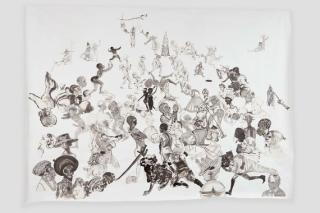
Enter the New York City art gallery Sikkema Jenkins & Co. sometime between today and October 14, and you will encounter a world just as chaotic and dark and discombobulating as the one in which we live. That Chelsea space is where the Brooklyn artist Kara Walker—she of the massive and massively celebrated 2014 Domino Sugar factory installation—has mounted her latest work.

Walker’s subject matter is, and always has been, racism and misogyny and the way that America’s original sin of slavery continues to rot our country from the inside out. Her work, long before we elected a black president, long before we elected a white president single-mindedly intent on erasing the legacy of our black president, has served as an active, pointed rebuke to notions of a post-racial United States. First there were her silhouetted cutouts that packaged the nightmarish violence of everyday antebellum life in a jaunty, reductive, old-timey visual vernacular. That work, cunning and disturbing, won Walker a MacArthur “Genius” grant at the tender age of 27. Her installation several years ago at Brooklyn’s Domino Sugar factory, A Subtlety, or the Marvelous Sugar Baby, took things one step further. Her gigantic, glowing-white, Aunt Jemima-esque sugar sphinx, surrounded by shoe-polish brown sugar worker boys, relocated the slave trade to its natural terminus: a plant in the most metropolitan of northern cities, where supply met demand, where the fruits of slave labor were processed for the sweet-toothed (though not particularly sweet-hearted) American people.

More here.